Book a Free Strategy Call
Skip the read: talk to Walid in 30 min.
Free strategy call. We map your AI engineering team, you keep the notes.
Boosting your team's productivity isn't about throwing more software at the problem. It's about smart, targeted AI automation and strategic team augmentation. The goal is to scale your output dramatically, but without reflexively scaling your headcount.
Concretely: automate your highest-frequency manual task first, standardize one AI tool per workflow, and run a team productivity baseline so you have a number to beat.
Beyond the Hype: AI for Real Productivity Gains
Everyone is talking about AI, but very few are showing how to actually get real-world results from it. So many teams are stuck in a weird "productivity paradox": they're drowning in sophisticated tools, yet their actual output is flatlining. The issue isn't the tech; it's the complete lack of a coherent strategy for putting it to work.
This guide is for the CTOs, founders, and ops leaders who are tired of the generic advice. We’re going to build a practical framework where AI takes over the repetitive, soul-crushing tasks. This frees up your best engineers to do what you hired them for: solving the hard problems and driving real innovation.
The Real Cost of Inefficiency
Inefficiency is a silent killer. It’s more than wasted hours; it’s a direct hit to morale and your bottom line. Leadership and genuine engagement are the bedrock of any productive team, something tools alone can't fix.
In fact, Gallup found that a mind-boggling 70% of a team's engagement is directly tied to their manager. This leadership gap often leads to widespread disengagement, which costs the global economy a staggering $438 billion in lost productivity. You can dig deeper into the financial impact of workplace engagement on cake.com.
A look at how we've traditionally tried to solve these problems versus a modern, AI-centric approach makes the difference crystal clear.
Traditional vs AI-Augmented Productivity Approaches
| Productivity Challenge | Traditional Approach (High Headcount) | AI-Augmented Approach (Lean & Scalable) |
|---|---|---|
| Repetitive Tasks | Hire more junior staff to handle manual data entry, reporting, and administrative work. | Deploy AI agents to automate data collection, reporting, and workflow triggers. |
| Customer Support | Scale the support team linearly with customer growth, leading to high overhead. | Use AI chatbots for Tier 1 support and AI assistants to help agents find info faster. |
| Code Generation | Engineers write all boilerplate and repetitive code from scratch, slowing down development. | Use AI coding assistants (Cursor, Copilot) to generate code, write tests, and debug. |
| Project Management | Managers spend hours manually tracking progress, updating stakeholders, and nagging for updates. | Implement AI-powered PM tools to automate status updates, identify risks, and allocate resources. |
This goes beyond swapping one tool for another; it's a fundamental shift in how work gets done.
A Smarter Path to Scaling
Instead of just throwing more bodies at a growing workload, the smarter play is to amplify what your current team can do. This breaks down into a two-part strategy:
- AI Team Augmentation: Embed "AI-adopted engineers" directly into your existing teams through strategic placements. They'll drive the adoption of best practices and show everyone what's possible with advanced tools.
- Targeted Skill Development: Run specialized AI workshops for your dev teams. Get them hands-on with powerful platforms like Weavy.ai, Cursor, and Claude so they truly master them instead of dabbling.
By mixing intelligent automation with deep skill-building, you kickstart a powerful cycle of continuous improvement. The AI agents handle the operational noise, freeing up your newly upskilled engineers to drive the kind of innovation that actually scales the business. This is how you begin to change your team's entire workflow.
Related Reads
Hunting for Your Team's Productivity Bottlenecks
Before you can fire up AI to boost your team's output, you have to play detective. Just throwing automation at a problem without understanding its roots is like paving a road that goes nowhere. It looks like progress, but you’ll end up right where you started. The first move is a deep-dive ‘automation audit’ to find the real points of friction in your team's day-to-day grind.
This isn’t about vague complaints like “we have too many meetings.” It’s about digging into the specific, measurable moments where time and energy just… disappear. Think about it: what if your developers are burning five hours a week, each, on manual testing rollbacks or mind-numbing code reviews? That’s the kind of hidden tax that quietly kills momentum. Our job is to drag it into the daylight.
This whole process isn't about pointing fingers. It's about putting broken processes on trial. Once you identify these high-impact slowdowns, you'll have a rock-solid business case for building the AI agents and targeted workflows that deliver a real, immediate return.
Uncovering the Hidden Time Sinks
Productivity killers are masters of disguise, often masquerading as “just how we do things here.” To spot them, you have to question everything, from the second a ticket is created to the moment the code goes live.
Your investigation should zero in on tasks that are:
- Highly Repetitive: Is an engineer manually updating a Jira ticket every single time they push a commit? That’s a perfect candidate for automation.
- Prone to Human Error: Does someone have to copy-paste config settings for every new environment? That’s slow, and it’s a recipe for disaster.
- Full of Waiting: How long does a merge request just sit there, waiting for a review? These delays stack up and bring the whole team to a crawl.
Start simple. Sketch out your core processes on a whiteboard. A quick flow diagram of your CI/CD pipeline or your bug-squashing workflow can reveal some surprisingly clunky handoffs and unnecessary manual steps.
The real win in an automation audit is finding the sweet spot: the lowest effort for the highest leverage. Sometimes, a single script or a simple automated workflow can reclaim hundreds of engineering hours a year, freeing up your top talent to solve actual, complex problems.
Pinpointing Problems with Workshops and Team Augmentation
Once you have a map of your processes, it's time to get a feel for the human side of things. One of the best ways to do this is by running a dedicated AI workshop. This is more than another training session; think of it as a collaborative diagnostic.
In these workshops, you can guide your team through exercises to pinpoint their most soul-crushing tasks. Show them what's possible with modern AI tools like Cursor for writing boilerplate code or Claude for Dev Teams for untangling gnarly bugs. Seeing these tools in action usually sparks an "aha!" moment, where an engineer realizes a task that eats up their afternoon could be done in minutes. You could even introduce a platform like Weavy.ai to show how collaboration can be built right into the tools they already use, killing context-switching for good.
Another incredibly effective approach is AI team augmentation. This means bringing an "AI-adopted engineer" into your team through a strategic placement. This person becomes a catalyst. They don't just build solutions; they show everyone else how to think with an automation-first mindset. They can champion new tools and build the first few AI-powered workflows that prove the value right away, building momentum for a bigger shift. It's a fantastic way to bridge the skills gap and fast-track the whole team’s journey to peak productivity.
Free weekly brief
Steal our production automations
The exact n8n flows, Claude Code setups, and prompts we ship for clients, broken down step by step. No spam, unsubscribe anytime.
Building Your AI-Powered Automation Engine
Once you’ve uncovered where your team’s time and energy are leaking, it’s time to build the machinery to plug those gaps for good. This isn't about just grabbing some off-the-shelf software and hoping for the best. We're talking about designing and deploying a custom AI automation engine that fits your business like a glove.
Using flexible platforms like n8n and Make, you can integrate powerful large language models (LLMs) like GPT, Claude, and Gemini to build real, production-ready solutions. No abstract theory here, just actionable implementation.
This is especially true for companies with strict security needs. Building your own secure, self-hosted solutions means your data never leaves your control. It all fits neatly into your existing tech stack, even in government-grade environments.
The diagram below breaks down the high-level strategy. It’s a simple loop, but it’s incredibly effective.
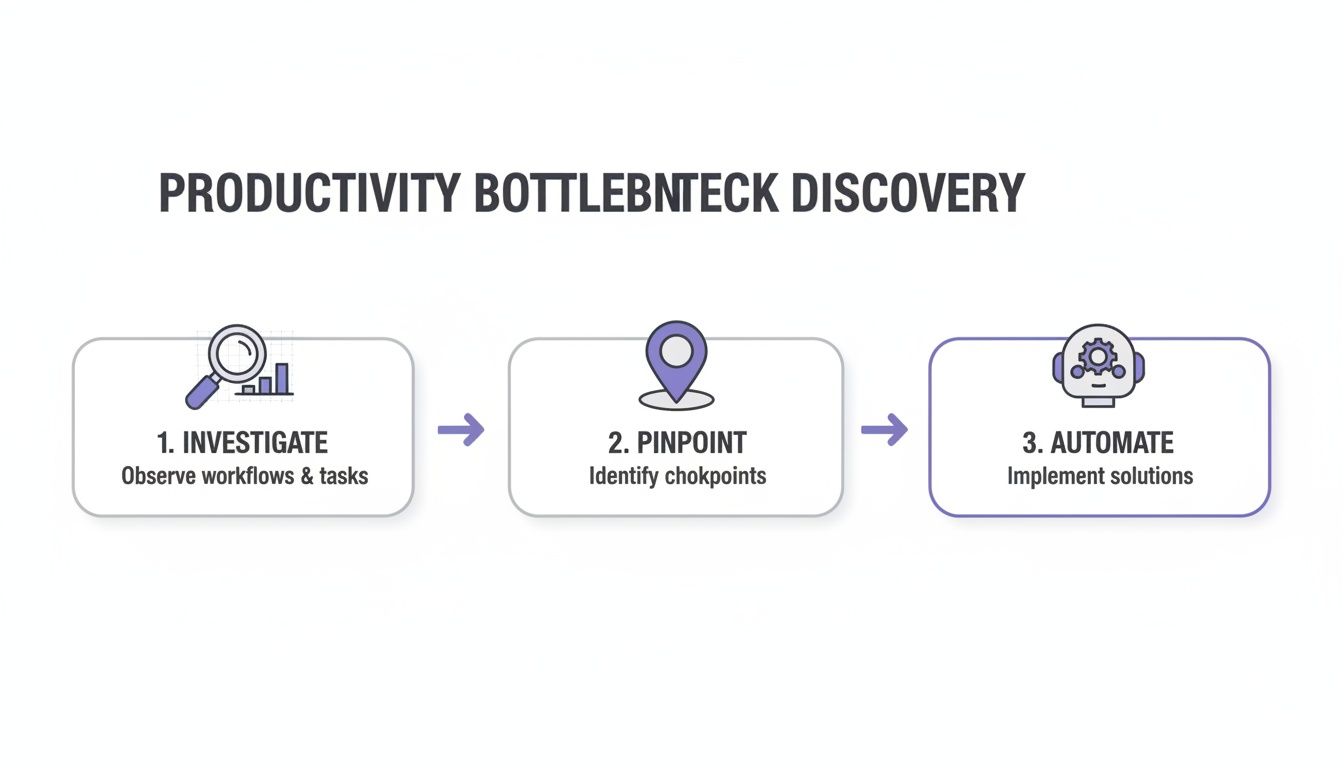
This Investigate, Pinpoint, Automate cycle is the core feedback loop for creating AI-driven workflows that genuinely move the needle on team productivity.
From Bottleneck to Automated Workflow
So, how does this look in the real world?
Imagine your support team is completely underwater. Your best engineers are constantly getting pulled away from deep, focused work to triage incoming tickets. It's a repetitive task, but it requires just enough context to make it frustratingly difficult to delegate. This is a classic productivity sinkhole just begging for automation.
Here’s how you could build a custom AI agent to fix it, step-by-step:
- Trigger: A new ticket lands in your support system, maybe Zendesk or Jira.
- Enrichment: The workflow instantly pings your CRM to pull customer data: their subscription level, recent activity, you name it.
- Analysis: All that info gets packaged up and sent to an LLM like Claude with a very specific prompt: "Analyze this support ticket for urgency, category (bug, feature request, billing), and sentiment. Return your findings as a JSON object."
- Action: The AI's analysis comes back, and the workflow takes over. It routes the ticket to the right engineering squad, assigns a priority level, and even slaps a pre-written summary into the ticket. The engineer gets everything they need in one go.
A single automated workflow like this can easily reclaim dozens of hours every single week. It lets your engineers focus on what they do best: solving complex problems, not managing them. This is a perfect example of how workflow automation for small business and enterprise teams can turn a manual chokepoint into a seamless, intelligent process.
The Power of AI Team Augmentation
Look, building these kinds of systems requires a unique blend of development chops and a deep, practical understanding of AI. This is where AI team augmentation comes in. Instead of crossing your fingers and hoping your current team can learn these complex skills overnight, you secure a placement for an "AI-adopted engineer" directly into your squads.
These specialists are catalysts. They don’t just build the first few automations and leave. They mentor your people, establish best practices, and show everyone what’s actually possible. Their presence turbocharges adoption and makes sure the solutions you build are stable, secure, and ready to scale from day one. It’s a much faster path to improving team productivity than just sending everyone to a training course.
By embedding an AI expert within your team, you're getting more than a project done. You're fundamentally upgrading your team's DNA and making an automation-first mindset part of your culture.
Accelerating Adoption with Targeted AI Workshops
While embedding an expert provides deep, focused firepower, you also need to build broader skills for the long haul. This is where tailored AI workshops can make the difference. I’m not talking about generic, one-size-fits-all training. These workshops need to be laser-focused on your team's actual challenges and tech stack.
Imagine a workshop centered on tools like Cursor and Claude for Dev Teams. The session wouldn't just be a product demo; it would be a hands-on lab where your engineers use these tools to solve a problem they are wrestling with right now. A specialized Weavy.ai workshop, for example, could demonstrate how to slash context-switching by integrating communication directly into developer tools.
- Cursor Workshop: Your engineers could learn to spin up boilerplate code for a new microservice or write a full suite of unit tests for a legacy module. They see firsthand how it can slash development time.
- Claude for Dev Teams Session: The team could tackle a nasty debugging scenario, feeding stack traces to the AI and getting suggestions for potential fixes. Hours of frustration can turn into a guided, productive problem-solving exercise.
These workshops, often led by an AI-adopted engineer placement, give your team the practical skills and confidence they need to actually use these tools every day. It’s how AI stops being a novelty and becomes a standard part of the engineering toolkit. Combining this kind of strategic training with embedded experts creates a powerful, complete system for leveling up your entire organization's output.
Boosting Engineers with AI Coding Assistants
High-level workflow automation is great, but real productivity gains happen at the individual level. For any CTO, the name of the game is amplifying the output of your most valuable (and expensive) resource: the engineering team. This is where standardizing advanced AI coding assistants stops being a nice-to-have and becomes a core competitive advantage.
Tools like Cursor, Claude for Dev Teams, and platforms such as Weavy.ai aren't fancy code editors. Think of them as intelligent partners that can fundamentally shift how your team writes, reviews, and maintains code. The real trick is moving past the initial hype and embedding these tools into your daily sprints to reach a whole new level of developer efficiency.
The impact is felt almost immediately. Instead of getting bogged down in repetitive work, your engineers can use AI to blast through the most time-consuming parts of their day, freeing them up to focus on what matters: architecture and complex problem-solving.
From Theory to Tangible Output
So, what does this look like in practice? These AI assistants are masters at eliminating the low-value work that silently burns through engineering hours and kills morale.
Let's get specific:
- Generating Boilerplate Code: A senior dev shouldn't be wasting their morning scaffolding a new microservice or writing the same old setup configs. An AI assistant can spit out that foundational code in seconds, built with best practices, letting the engineer get straight to the interesting logic.
- Writing Complex Unit Tests: Everyone knows testing is critical, but man, can it be tedious. AI can analyze a function and generate a thorough test suite, often catching edge cases a human might miss after a long day.
- Translating Legacy Codebases: Modernizing old code is a necessary evil: high-risk and often a massive time sink. You can prompt an AI assistant to translate entire chunks of a legacy codebase, like an ancient Perl script or a Java monolith, into something modern like Python or Go. This massively cuts down the manual effort and de-risks the whole project.
The real magic here is that these tools act as a force multiplier. They don't replace skilled engineers; they augment their abilities, letting them produce higher-quality code in a fraction of the time.
The Strategic Value of AI Team Augmentation
Just giving your team a license for a new tool and calling it a day is a recipe for failure. Real adoption requires a cultural shift, and the fastest way I've found to spark that change is through AI team augmentation. This strategy is simple: secure the placement of an AI-adopted engineer directly into your existing dev teams.
This person is more than just another developer. They're an internal champion, a mentor, and a living, breathing example of what's possible. They don't just use a tool like Cursor; they show everyone else how to weave it into the team’s existing Git workflow, CI/CD pipeline, and code review process.
It’s a hands-on approach that works miles better than any top-down mandate. When your developers see a peer refactor a complex module in 20 minutes instead of three hours using an AI assistant, the value becomes undeniable. This "show, don't tell" method drives organic adoption and builds internal expertise that sticks. For a deeper dive, exploring some expert tips for AI coding can provide a strong foundation for your team.
Mastering the Tools with Specialized AI Workshops
Alongside embedding experts, structured training is the key to scaling this across the whole organization. But generic, one-size-fits-all training sessions are a waste of time. To be effective, AI workshops have to be specialized and laser-focused on solving your team’s actual problems.
Imagine a workshop centered specifically on Weavy.ai or Claude for Dev Teams. The agenda wouldn't be a boring product tour. It would be an intense, hands-on problem-solving session.
A workshop that actually moves the needle might look like this:
- Problem Introduction: Kick off with a real challenge the team is facing: a nasty bug in a critical service, or the need to document an unfamiliar third-party API.
- Guided Application: The workshop leader (ideally, your embedded AI-adopted engineer) guides the team on how to use Claude's reasoning to analyze stack traces or Weavy.ai's features to streamline their comms.
- Hands-On Implementation: The team then breaks out and immediately applies these new techniques to their own codebase. They get instant feedback and see real progress by the time the session ends.
This focused, practical approach ensures your team doesn't stop at learning about the tools; they learn how to master them. When you combine the deep impact of AI team augmentation with the broad upskilling from specialized workshops, you create a powerful system for seriously boosting your engineering output.
Measuring the True Impact of AI on Productivity
So, you’ve started rolling out AI agents and giving your engineers powerful coding assistants. That’s a great first step, but it's only half the battle. An AI initiative is only as good as its results, and you need a clear, data-driven way to prove its value.
Founders and CTOs can't just rely on gut feelings. You need to track the real-world ROI of your automation and augmentation efforts. This all starts with establishing a baseline before you roll out any new tools. If you don’t know where you started, you’ll never be able to prove how far you’ve come. This is how you build a solid business case and show exactly how AI is moving the needle.
Engineering Metrics That Matter
For engineering leaders, the impact of AI should show up almost immediately in your core delivery metrics. These KPIs are the lifeblood of any high-performing dev team, and they offer a perfect lens through which to view productivity gains.
When you equip your team with AI coding assistants and automate chunks of the CI/CD pipeline, you should see direct improvements here:
- Cycle Time: This is the total time from the first commit to deployment. When AI assistants are generating boilerplate code and writing unit tests, you'll see this metric shrink significantly.
- Deployment Frequency: How often are you shipping to production? AI-driven workflows that automate testing and review processes let your teams release smaller, more frequent updates with way more confidence.
- Mean Time to Recovery (MTTR): When something inevitably breaks in production, how fast can you fix it? AI tools can help engineers debug faster and pinpoint root causes, slashing downtime.
Tracking these metrics gives you undeniable proof. A shrinking cycle time and a rising deployment frequency are the clearest signals that your investment in AI is directly accelerating your time-to-market.
Beyond Engineering: Operational KPIs
The ripple effects of AI don't stop with engineering. When you deploy custom AI agents to handle operational tasks, you create efficiencies all across the organization. The trick is to track metrics that are specific and relevant to what each team actually does.
This is how you quantify improvements in real terms, whether it's cost savings, faster service, or better lead quality. Your goal is to draw a straight line from each automation to a tangible business outcome.
Here’s a look at how different teams can measure the impact of AI on their productivity.
KPIs for Measuring AI Productivity Gains
This table breaks down some key metrics you should track before and after implementing AI solutions, showing how automation can directly improve performance across different parts of your business.
| Team Function | Key Performance Indicator (KPI) | How AI Improves This Metric |
|---|---|---|
| Operations | Customer Ticket Resolution Time | AI agents can triage tickets, gather context, and provide summaries, letting support staff resolve issues much faster. |
| Marketing | Cost Per Lead (CPL) | Automated AI workflows can qualify leads from various channels, ensuring the sales team only spends time on high-intent prospects. |
| Sales | Lead Response Time | AI can instantly engage new leads, book meetings, and answer initial questions, preventing hot prospects from going cold. |
By focusing on these specific KPIs, you can move from "we think AI is helping" to "we know AI has reduced our CPL by 15%."
Proving the Value of AI Workshops and Augmentation
It's also essential to measure the impact of strategic moves like AI workshops and AI team augmentation. The effects might seem less direct than a single automation, but they are incredibly powerful and absolutely measurable over time.
For example, after a series of hands-on workshops with tools like Cursor or Claude for Dev Teams, just survey your engineers. Ask them to estimate the hours they're saving each week on tedious tasks like debugging or writing tests. This qualitative data, paired with your hard KPIs, paints a complete picture of the productivity boost.
Similarly, when you bring in an AI-adopted engineer through a team augmentation placement, their impact should be visible in the team's velocity and the adoption rate of new tools. They act as a catalyst, and you can track their influence through the improved performance of the entire squad. This combined approach is how you prove that your strategic AI investments are what's really driving team productivity forward.
Scaling AI Success Across Your Organization
Getting a successful AI pilot off the ground with one engineering team is a fantastic start. But the real magic happens when you scale those wins across the entire company. The goal is to move from a few one-off projects to a company-wide system of continuous improvement, where AI is more than a tool, but a core part of how you operate.
This shift doesn't happen by accident. It requires a deliberate strategy to weave AI capabilities into the fabric of your teams. One of the most powerful ways we've seen this work is through AI team augmentation. Instead of siloing your AI talent, you secure placements for AI-adopted engineers directly into different departments.
These folks become your internal champions. They don't just parachute in, build a solution, and leave; they transfer knowledge, upskill their colleagues, and show everyone what's possible, making sure the new, better way of working actually sticks.
Creating Long-Term AI Competency
To make this cultural change last, you need to back it up with great training. Targeted AI workshops are essential for building foundational skills across the board. Imagine a session showing your dev team how to use a code assistant like Cursor or Claude, and suddenly they're cutting debug time in half.
When workshops are hands-on and focused on solving the actual problems your teams face every day, the value of AI becomes impossible to ignore. A workshop on Weavy.ai, for instance, can directly address communication bottlenecks within the development cycle.
When you pair the deep, embedded expertise from AI team augmentation placements with the broad skill-building from workshops, you create a flywheel for long-term growth. This is how you go from isolated wins to an organization that’s constantly finding new ways to get better.
This approach ensures your investment in automation delivers compounding returns. As more people adopt an AI-first mindset, they start spotting optimization opportunities on their own.
If you're ready to explore the foundational elements of this strategy, you can learn more about how to get started with AI agents for business in our detailed guide. It’s about fundamentally changing your company’s DNA to be more agile and efficient.
Common Questions We Hear
When you start digging into AI to boost your team's output, a few practical questions always pop up. It's totally normal. Let's tackle the big ones head-on, because getting these answers right is key to seeing real results.
Do We Really Need to Hire Expensive AI Engineers?
Bringing on a full-time AI specialist is a huge commitment, both in cost and time. Honestly, it's often overkill.
A much smarter, faster approach is AI team augmentation. Think of it as embedding an expert ‘AI-adopted engineer’ directly into your team for a set period. You get instant expertise without the long-term overhead of a new hire, they accelerate your projects, and, most importantly, they transfer their skills to your crew. Securing a strategic placement is a high-impact, cost-effective way to get moving.
Are AI Workshops Just Another Time-Sucking Training Session?
We've all sat through those generic training sessions that go nowhere. This is different. A good AI workshop isn't about abstract theory; it delivers tangible returns by focusing on tools your developers can actually use tomorrow.
We're talking about things like Cursor, Weavy.ai, and Claude for dev teams. The magic happens when you use these tools to solve a real, nagging problem your team is facing right now. When an engineer watches an AI assistant unravel a complex bug in minutes during a focused workshop on Claude or Cursor, the lightbulb goes on. That’s how you make new skills stick.
What Does AI Team Augmentation Actually Look Like Day-to-Day?
It’s like dropping a catalyst into your squad. An AI-adopted engineer joins your team through a planned placement and works right alongside them on your current projects. They’re not off in a corner building things; they're actively modeling best practices.
For instance, they might pair-program using Cursor to show the team how to instantly generate unit tests. Or they might set up a slick, collaborative workflow in Weavy.ai that eliminates a bunch of manual steps. It's this hands-on mentorship that drives real adoption and makes your whole team more efficient for the long haul.
If this sounds like the right fit, our AI automation agency page covers scope, process, and how an engagement starts.
For cross-referenced reading: how to make your team AI-native covers the cultural and tooling shift; best workflow automation platforms compares the automation stack; and how to improve workflow efficiency digs into the engineering-specific optimizations.
Ready to stop guessing and start building a more productive team? AY Automate specializes in designing the AI agents, workflows, and team augmentation strategies that deliver measurable results. Schedule your free automation audit today.
Continue Reading
AI Agents for Business in 2026: Real Use Cases, Cost, and How to Pick the Right One
Updated June 2026. "AI agents for business" went from buzzword to real category between 2024 and 2026.
How to Build an AI Chatbot That Drives 10X Growth
A practical guide on how to build an AI chatbot for your business. Learn to select LLMs, design conversations, and deploy agents that scale.
Unlocking Scale With Integration Software as a Service
Discover how Integration Software as a Service (iPaaS) slashes operational costs and scales your business. A complete guide for CTOs and founders.
Book a Free Strategy Call
Building this in production?
Walid runs a 30-min call to map your AI engineering team. Free, no slides.
Free weekly brief
Steal our production automations
The exact n8n flows, Claude Code setups, and prompts we ship for clients, broken down step by step. No spam, unsubscribe anytime.

Walid founded AY Automate to help businesses ship AI workflows that actually move revenue. He leads strategy and oversees every client engagement end-to-end.
Full Bio →