Book a Free Strategy Call
Skip the read: talk to Walid in 30 min.
Free strategy call. We map your AI engineering team, you keep the notes.
You measure operational efficiency with three core ratios: output per engineer (delivery velocity), revenue per FTE (value per headcount), and automation coverage (percentage of workflows running without manual triggers). These numbers tell you whether AI and process changes are compounding or stalling.
Measuring operational efficiency goes beyond shaving a few seconds off a task here and there. It’s about fundamentally rethinking how your teams create value. The real shift today is figuring out how to scale your output without proportionally scaling your headcount, and that’s where AI and automation come in. This guide walks through exactly how CTOs are making that shift. This means we have to move beyond old-school metrics and start measuring the direct, tangible impact of technology on your core operations.
Rethinking Operational Efficiency In An AI-Driven World
Let's be honest: the traditional playbook for boosting efficiency is gathering dust. Squeezing out tiny, incremental improvements just doesn't cut it anymore.
True operational excellence today is all about how well you can weave intelligent systems into your daily workflows. The goal is to augment your team's capabilities, freeing them from the soul-crushing repetitive work so they can focus on the strategic thinking that actually grows the business. It’s a massive shift from simply doing things faster to building resilient, automated operations that can scale up or down on a dime.
This new reality demands a fresh take on measurement. Instead of just tracking labor hours against widgets produced, we need to focus on how well AI-driven solutions are being adopted and the impact they're having. This is more than a niche idea; a recent PwC survey found that a staggering 93% of business leaders see improving operational efficiency as a top priority. What’s more, 98% of them reported that digital tools have dramatically improved visibility into their operations.
Pinpoint, Quantify, and Measure Your Progress
To make this work, you need a simple, repeatable process. It all comes down to identifying the right opportunities, understanding their true cost, and then relentlessly tracking the impact of your solutions over time.
I’ve found that a straightforward three-step process works best: pinpoint, quantify, and measure. It’s a clean framework you can apply to any efficiency initiative.
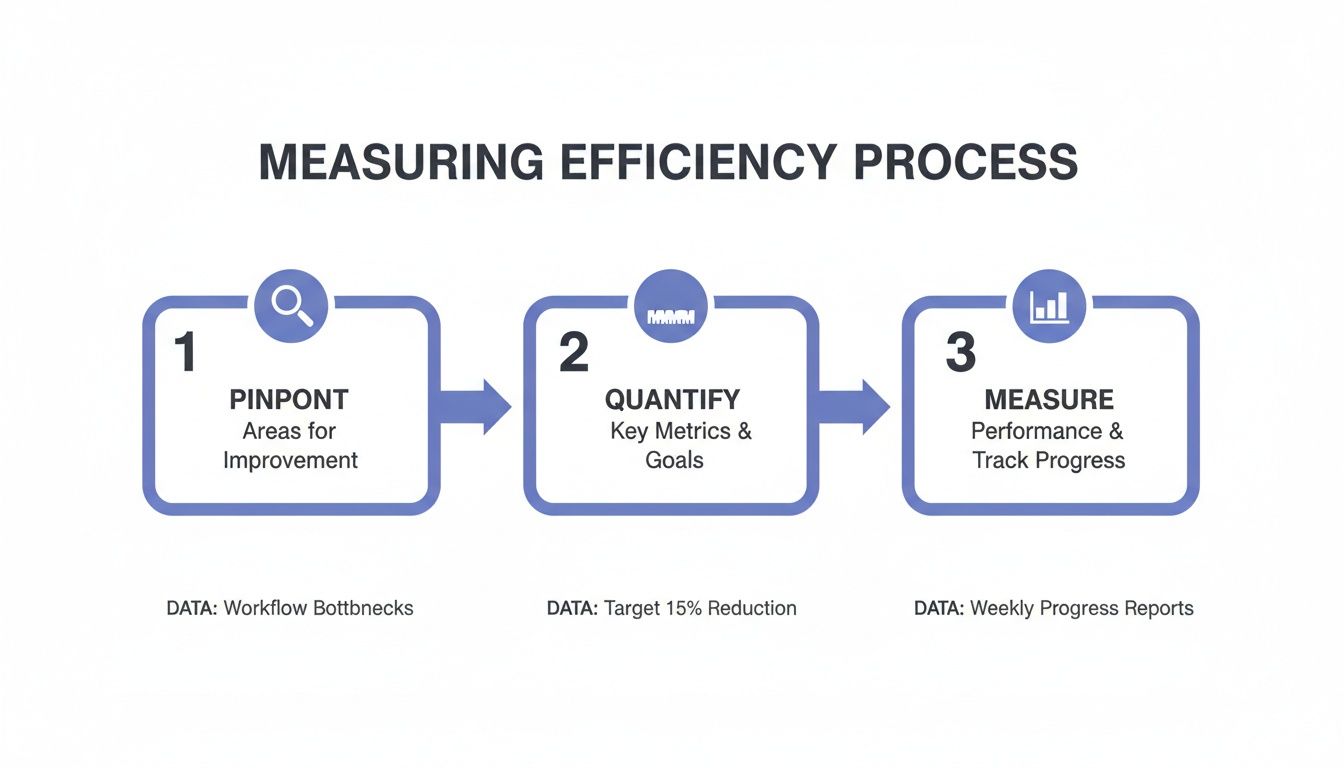
This loop is the core of modern efficiency measurement. You start by zeroing in on high-impact, repetitive processes. Then you do the math to figure out how much they're really costing you in time and resources. Finally, you measure the real-world performance gains you get after bringing in AI to do the heavy lifting.
To put this all into perspective, I've mapped out the key components of a modern measurement strategy into a simple table.
Key Pillars of Modern Operational Efficiency Measurement
This table breaks down the core components of an effective efficiency measurement strategy in today's AI-driven world.
| Pillar | Focus Area | Example KPI |
|---|---|---|
| Goal Alignment | Ensuring efficiency efforts directly support business objectives. | Reduction in cost-to-serve a customer. |
| KPI Selection | Choosing metrics that reflect the impact of automation. | Cycle Time for automated processes. |
| Data Integration | Pulling data from both human and automated workflows. | Data sync latency between CRM and AI Agent. |
| Continuous Feedback | Using performance data to refine AI and automation logic. | Error rate reduction in an automated workflow. |
By keeping these pillars in mind, you ensure your measurement system is more than tracking numbers but is actively helping you build a smarter, more efficient operation.
Strategies For AI-Powered Transformation
Putting this into action is about more than just buying the latest software; it requires a strategic plan to integrate AI into your teams and workflows. The real aim is to build an internal engine for continuous improvement.
Here are a few practical strategies that get results:
- AI Team Augmentation: Instead of spending months on a traditional hiring cycle, you can bring in specialized AI talent to work directly alongside your existing teams. They transfer knowledge and get projects moving fast.
- Placing AI-Adopted Engineers: This is the fastest way I've seen to inject practical, hands-on expertise where you need it most. You embed engineers who are already fluent in modern AI tools directly into your squads.
- Targeted AI Workshops: Give your current teams the skills they need to thrive. Hands-on AI workshops on collaborative platforms like Weavy.ai or AI coding assistants like Cursor and Claude for dev teams can completely change a development team's productivity. You can learn more about how AI agents for business are revolutionizing these workflows.
By focusing on these strategies, you stop talking about theoretical gains and start seeing tangible, measurable outcomes. The ultimate prize is more than cutting costs; it's building a more agile, intelligent, and scalable organization that's ready for whatever comes next.
Related Reads
Picking KPIs That Actually Move the Needle

If you want to measure operational efficiency right, you have to look beyond the textbook metrics. Forget the vanity numbers that look pretty on a slide deck but give you zero real insight into what’s happening on the ground.
Your Key Performance Indicators (KPIs) need to paint a direct, actionable picture of your operational health. This is especially true when you start weaving AI agents and automated workflows into your teams. The key is to stop thinking in abstract terms and start measuring what your people, and your bots, actually do.
Evolving Your KPIs for AI-Augmented Teams
Think about a dev team. Sure, "cycle time" is a classic metric, but it’s too broad to be truly useful. A far more powerful KPI is time from commit to deployment. When you invest in AI workshops for your dev team on tools like Cursor or Claude, this is the metric that proves it was worth it. You can see the direct impact on your pipeline’s velocity.
Same goes for a growth marketing team. "Cost per unit" is vague. A much sharper KPI is the cost per qualified lead generated via automation. This tells you exactly how well your AI agents are sifting through prospects, giving you a clear ROI on your automation spend.
Here are a few other ways I’ve seen teams adapt their KPIs:
- For Creative Teams: Instead of just counting assets, measure the time-to-first-draft for AI-generated creatives versus the old manual process.
- For Sales Ops: Track the percentage of leads automatically qualified and routed by an AI agent within five minutes of submission.
- For Engineering Squads: When you bring in AI-adopted engineer placements, track their impact by measuring the reduction in PR review times or the increase in deployment frequency for their squad.
These hyper-specific KPIs give you a clean, unambiguous signal about what’s working and what isn’t. They draw a straight line from your tech investments to real business outcomes.
Finding the Right Mix of Leading and Lagging Indicators
To get the full story, you need a mix of indicators. Lagging indicators tell you what already happened, while leading indicators help you predict what's coming. Relying on just one gives you a blind spot.
The best measurement frameworks I've seen always combine lagging indicators, like Overall Equipment Effectiveness (OEE) for a factory line, with leading ones, like the adoption rate of a new AI tool among engineers. A rising adoption rate is a powerful hint that future efficiency gains are on the way.
Think of it this way: lagging indicators are the result, and leading indicators are the activities that get you that result.
If your big goal is to slash customer support resolution time (a lagging indicator), a strong leading indicator would be the percentage of support tickets handled by an AI agent without human intervention. By keeping an eye on that leading metric, you can actively influence the final outcome.
Tie Every KPI Back to Your Big-Picture Goals
At the end of the day, the only KPIs that matter are the ones tied directly to your most critical business goals. If your company’s North Star is to achieve 10x scale without a 10x increase in headcount, then every single efficiency metric should reflect that mission.
Start by asking: what are the biggest operational drags slowing us down? Manual data entry? A clunky development pipeline? An inefficient customer onboarding process? This is where an expert eye helps. For instance, AI team augmentation can bring in immediate expertise to pinpoint and automate these core bottlenecks, ensuring your KPIs are aimed at the highest-impact areas.
This strategic alignment is non-negotiable. It turns measuring operational efficiency from a technical chore into a core driver of growth. Suddenly, each metric becomes a lever you can pull to get closer to your ultimate goals. The data you collect is no longer just for reporting; it’s for making smarter, faster decisions.
Digging into foundational concepts like workflow automation for small business can help you spot these high-impact areas that are ripe for improvement.
Free weekly brief
Steal our production automations
The exact n8n flows, Claude Code setups, and prompts we ship for clients, broken down step by step. No spam, unsubscribe anytime.
Building Your Measurement Infrastructure

You can't measure what you can't see. Simple as that. When your systems are disconnected, you’re operating with massive blind spots. Before you can track a single KPI with any real confidence, you have to build the technical foundation to get a clear, unified view of your data.
This is all about breaking down the data silos that kill so many efficiency initiatives before they even get off the ground.
From my experience, this is the single most common point of failure. Teams come up with brilliant KPIs but can't actually pull the data because their CRM, project management tool, and finance software don’t talk to each other. What you're left with is a chaotic mess of manual exports and spreadsheet hell.
This fragmentation is more than a minor annoyance; it's a silent killer of efficiency. A recent study on workplace productivity found that 50% of businesses are juggling an average of 17 disconnected tech solutions. Even worse, a mere 4% have managed to achieve full integration. This chaos forces 37% of organizations to dedicate 11 or more full-time employees just to manually wrangling data for reports. You can dig into more of these stats in the 2025 Workplace Statistics report.
Connecting Your Disparate Tools
To get that single source of truth, you need production-grade integrations that securely connect your entire tech stack. These aren't flimsy, one-off connections. We're talking about durable workflows designed to move data reliably and consistently between your systems.
Whether you use a powerful automation platform like n8n or Make or opt for custom code, the end goal is the same: create a steady flow of information that feeds your measurement system. This is what allows you to automatically pull metrics right from the source: the exact places where the work actually happens.
For instance, you could build an integration that:
- Pulls "time to resolution" data directly from your customer support platform's API.
- Connects your Git repository to a dashboard to track "commit to deployment" cycle times.
- Links your CRM to your marketing automation tool to measure "cost per qualified lead."
Identifying Data Sources and Killing Manual Reporting
Once your systems are connected, the next move is to map your chosen KPIs to their specific data sources. For every single metric you plan to track, you must identify precisely where that information lives. This exercise forces you to get granular and ensures you’re pulling clean, accurate data from the start.
With this map in place, you can finally build automated workflows to kill manual reporting for good. Imagine a system that automatically collects, calculates, and visualizes your KPIs without a single person having to run a report. This frees up countless hours previously lost to data drudgery. If you want to learn more about eliminating these tedious tasks, check out our guide on how to automate data entry.
A practical starting point I always recommend is a simple automation audit. Map your current workflows, identify the critical data gaps, and pinpoint the easiest integration wins first. It’s all about delivering immediate value.
This infrastructure is the absolute bedrock of your entire measurement strategy. It transforms your data from a scattered, unreliable mess into a clean, automated, and powerful asset for making real decisions. By investing in this foundation, you ensure the insights you generate are interesting and trustworthy and actionable.
Turning Raw Data Into Actionable Insights
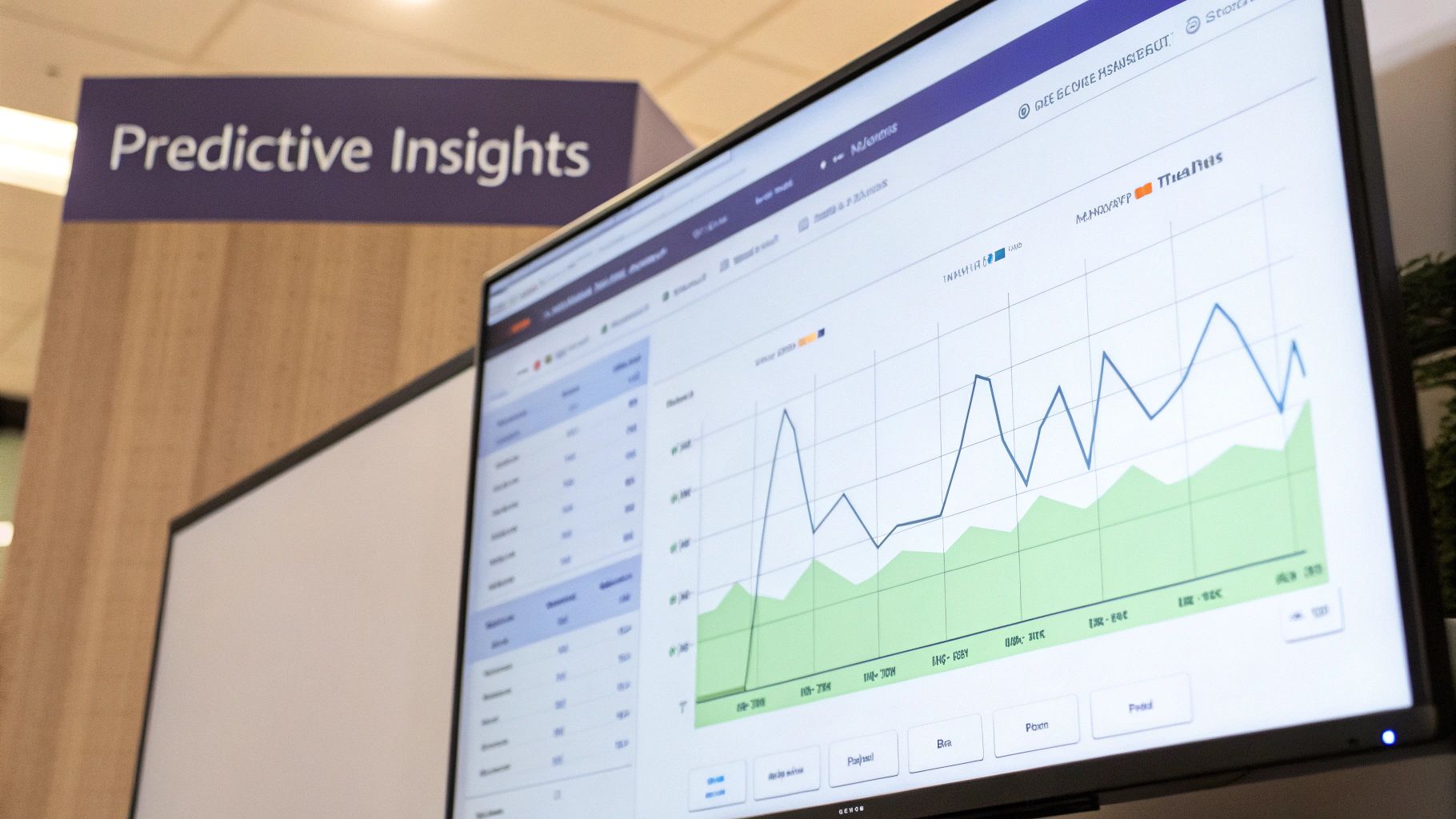
Alright, you’ve connected your systems and have a clean, unified stream of data. This is where the real work begins. It’s time to stop looking at numbers as a record of what happened and start using them to shape what happens next.
This means moving past static spreadsheets. We need dynamic, real-time dashboards that surface problems before they have a chance to derail your projects.
A well-designed dashboard is your first line of defense. It can instantly flag anomalies, helping you spot a bottleneck forming in your dev pipeline or a sudden dip in lead quality just by looking at a chart. But honestly, visualization is just the start. Today's tools let us go so much deeper.
Going Beyond Dashboards with AI Agents
True operational efficiency isn’t about passively watching data; it's about actively responding to it. This is where AI agents completely change the game. Instead of just collecting metrics, these agents can run an initial analysis, pick out the critical signals from the noise, and ping the right person to take action.
Imagine an AI agent that lives and breathes your engineering team's cycle times. When it notices the code review stage is consistently lagging behind your benchmarks, it doesn't just update a graph. It can automatically create a task for the engineering manager, attaching all the relevant data and flagging the issue for immediate human intervention.
This proactive approach turns your measurement framework into an early warning system. You're closing the loop between insight and action way faster than any manual check ever could.
You Still Need Human Expertise
While dashboards and agents are powerful, generating those game-changing insights often requires a specific kind of expertise. This is especially true in complex fields like software development, where the little details of workflow and tooling can make or break productivity. Just handing your team a new AI tool and expecting magic is a recipe for failure.
This is where you need to get smart about integrating talent. To truly understand what your data is telling you, you need people who are fluent in both your operational headaches and the AI that can fix them.
-
AI Team Augmentation: Bringing in specialized AI talent can seriously fast-track your ability to make sense of complex data. These experts can build custom dashboards, configure monitoring agents, and translate raw metrics into strategic recommendations your leadership can actually use.
-
AI-Adopted Engineer Placements: Another smart move is to embed engineers who are already masters of modern AI coding assistants into your teams. They don't just boost their own squad's output; they become mentors, showing everyone else how to get the most out of tools like Cursor and Claude and even how to spot new efficiency metrics.
The most powerful insights always come from combining technology with human experience. An AI agent can flag a slowdown, but an experienced AI-savvy engineer can diagnose the root cause, whether it’s technical debt or a clunky testing process, and actually implement a fix.
Activate Your Team with Hands-On AI Workshops
To make these gains last, you have to build this capability within your own team. Targeted, hands-on AI workshops are the best way to get your engineers using AI tools and truly understanding the efficiency data they produce.
Think about a workshop focused on advanced code generation and debugging for dev teams using tools like Cursor and Claude, or a session on collaborative development platforms like Weavy.ai. These aren't your typical, boring training modules. They're practical, skill-building sessions that teach your team how to work smarter, not harder alone.
Once developers learn to use these tools effectively, they start seeing their own work through an efficiency lens. They become active players in the process, suggesting new KPIs and pointing out automation opportunities you would have missed. This shift in culture, from passive execution to active improvement, is the real endgame.
Putting Your Efficiency Data Into Action
Gathering data is only half the battle. Honestly, measurement without action is little more than an academic exercise. This is where the rubber meets the road, where we turn those carefully curated KPIs into real-world performance gains.
It’s time to build a continuous improvement loop that’s actually powered by a smart mix of technology and talent.
Once your dashboards light up, flagging bottlenecks and surfacing opportunities, the big question is: what now? The answer is to strategically inject AI expertise directly into your workflows to act on those signals. From my experience, there are a few proven ways to do this that deliver the fastest, most sustainable results.
These approaches take you from just knowing your efficiency numbers to actively changing them. It’s about creating a culture where data doesn’t just get reported; it gets acted upon, fast.
Accelerate Impact with AI-Adopted Engineer Placements
One of the quickest ways to see a tangible return is to embed engineers who are already masters of modern AI tools directly into your teams. Think of this as the fast-track option. You get an immediate boost in productivity and expertise, skipping the long ramp-up period.
These folks are more than coders; they're efficiency catalysts. I've seen AI-adopted engineer placements completely change a team's dynamic in a matter of weeks. When you drop someone fluent in tools like Cursor for coding or Claude for complex problem-solving into a squad, they don't just finish their own tasks faster. They start showing everyone else what's possible, and that lifts the skill level of the whole team.
For instance, if your data shows pull request review cycles are a major bottleneck, an experienced AI-adopted engineer can introduce automated code review agents or demonstrate advanced debugging techniques that slash that time. They become a living, breathing example of a better way to work, which drives organic adoption of new tools and practices.
Gain Agility with AI Team Augmentation
Sometimes, you don't need a permanent hire. You just need a targeted injection of specialized skill to crush a specific efficiency problem. That’s where AI team augmentation comes in. It’s about bringing in expert AI talent to work alongside your existing teams for a defined period, giving you high-level expertise without the long-term commitment.
This strategy is perfect when your data points to a complex challenge your current team isn't equipped to handle. Maybe you've identified a need for a custom AI agent to automate customer support triage, but no one on your team has built one before. Augmenting your team with an AI specialist gets that project built, deployed, and delivering value in a fraction of the time it would take to hire and train someone new.
This model provides incredible flexibility. You get the exact expertise you need, right when you need it, allowing you to stay nimble and respond to operational challenges with speed and precision.
It's a powerful way to de-risk ambitious automation projects and make sure they’re built to production-grade standards from day one.
Build Long-Term Capability with Targeted AI Workshops
Placements and augmentation deliver immediate impact, but building a lasting culture of efficiency means investing in your own people. This is where targeted AI workshops are essential. The goal here is to systematically upskill your existing teams, turning them into proactive agents of improvement themselves.
Good workshops are not generic, boring training sessions. They are hands-on, practical deep dives into specific tools and workflows that directly address the pain points your data has revealed. An AI workshop for your dev team on using code generation tools like Code Llama effectively, for example, can directly impact your "commit to deployment" cycle time.
I’ve personally seen the incredible effect of teaching a development team how to properly use Claude for problem-solving or Cursor for an AI-native coding environment. It doesn't just make them write code faster; it fundamentally changes how they approach problem-solving, debugging, and testing. Similarly, showing a team how to use a tool like Weavy.ai in a workshop can streamline their entire collaborative project process.
Ultimately, labor productivity growth is a critical way to gauge operational efficiency. The latest thinking on this emphasizes how generative AI can slash task times. But achieving those huge performance boosts of 50-70% in key areas requires more than just tools; it demands redesigned operating models.
A practical measure for operations leaders is the "productivity lever index," which assesses AI's impact on specific workflows. High performers are achieving over 50% task time reductions. If you want to dive deeper, you can explore how curiosity-fueled tech integration powers productivity by checking out the OECD's insights on productivity developments.
Choosing Your AI Implementation Strategy
So, which path is right for you? It really depends on your specific goals, timeline, and what you’ve got in-house. This table breaks down the options to help you decide.
| Strategy | Best For | Key Benefit |
|---|---|---|
| AI-Adopted Engineer Placements | Teams needing an immediate, hands-on productivity boost and skill transfer. | Instant injection of practical AI expertise and accelerated project velocity. |
| AI Team Augmentation | Tackling specific, complex automation projects without long-term overhead. | Access to specialized, high-level AI talent on-demand for critical initiatives. |
| Targeted AI Workshops | Building sustainable, in-house capabilities for long-term efficiency gains. | Upskills your existing workforce and builds a culture of continuous improvement. |
By thoughtfully combining these strategies, you create a powerful, multi-layered approach to operational improvement. You can put out immediate fires with placements and augmentation while building the foundation for long-term excellence with workshops. This is how you move from just measuring efficiency to truly mastering it.
Got Questions? Let's Talk Strategy
When you first start digging into efficiency metrics, a few common questions always pop up. Here are some of the most frequent ones I hear, along with some straight-up, practical advice to get you moving.
We Have No System in Place. Where on Earth Do We Start?
If you're starting from a blank slate, don't try to boil the ocean. Seriously. The absolute best first step is to pick one single, high-volume workflow and do a quick process audit.
Think about a repetitive task your team does all day, maybe it's customer onboarding or lead qualification. Just for a week, manually track the time it takes, the costs involved, and how often mistakes happen. This simple baseline data is pure gold. It gives you a clear, undeniable starting point and helps you spot the low-hanging fruit without investing a dime in new software.
How Do We Actually Calculate the ROI of an AI Agent?
This is more straightforward than you might think. First, you need to quantify your "before" state. Calculate the total employee hours spent on that task each month and multiply it by their fully-loaded hourly cost. Don't forget to factor in the cost of any errors that occur.
Then, figure out your "after" state: what does it cost to run the AI agent? The ROI is simply the monthly savings minus the agent's cost. For example, if you save 100 hours of an employee's time who costs you $50/hour, that’s a $5,000 monthly saving. An AI agent doing that same work might cost a tiny fraction of that, giving you an immediate and very clear return.
My Engineering Team Thinks AI Coding Tools Are a Gimmick. How Can I Get Them on Board?
Ah, the skeptical engineering team. This is a common one, and you have to approach it with proof, not pressure. Their concerns are often valid; some studies have even shown that AI tools can initially slow down senior developers who have a deeply ingrained workflow. The trick is to show them the value on their own terms.
Forget top-down mandates. Instead, run a small pilot program with a few of your more innovative developers. Set up a hands-on AI workshop for your dev team focused on a specific tool they might actually use, like Cursor for an AI-native IDE or Claude for complex debugging tasks. When it's led by an expert who gets developer culture, these sessions can demonstrate real, tangible time savings on their actual work.
This approach respects their expertise while proving the tool's value directly. When other developers see their peers shipping quality code faster and with fewer errors, organic adoption will follow.
Another really effective tactic is AI-adopted engineer placement. Find an engineer who is already a pro with these tools and embed them in a skeptical team. They become a living, breathing example of best practices and a go-to mentor, which is far more persuasive than any manager's directive.
What's Better: AI Team Augmentation or AI Workshops?
This isn't an "either/or" question. The right choice between AI team augmentation and AI workshops really boils down to your immediate needs versus your long-term goals. They solve completely different problems.
-
Go for AI Team Augmentation when: You have a specific, high-stakes project with a looming deadline that your current team just doesn't have the skills for. This gets you an immediate injection of high-level expertise to get the job done fast.
-
Invest in AI Workshops when: Your goal is to build a sustainable, in-house capability. This is all about upskilling your own people and making efficiency part of your team's DNA for the long haul.
Honestly, the best strategy is often a hybrid. Bring in an augmented team to knock out an urgent project while you simultaneously run workshops to train your internal team. That way, you get immediate results and the lasting value of a team that can maintain and innovate on the solution moving forward.
If this sounds like the right fit, our AI automation agency page covers scope, process, and how an engagement starts.
Ready to stop just measuring and start transforming your operations? The expert team at AY Automate can help you scale 10X without increasing headcount, using custom AI agents and strategic automation. Book your free automation audit today and see what's possible.
For a custom implementation of the measurement frameworks and dashboards covered in this guide, see AY Automate workflow automation.'s possible.
Continue Reading
AI Agents for Business in 2026: Real Use Cases, Cost, and How to Pick the Right One
Updated June 2026. "AI agents for business" went from buzzword to real category between 2024 and 2026.
How to Build an AI Chatbot That Drives 10X Growth
A practical guide on how to build an AI chatbot for your business. Learn to select LLMs, design conversations, and deploy agents that scale.
Unlocking Scale With Integration Software as a Service
Discover how Integration Software as a Service (iPaaS) slashes operational costs and scales your business. A complete guide for CTOs and founders.
Book a Free Strategy Call
Building this in production?
Walid runs a 30-min call to map your AI engineering team. Free, no slides.
Free weekly brief
Steal our production automations
The exact n8n flows, Claude Code setups, and prompts we ship for clients, broken down step by step. No spam, unsubscribe anytime.

Walid founded AY Automate to help businesses ship AI workflows that actually move revenue. He leads strategy and oversees every client engagement end-to-end.
Full Bio →