Book a Free Strategy Call
Skip the read: talk to Walid in 30 min.
Free strategy call. We map your AI engineering team, you keep the notes.
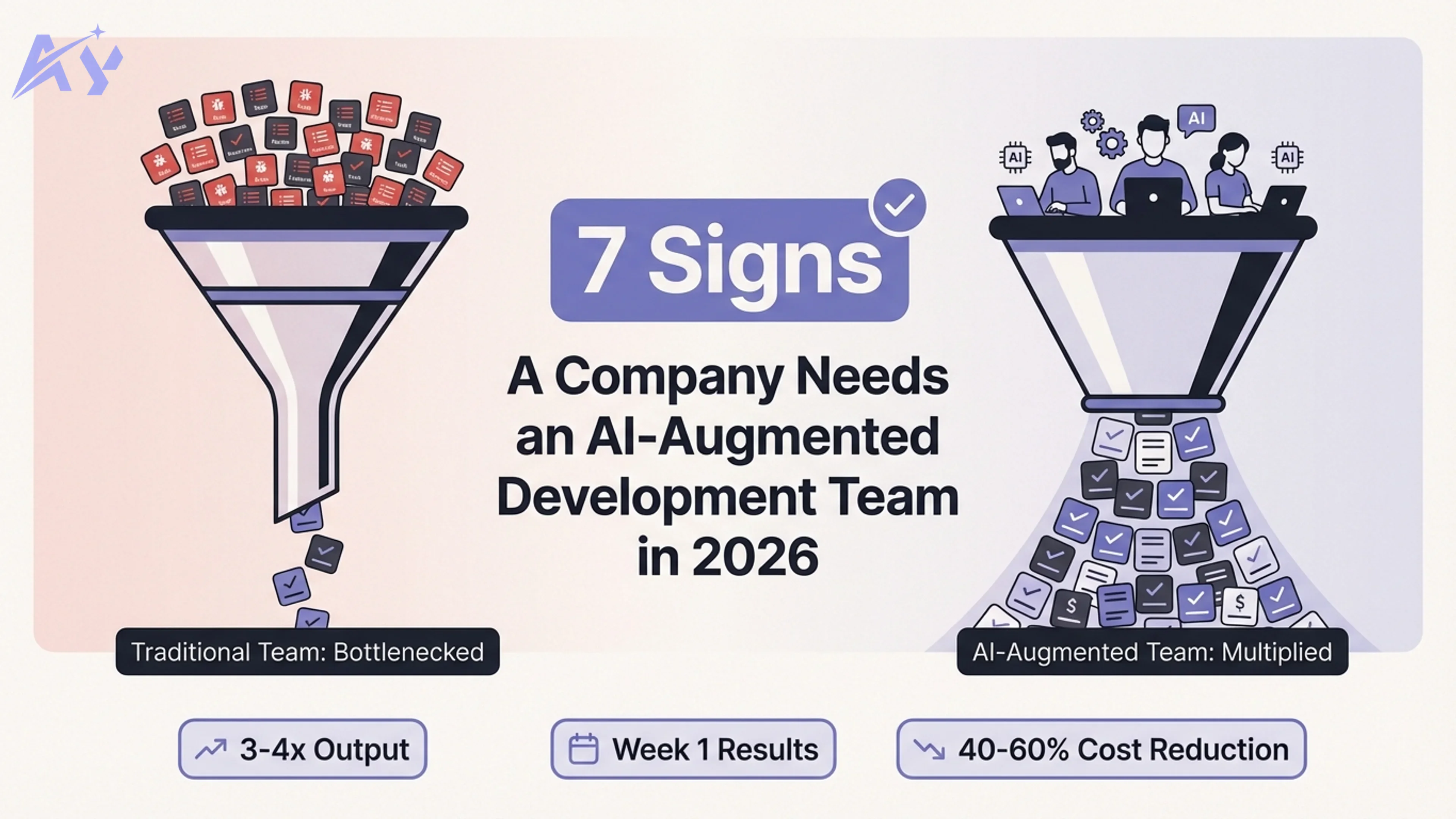
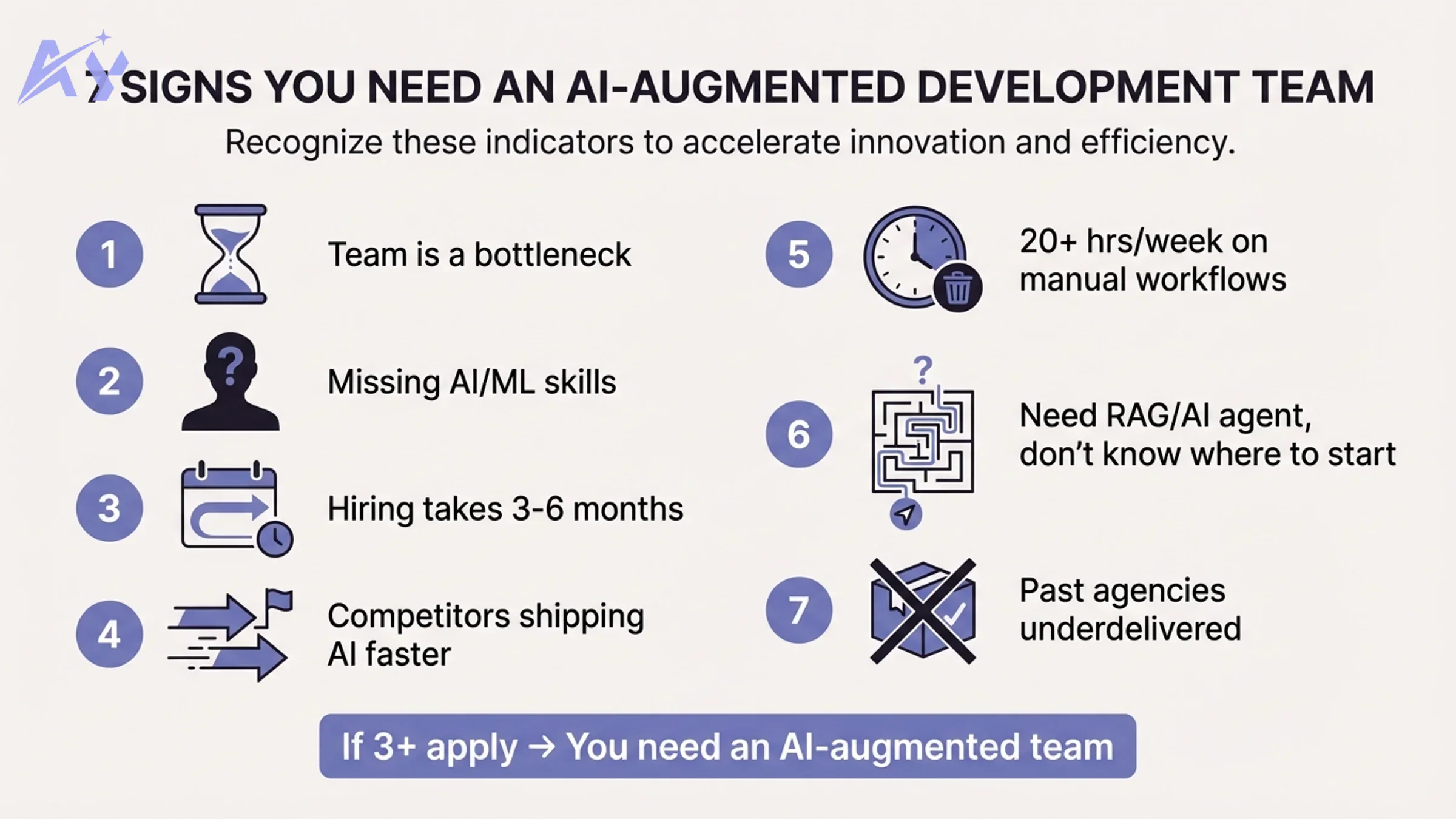
You need an AI-augmented development team if 3 or more of these 7 signs apply: your dev team is a bottleneck but you cannot afford to double headcount; you need AI/ML features but lack in-house skills; you are stuck in a 3-6 month hiring cycle; competitors are shipping AI features faster; you have 20+ hours per week of automatable workflows; you need a RAG pipeline or AI agent; or traditional agencies have delivered slow, expensive results.
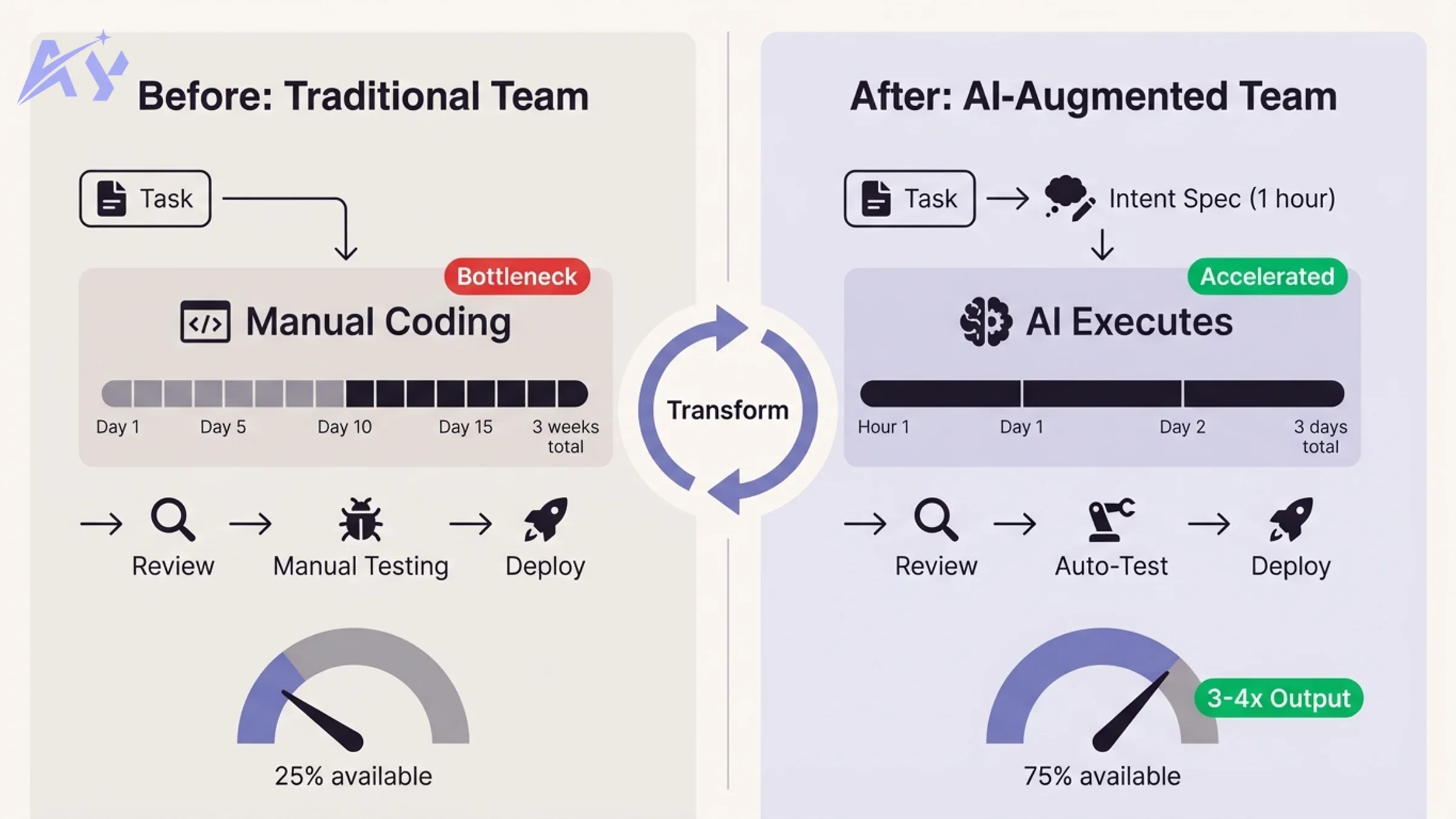
When a development team adds AI agents, the unit of work changes: engineers stop writing every line and start defining intent, orchestrating agents to execute it, and reviewing what ships. Per-engineer output multiplies 3-4x without adding headcount, and a 2-3 person agentic team can match the delivery of a traditional team several times its size.
The pressure behind this shift is real. A 2024 McKinsey survey found that 40% of engineering leaders cite developer capacity as their top constraint on growth, ahead of budget and strategy. And the default fix, opening another 3-6 month hiring cycle, is no longer fast enough.
AI-augmented development multiplies the output of the engineers you already have, or brings in a small team of AI-native engineers who each operate at 3-4x the throughput of a traditional developer. If your engineering org feels like it's perpetually behind, read these 7 signs carefully. If 3 or more apply to you, you don't need another hire. You need an AI-augmented team.
What is an AI-augmented development team?
An AI-augmented development team is an engineering team that uses AI agents, intent-driven coding tools (like Claude Code, Cursor, or Copilot), and automated workflow infrastructure to increase per-engineer output without proportionally scaling headcount.
Rather than writing every line manually, engineers on an AI-first development team operate at the intent level: they define what needs to be built, orchestrate AI agents to execute it, review and refine the output, and ship faster by an order of magnitude. Think of it as the difference between driving a car and pushing one.
At the agency level, this means a 2-3 person agentic development team from AY Automate can deliver the output of an 8-10 person traditional team, with production-grade quality controls, daily progress updates, and audit-ready documentation built in.
Related Reads
Sign 1: your dev team is a bottleneck, but you can't afford to double headcount
This is the most common trigger. The roadmap is stacked, stakeholders are pressuring for delivery, and your engineers are already stretched. The obvious solution, hiring more developers, runs headlong into the reality: senior engineers take 3-6 months to hire, 3 months to ramp, and $150K-$250K per year in fully loaded cost.
You're not underresourced. You're under-multiplied.
The right solution: bring in an AI staff augmentation model where each augmented engineer operates with AI toolchains that compress weeks of work into days. You scale output, not payroll.
| Approach | Time to productivity | Annual cost | Output multiplier |
|---|---|---|---|
| Traditional senior hire | 4-6 months | $180K-$250K | 1x |
| Offshore agency | 2-4 months | $80K-$150K | 0.6x (quality-adjusted) |
| AI-augmented placement | 2-4 weeks | $60K-$120K | 3-4x |
Free weekly brief
Steal our production automations
The exact n8n flows, Claude Code setups, and prompts we ship for clients, broken down step by step. No spam, unsubscribe anytime.
Sign 2: you need AI/ML features but your team doesn't have the skills
Your product roadmap has "AI-powered" features on it. Personalization, intelligent search, recommendation engines, document processing, a conversational interface. Your current engineers are solid generalists, but building a production RAG pipeline or fine-tuning an LLM is a different discipline entirely.
Reskilling takes 6-12 months. Hiring a dedicated ML engineer in 2025 is a 4-6 month search with 8+ competing offers per candidate.
The right solution: bring in engineers with RAG pipeline architecture and AI agent development experience from day 1. Ship the feature in weeks, not quarters, with a team that has already built these systems in production.
Sign 3: you're stuck in a hiring cycle that takes 3-6 months per engineer
Your last 3 engineering hires each took an average of 4.5 months from job posting to first day. By the time each one was fully productive, the project they were hired for had pivoted twice.
This is a structural problem, not a recruiting problem. Traditional hiring is too slow for fast-moving product cycles. Every sprint that slips while you wait for headcount is compounding technical and competitive debt.
The right solution: staff augmentation with AI-augmented engineers who can be onboarded to your codebase in days rather than months, using AI-assisted codebase analysis, documentation generation, and context loading. Week 1 results are standard, not exceptional.
Sign 4: your competitors are shipping AI features and you're falling behind
Your closest competitor just announced an AI-powered feature. Another is advertising 10x faster onboarding via automation. Your product team is asking "when can we do that?" and your engineering team is answering "we're already at capacity."
This is the competitive version of the capacity problem, and it has a compounding urgency. Every quarter you don't ship AI-native features is a quarter of positioning loss that takes twice as long to recover.
The right solution: an AI strategy consulting engagement to identify the 2-3 AI features with the highest competitive impact, followed by rapid execution with an AI-first development team that builds and ships in parallel with your existing team, not instead of it.
Sign 5: you have workflows that eat 20+ hours per week that could be automated
Look at your engineering team's week. How many hours go to:
- Manual data pipeline runs and monitoring
- Repetitive API integrations and webhook setups
- Report generation and Slack/email status updates
- Copy-paste data movement between systems
- Testing and QA runs that follow a predictable script
If the answer is more than 15-20 hours per week across your team, you're paying senior engineers to do junior-level repetitive work. These are not judgment calls. They're deterministic processes that a well-built automation handles in seconds.
The right solution: a custom workflow automation audit that maps your highest-volume repetitive processes and eliminates them with n8n or agent-based automation. Most teams recover 20-40% of their engineering capacity within the first 30 days.
| Workflow type | Manual time (weekly) | Post-automation time | Hours recovered |
|---|---|---|---|
| Data pipeline monitoring | 8 hrs | 0 hrs (alerting only) | 8 hrs |
| Integration testing | 6 hrs | 0.5 hrs (review only) | 5.5 hrs |
| Status report generation | 4 hrs | 0 hrs (auto-generated) | 4 hrs |
| API integration setup | 5 hrs | 1 hr (config review) | 4 hrs |
| Total | 23 hrs/week | 1.5 hrs/week | 21.5 hrs |
Sign 6: you need to build a RAG pipeline or AI agent but don't know where to start
You've decided to build something with AI. Maybe it's a document Q&A system, a customer support agent, or an internal knowledge base that answers questions across your entire codebase and documentation.
You've read about RAG, vector databases, embedding models, chunking strategies, and retrieval evaluation. The more you read, the more complex the decision tree becomes: which vector DB, which embedding model, how to handle context windows, how to evaluate retrieval quality, how to prevent hallucination at production scale.
This is not a documentation problem. It's an experience problem. These decisions are hard to get right without having built and broken multiple production RAG systems.
The right solution: bring in a team that has built RAG pipeline architecture across dozens of production deployments. The architecture decisions that take 6 weeks of research can be made in a 2-hour scoping call when the person on the other side has built this before.
Sign 7: you've tried traditional agencies and got slow, expensive, low-quality output
You hired a software agency. Deliverables slipped by 3 weeks. The code arrived without tests. You found security vulnerabilities in the first review. The team churned through 2 account managers and 3 developers mid-project. The price was high and the output felt like a demo, not a production system.
This is not an edge case. It's the modal outcome with traditional software agencies because traditional agencies optimize for billable hours, not outcomes.
The right solution: the AI-augmented software development company model flips this. AY Automate engineers are ex-IBM architects and senior practitioners with 8+ years average experience, the same bar we use to rank the best AI software development companies more broadly. Our model is daily updates, transparent progress, audit-ready documentation, and production-grade quality gates from week 1. The 1 AY engineer = 3-4 average developers benchmark comes from what 200+ client engagements across US and EU have validated over 8+ years.
What to do if 3 or more of these apply to you
If you recognized your situation in 3 or more of these signs, you're not alone, and the problem is solvable. An AI-first development team doesn't replace your existing engineering org. It multiplies it by taking on the highest-value new work, removing the biggest workflow drains, and shipping the AI features that move your competitive position.
The practical path forward:
- For capacity bottlenecks: AI staff augmentation puts engineers embedded in your team or operating independently, productizing fast
- For AI feature gaps: AI agent development and RAG pipeline architecture deliver production-grade AI systems built and handed off
- For strategic clarity: AI strategy consulting gives you a fractional CAIO who maps the 90-day roadmap and prioritizes by ROI
- For workflow reclamation: Custom workflow automation removes the 20+ hours/week of manual process drag
AY Automate delivers results from week 1. No black-box engagements, no months-long warmup, no surprise invoices. If you're ready to stop treating engineering capacity as a constraint and start treating it as a multiplier, the next step is a 30-minute discovery call.
Book a discovery call, or explore the engineer placement and AI strategy consulting services directly.
Sources: McKinsey State of AI 2024, LinkedIn Talent Insights 2024, Stack Overflow Developer Survey 2024, Bureau of Labor Statistics Software Developer Wage Data 2024
FAQ
What is an AI-augmented development team? An AI-augmented development team is an engineering team that uses AI coding tools, autonomous agents, and automated workflow infrastructure to multiply per-engineer output, typically 3 to 4 times the throughput of a traditional team.
How is an AI-augmented team different from a traditional software agency? Traditional agencies bill by the hour and optimize for utilization, not outcomes. An AI-augmented team optimizes for delivery velocity and quality, with daily progress updates, production-grade quality gates, and audit-ready documentation from week 1.
How quickly can an AI-first development team become productive on my codebase? With AI-assisted codebase analysis and documentation generation, a skilled AI-native engineer can be productive on a new codebase within days rather than months.
Can I scale my dev team with AI without replacing my existing engineers? Yes. The most common model is additive: an AI-augmented team from AY Automate handles net-new AI feature development and automation infrastructure while your existing team maintains the core product.
What types of companies benefit most from an AI-augmented software development company? SaaS founders who need to ship AI features fast, CTOs at growth-stage companies where engineering is the bottleneck, and operations-heavy businesses with 20+ hours per week of manual workflow drag.
What is intent-driven engineering? Intent-driven engineering is the practice of working at the level of goals and specifications rather than individual lines of code. Engineers define what the system should do, AI agents generate and iterate on the implementation, and the engineer reviews, refines, and ships.
Continue Reading
AI QA Testing Agents: What to Automate, Where QA Judgment Leads (2026)
What an AI QA testing agent does well (test generation, regression testing, cross-browser checks), where QA judgment still leads, and how this differs from agent evals.
Why 88% of AI Agent Pilots Never Reach Production (and How to Be in the Rest)
IDC, Forrester and Anaconda, and McKinsey all published separate 2026 research landing on the same number: roughly 9 in 10 AI pilots never reach production. Here is what the 12% that ship do differently.
Your AI pilot isn't broken. Your deployment infrastructure is.
IDC finds 88% of enterprise AI pilots never reach production. McKinsey finds only 6% of companies see real ROI. Forkast finds 41% of the ones that do ship lose money within a year. None of it is the model's fault.
Book a Free Strategy Call
Building this in production?
Walid runs a 30-min call to map your AI engineering team. Free, no slides.
Free weekly brief
Steal our production automations
The exact n8n flows, Claude Code setups, and prompts we ship for clients, broken down step by step. No spam, unsubscribe anytime.

Robel engineers production-grade automation pipelines at AY Automate, focused on integrations, reliability, and the systems that keep client workflows running.