Book a Free Strategy Call
Skip the read: talk to Walid in 30 min.
Free strategy call. We map your AI engineering team, you keep the notes.
AI solutions for enterprise in 2026: workflow automation to eliminate manual handoffs, intelligent document processing for back-office ops, AI agents for customer-facing workflows, and predictive analytics for demand and capacity planning. Start with the highest-ROI use case for your industry.
For a long time, enterprise AI felt more like a concept for the future than a practical tool for today. That’s changed. Now, it's the engine driving modern business growth.
Think of it as a strategic shift away from purely manual processes and toward an intelligent, automated 'digital workforce' that operates around the clock. This is how businesses achieve massive scale without the old-school requirement of massively scaling their headcount, creating a powerful competitive advantage.
Why AI Solutions Are the New Competitive Edge
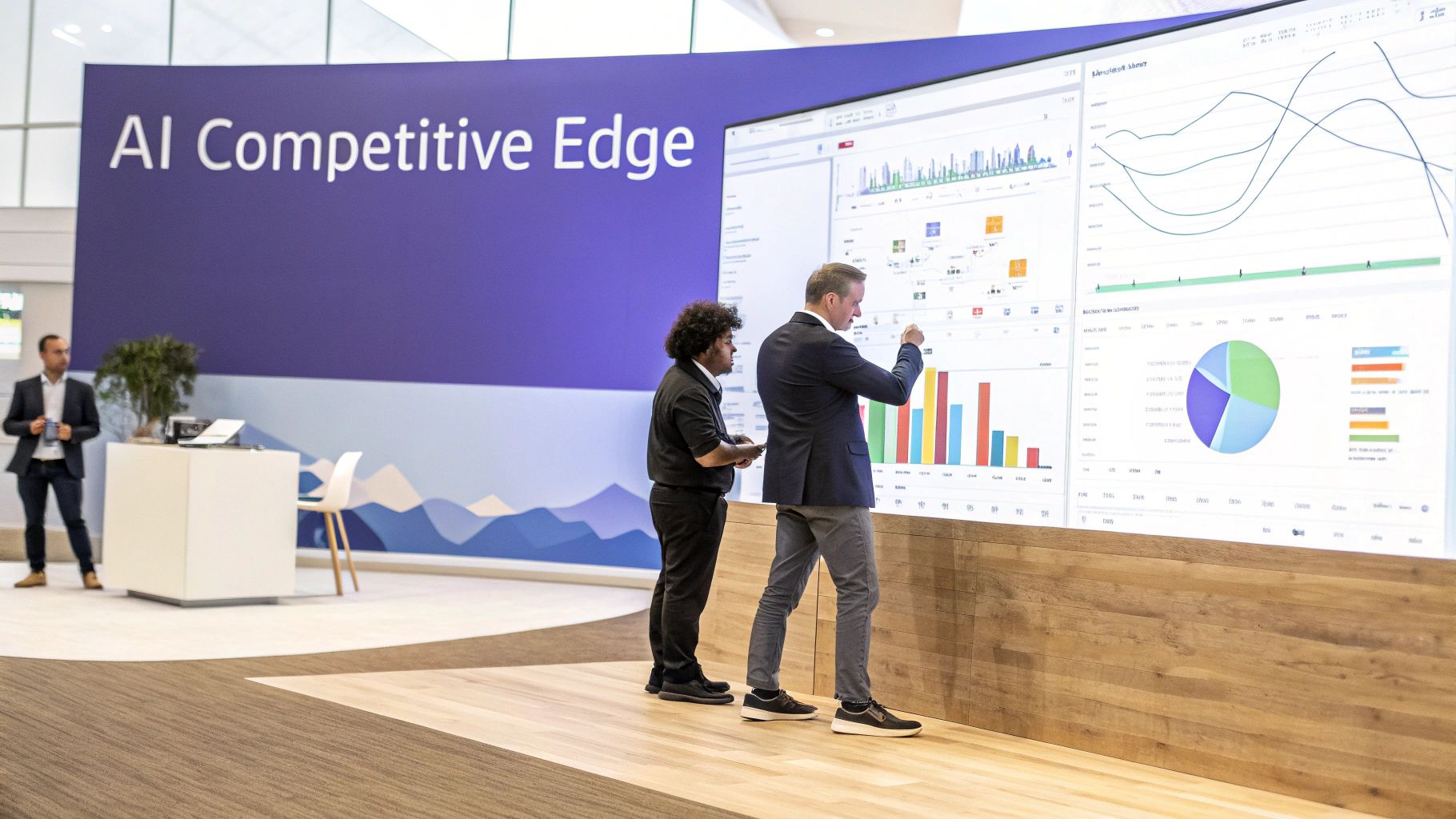
In a market that moves this fast, the companies that lead are the ones that can operate efficiently and scale on demand. Enterprise AI is what enables that potential. We're moving beyond simple software tools; we're talking about making AI a core part of business strategy.
It all comes down to building a digital workforce of custom AI agents and automated workflows. These systems handle the repetitive, time-consuming tasks, freeing up your human experts to focus on what they do best: high-value innovation and strategic thinking. This goes beyond bolting on new software; it's about re-architecting how work gets done from the ground up to drive real business outcomes.
From Pilot to Production: The Adoption Challenge
The momentum is undeniable. Global surveys show that by 2025, a staggering 88% of organizations will be using AI in at least one business function. But here's the catch: only about a third of those companies have managed to scale their AI initiatives beyond the pilot stage.
This reveals a major readiness gap between trying AI and truly transforming with it. It's a clear sign that successful implementation requires more than just good tech; it demands a clear strategy, the right skills, and a plan to make sure new tools are actually adopted and used effectively.
Building Your Edge with People and Training
To truly get ahead, you have to invest in your people. Building an elite AI team from scratch is often too slow and expensive for most companies. A smarter, more effective strategy blends expert talent acquisition with practical, hands-on training.
- AI Adopted Engineers Placements: We integrate pre-vetted AI engineers directly into your teams to speed up development and transfer critical knowledge from day one.
- AI Team Augmentation: Need to bridge an immediate skill gap or de-risk a complex project? We can supplement your existing workforce with specialized AI talent right when you need it.
- Targeted AI Workshops: We deliver hands-on training sessions focused on the specific, high-impact tools your development teams use daily.
Think of it this way: placing an expert engineer is like signing a star player, while AI workshops are the training camps that elevate the entire team's performance. You need both to win.
For example, workshops centered on tools like Cursor, an AI-first code editor, or advanced sessions on using models like Claude for code generation, can give your developer productivity a serious boost. These aren't theoretical lectures; they're practical learning experiences designed to ensure your investment in AI technology translates directly into better workflows and faster innovation.
For a deeper look at how this works in practice, check out our guide on AI automation for business. This combination of expert placement and team-wide upskilling creates a solid, sustainable foundation for long-term success.
Key Enterprise Functions Transformed by AI Solutions
To make this more concrete, let's look at how AI solutions are making a measurable impact across different parts of a business. The table below breaks down a few key areas where AI is an add-on and a core driver of efficiency and growth.
| Business Function | AI Solution Example | Primary Business Impact |
|---|---|---|
| Sales & Marketing | AI-powered lead scoring and qualification agents | Increased lead quality and higher conversion rates |
| Customer Support | 24/7 intelligent chatbots and resolution assistants | Reduced response times and improved customer satisfaction |
| Finance & Accounting | Automated invoice processing and fraud detection | Lower operational costs and minimized financial risk |
| Human Resources | AI-driven resume screening and candidate matching | Faster hiring cycles and better talent acquisition |
| Operations | Predictive maintenance and supply chain optimization | Reduced downtime and more efficient logistics |
As you can see, the applications are both broad and deep. From front-office customer interactions to back-office operational workflows, AI provides the tools to not only do things faster, but to do them smarter.
Related Reads
Building Your AI Powerhouse with Team Augmentation
Trying to build an elite AI team from scratch is a massive undertaking. It’s slow, incredibly expensive, and you risk making costly mistakes that can stall your projects before they ever get off the ground. It’s a common story, and it’s why so many enterprise AI initiatives fail to deliver real value.
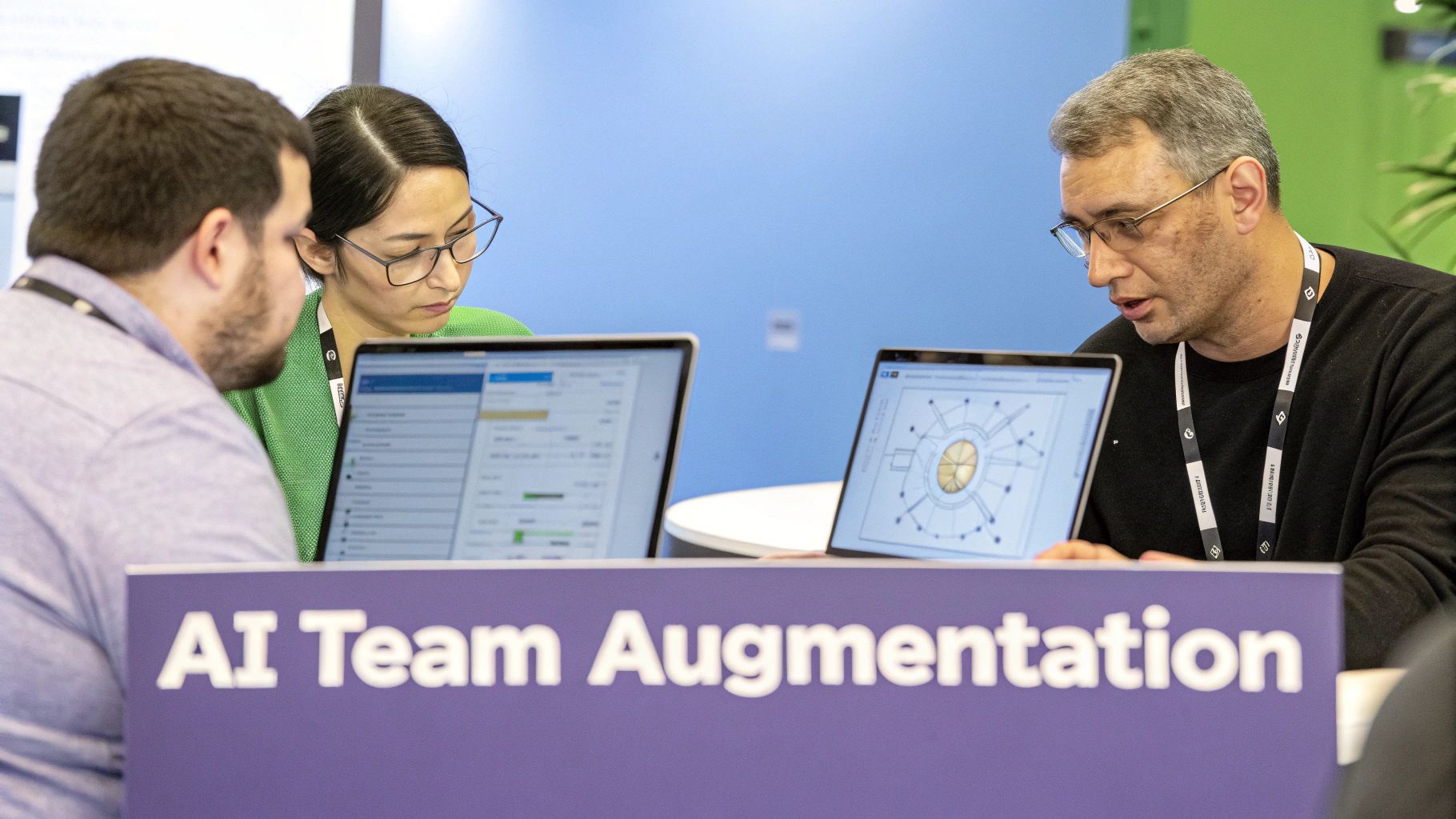
But there’s a much more direct path. AI team augmentation offers a smarter way to get things done without the usual headaches. This isn’t about just outsourcing a few tasks; it’s about embedding seasoned AI engineers directly into your team to hit the ground running from day one.
Think of it as a strategic partnership designed to de-risk your most important AI initiatives. By bringing in vetted experts, you immediately fill critical skill gaps and get access to specialized knowledge, with no lengthy recruiting or training cycles required.
Gaining Immediate Access to Specialized Skills
One of the biggest wins with team augmentation is the instant injection of high-level expertise. Imagine bringing on an architect with an ex-IBM background who just gets the security and scalability demands of a corporate environment. That kind of experience is priceless.
These pros show up with proven track records and a deep understanding of the exact tools you need to build solid ai solutions for enterprise workflows. Their expertise often includes:
- Automation Platforms: Mastery of integration workhorses like n8n and Make, which are essential for connecting different systems and creating seamless, automated processes.
- Advanced LLMs: Practical, hands-on knowledge of large language models like Claude and Gemini for complex tasks like code generation, deep data analysis, and content creation.
- Secure Implementation: The ability to architect and deploy solutions that meet strict security and compliance rules, a total non-negotiable for any enterprise-grade app.
As you build out your AI capabilities, having the right tools is half the battle. Exploring the top no-code AI platforms can be a real advantage, giving both your technical and non-technical people the power to build.
A Dual-Benefit Model: Building Solutions and Skills
The real magic of AI team augmentation is that you get two massive benefits at once. First, you get your AI solutions developed and deployed much faster, which means you start seeing an ROI far sooner than if you tried to build everything internally.
Second, and this is just as important, your own team gets an incredible upskilling opportunity. As the augmented engineers work side-by-side with your staff, they naturally transfer their knowledge through collaboration, mentorship, and real-world problem-solving. Your team isn’t just handed a final product; they’re part of building it.
This model transforms a short-term project into a long-term investment. You're more than buying a solution; you're building an internal capability that will pay dividends for years to come.
This kind of hands-on learning is far more effective than any textbook or training course. Your team learns the best practices for prompt engineering, workflow design, and AI-powered coding right in the middle of their daily work. For companies looking to bring this kind of expertise in-house, exploring options for AI adopted engineers placements is the logical next move.
Free weekly brief
Steal our production automations
The exact n8n flows, Claude Code setups, and prompts we ship for clients, broken down step by step. No spam, unsubscribe anytime.
Bridging the Skill Gap with Strategic AI Workshops
So you’ve invested in powerful new AI tools. That's the easy part. The real challenge, and where countless initiatives stumble, is getting your teams to actually use them. Without a solid plan for adoption, even the most impressive tech ends up as just another expensive, underused subscription.
This is exactly where strategic, hands-on AI workshops come in. They cut through the theory and provide practical, role-specific training that gives your people the confidence and skills to wire AI directly into their daily work. The goal here is simple: turn that initial skepticism into genuine enthusiasm by showing them immediate, tangible value.
From Tools to Tangible Productivity
The gap between deploying AI and seeing a real payoff almost always comes down to training. A recent report really puts this in perspective: companies have deployed, on average, 200 different AI tools, yet a tiny 28% of employees feel they actually know how to use them. That’s a massive bottleneck. Think about it: AI investments have skyrocketed 2.5 times since 2023, but much of that money is just evaporating due to poor adoption. For a deeper dive, check out the full enterprise AI adoption report from WalkMe.
Good workshops close that gap. These aren't your typical, generic software demos. They are focused, problem-solving sessions designed around the real-world headaches your teams face every day. This approach turns training from a chore into a genuine productivity boost.
A tool is only as good as the person using it. Strategic workshops ensure your team is more than handed AI tools, but is truly empowered by them. It's a shift in mindset from simple ownership to active mastery, and that’s where real ROI begins.
By showing teams how to standardize their use of AI and demonstrating clear efficiency wins, these workshops build a culture of innovation from the ground up. You stop being just a consumer of AI technology and start becoming a builder of AI-driven success.
Practical Workshops for Modern Development Teams
Let’s make this concrete. Think about your technical teams, where even small efficiency gains can have a huge ripple effect on project timelines and code quality.
- AI-Powered Coding with Cursor: Imagine a workshop centered on an AI-first code editor like Cursor. Your developers learn to write, debug, and refactor code in a fraction of the time. They’d practice using AI to generate boilerplate, untangle complex logic, and turn hours of frustrating work into minutes.
- Advanced Prompt Engineering with Claude for Code: Or picture a session on a powerful LLM like Claude. Here, the team goes deep on crafting precise prompts that produce high-quality, production-ready code. It’s about reducing manual slog and improving consistency across the board.
Here’s a look at how a platform like Weavy.ai structures its workshops to accelerate AI adoption for developers.
This visual gets to the heart of it: effective training has to be specific, tool-focused, and centered on solving the immediate problems your team is grappling with right now.
The Strategic Value of AI Team Augmentation and Training
The most successful AI adoption strategy combines two things: AI team augmentation and continuous training. You bring in seasoned experts who not only accelerate your development but also mentor your existing staff, embedding best practices right into your team’s DNA.
This creates a powerful feedback loop. The augmented engineers on the ground can spot critical skill gaps and help design workshops that are perfectly tailored to what your team actually needs. It's an approach that builds both your technology and your talent at the same time, ensuring you create a self-sustaining AI capability long after the initial project is done.
Your Four-Step AI Implementation Roadmap
Trying to jump from AI theory to real-world business results without a clear plan is a recipe for disaster. Too often, promising AI projects get stuck in an endless pilot phase, never quite delivering the value everyone hoped for. To avoid this, you need a methodical, battle-tested approach that de-risks the whole process.
This framework breaks the journey down into four straightforward, actionable stages. Think of it as our playbook for building secure, reliable, and high-ROI AI solutions that plug right into your existing operations, delivering value from day one and scaling as you grow.
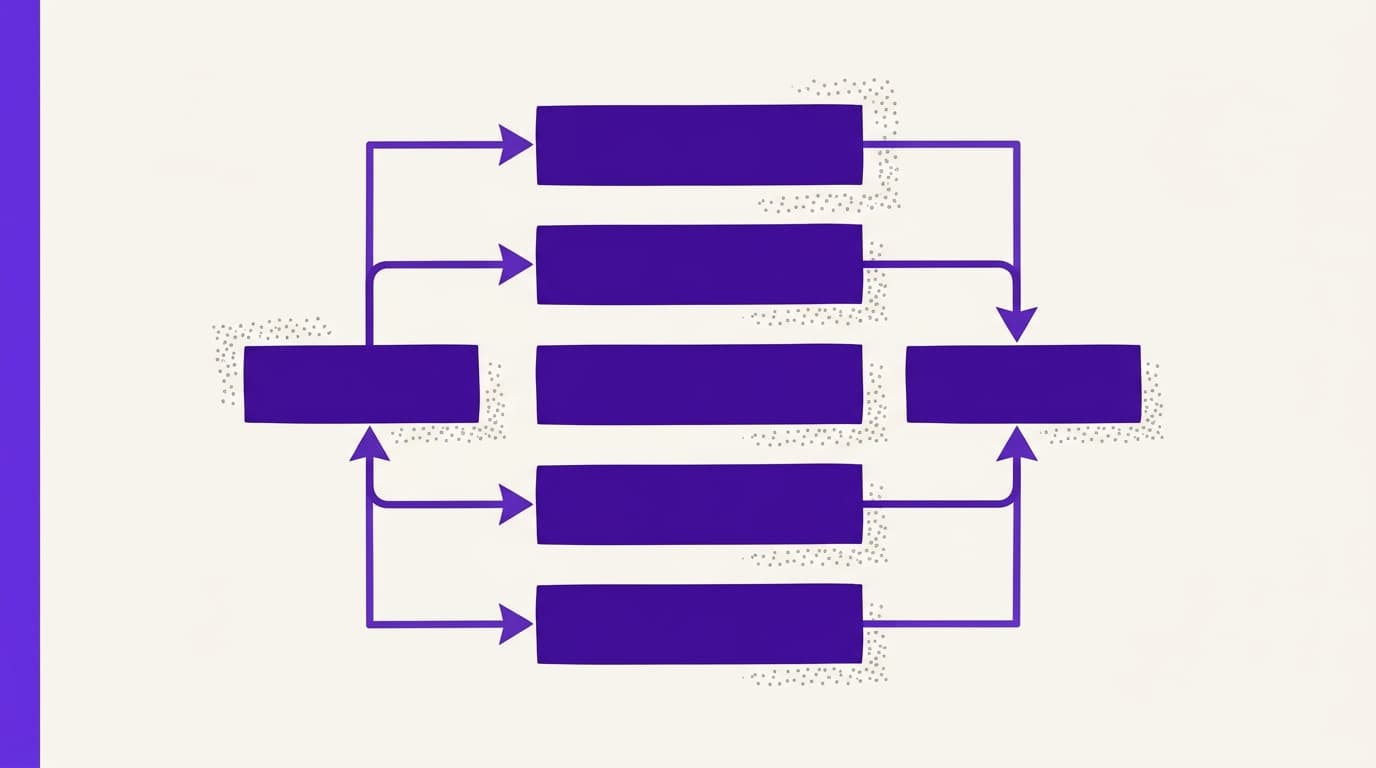
The path to getting AI right is a structured one, starting with the right tools and ending with a team that knows how to use them.
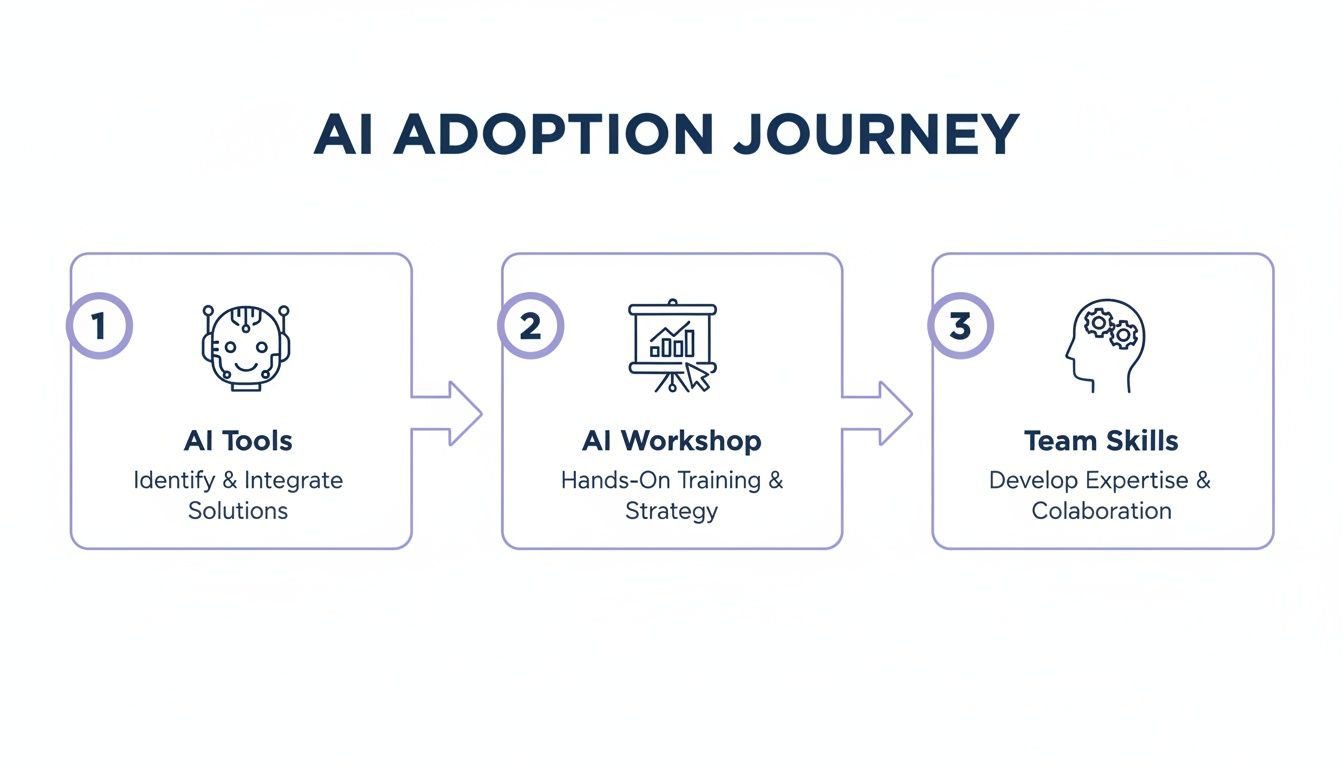
This isn’t just about handing people new software; it's about building genuine skills through hands-on workshops. That’s how you get true, company-wide adoption.
Step 1: Discovery and Audit
First things first: we have to find the biggest opportunities. We start by taking a deep dive into your current workflows to pinpoint exactly where automation will make the most impact. This isn't about chasing buzzwords; it's about finding the real-world bottlenecks that are slowing you down.
For instance, we might find that your sales team is spending 40% of their time just on manual data entry and follow-ups. That’s an immediate red flag and a perfect candidate for an AI agent that can handle those repetitive tasks, freeing up your experts to do what they do best: close deals.
Step 2: Strategy and Roadmap
Once we know where to aim, we design the solution. This means creating a detailed technical roadmap that lays out precisely how the AI will integrate with your existing tech stack. We map out every connection, data flow, and security protocol to ensure deployment is seamless and secure.
This is also where we figure out the people part of the equation. Do we need to bring in specialized engineers through AI team augmentation to get it done faster? Or can your internal team lead the charge with support from our targeted AI workshops? We make that call together.
A solid strategy is your blueprint for success. It connects the technical build to your business goals and gets everyone, from developers to stakeholders, rowing in the same direction. This clarity is what separates a successful AI project from an expensive experiment.
Step 3: Implementation and Quality Assurance
With the roadmap in hand, our engineers get to work building production-grade AI agents and workflows. This is where the strategy becomes reality. We use a mix of custom code and powerful automation platforms to build solutions that are robust, scalable, and designed to run 24/7 with little to no hand-holding.
Of course, rigorous testing is non-negotiable. Every single component is put through its paces with extensive quality assurance (QA) to squash any bugs before they see the light of day. We simulate real-world scenarios to guarantee the AI performs exactly as expected, delivering accurate, reliable results every time. This is how you build trust and get your team on board.
Step 4: Optimization and Scaling
Launching an AI solution isn’t the finish line; it’s the starting gun. After deployment, we shift into a continuous cycle of monitoring, optimizing, and scaling. We keep a close eye on key performance metrics to measure the solution’s impact and find ways to make it even better.
This ongoing support ensures your AI investment keeps paying dividends for the long haul. As your business evolves, we can scale the solution, add new features, or even roll out similar agents to other departments. This final step turns a one-off project into a sustainable engine for growth, ensuring your AI adapts and improves right alongside your business.
Measuring the Real ROI of Enterprise AI
So, how do you actually measure the financial kickback from an AI investment? It’s a make-or-break question for any founder or CTO. We need to cut through the fluff and focus on the hard metrics that really matter to your bottom line.
The real return on investment (ROI) isn't some vague promise of "efficiency." It's a tangible, calculable figure.
Calculating this value means looking at every corner of your business. It’s about tracking direct cost savings from automated workflows, seeing revenue climb thanks to AI-powered marketing, and watching operational overhead shrink. The real magic happens when expert-led deployment moves your AI solutions for enterprise out of the pilot phase and into full, daily production.
This is the shift that delivers lasting value, letting your business scale aggressively without having to scale your headcount at the same rate. It’s about building a leaner, more powerful organization from the inside out.
AI is No Longer Optional: It's a Competitive Necessity
The market is more than shifting; it's stampeding. AI has moved from a "nice-to-have" novelty to a fundamental competitive tool. In 2025, enterprises are projected to pour a staggering $37 billion into generative AI solutions.
That's a massive 3.2x jump from the $11.5 billion spent in 2024. The urgency is real: deals for AI solutions are now converting at nearly double the rate of traditional software as leaders scramble to automate.
But simply throwing money at the problem isn't enough. Here’s the reality check: only 31% of AI use cases actually made it to full production in 2025. While that’s double the previous year, it reveals a massive gap. Without expert deployment, most AI initiatives fizzle out before they can deliver any real value. You can dig into these enterprise AI spending patterns from Menlo Ventures for a closer look.
Key Metrics for Tracking AI-Driven ROI
To prove your AI investment is paying off, you need to track the right key performance indicators (KPIs). These metrics give you a clear, data-backed story of how AI is impacting your business.
Here are a few essential areas to watch:
- Cost Reduction: Look for direct savings. Track the drop in labor hours for repetitive tasks, lower software subscription costs, and reduced operational expenses in departments like customer support or finance.
- Productivity Gains: Measure the increase in output. Are your marketing teams producing content faster? Is your dev team’s code commit frequency up? Are sales reps processing more leads?
- Revenue Growth: Connect new revenue directly to AI initiatives. This could be improved lead qualification from an AI agent, higher conversion rates from personalized marketing, or an increase in customer lifetime value.
True ROI is a blend of hard savings and strategic gains. While cutting costs provides an immediate win, the ability to scale operations and innovate faster is where AI delivers its greatest long-term value.
Ultimately, tracking these numbers builds an undeniable business case for further investment. It proves that AI solutions for enterprise are more than a cost center but a powerful engine for sustainable growth.
A Comparative Look at Operational Costs
The financial impact really hits home when you put traditional workflows side-by-side with their AI-augmented counterparts. The right AI solution doesn’t just make a process a little better; it fundamentally rewires the cost structure and the time it takes to get work done. For a deeper look, check out our guide on how to measure operational efficiency.
To make this crystal clear, we've broken down the cost and efficiency gains across a few common business functions. The table below shows just how stark the difference can be.
Cost and Efficiency Traditional vs AI-Augmented Operations
| Operational Area | Traditional Approach (Cost/Time) | AI-Augmented Approach (Cost/Time) | Potential ROI/Savings |
|---|---|---|---|
| Lead Qualification | 15 minutes per lead (Manual) | <1 minute per lead (Automated) | 90%+ reduction in time, increased sales capacity |
| Content Creation | 8-10 hours per article (Human) | 2-3 hours per article (AI-assisted) | 70%+ faster production, higher content volume |
| Customer Support | $15 per support ticket (Agent) | $1 per support ticket (Chatbot) | Significant cost savings and 24/7 availability |
This table gets to the heart of what enterprise AI is all about. It’s not about incremental improvements. It’s about achieving dramatic leaps in speed and cost-effectiveness, freeing up your team to focus on the high-impact, strategic work that truly drives the business forward.
Common Questions About Enterprise AI Solutions
When you start looking seriously at AI for your business, the questions come thick and fast. It's completely normal. Moving from "this sounds interesting" to actually writing checks and rolling out a solution requires real clarity and confidence.
We get these questions all the time from CTOs, founders, and ops leaders. Let's tackle them head-on and clear up the most common hurdles.
How Can We Secure AI Solutions in Our Enterprise?
Security is more than a feature; it's the foundation. The only way to do this right is with secure, self-hosted AI solutions built from the ground up for sensitive company data. Anything less is a non-starter.
This starts with a deep security audit during the discovery phase, long before a single line of code is written. We need to find and plug any potential holes right from the beginning. The goal is to weave the AI into your existing Identity and Access Management (IAM) systems. By using custom-coded integrations with platforms like n8n, we can keep a tight grip on exactly how data moves, ensuring your most sensitive information never, ever leaves your private infrastructure.
The golden rule is this: security is day one, not a day-two patch. When you work with people who cut their teeth in highly secure environments, like ex-IBM architects, you’re building your AI on a bedrock of trust and compliance from the very start.
What Is the Difference Between AI Team Augmentation and Outsourcing?
The difference is huge, and it comes down to one thing: integration versus isolation.
Classic outsourcing is like hiring a mercenary team. You hand over a project, they go into a black box, and (hopefully) they come back with the finished product. The problem? Communication is a nightmare, they don't really understand your business, and when the project is over, all that knowledge and expertise walks right out the door. You're left with a solution you might not know how to maintain or improve.
AI team augmentation is the complete opposite. It's a deeply collaborative partnership. We embed our expert AI engineers directly into your teams. They sit in your meetings, work in your codebases, and solve problems side-by-side with your people.
It’s a model designed to build your company’s long-term muscle. You get the solution built right, and your team gets a masterclass in how to run, scale, and build upon it for years to come. It’s about creating a lasting advantage, not ticking a project off a list alone.
How Do AI Workshops Overcome Team Skepticism?
Skepticism almost always melts away when people see AI solving their problems, right in front of them. Most AI training is generic theory. That doesn't work. Good workshops get hands-on with the exact tools and challenges your team faces every single day.
For example, a workshop on an AI coding assistant like Cursor isn't a sales pitch. It’s a session where your developers use it to fix real bugs from their current sprint. When we teach them to use a tool like Claude for code generation, we show them how to tackle a complex feature they’ve been stuck on. And when it comes to rolling out AI across the board, it's vital to cover the legal and data side of things, which is where something like a practical AI GDPR compliance guide becomes essential.
The "aha!" moment happens when they see the tangible results, when they write, debug, and refactor code in a fraction of the time. Suddenly, they're not being forced to adopt something; they're asking for it. The skepticism vanishes, replaced by genuine excitement.
How Quickly Can We See a Return on Our AI Investment?
The timeline for ROI always depends on the project, but you’d be surprised how fast you can see a real return. High-impact automations, especially for repetitive tasks, can start paying for themselves almost immediately.
Think about automating routine customer support tickets or the mind-numbing work of qualifying sales leads. These kinds of projects can free up your team and cut costs within the first quarter.
That's why a smart partner always starts with a thorough automation audit. The first step is to pinpoint these "quick wins." This lets us build a roadmap that balances your big, long-term strategic goals with initial projects that deliver an immediate, undeniable ROI. It's the best way to build momentum, get everyone on board, and prove the value of AI from day one.
Ready to stop asking questions and start getting answers? For a view of how enterprise automation looks at scale, enterprise automation solutions covers the patterns that scale. How to automate business processes is a practical implementation guide. And best AI agent development agencies helps you evaluate partners before committing.
AY Automate builds custom AI solutions that actually work, delivering results you can measure. We use a mix of AI-adopted engineer placements, team augmentation, and targeted workshops to solve your biggest headaches while making your own team smarter.
Book your free automation audit today and let's find your biggest opportunities.
Continue Reading
What Is Hyperautomation in 2026? (Definition, Stack, and the Honest ROI)
Hyperautomation in 2026: RPA combined with AI agents. What frontier models changed, where it delivers ROI, and when plain automation is the right answer.
AI Agents for Business in 2026: Real Use Cases, Cost, and How to Pick the Right One
Updated June 2026. "AI agents for business" went from buzzword to real category between 2024 and 2026.
Custom AI Agent Development in 2026: The Honest Buyer's Guide
Updated June 2026. Two years ago, "AI agent development" meant a chatbot with extra steps.
Book a Free Strategy Call
Building this in production?
Walid runs a 30-min call to map your AI engineering team. Free, no slides.
Free weekly brief
Steal our production automations
The exact n8n flows, Claude Code setups, and prompts we ship for clients, broken down step by step. No spam, unsubscribe anytime.

Robel engineers production-grade automation pipelines at AY Automate, focused on integrations, reliability, and the systems that keep client workflows running.