Book a Free Strategy Call
Skip the read: talk to Walid in 30 min.
Free strategy call. We map your AI engineering team, you keep the notes.
AI automation for business combines AI models with workflow tools. The AI (Claude, GPT-4o, or a fine-tuned model) handles the judgment: reading an email, classifying a document, drafting a response. The workflow platform (n8n, Make, or Zapier) handles the routing: trigger on an event, pass data to the model, act on the output. Together they cover cases that traditional automation could not: unstructured text, edge cases, and inputs that weren't anticipated when the workflow was built.
The clearest sign you need AI in your automation is when your rules keep breaking. If you are maintaining a 200-condition switch statement to classify support tickets, that is a job for a language model, not a flowchart.
This guide covers the main patterns for AI automation in business, the tools that make it possible, and practical starting points for teams that want results before the end of the quarter.
What Is AI Automation in Business, Really?

At its heart, AI automation is the marriage of two powerful ideas. You have traditional automation, which is great at following a strict set of rules, and then you have artificial intelligence, which can learn, adapt, and make judgments.
Think of it like the difference between a simple calculator and a seasoned financial analyst. The calculator just crunches the numbers you give it. The analyst, on the other hand, interprets the data, spots trends, and offers actual insights. Blending these two creates systems that are efficient and truly intelligent.
This "digital workforce" isn't one single thing; it’s built from a few key components. Workflow automation platforms like Make or n8n are the central nervous system, connecting your apps and telling them what to do. Large Language Models (LLMs) like GPT or Claude provide the brainpower, understanding language and generating human-like text. And finally, specialized AI agents act as your autonomous employees, capable of tackling complex, multi-step jobs all on their own.
The Human Side of AI Adoption
Getting AI right is less about the tech and more about your people. A successful implementation hinges on equipping your human team, not deploying a new tool alone. That means making smart decisions about how you build up your internal skills for the long haul.
One of the most effective ways to do this is with AI team augmentation. This is where you embed a highly-skilled engineer who lives and breathes AI directly into your existing teams. They’re more than there to do a job; they act as a catalyst, speeding up your projects while transferring critical, hands-on knowledge to your own staff. It's a "show, don't tell" approach to leveling up.
This is about building a self-sufficient, AI-literate organization. You're shifting from simply outsourcing a task to cultivating an internal powerhouse that can drive its own AI initiatives forward.
Upskilling Through Practical Training
Beyond bringing in an expert, you need to get your whole team speaking the language of AI. Generic online courses are a start, but they often miss the mark because they aren't tied to what your team actually does every day. Targeted, practical workshops are where the real learning happens.
The best AI workshops focus on the tools your developers will be using day-in and day-out. This includes:
- Advanced AI Coding Assistants: Training on tools like Cursor helps developers write, debug, and refactor code with an AI partner, which can dramatically boost their output and the quality of their work.
- AI Collaboration Platforms: Workshops on systems like Weavy.ai teach teams how to weave AI-powered collaborative features directly into the products they’re already building.
- Applied LLM Integration: Hands-on sessions with models like Claude show engineers how to properly prompt, fine-tune, and integrate these powerful language tools for specific, real-world business problems.
By focusing on these practical skills (from team augmentation to hands-on workshops), you stop just using AI and start making it part of your company's DNA. It becomes a genuine competitive advantage.
Related Reads
How AI Delivers a Real Strategic Advantage
Let's move past the buzzwords. The true value of AI automation for business isn't some far-off concept; it’s about the concrete results you can see and measure. Bringing these intelligent systems into your company is more than a tech upgrade; it’s a fundamental shift that gives you a serious strategic edge.
We’re seeing companies use this technology to slash operational costs, sometimes by as much as 60%, and win back thousands of hours that were previously sucked up by manual, repetitive work. It’s about turning core functions (sales, marketing, finance, operations) into hyper-efficient, data-driven engines for growth.
Instead of just hiring more people to handle a bigger workload, you can scale your output exponentially. This frees up your best people to focus on the high-level thinking and strategic work that actually moves the needle. This isn't science fiction; it's happening right now, creating a clear gap between the businesses that get on board and those that get left behind.
Real-World Use Cases and Clear ROI
To really get a feel for the power of AI automation, you have to look at how it works in the real world. These are more than theories; they're proven applications delivering a substantial return on investment for businesses today.
Take sales, for example. Custom AI agents can now run entire sales development processes on their own.
Imagine an AI that not only finds promising leads from different sources but also qualifies them, reaches out with personalized messages, and books meetings straight into your sales rep’s calendar. That frees up your sales team to do what they do best: build relationships and close deals. We dive deep into how these systems work in our complete guide to AI agents for business.
Now think about a headache like financial reporting. AI-powered workflows can completely overhaul this process by:
- Automating Data Aggregation: Pulling financial data from all your different platforms (your bank, CRM, accounting software) into one clean dashboard.
- Generating Insightful Reports: Analyzing all that data to create cash flow statements, P&L reports, and even predictive forecasts without anyone lifting a finger.
- Ensuring Compliance: Automatically flagging oddities or potential compliance issues in real-time, cutting down the risk of expensive human errors.
By automating these critical but mind-numbing tasks, you're more than improving accuracy. You’re giving your leadership team instant access to the financial intelligence they need to make smarter decisions, faster.
Gaining an Edge with Secure Self-Hosted LLMs
For a lot of companies, especially those in regulated industries or with sensitive IP, data security is everything. This is where self-hosted Large Language Models (LLMs) offer a massive advantage. Cloud-based models are great, but sending your company’s private data to a third-party server is a risk many can't afford to take.
When you deploy an LLM inside your own secure infrastructure, you get total control over your data. This model becomes your private, in-house "brain" that can be fine-tuned on your company’s specific information, from internal playbooks to customer chat logs. The result is an AI that gets your business on a deep level and operates with a level of security that public APIs just can't touch. For any founder or CTO serious about data sovereignty, this is the only way to go.
The momentum here is impossible to ignore. The latest numbers show that enterprise AI adoption is now mainstream, with 87% of large enterprises rolling out AI solutions. It's more than the big players, either; mid-market companies report 75% adoption.
On average, businesses are seeing 34% gains in operational efficiency and 27% cost reductions within just 18 months. These aren't small wins; they're proof that AI automation is critical for survival in this market. You can dig into more of these AI adoption statistics and see the impact for yourself. For a fuller, sourced picture, see our AI automation statistics for 2026, 50 verified numbers on adoption, ROI, and spend. The strategic advantage AI offers is no longer a secret; it’s a requirement.
Free weekly brief
Steal our production automations
The exact n8n flows, Claude Code setups, and prompts we ship for clients, broken down step by step. No spam, unsubscribe anytime.
Building Your AI Automation Tech Stack
Choosing the right technology for your AI automation strategy is like assembling a high-performance team. You need a strong central nervous system to coordinate everything and a powerful brain to handle the complex thinking.
Get these two components right, and you’ve built a foundation for some serious operational scale. For founders and CTOs, the decisions you make here will shape everything that follows. The goal is to pick tools that not only solve today’s problems but can also grow with you, fitting into your existing setup without creating a mess of complexity or security risks.
The Central Nervous System: Low-Code Platforms
Think of low-code automation platforms as the operational backbone of your business. Tools like n8n and Make act as the central nervous system, connecting all your separate apps (your CRM, your marketing tools, your financial software) into a single, cohesive workflow.
These platforms let you visually design and build automated processes, no deep coding knowledge required. This is how you automate day-to-day tasks like syncing customer data between sales and support, or automatically pulling reports from multiple sources. For any business looking to get automation up and running quickly, these tools provide the essential glue to make it all work together. They can even handle more complex jobs like data extraction, a process we break down in our guide on how to automate data entry.
The flowchart below shows just how directly AI automation can drive core business goals like cost reduction and efficiency gains.
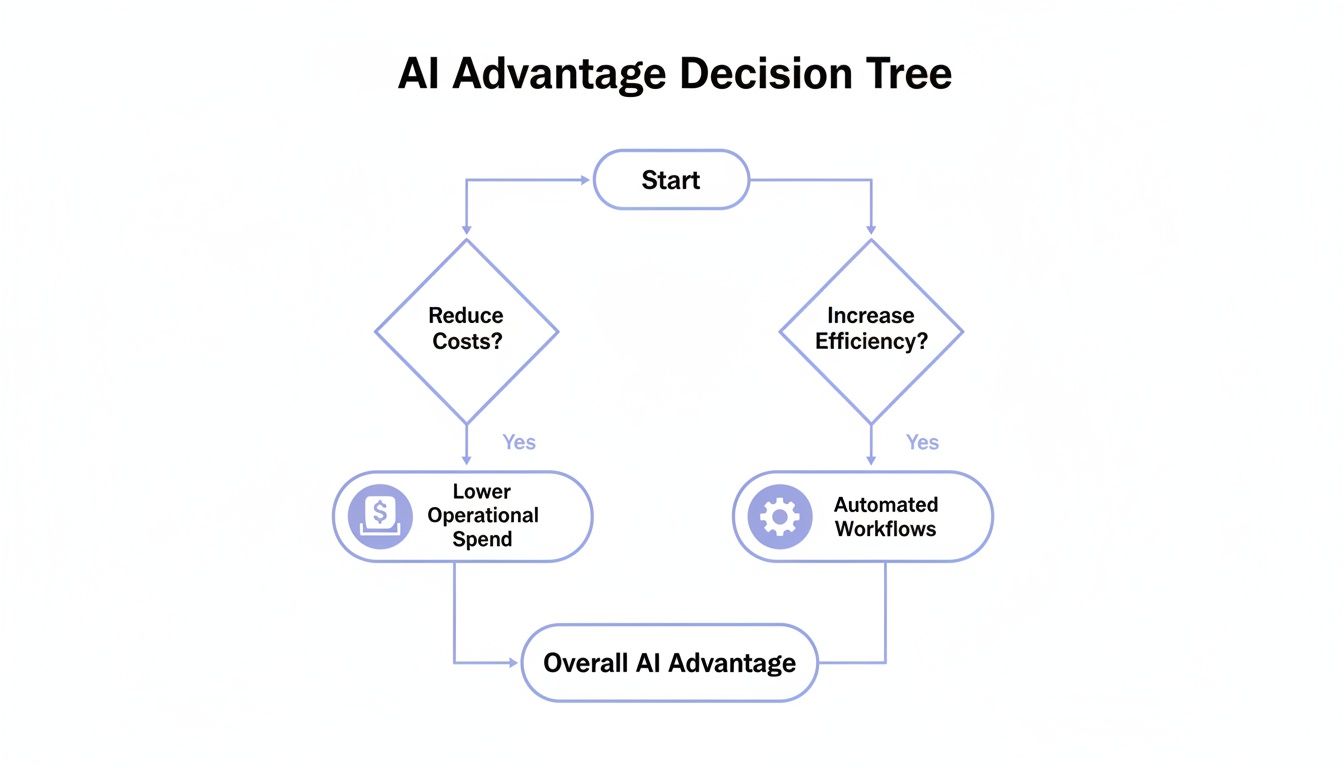
As you can see, whether your immediate goal is to slash costs or to get more done with the team you have, AI provides a clear path to a real strategic advantage.
The Brain: Large Language Models
If low-code platforms are the nervous system, then Large Language Models (LLMs) are the brain. These are the AI models like OpenAI's GPT series, Google's Gemini, and Anthropic's Claude that provide the raw cognitive power for understanding language, making decisions, and generating content.
Your choice here really comes down to two main paths: using a cloud-based API or deploying a self-hosted model.
-
Cloud APIs: These are the "plug-and-play" option. They’re easy to access and integrate, offering incredibly powerful, pre-trained models on a pay-as-you-go basis. They are perfect for startups and teams that need to move fast and test ideas without a huge upfront investment in servers and hardware.
-
Self-Hosted Models: For businesses with strict data security requirements or highly specialized needs, hosting an LLM on your own servers gives you maximum control and privacy. Your sensitive data never leaves your environment, and you can fine-tune the model exclusively on your proprietary information for a unique competitive edge that no one else can replicate.
The adoption rates tell the story of how important this decision has become. Business AI adoption has already hit 46.6% across companies of all sizes. Digging deeper, 36.8% of businesses are using OpenAI and 16.7% are using Anthropic, according to a recent economic lab analysis. This extends beyond chatbots; AI is being embedded into finance, sales, and operations, areas where judgment and speed directly impact the bottom line.
The right combination of a solid automation platform and a powerful LLM creates a tech stack capable of executing tasks and of thinking, adapting, and driving intelligent business outcomes around the clock.
An Actionable Roadmap to AI Implementation
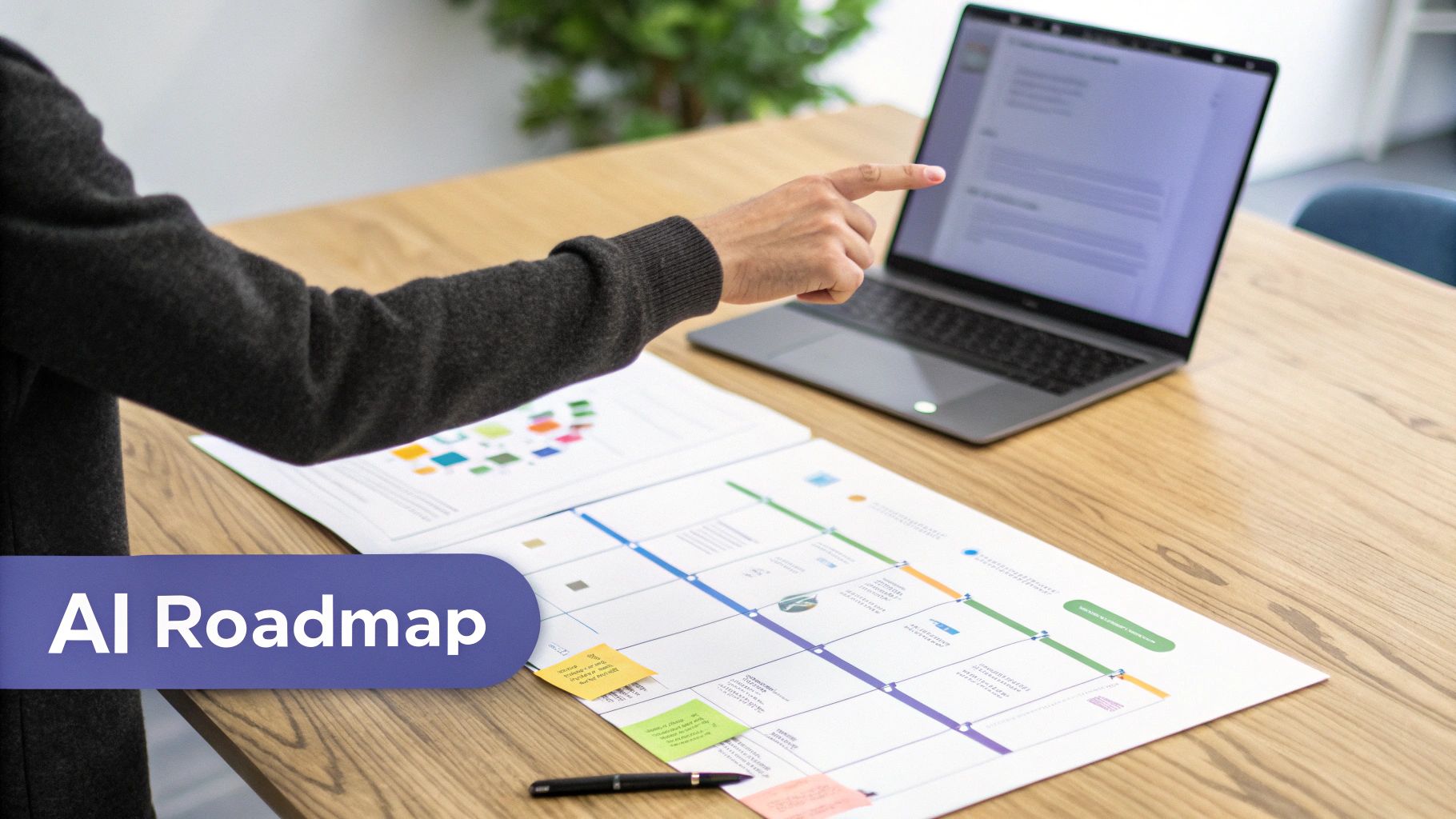
Jumping from a cool idea to a fully working AI system doesn't happen by accident. You need a clear, structured plan. Without a solid roadmap, even the most exciting AI automation for business projects can fizzle out, leaving you with wasted time and missed chances.
The trick is to be methodical. You want each step to build on the last, taking you from a rough concept all the way to a real, measurable impact on your business. This four-phase approach takes out the guesswork and gives you a clear path to getting it right. It’s all about making sure the tech we build directly serves your business goals.
Phase 1: Audit and Discovery
First things first, we need to pop the hood and see how your business really runs. The whole point of the Audit and Discovery phase is to pinpoint exactly which processes are crying out for automation. We’re more than looking for any old task; we’re hunting for the big wins that will give you the best bang for your buck.
We’ll dig into workflows across your entire company: sales, marketing, operations, you name it. The goal is to find the biggest bottlenecks and the most mind-numbing, repetitive tasks that are eating up your team's time. By mapping out how work gets done now, we can put a real number on the cost of inefficiency. What comes out of this is a clear, prioritized list of automation opportunities, ranked by their power to boost efficiency and slash costs.
Phase 2: Strategy and Design
Once we know what to automate, it’s time to figure out how. In the Strategy and Design phase, we turn our findings from the audit into a concrete technical game plan that’s built around your specific goals. This is where we architect the solution and pick the perfect tools for the job.
This strategic blueprint lays out everything:
- Technology Selection: We'll choose the right mix of platforms like n8n or Make, LLMs like GPT-4 or Claude, and any custom code needed to tie it all together.
- Workflow Architecture: This involves designing the logic of the new automated processes. We make sure they plug cleanly into the systems you already use, so there’s no disruption.
- Success Metrics: We’ll define clear Key Performance Indicators (KPIs) to track success. This could be anything from cost savings and hours reclaimed to higher lead conversion rates.
This phase makes sure the final solution isn’t just a cool piece of tech, but a tool perfectly shaped to deliver the business results you’re after.
Phase 3: Implementation and Deployment
With a solid plan locked in, it’s time to build. The Implementation and Deployment phase is where we bring the designs to life, turning them into a production-ready AI solution. Our team of certified experts gets to work building, testing, and rolling out the automated workflows and AI agents.
This is the hands-on part. We're configuring platforms, writing code, and putting every single component through its paces to make sure it runs like a clock in the real world. We’re serious about quality assurance because we want the solution to be secure, stable, and ready to handle your workload from day one. To see how these systems come together, check out our guide on workflow automation for small business.
This isn't a "set it and forget it" process. A successful deployment is the beginning of a continuous improvement cycle, where the system is built to evolve and adapt alongside your business.
Phase 4: Monitor and Optimize
The job isn’t done when the system goes live; in fact, it’s just getting started. The final phase, Monitor and Optimize, is all about making sure you get every bit of value out of your investment. We keep a close eye on how the AI automation is performing against the KPIs we set back in the strategy phase.
This means we're constantly watching system health, digging into performance data, and looking for ways to make things even better. As your business evolves, we’ll tweak and enhance the automations to keep them perfectly in sync with your goals. This ongoing optimization cycle is what turns your AI systems from a one-time project into a long-term asset that keeps driving growth and efficiency.
Upskilling Your Team for the AI Era
Look, implementing a powerful new technology stack is only half the battle. The real, lasting success of any AI automation for business strategy comes down to your people.
Without a skilled team to manage, scale, and innovate with it, that fancy tech is just an expensive tool sitting on a shelf. Equipping your team is what turns a one-off project into a core competitive advantage that pays dividends for years.
This is exactly where many companies stumble. They get so caught up in the systems they forget about the people who have to run them day in and day out. The goal is more than to deploy AI; it's to build a culture of innovation from within, creating a team that's comfortable with AI and fluent in it.
This takes more than just sending out a few training videos. You need a deliberate, hands-on approach to building real internal capabilities. Let's dig into the most effective ways to get your team ready for this new way of working.
Accelerate Progress with AI Team Augmentation
One of the fastest ways to jumpstart your AI initiatives is through AI team augmentation. This involves strategic AI-adopted engineer placements where you embed a highly skilled AI expert directly into your team. Think of it as bringing in a seasoned specialist who doesn't just build your systems, but also acts as a mentor and guide for your own people.
It’s a powerful alternative to traditional hiring or outsourcing. Instead of just handing a project off to an external team and hoping for the best, you bring the expertise in-house. This expert works side-by-side with your engineers and project managers, transferring critical knowledge in real time.
The benefits here are massive:
- Rapid Knowledge Transfer: Your team learns by doing. They absorb best practices and advanced techniques directly from a pro who is working on your specific projects.
- Project Acceleration: With an expert leading the charge, you can navigate complex challenges and get to production-grade solutions much, much faster.
- Reduced Risk: You sidestep the common pitfalls because you have someone on your team who has already seen and solved these problems before.
Team augmentation is all about building sustainable, long-term capability. It's an investment in your people that pays off long after the specialist’s placement ends, leaving you with a team that is more confident and self-sufficient in AI.
Building Internal Experts Through Targeted AI Workshops
Beyond embedding specialists, you need to build a broad base of AI literacy across your development teams. Generic, theory-based training often falls flat because it isn’t connected to the actual challenges your developers face every day.
The most impactful learning comes from practical, hands-on workshops focused on the specific tools they will be using to build, deploy, and maintain your new AI systems. These workshops should be designed to turn your existing talent into an AI-powered force, not bore them with academic concepts.
Practical Workshops for Modern Dev Teams
Effective training zeroes in on the tools that give you the biggest bang for your buck. A well-designed workshop series will provide deep dives into a few areas that pay off most.
First up, training on AI-native code editors like Cursor is fundamental. These tools act as a collaborative partner for developers, helping them write, debug, and refactor code with AI assistance. A workshop on Cursor would teach your team how to use its features to speed up development cycles and improve code quality, making them dramatically more efficient.
Second, workshops covering AI collaboration platforms like Weavy.ai are essential for your product teams. These sessions show them how to integrate AI-powered features (like smart chat or content moderation) directly into your own applications. This lets your developers to build more engaging and intelligent products without having to reinvent the wheel.
Finally, you need practical sessions on integrating and prompting advanced Large Language Models like Claude. These workshops have to go beyond basic API calls. They need to teach your engineers how to craft effective prompts, fine-tune models for your specific use cases, and handle the outputs reliably. Mastering these skills is what separates a generic AI integration from a truly intelligent business solution.
By focusing on these practical strategies (from strategic engineer placements to targeted workshops on tools like Cursor and Claude), you create a resilient, adaptable team. You're more than implementing AI automation for business; you're building an organization that can actually lead and innovate in the AI era.
So, How Do You Find the Right AI Partner?
Finding that partner is easier with a side-by-side view; our ranked comparison of AI automation agencies covers pricing, specialties, and where each one fits.
Let's be honest: executing a real AI automation strategy is about more than just plugging in a new tool. It demands a very specific kind of expertise. Without the right people in your corner, even the most exciting AI projects can fizzle out, never delivering that ROI you were promised.
Think of an experienced partner as your guide through this new territory. They’ve walked this path before and know how to handle the complexities, so your investment turns into actual, measurable growth. Their job is to bring the strategic oversight and technical chops needed to build solid, scalable solutions that genuinely fit your business goals.
A true partner does a lot more than just ship code and send an invoice. They work with you to build up your own internal skills, making sure your team can confidently manage and innovate with AI long after the initial project is done. This usually happens through a mix of hands-on support and focused training.
It's About Building Your In-House Muscle
One of the smartest ways to do this is through AI team augmentation. This isn't about bringing in temporary contractors to fill a seat. It’s about the strategic placement of AI-adopted engineers directly into your organization. They become part of your team, working on your projects side-by-side with your people, transferring critical knowledge every single day. It’s a powerful way to accelerate your roadmap while building a self-sustaining AI practice from the inside out.
But you also need focused training to complement that on-the-job learning. A great partner will offer practical, hands-on AI workshops designed specifically for your dev teams, teaching them the exact tools they’ll need to win.
These sessions need to be all action, no fluff. We're talking about workshops centered on:
- AI-Native Coding Tools: Getting your developers fluent in platforms like Cursor so they can write, debug, and ship code way faster with AI assistance.
- Applied LLM Integration: Deep dives into powerful models like Claude, teaching your team how to craft the sophisticated prompts and build the reliable integrations your unique use cases demand.
- Collaborative AI Platforms: Hands-on training with systems like Weavy.ai that show your engineers how to embed intelligent, collaborative features right into the products your customers already use.
This combination of embedded engineers and targeted workshops is what turns your team into a genuine powerhouse. You’re more than buying a one-off service; you’re investing in your people and building a long-term competitive edge.
Choosing a partner who gets this, who prioritizes equipping your team, is the key to what AI automation can really do for your business. It's how you scale 10X without just throwing more people at the problem.
Your AI Automation Questions, Answered
What’s the difference between AI team augmentation and just hiring more engineers?
Think of AI team augmentation as bringing in a specialist: a seasoned pro who joins your crew to lead the charge on complex AI projects. It’s not about just filling a seat; it’s about strategically embedding an expert who can accelerate your roadmap and, just as importantly, teach your team how to fish.
The whole point is to build up your own internal muscle. These specialists work alongside your engineers, transferring critical knowledge and establishing best practices. Over time, your team becomes self-sufficient in AI, which is a far more scalable and sustainable strategy than simply adding to the payroll. It’s an investment in your company’s future capabilities.
How can we prepare our team to actually use these new AI tools?
Forget generic, one-size-fits-all training courses. They rarely stick. The key is to get your team into practical, hands-on AI workshops that focus on the exact tools they’ll be using every day to solve your company's specific problems.
Here’s what that looks like in the real world:
- AI-Native Code Editors: Instead of just talking about AI in coding, get your developers into a workshop for a tool like Cursor. They'll learn firsthand how to write, refactor, and debug code exponentially faster.
- Applied LLM Integration: Don’t just read the API docs. Run sessions where your engineers build real, working prototypes with a model like Claude. This is how they learn to build reliable, sophisticated AI features for your business.
- AI Collaboration Platforms: Get your team training on a system like Weavy.ai. This teaches them how to embed intelligent chat and collaboration features directly into the products your customers already use.
This focus on practical application is everything. It ensures your team doesn't just learn AI theory; they learn how to build with it. That’s how you turn your existing talent into a massive competitive advantage.
If this sounds like the right fit, our AI automation agency page covers scope, process, and how an engagement starts.
For related reading: best workflow automation platforms compares the tools that power business automation at scale; how to automate business processes covers the step-by-step implementation approach; and AI tools for business productivity reviews the platforms with the highest ROI in 2026.
Ready to build your digital workforce and scale your operations? AY Automate designs and deploys the custom AI solutions that drive real business growth. Book your free automation audit today.
Continue Reading
AI Agents for Business in 2026: Real Use Cases, Cost, and How to Pick the Right One
Updated June 2026. "AI agents for business" went from buzzword to real category between 2024 and 2026.
What Is Hyperautomation in 2026? (Definition, Stack, and the Honest ROI)
Hyperautomation in 2026: RPA combined with AI agents. What frontier models changed, where it delivers ROI, and when plain automation is the right answer.
Custom AI Agent Development in 2026: The Honest Buyer's Guide
Updated June 2026. Two years ago, "AI agent development" meant a chatbot with extra steps.
Book a Free Strategy Call
Building this in production?
Walid runs a 30-min call to map your AI engineering team. Free, no slides.
Free weekly brief
Steal our production automations
The exact n8n flows, Claude Code setups, and prompts we ship for clients, broken down step by step. No spam, unsubscribe anytime.

Robel engineers production-grade automation pipelines at AY Automate, focused on integrations, reliability, and the systems that keep client workflows running.