Book a Free Strategy Call
Skip the read: talk to Walid in 30 min.
Free strategy call. We map your AI engineering team, you keep the notes.
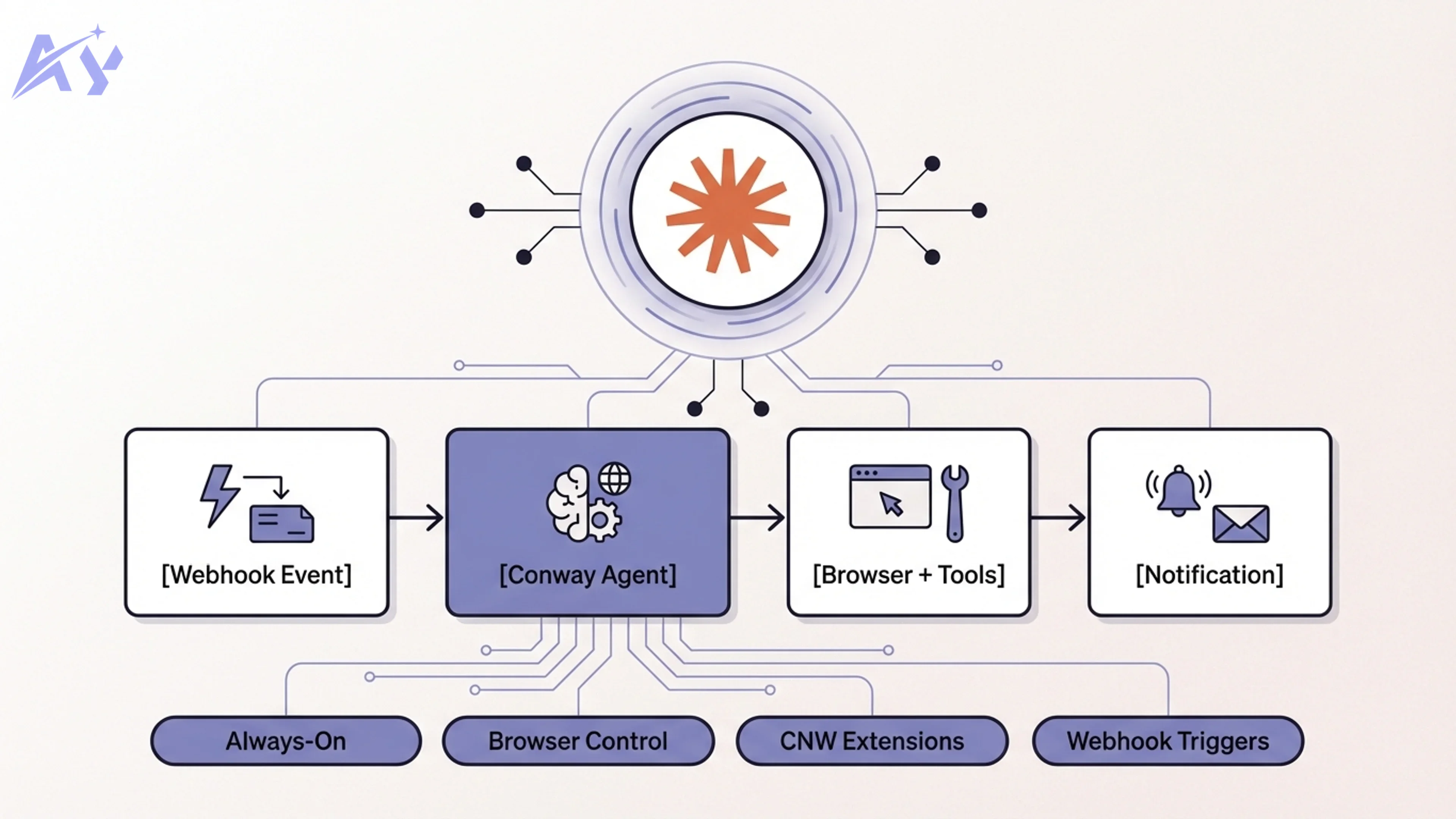
Anthropic has been quietly testing one of its most ambitious products yet: a persistent, always-on AI agent platform called Conway. First surfaced by TestingCatalog in early April 2026, Conway is not a new Claude model or a chatbot feature. It is a fundamentally different way of interacting with AI. Claude does not wait to be prompted, but operates continuously as a background agent that monitors, acts, and connects to your tools around the clock.
If Conway ships as described, it marks a decisive shift in how enterprise teams will deploy AI: from reactive assistants to proactive digital workers embedded directly in your stack.
Here is everything that has been confirmed so far, and what it means for businesses building on top of Claude.
What Is Anthropic Conway?
Conway is Anthropic's codename for a persistent agent environment built around Claude. Unlike the standard Claude.ai chat interface, Conway runs as a standalone instance: a dedicated workspace that stays active even when you are not in the tab.
The platform was surfaced through a combination of leaked source code (the April 2026 Claude Code npm leak) and direct discovery by AI researcher community TestingCatalog, who found Conway pages linked inside Anthropic's production infrastructure.
The name "Conway" is reportedly an internal Anthropic project name. Some sources have also referred to it under the codename "Lobster," though Conway appears to be the primary designation across leaked documentation.
What Makes It Different From Regular Claude?
Standard Claude operates on a request-response model: you send a message, Claude replies, and the session is stateless unless you continue in the same conversation thread. Conway breaks that model entirely.
| Feature | Standard Claude | Conway Agent |
|---|---|---|
| Operation mode | Request-response | Always-on, continuous |
| Session persistence | Per-conversation | Persistent across time |
| External triggers | User prompt only | Webhooks, events, scheduled |
| Browser control | Via Claude.ai artifacts | Direct native control |
| Extension support | None | CNW ZIP ecosystem |
| Code execution | Via Claude Code (manual) | Integrated, autonomous |
| Notification system | In-chat only | Push notifications |
The core shift is from reactive to proactive. Conway can be triggered by an external event, complete a multi-step task in the background, and notify you only when it needs input or has finished.
Conway's Core Architecture: Three Zones
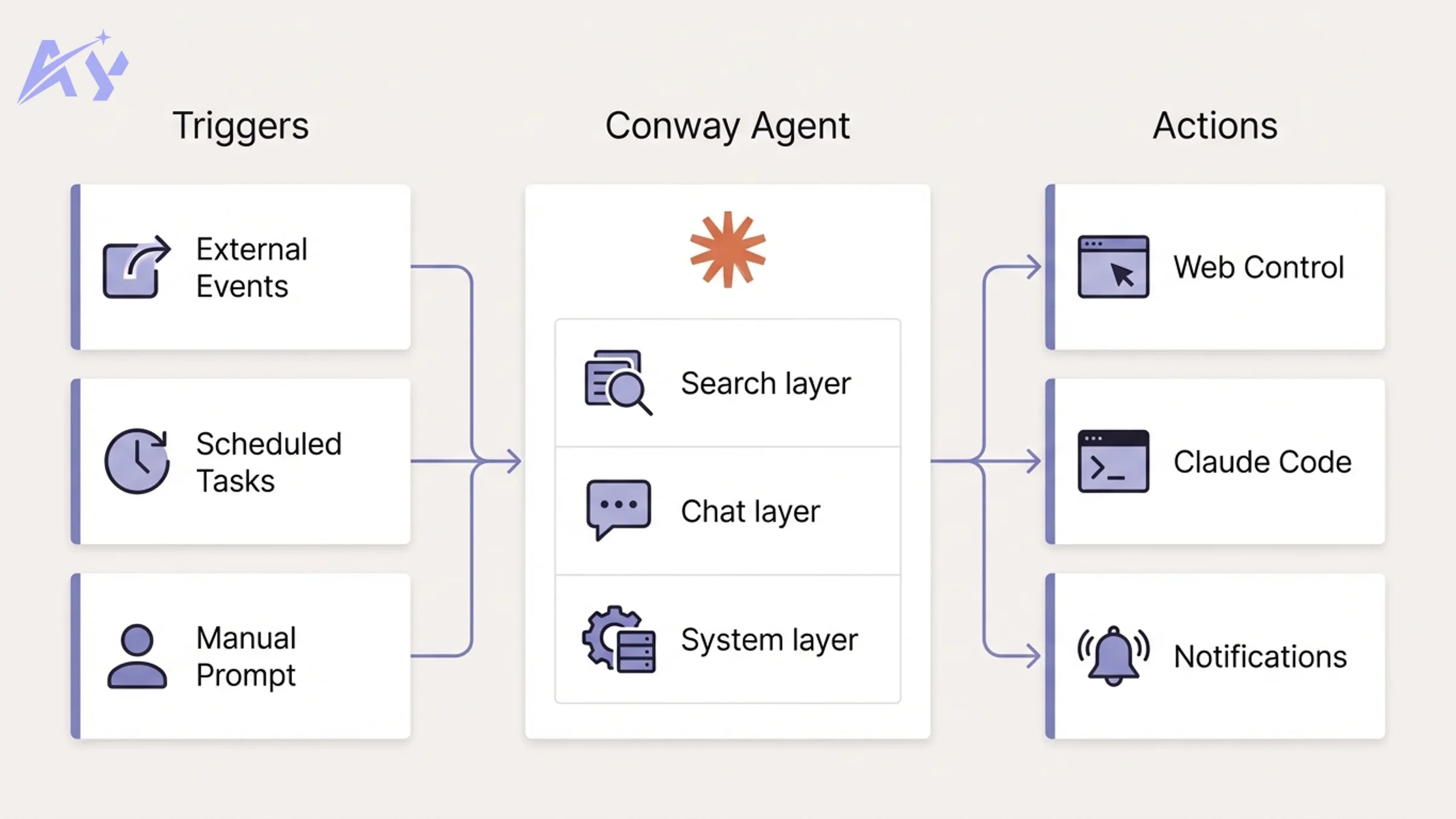
Based on leaked interface screenshots and technical descriptions, Conway's UI is organized into three primary zones:
1. Search
A knowledge and retrieval layer that gives the Conway instance access to internal documents, connected data sources, and web context. Think of this as the agent's memory and lookup system.
2. Chat
The conversational interface where users can direct the agent, review its activity log, and give high-level instructions. This is not a traditional chat. It operates more like a task management interface where you can see what the agent has done, is doing, and plans to do.
3. System
The configuration and control layer. This is where you connect tools, manage extensions, configure webhook endpoints, and define the agent's operating parameters. The "Manage your Conway instance" panel lives here.
Key Features Confirmed
Always-On Operation
Conway runs continuously, even without an active user session. This means it can:
- Monitor connected data sources for changes
- Execute scheduled tasks at defined intervals
- Respond to external events automatically
- Run long-horizon tasks that span hours or days
This is the core capability that separates Conway from every other Claude product. The agent is not a tool you use. It is a worker that runs alongside your team.
Browser Control
Conway can directly operate a browser, not through a restricted sandbox but with full navigation, form filling, and interaction capabilities. This enables autonomous web research, form submission, scraping structured data from live pages, and completing multi-step workflows that require UI interaction.
This positions Conway directly against products like OpenAI's Operator and Anthropic's own Claude Computer Use, but integrated natively into the persistent agent environment rather than as a one-off task.
Webhook-Based Invocation
One of the most technically significant features: Conway can be triggered by external services via webhooks. This means you can wire Conway into any event-driven system: a new Salesforce lead, a failed CI/CD build, a Slack message containing a keyword, a new row in a spreadsheet, and have the agent act automatically without any human initiating a prompt.
For engineering and operations teams, this is a big shift. Conway becomes an always-listening process in your architecture rather than a tool you open in a browser tab.
Claude Code Integration
Conway natively integrates with Claude Code (Anthropic's agentic coding environment), giving it access to:
- File system read/write
- Terminal command execution
- Git operations
- Code generation and testing workflows
The integration appears to be bidirectional: Conway can invoke Claude Code sub-agents, and Claude Code tasks can surface results back into the Conway interface.
If you are building or evaluating AI coding infrastructure, our AI agent development team can help you architect systems that use these capabilities today.
The CNW Extension Ecosystem
Perhaps the most strategically interesting feature in Conway is the CNW ZIP standard, Anthropic's upcoming extension format for the platform.
Under the "Manage your Conway instance" interface, there is an Extensions panel where users can install .cnw.zip files, packaged bundles that add:
- Custom tools: New capabilities or API integrations the agent can call
- UI tabs: Additional interface panels inside the Conway workspace
- Context handlers: Processors that shape what information the agent sees and how it reasons
This is Anthropic's app store play. If CNW ships as a public standard, third-party developers will be able to build and distribute Conway extensions, creating an ecosystem of specialized agent capabilities that plug into the base platform.
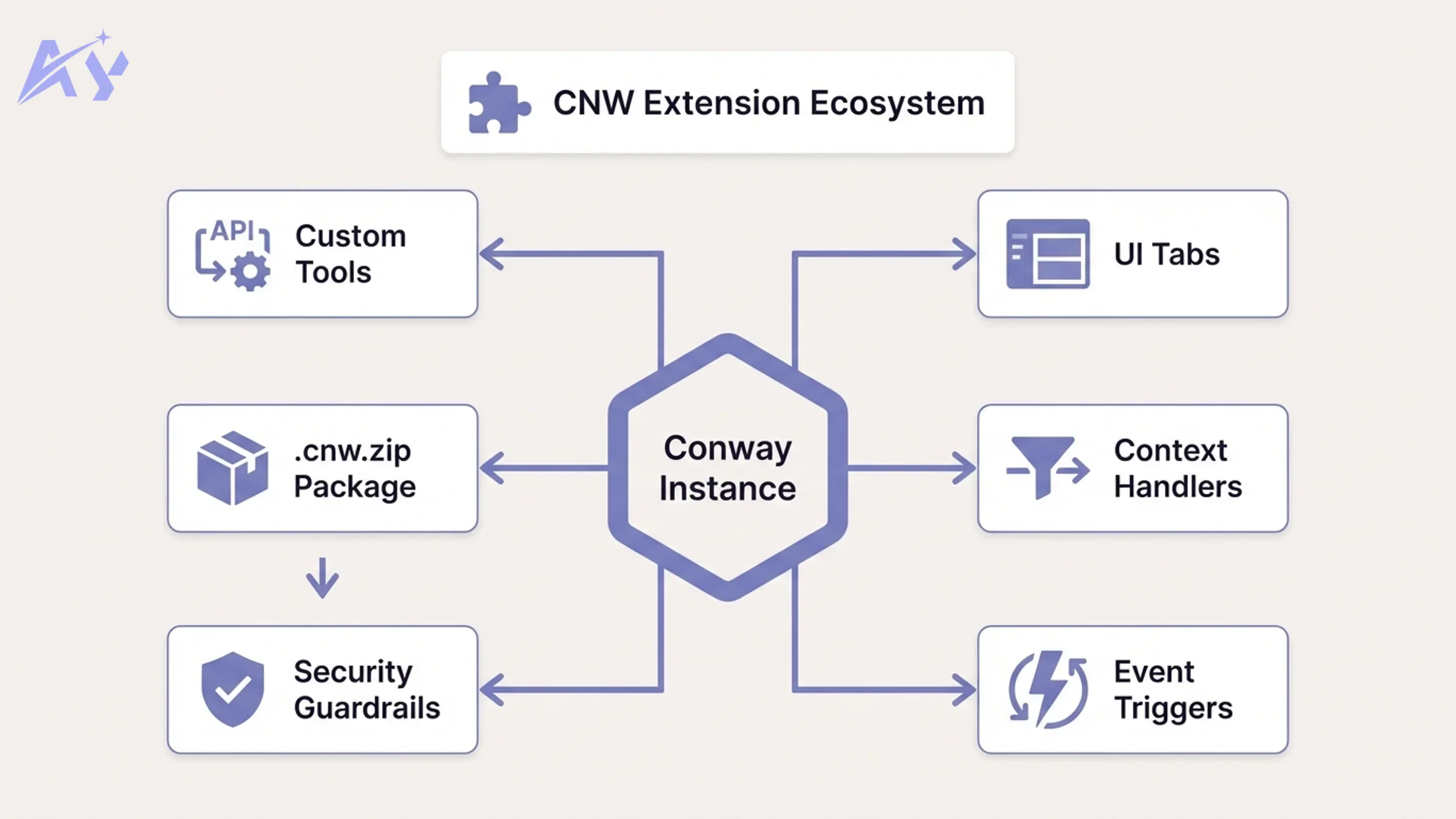
The parallel to Claude's existing MCP (Model Context Protocol) is deliberate but distinct. MCP standardizes how Claude connects to data sources and tools in agentic workflows. CNW standardizes how Conway's persistent environment is extended with new packaged capabilities: a higher-level abstraction built on top of MCP's foundation.
For teams already building custom workflow automation with Claude, the CNW standard will eventually provide a structured, distributable way to package those workflows as installable extensions.
Conway vs. Competing Always-On Agent Platforms
Conway enters a field that is already crowded at the enterprise end, with OpenAI, Google, and several startups racing toward persistent agent architectures.
| Platform | Vendor | Always-On | Extension Ecosystem | Browser Control | Webhook Triggers |
|---|---|---|---|---|---|
| Conway | Anthropic | Yes (confirmed) | CNW ZIP (pending) | Yes | Yes |
| Operator | OpenAI | Limited | No | Yes | No |
| Project Mariner | Google DeepMind | No | No | Yes | No |
| Devin | Cognition | Yes | No | Yes | Limited |
| Claude Code (current) | Anthropic | No | Via MCP | Limited | No |
Conway's combination of always-on operation, event-driven triggers, and an open extension standard is currently unique in the market. No competitor has announced all three together in a unified platform.
The closest parallel is Microsoft Copilot Studio, which supports workflow triggers and custom connectors, but Copilot Studio is a no-code workflow builder, not a reasoning agent that can autonomously plan and execute complex tasks.
What This Means for Enterprise AI Strategy
Conway is more than a product update. It signals where the competitive frontier in enterprise AI is moving: from AI that assists humans to AI that operates alongside humans as a persistent digital worker.
Here are the strategic implications:
Workflow automation will be restructured. Tasks currently handled by RPA tools, scheduled scripts, or human monitoring queues are all candidates for Conway-style agent delegation. Teams running custom n8n automation will want to evaluate which workflows can be upgraded to intelligent agents.
The integration surface expands dramatically. Webhook invocation means Conway becomes a node in your event-driven architecture. Engineering teams should start mapping which system events are candidates for agent delegation now, before deployment.
Extension development is a new skill category. When the CNW standard ships, there will be immediate demand for developers who can build, package, and maintain Conway extensions. This mirrors the MCP server ecosystem that emerged over the past year.
Security and governance requirements increase. A persistent agent with browser access, code execution, and external connectivity is a significant attack surface. Teams deploying Conway will need solid AI strategy consulting to define guardrails, audit trails, and access policies before giving it production system access. Our AI code security service is directly relevant here, covering secure agent design, code-level vulnerability assessment, and safe deployment practices for autonomous AI systems.
The training gap widens. Most employees have never managed an AI agent that operates autonomously. Corporate AI training programs will need to evolve to cover agent oversight, task delegation, and error recovery, not prompt writing alone.
What We Do Not Know Yet
Despite the confirmed details, several critical questions remain unanswered:
- Pricing model: Is Conway a standalone product, a Claude Pro/Team tier feature, or an enterprise API capability? No pricing has leaked.
- Availability timeline: No public release date has been announced. The platform appears to be in limited internal testing.
- Safety mechanisms: How does Anthropic's Constitutional AI approach apply to always-on autonomous action? The safety architecture for a background agent is substantially more complex than a chatbot.
- Data handling: What data does Conway retain between sessions? How are conversation logs and task histories managed under GDPR and enterprise data residency requirements?
These questions will be central to enterprise procurement decisions when Conway eventually ships publicly.
Sources: TestingCatalog: Exclusive: Anthropic tests its own always-on "Conway" agent, Dataconomy: Anthropic Tests Conway As A Persistent Agent Platform For Claude, Times of AI: Anthropic's Always-On AI Agent Conway Leaked, TechBriefly: Anthropic explores extension based agent system with Conway, AI Base News: Anthropic Tests Lobster Conway
FAQ
What is Anthropic Conway?
Anthropic Conway is a persistent, always-on AI agent platform built on top of Claude. Unlike standard Claude chat sessions, Conway operates continuously in the background, can be triggered by external webhooks, controls a browser directly, and supports a custom extension ecosystem via the CNW ZIP standard.
How is Conway different from Claude.ai?
Claude.ai is a conversational interface where Claude responds to user prompts within a session. Conway is a persistent agent environment that runs whether or not you are actively using it. It can initiate actions based on external events, complete long-horizon tasks autonomously, and send notifications when it needs input or has completed a task.
What is the CNW ZIP extension standard?
CNW ZIP is Anthropic's upcoming extension format for the Conway platform. Developers can package custom tools, UI tabs, and context handlers into .cnw.zip files that install directly into a Conway instance. This creates an app-store-style ecosystem for extending Conway's capabilities with specialized integrations.
Can Conway control a browser?
Yes. Based on leaked interface details, Conway has native browser control capabilities. It can navigate pages, fill forms, extract data, and complete multi-step workflows that require UI interaction. This is similar to Claude Computer Use but integrated into the persistent agent environment.
How does Conway use webhooks?
Conway can be invoked by external services sending HTTP webhook requests to a Conway endpoint. This means any event-driven system: CRM updates, CI/CD pipeline events, messaging platforms, or databases, can trigger autonomous Conway workflows without a human initiating a prompt.
When will Anthropic Conway be publicly available?
Anthropic has not announced a public release date for Conway. As of April 2026, the platform is in limited internal testing. Given the complexity of safety and governance requirements for always-on agents, a broader rollout is likely months away.
What is the difference between Conway and Claude Code?
Claude Code is Anthropic's agentic coding assistant that developers run manually in their terminal or IDE. Conway is a persistent background agent that can invoke Claude Code as a sub-agent within larger automated workflows. Conway adds always-on operation, webhook triggers, browser control, and the extension ecosystem on top of Claude Code's coding capabilities.
What security risks does an always-on agent like Conway introduce?
A persistent agent with browser access, code execution, and external connectivity introduces significant risks including unauthorized data access, prompt injection via connected services, and supply chain risks in the extension ecosystem. Enterprise deployments will require defined permission scopes, audit logging, and clear escalation policies. Our AI agent development team advises on secure agent architecture for exactly these scenarios.
How does Conway compare to OpenAI's Operator?
OpenAI's Operator also supports browser control but operates as a single-session tool rather than a persistent background agent. Conway adds always-on operation, webhook triggers, and an open extension standard that Operator does not currently offer. Conway is currently in testing; Operator has had limited public availability since early 2025.
Can businesses build on Conway today?
Not publicly. Conway is not yet available via API or as a developer platform. However, businesses can prepare by auditing which workflows are candidates for agent delegation, mapping event-driven triggers in their existing systems, and evaluating custom workflow automation frameworks that will integrate with Conway when it ships.
For teams preparing now: how to set up Claude Code covers the agentic tooling that feeds into always-on agent platforms like Conway; best AI agent development agencies lists specialist teams building in this space; and best Claude Code agencies covers the delivery partners positioned for agentic work at scale.
Continue Reading
GPT-6 Astra vs Claude Fable 5.1 vs Opus 5.5: Why Model Routing Wins
GPT-6 Astra and Claude Fable 5.1 both list at $10 and $50 per million tokens. Claude Opus 5.5, GPT-6 Sol and GPT-6 Luna, all released September 22, cost far less. Verified prices, one independent index and a task-by-task routing table, prices checked September 26, 2026.
AI automation agencies that ship to production: 9 compared (2026)
About 88% of enterprise AI proofs of concept never reach production, according to IDC research cited by bex.co. We graded 9 small and mid-size AI automation agencies, AY Automate included, on whether their own sites show shipped production work and maintenance after launch.
Is Your AI Agent Production-Ready, or One Incident Away From a Headline?
AI agent incidents went from a survey statistic to a UN agenda item in 2026. What the OpenAI test agents did to Hugging Face, why static guardrails fail against agents that can plan around them, and the controls to have before an agent gets write access.
Book a Free Strategy Call
Building this in production?
Walid runs a 30-min call to map your AI engineering team. Free, no slides.
Free weekly brief
Steal our production automations
The exact n8n flows, Claude Code setups, and prompts we ship for clients, broken down step by step. No spam, unsubscribe anytime.

Taha builds and ships custom AI agents and workflow automations for AY Automate clients across SaaS, finance, and professional services.