Book a Free Strategy Call
Skip the read: talk to Walid in 30 min.
Free strategy call. We map your AI engineering team, you keep the notes.
TL;DR
- Pick Antigravity if you want a free way to run agentic coding across a desktop app, a terminal, and IDE extensions, with a choice of reasoning models that includes Gemini 3.x, Claude Sonnet 4.6, Claude Opus 4.6, and GPT-OSS-120b in a single product.
- Pick Claude Code if you want Anthropic's own agent runtime: a CLI built around Claude specifically, with two years of published skills, MCP servers, and CI patterns behind it.
- Use both if you're serious about agentic coding, and it's worth noting the split isn't as clean as Gemini CLI vs Claude Code: Antigravity can literally run Claude as its model, so picking Antigravity doesn't mean giving up Claude, it means giving up Claude Code's specific agent loop and ecosystem.
- Pricing: Antigravity's individual tier is $0/month with no subscription, including access to Claude Sonnet 4.6 and Claude Opus 4.6 under basic weekly rate limits. Higher-volume access sits behind Google AI Pro and Google AI Ultra, priced as part of Google's existing AI subscription tiers (Antigravity's own pricing page names the tiers but doesn't list a dollar figure, check Google's current subscription pricing directly). Claude Code has no standing free tier: it's metered against Anthropic API usage or bundled into a Claude Max plan ($100-$200/mo depending on tier).
Google shipped Antigravity in November 2025 as its answer to the agentic coding push Anthropic and others had already started. Ten months later, it's not a single CLI: it's a desktop app (Antigravity 2.0), a terminal client (Antigravity CLI), a Python SDK, and a set of IDE extensions for VS Code, JetBrains, Zed, Xcode, and Visual Studio, all sharing one agent runtime. Claude Code stayed narrower on purpose: one CLI, one model family, built by the company that makes the models it runs.
That difference in scope is the actual story here, more than any single feature. This comparison is checked against Antigravity's live product site, pricing page, and developer docs as of September 2026, not marketing copy or a training-data snapshot of a product that ships new versions most weeks.
Related Reads
Side-by-side comparison
| Dimension | Antigravity | Claude Code |
|---|---|---|
| Maker | Anthropic | |
| License | Proprietary (app, CLI, IDE extensions); Skills follow an open SKILL.md standard | Proprietary CLI (source not open) |
| Primary surface | Desktop app, terminal, IDE extensions, and SDK | Terminal |
| Models | Gemini 3.8/3.7/3.6 Flash, Gemini 3.1 Pro, Claude Sonnet 4.6, Claude Opus 4.6, GPT-OSS-120b (user-selectable) | Claude (Sonnet, Opus, Haiku) only |
| Context window | Not published as one headline number; varies by the model you select | 200K tokens standard (1M in beta on some plans) |
| Free tier | Yes: $0/month for individuals, no card required, includes every listed model under basic weekly rate limits | No standing free tier; API usage or Claude Max subscription |
| Hooks | Yes: PreToolUse, PostToolUse, PreInvocation, PostInvocation, Stop, configured in hooks.json | Yes: PreToolUse, PostToolUse, SessionStart, and more |
| Skills | Yes: SKILL.md folders, workspace (.agents/skills/) or global (~/.gemini/config/skills/) scope | Yes: Anthropic Skills, markdown packs auto-loaded by trigger |
| Subagents | Yes: built-in (research, browser, self) plus custom .md subagents with inherit/branch/share workspace modes | Yes: spawned via the Task tool |
| MCP support | Yes: MCP Store plus manual global/workspace server configs, OAuth and custom headers | Yes, first-party from launch |
| Context file | No single named file documented; project scope comes from Projects (folder/repo boundaries) and Build with Google bundles | CLAUDE.md |
| Checkpointing / rewind | New Worktree Mode isolates an agent's changes in a separate git worktree you can discard or merge; not documented as a named "rewind" feature | Yes: session persistence across turns |
| GitHub integration | Not documented on Antigravity's public pages as of this writing | Anthropic-published GitHub Action for PR review and issue triage |
| Sandboxing | Yes: Terminal Sandbox on native OS primitives (Linux namespaces, macOS Seatbelt), no VMs or containers | Yes: permission model with per-tool, per-command allowlists |
| Pricing model | Free tier, then Google AI Pro/Ultra subscriptions, or consumption-based pricing via Google Cloud for orgs | Metered API usage or Claude Max bundle |
| Ecosystem maturity | Newer (launched Nov 2025), shipping new versions almost weekly per its own changelog; "Build with Google" bundles cover Firebase, Android, and Maps out of the box | More established; larger body of community skills, MCP servers, CI patterns |
The table has more asymmetry than the Gemini CLI comparison does, because Antigravity isn't trying to be a narrower version of Claude Code. It's trying to be the one place you run agents, regardless of which model is doing the reasoning.
Free weekly brief
Steal our production automations
The exact n8n flows, Claude Code setups, and prompts we ship for clients, broken down step by step. No spam, unsubscribe anytime.
Antigravity deep dive
Antigravity is Google's agentic development platform, and the product line has four parts. Antigravity 2.0 is the desktop app: a command center for managing multiple local agents in parallel, grouping conversations into Projects, and scheduling recurring tasks. Antigravity CLI is the terminal-first client, built for running autonomous coding agents, shell commands, and background subagents from the keyboard. Antigravity SDK is a Python library for prototyping custom agents on top of Antigravity's own agent harness. Antigravity for IDEs adds extensions for VS Code, Visual Studio, JetBrains, Zed, and Xcode. All four talk to the same backend, so a Project and its settings aren't locked to one surface.
The model picker is the headline feature, and it's the thing that actually separates Antigravity from being "Google's Claude Code." The free individual tier, at $0/month with no subscription, gives you a dropdown that includes Gemini 3.8 Flash, Gemini 3.7 Flash, Gemini 3.6 Flash, Gemini 3.1 Pro, Claude Sonnet 4.6 (thinking), Claude Opus 4.6 (thinking), and GPT-OSS-120b. Rate limits are tracked separately for the Gemini family and for the Claude/GPT models, and your chosen model stays sticky for the rest of a running turn even if you switch mid-task. The paid Google AI Pro and Google AI Ultra tiers raise those rate limits and add a flexible AI credit pool; an organization plan through Google Cloud adds consumption-based pricing and Gemini Enterprise integration, though that enterprise tier drops access to the Claude and GPT-OSS models and sticks to Gemini only.
Projects define what an agent can touch: one or more local folders or git repositories, each with its own settings and security policy. Starting an agent gives you a choice between Local Mode, where it works directly in your active folder, and New Worktree Mode, where it works in an isolated git worktree you can review and merge (or discard) separately from your main branch.
Artifacts are Antigravity's answer to reviewing long-running agent work without babysitting every tool call. An agent produces structured deliverables (implementation plans, code diffs, architecture diagrams, generated images, browser recordings of its own UI testing) mostly during a Planning Mode phase, and you review those at milestones instead of watching each step. The desktop app has a dedicated review pane for this; the CLI surfaces the same artifacts through a keyboard-driven panel.
Permissions and sandboxing are more granular than most CLI agents publish. Every sensitive action is represented as action(target) (read_file, write_file, read_url, execute_url, and more), evaluated across Deny, Ask, and Allow lists with Deny always winning ties. A separate Terminal Sandbox isolates shell commands using native OS primitives: Linux namespaces on Linux, Seatbelt profiles on macOS, no virtual machines or Docker images to manage. Files like ~/.ssh and .env stay blocked by default, and network access is limited to domains you've approved.
Subagents ship with three built-ins: research for codebase exploration, browser for sandboxed, interactive browser testing (invoked via /browser), and self, a clone of the calling agent with identical instructions and tools. You can also define custom subagents as .md files with YAML frontmatter, discovered automatically from your workspace or global config. A parent agent spawns them with invoke_subagent, choosing whether the subagent shares the parent's workspace, gets its own git worktree, or shares storage without git isolation, and each subagent starts with a clean context window rather than inheriting the parent's conversation history.
Hooks, skills, and MCP round out the customization layer. Hooks fire at PreToolUse, PostToolUse, PreInvocation, PostInvocation, and Stop, configured in a hooks.json file, close in shape to Claude Code's own hook events. Skills follow an open SKILL.md standard, stored per-workspace in .agents/skills/ or globally in ~/.gemini/config/skills/, and Google ships curated "Build with Google" bundles (Firebase, Android, Google Maps, Chrome DevTools, Dart/Flutter) that package Skills and MCP servers together for specific stacks. MCP itself supports an in-app MCP Store plus manually configured servers with OAuth and custom headers, at both global and workspace scope.
Where Antigravity stops being the obvious answer: ecosystem maturity and a documented GitHub integration. It's genuinely new (November 2025) and iterates fast, shipping incremental releases most weeks per its own changelog, but it hasn't accumulated the two years of community MCP servers, published skills, and CI recipes that Claude Code has. And unlike Gemini CLI and Claude Code, Antigravity doesn't publish a dedicated GitHub Action on its public docs as of this writing.
Claude Code deep dive
Claude Code is Anthropic's coding agent. Install it via npm, run claude in a project directory, and the CLI already has tools to read and write files, run bash, search the codebase, and call any MCP server you point it at.
The defining property is agentic maturity. Claude Code was built around the agent loop from the start: a structured plan mode for tasks that need scoping before execution, a permissions system that asks before running shell commands, and session persistence across turns. It's built for describing an outcome and letting the agent work for minutes or hours.
Hooks, skills, and sub-agents are the customization layer. Hooks intercept lifecycle events (PreToolUse, PostToolUse, SessionStart, UserPromptSubmit) so you can inject formatters, linters, or custom validation. Skills are markdown knowledge packs that auto-load on trigger phrases. Sub-agents are spawned via the Task tool, each with its own context window and toolset.
MCP is native and was the reference implementation at launch, which means most MCP servers (filesystem, Postgres, Linear, Notion, GitHub) drop in with one config entry and get exercised by a wider set of real projects.
Where Claude Code stops being the right answer: cost predictability and model choice. There's no free daily quota, and there's no dropdown of other providers' models to fall back on if Claude isn't the right tool for a given task. If you want a single agent that can reach for Gemini, Claude, or an open model depending on the job, that's Antigravity's structure, not Claude Code's.
Head-to-head
Cost
Antigravity wins clearly. Its individual tier is free with no subscription, no card, and full access to every listed model, including Claude Sonnet 4.6 and Claude Opus 4.6, under basic weekly rate limits. Claude Code has no standing free tier: you pay Anthropic API rates per token, or bundle into Claude Max ($100-$200/mo depending on tier) for a fixed quota. Heavy agentic users can spend meaningfully more on Claude Code than on Antigravity's free tier, though Antigravity's paid Google AI Pro/Ultra tiers exist for anyone who outgrows the basic rate limits.
Model access
Antigravity wins outright, and this is the real headline. It's the only one of the two that lets you pick between Gemini 3.x models, Claude Sonnet 4.6, Claude Opus 4.6, and GPT-OSS-120b in the same interface, with usage tracked separately for the Gemini family versus the Claude/GPT family. Claude Code is Claude-only by design; that's a feature if you specifically want Anthropic's models and nothing else, and a limitation if you want to route different tasks to different model providers without switching tools.
Surface area
Antigravity wins on breadth. A desktop app, a terminal client, IDE extensions for five editors, and a Python SDK, all sharing one backend, cover more workflows than a single CLI can. Claude Code wins on focus: one surface, one thing to learn, no decision about which of four apps to open for a given task.
Agentic maturity and ecosystem
Claude Code wins here. Both tools have hooks, skills, subagents, MCP, and granular permissions now, and Antigravity's permission engine (explicit Deny/Ask/Allow precedence, native-OS sandboxing) is arguably more thoroughly documented than Claude Code's. What Claude Code has that Antigravity doesn't yet is time: two years of published skills, MCP servers built and tested against it, and documented CI and hook patterns from teams running it in production. Antigravity is iterating fast (its own changelog shows near-weekly releases), but it's working from a shorter track record.
Review workflow
Roughly a tie, with different mechanics. Antigravity's Artifacts system (implementation plans, diffs, architecture diagrams, browser recordings, reviewed at milestones rather than step by step) is a more structured take on async review than most CLI agents publish. Claude Code's plan mode and permission prompts cover similar ground with less named ceremony around it. Which one you prefer depends on whether you want a dedicated review pane or a lighter-weight terminal flow.
GitHub integration
Claude Code wins by default here, since Anthropic publishes a GitHub Action for PR review and issue triage and Antigravity doesn't document an equivalent on its public pages as of this writing. If GitHub-native automation matters to your workflow today, that gap is worth checking directly before you commit.
When to pick which
Pick Antigravity when:
- You want to try agentic coding with zero spend, including access to Claude's own models, under a free tier.
- You'd rather have one platform with a desktop app, CLI, IDE extensions, and SDK than pick a single surface upfront.
- You want the option to route different tasks to different model providers (Gemini, Claude, GPT-OSS) without switching tools.
- You're building on Firebase, Android, or another Google-adjacent stack and want the "Build with Google" bundles pre-configured.
Pick Claude Code when:
- You want the more mature agent runtime with the deepest library of published skills and MCP servers to borrow from.
- You're running production agent workflows and want patterns other teams have already tested at scale.
- You specifically want Anthropic's models for the coding and reasoning tasks you're running, with nothing else in the loop.
- You need a documented GitHub Action for PR review and issue triage today, not eventually.
Can you use both?
Yes, and the split here works differently than most "use both" answers in this series, since Antigravity can run Claude as its own reasoning model. That means the real choice isn't always "Claude or Gemini," it's "which agent loop and review workflow do I want wrapped around Claude for this task."
A reasonable split looks like this:
- Use Antigravity's free tier for early exploration on a new codebase, switching between Gemini and Claude models in the same interface depending on which one reasons better about the problem in front of you.
- When a task needs Claude Code's more battle-tested agent loop, especially anything with hooks, MCP servers, or CI integration you've already built around it, hand it to Claude Code directly.
- Commit between agentic runs regardless of which tool is running, so you can roll back cleanly if either agent gets something wrong.
- Avoid running both on the same file at the same time; neither coordinates with the other and they can step on the same edit.
For teams that want a Claude Code setup done properly, with hooks, skills, and MCP servers tailored to their codebase, we build Claude Code agency-grade setups for product teams. The goal is picking the tool that earns its keep for the task in front of you, not defending a single-vendor stack out of habit.
Closing
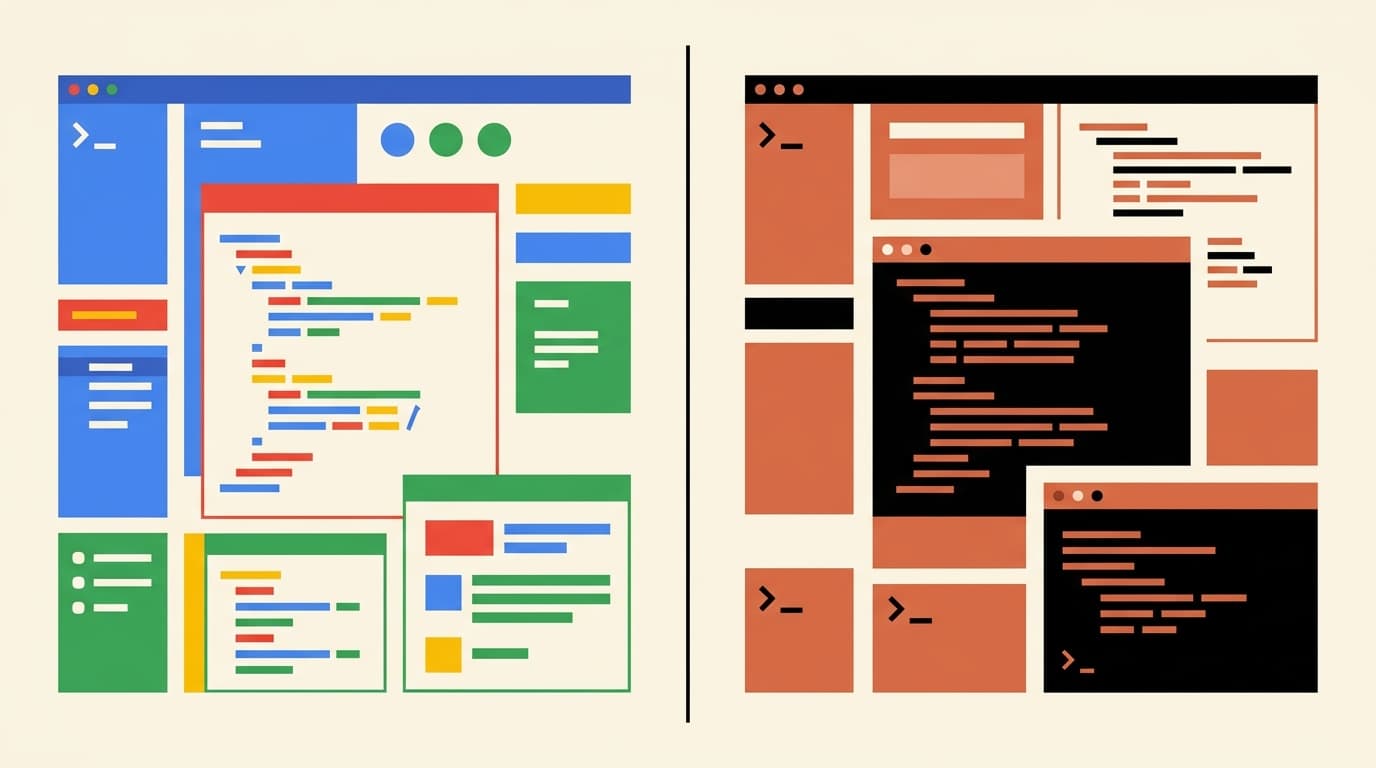
Antigravity and Claude Code solve a similar problem from opposite directions. Anthropic built one CLI around one model family and spent two years deepening the ecosystem around it. Google built one platform across four surfaces and made the model a dropdown, including Claude itself as one of the options. If cost and model flexibility matter most, Antigravity's free tier is hard to argue with. If you want the runtime with the longest production track record and the deepest library of things other teams already built, that's still Claude Code.
If you want help designing the right agentic setup for your team (Claude Code skills, hooks, MCP servers, CI integration), book a free consultation. We'll audit your stack and tell you where each tool earns its keep. The Claude Code workflows guide covers the 8 production patterns worth learning first.
FAQ
Is Antigravity better than Claude Code?
Neither is universally better. Antigravity wins on cost (a genuine free tier) and model flexibility (Gemini, Claude, and GPT-OSS models in one dropdown). Claude Code wins on agentic maturity and ecosystem depth: more published skills, more MCP servers built against it, more production precedent, plus a documented GitHub Action. Pick based on which trade-off matters for your work.
Is Antigravity free?
Yes, for individuals: $0/month with no subscription required, including access to every listed model (Gemini 3.x, Claude Sonnet 4.6, Claude Opus 4.6, GPT-OSS-120b) under basic weekly rate limits. Heavier use scales through Google AI Pro or Google AI Ultra, or a consumption-based Google Cloud plan for organizations.
Can Antigravity really run Claude models?
Yes. Antigravity's model picker includes Claude Sonnet 4.6 (thinking) and Claude Opus 4.6 (thinking) alongside Gemini 3.x models and GPT-OSS-120b, on the free tier and above. The Google Cloud enterprise tier is the exception: it currently limits selection to Gemini models only.
How much does Claude Code cost?
There's no standing free tier. You either pay Anthropic API rates per token, or bundle into a Claude Max plan ($100-$200/mo depending on tier) for a fixed usage quota. Heavy agentic users can outspend Antigravity's free and entry tiers by a wide margin.
Does Antigravity support MCP?
Yes. Antigravity has an in-app MCP Store for one-click installs plus manual global or workspace server configuration with OAuth and custom header support. Both tools treat MCP as a first-class extension point, not a bolt-on.
Does Antigravity have hooks and subagents?
Yes, both are current features. Hooks fire at PreToolUse, PostToolUse, PreInvocation, PostInvocation, and Stop, configured in a hooks.json file. Subagents ship built in (research, browser, and self) and you can define custom ones as markdown files with YAML frontmatter.
Which has the bigger context window?
Antigravity doesn't publish one headline context-window number, since it varies by which model you select in the dropdown. Claude Code's standard context is 200K tokens, with 1M-token context in beta on some plans. If a single, predictable context size matters more than model choice, that predictability favors Claude Code.
Is Antigravity open source?
No. The Antigravity app, CLI, and IDE extensions are proprietary. Its Skills format follows an open SKILL.md standard shared with other agent tools, but that's a file format, not the product itself. Claude Code's CLI is also proprietary; Anthropic documents its behavior and permissions model but does not publish the source.
Can I use Antigravity and Claude Code together?
Yes, and it's a more interesting split than most "use both" setups, since Antigravity can run Claude as its own reasoning model. A common pattern is using Antigravity's free tier to explore a codebase across multiple models, then handing tasks that need Claude Code's specific agent loop, hooks, or MCP setup to Claude Code directly. Commit between runs and avoid touching the same file with both at once.
Continue Reading
AGENTS.md Explained: The Open Spec for AI Coding Agent Instructions
AGENTS.md is an open, cross-tool markdown file for giving AI coding agents project context: build commands, tests, and conventions. Codex, Cursor, Aider, and opencode read it natively. Claude Code reads its own CLAUDE.md and treats AGENTS.md as an explicit import, not an automatic fallback.
Claude Skills Marketplace: Where to Find and Submit Claude Skills (2026)
There's no single official Claude Skills Marketplace. Skills ship inside plugins across two Anthropic-run catalogs and Anthropic's own GitHub repo, plus a few independent community sites that index or curate skills separately. Here's where to actually find them, and the real path to submit one.
Aider vs Claude Code (2026): Open-Source, Any-Model CLI vs Anthropic's Agent
Aider vs Claude Code in 2026: Aider is a free, open-source, git-native pair-programming CLI that works with almost any model. Claude Code is Anthropic's own agent runtime, narrower by design but with native MCP, hooks, and subagents.
Book a Free Strategy Call
Building this in production?
Walid runs a 30-min call to map your AI engineering team. Free, no slides.
Free weekly brief
Steal our production automations
The exact n8n flows, Claude Code setups, and prompts we ship for clients, broken down step by step. No spam, unsubscribe anytime.

Robel engineers production-grade automation pipelines at AY Automate, focused on integrations, reliability, and the systems that keep client workflows running.