Book a Free Strategy Call
Skip the read: talk to Walid in 30 min.
Free strategy call. We map your AI engineering team, you keep the notes.
8 Best AI Agent Observability Tools in 2026 (Tracing, Evals, Cost Tracking)
The best AI agent observability tools in 2026 are Langfuse (open-source, best for LLM traces) and Arize Phoenix (best for evals). AI agent observability is now a core operations requirement, not a nice-to-have. Once an agent runs in production, it makes dozens of model calls, retrieval steps, and tool invocations per request. When something breaks, slows down, or quietly burns budget, you need to see exactly which step failed and why. The tools in this guide give you that visibility.
This is an ops-buyer guide. It compares eight real platforms used by engineering teams in 2026 to trace agent runs, evaluate output quality, and track token cost. Each one solves the same core problem from a different angle, so the right pick depends on whether you self-host, who owns evaluation, and how much existing infrastructure you want to reuse.
We focus on three things ops teams actually pay for: distributed tracing of every agent step, evaluations that catch quality regressions, and cost tracking that attributes spend to models, users, and features. For each tool we cover what it tracks, who it fits, and whether it is open-source or SaaS.
If you run agents at scale and want help wiring observability into a production stack, our team builds and maintains these pipelines through automation maintenance and support.
TL;DR
- Langfuse and Arize Phoenix lead the open-source field for self-hosted tracing plus evals, both built on OpenTelemetry.
- Helicone is the fastest path to LLM cost tracking, since it sits as a proxy and needs almost no code change.
- LangSmith and Braintrust are the strongest commercial platforms when evaluation quality drives your roadmap.
- Traceloop OpenLLMetry and OpenLIT are open standards that pipe agent telemetry into tools you already run, like Datadog or Grafana.
- Datadog LLM Observability fits teams that want agent monitoring inside an existing enterprise observability platform.
- Pick on three axes: open-source versus SaaS, depth of evals, and how precise the cost attribution needs to be.
What is AI agent observability?
AI agent observability is the practice of capturing, storing, and analyzing every step an AI agent takes so you can debug failures, measure quality, and control cost. It extends classic application observability (logs, metrics, traces) to the specifics of large language models and multi-step agents.
A single agent request can fan out into many operations: a planning call, several tool calls, retrieval from a vector database, and a final synthesis call. Observability tooling records each of these as a span inside one trace, so you can replay the full run and see inputs, outputs, latency, and token counts at every node.
Most modern tools build on OpenTelemetry, the vendor-neutral telemetry standard. That matters because it lets you instrument once and send the same data to different backends, which protects you from lock-in. Many platforms add an LLM-specific layer (often called OpenInference or OpenLLMetry) that knows how to capture prompts, completions, and model metadata.
Free weekly brief
Steal our production automations
The exact n8n flows, Claude Code setups, and prompts we ship for clients, broken down step by step. No spam, unsubscribe anytime.
Why it matters (cost, latency, quality)
Three failure modes push teams to adopt observability. The first is cost. Token spend scales with usage, and a single inefficient prompt or runaway agent loop can multiply a bill overnight. Cost tracking attributes spend to specific models, users, and features so you can find and fix the expensive paths.
The second is latency. Agents chain calls, so total response time is the sum of every step. Without tracing, a slow retrieval or a redundant model call hides inside an opaque request. Span-level timing shows you exactly where the seconds go.
The third is quality. Models drift, prompts regress, and edge cases slip through. Evaluations score outputs against datasets or LLM-as-judge rubrics, both offline before you ship and online in production. This is the difference between guessing your agent works and proving it. If quality and reliability are your priority, our AI agent development practice bakes evals in from the first sprint.
Langfuse
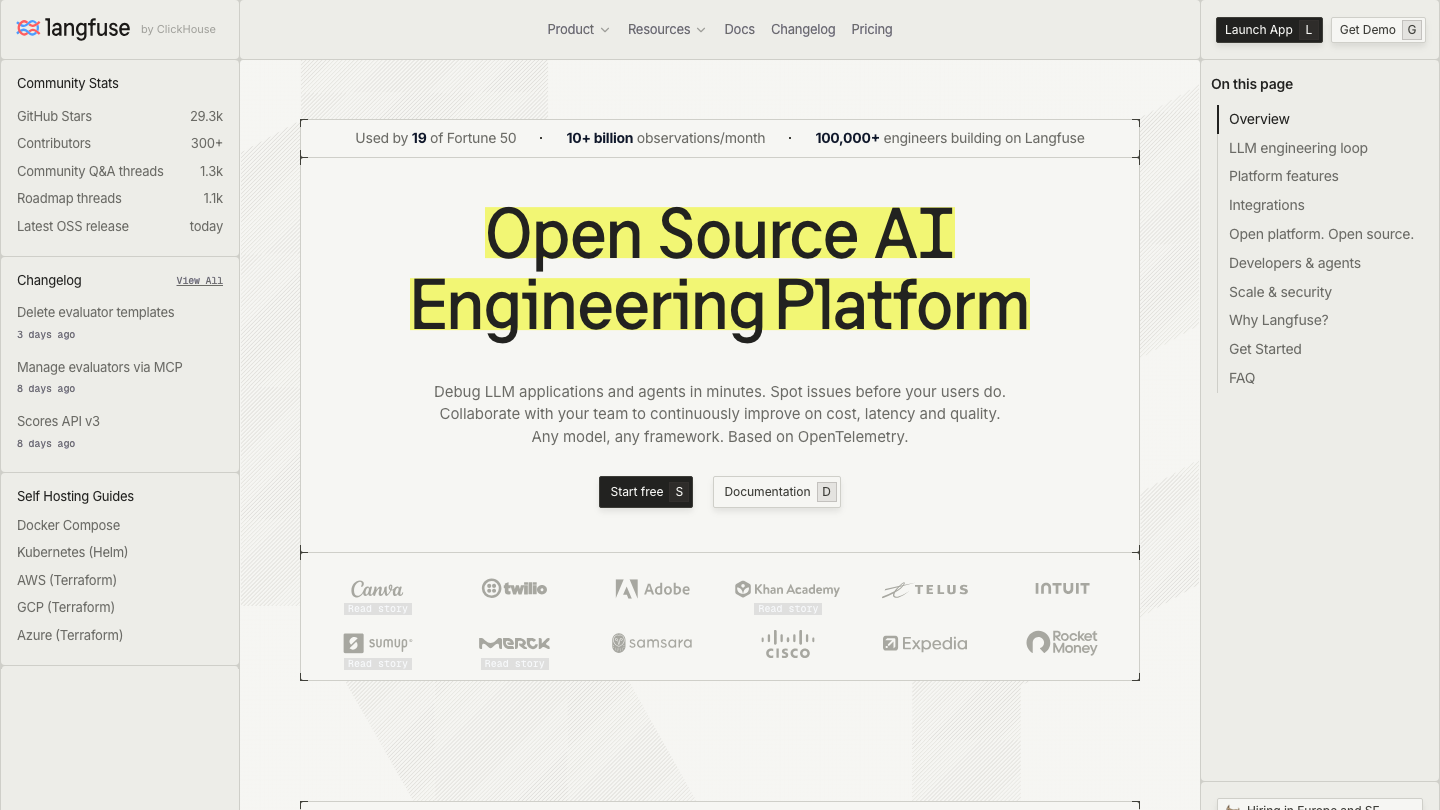
Langfuse is the most widely adopted open-source LLM engineering platform, and it has become the default choice for teams that want self-hosted observability with a full feature set. Its core is MIT-licensed and covers end-to-end tracing, prompt management, evaluations, datasets, and a playground.
What it tracks: full agent traces with nested spans, token usage and cost per call, prompt versions, dataset-based and LLM-as-judge evals, and user-level metrics. It integrates with OpenTelemetry, LangChain, the OpenAI SDK, and LiteLLM.
Best for: teams that want an all-in-one, self-hostable platform and value owning their data. It scales from a local Docker setup to large production deployments.
Open-source vs SaaS: both. The core is open-source and free to self-host, with a managed cloud tier for teams that prefer not to run infrastructure.
Helicone
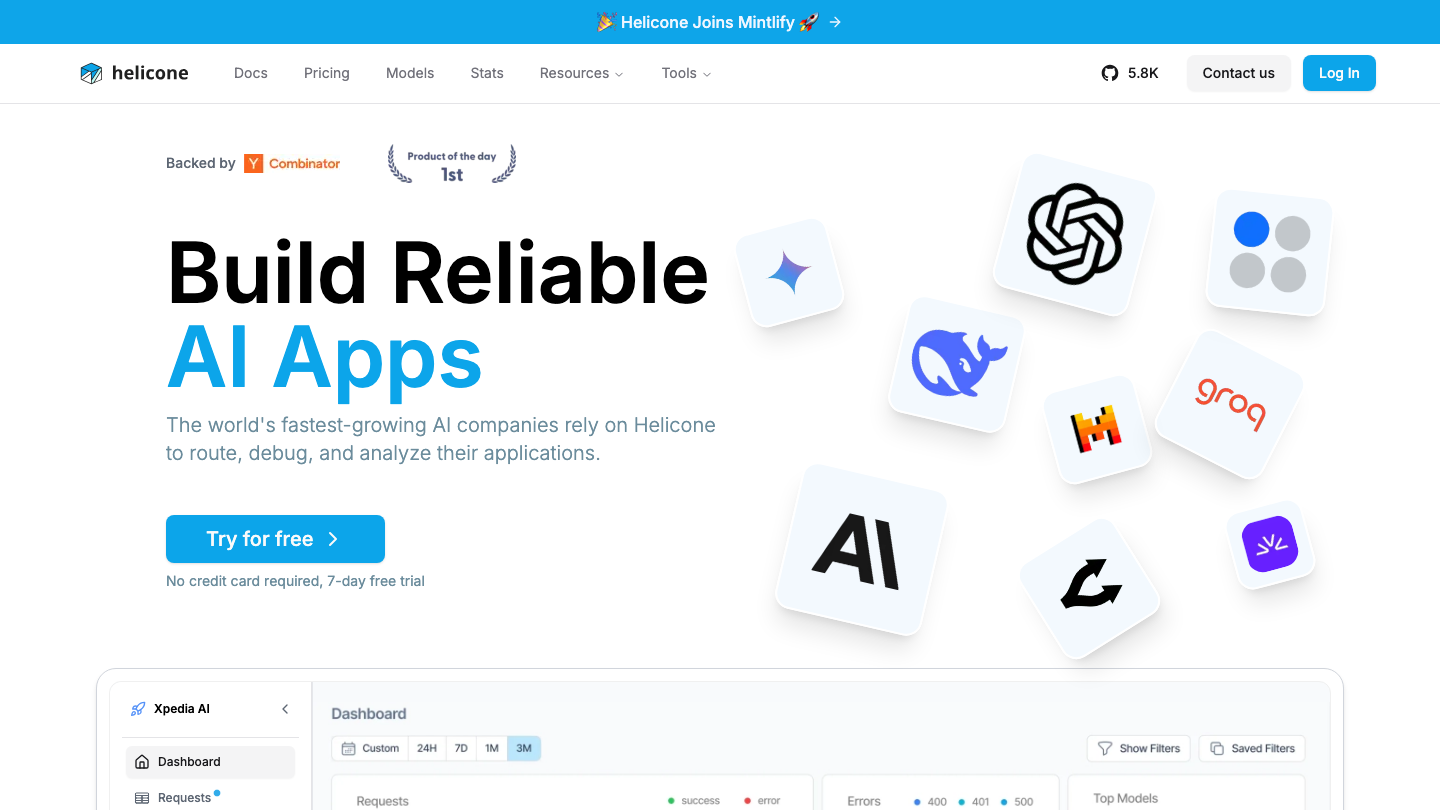
Helicone is an open-source observability platform built around a proxy model, which makes it the fastest tool here to switch on. You change a base URL or add one line, and every request flows through Helicone with no further instrumentation.
What it tracks: every request automatically, with detailed cost tracking across providers, latency, usage trends, top models, and per-user analytics. Its model registry prices 300-plus models, so cost numbers are precise rather than estimated.
Best for: teams whose first priority is LLM cost tracking and request logging with minimal engineering effort. The proxy approach suits products that route through many providers.
Open-source vs SaaS: both. The platform is open-source and self-hostable, with a hosted cloud option.
Arize Phoenix
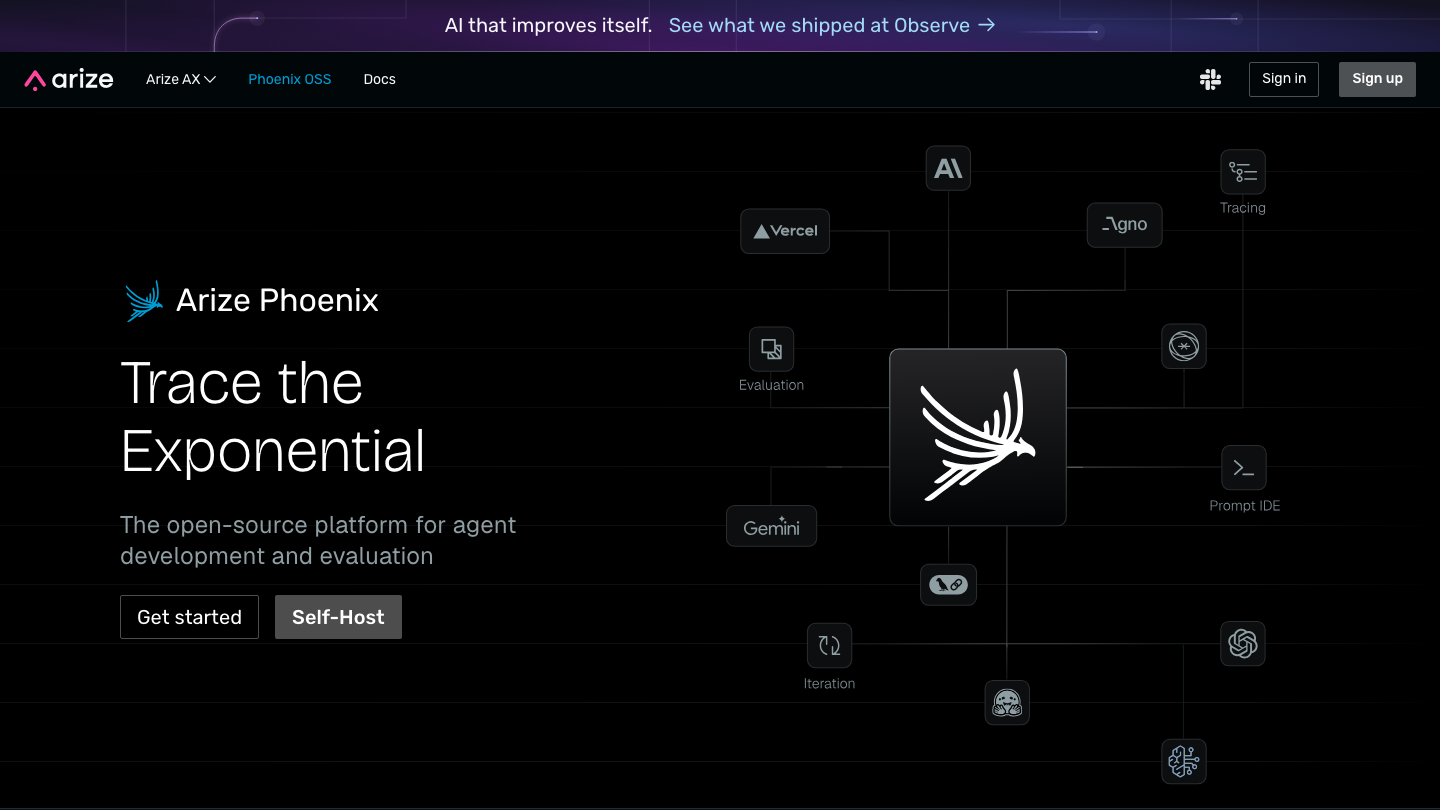
Arize Phoenix is an open-source AI observability and evaluation tool that runs entirely on your machine with a single function call, with no API keys or cloud account required. It captures traces through OpenTelemetry and OpenInference auto-instrumentation.
What it tracks: distributed traces of every LLM call, retrieval, and agent step, plus LLM-based evaluations through its phoenix.evals library. It adds dataset management, RAG-specific metrics, and embeddings analysis for deeper retrieval debugging.
Best for: teams that want LangSmith-level tracing and evals without sending data to a third party, and engineers who do heavy RAG work.
Open-source vs SaaS: open-source for Phoenix itself, with a separate commercial Arize platform for enterprise-scale monitoring.
LangSmith
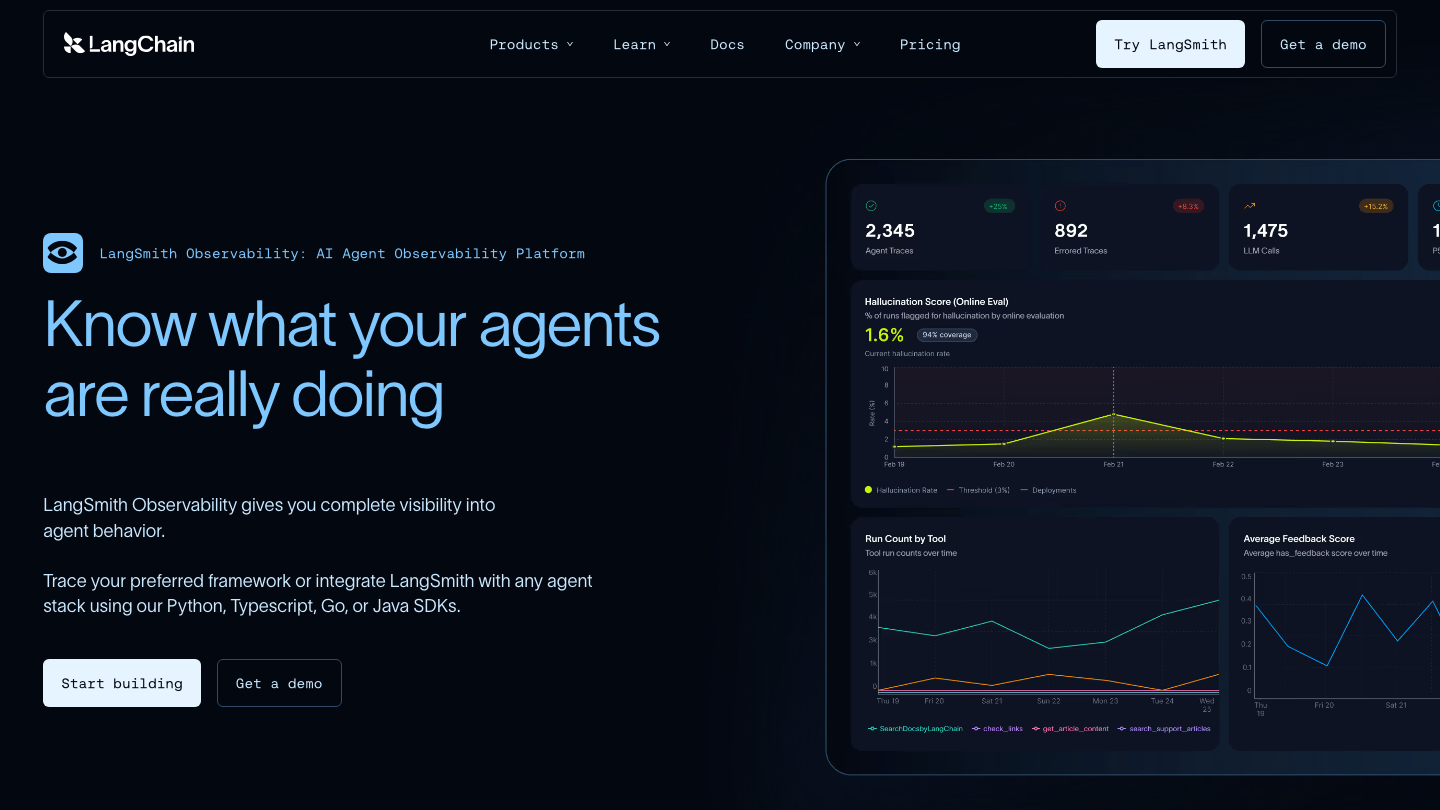
LangSmith is the commercial observability and agent engineering platform from the LangChain team, though it is framework-agnostic and works without LangChain. It is built to take an agent from prototype to production with strong evaluation tooling.
What it tracks: every step of an agent run, production-wide performance metrics, and a unified cost view across full agent workflows. Its evaluation suite ships 30-plus templates covering safety, response quality, trajectory, and multimodal checks, usable for both offline experiments and online monitoring.
Best for: teams that want a polished, managed platform where evaluation is a first-class workflow, and especially teams already in the LangChain ecosystem.
Open-source vs SaaS: primarily SaaS, hosted at the LangSmith cloud with enterprise self-hosting available.
Braintrust
Braintrust is a commercial platform that tightly couples observability and evaluations in one workflow, positioning itself as the quality layer for production AI. It is used by teams at companies like Stripe, Vercel, and Notion.
What it tracks: production traces, output quality through custom and built-in scorers, and prompt and model iteration. Its assistant, Loop, analyzes production traces in natural language, generates eval datasets, and recommends scorers. A purpose-built data store keeps queries fast at scale.
Best for: teams where rigorous, continuous evaluation drives the roadmap and where engineers and domain experts collaborate on quality.
Open-source vs SaaS: SaaS, with SDK, OpenTelemetry, and proxy integration methods for flexible onboarding.
Traceloop OpenLLMetry
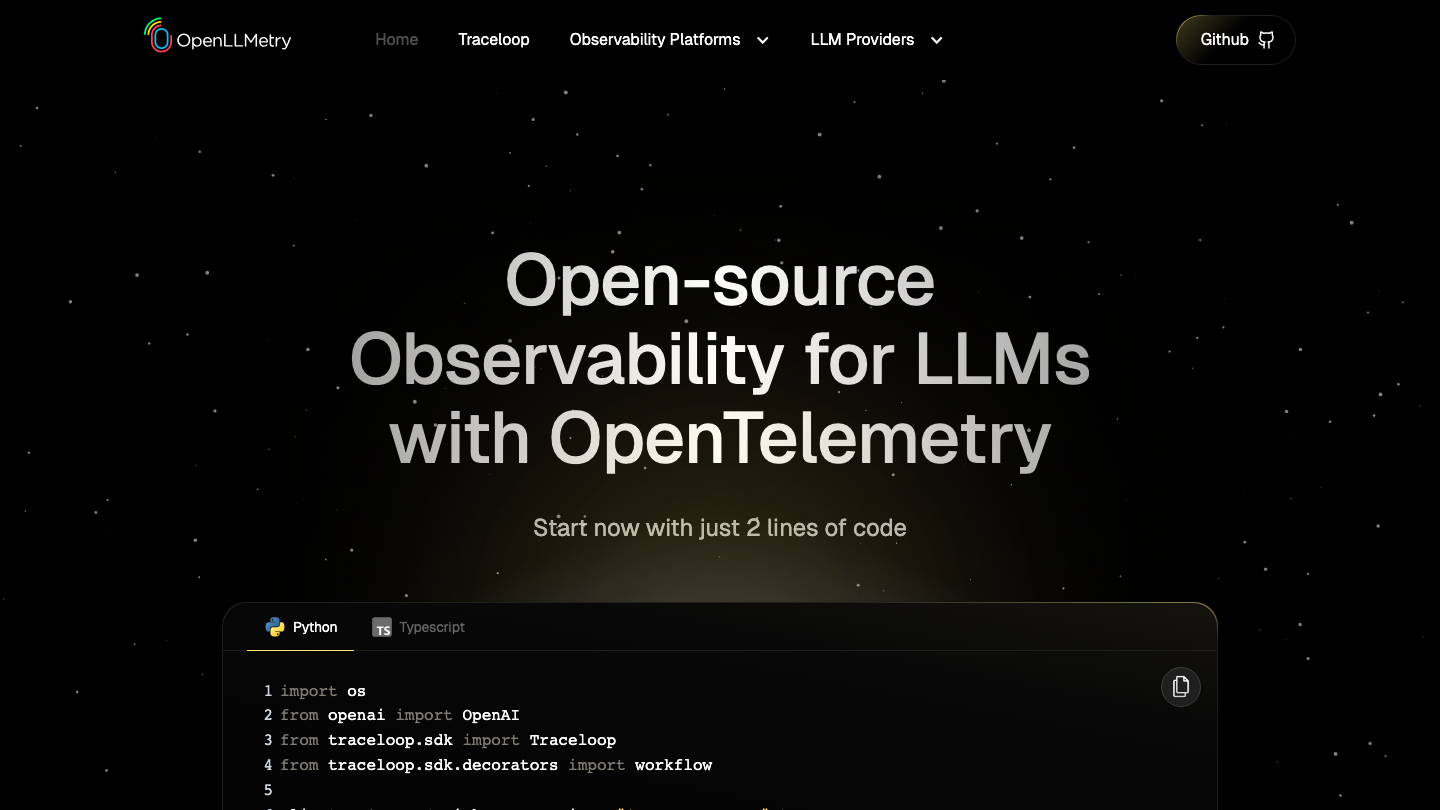
Traceloop OpenLLMetry is an open-source SDK that extends OpenTelemetry to LLMs, maintained by Traceloop. Rather than being a destination, it is the instrumentation layer that produces standardized agent telemetry.
What it tracks: LLM-specific data on top of standard OpenTelemetry traces and metrics, including model name and version, prompt and completion tokens, temperature, latency, and errors. It ships instrumentations for OpenAI, Anthropic, Cohere, vector databases like Pinecone, and frameworks like LangChain and Haystack.
Best for: teams that already run an observability backend and want to add LLM visibility without adopting a new platform. Because it uses the OpenTelemetry protocol, you can pipe data into Datadog, New Relic, Sentry, or Honeycomb.
Open-source vs SaaS: open-source under Apache 2.0, with a commercial Traceloop platform for managed reliability.
Datadog LLM Observability
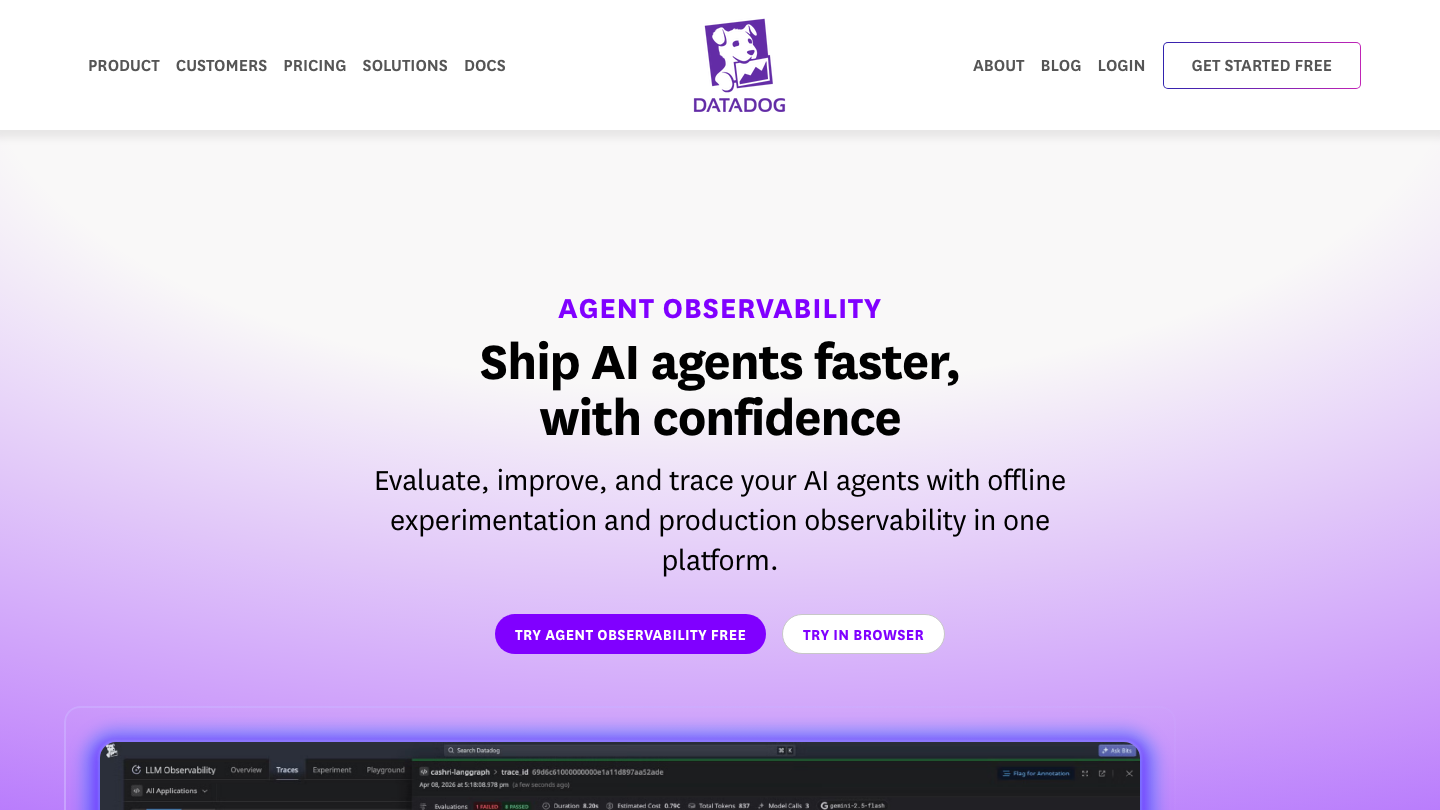
Datadog LLM Observability brings agent monitoring into the established Datadog platform, which suits organizations already standardized on Datadog for infrastructure and APM. It is generally available and has expanded to cover agentic workflows.
What it tracks: end-to-end agent and LLM traces, operational performance, and evaluations for quality, privacy, and safety. Because it lives inside Datadog, you correlate agent behavior with the rest of your system metrics, logs, and APM data in one place.
Best for: enterprise teams that want LLM observability unified with existing monitoring, governance, and security tooling rather than a separate point solution.
Open-source vs SaaS: SaaS, as part of the broader Datadog platform.
OpenLIT
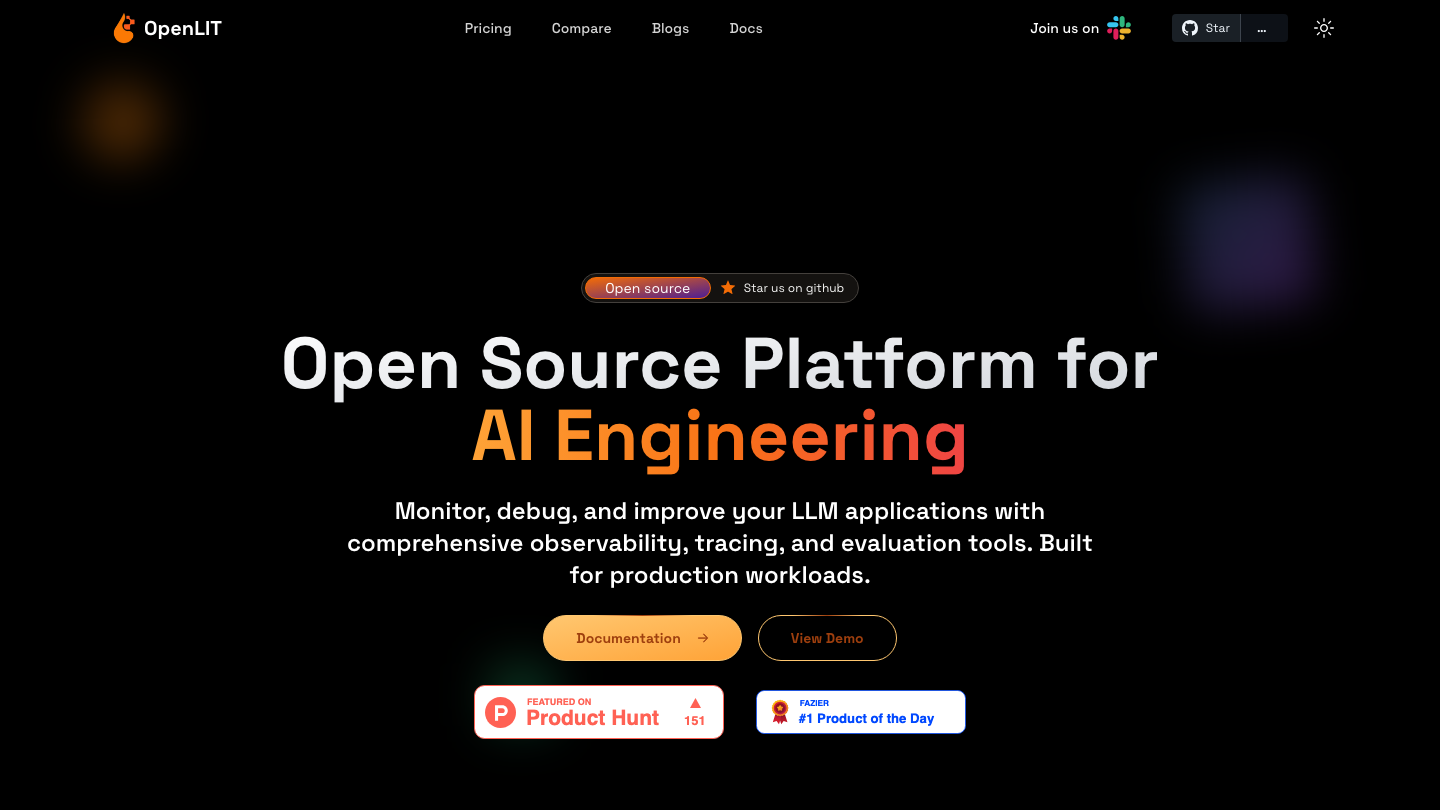
OpenLIT is an open-source, OpenTelemetry-native AI engineering platform that auto-instruments your stack with a single line of code. It positions itself as a unified observability layer that also handles GPU monitoring, guardrails, and prompt management.
What it tracks: distributed traces, token usage, response times, and request flows in real time, plus online and offline evaluations through its UI and SDKs. It auto-instruments 50-plus LLM providers, vector databases, and agent frameworks.
Best for: teams that want an open standard, broad provider coverage, and extras like GPU monitoring in one self-hosted package.
Open-source vs SaaS: open-source and free to self-host, built on OpenTelemetry so its data flows into compatible backends.
Comparison table
| Tool | Tracing | Evals | Cost tracking | OSS/SaaS |
|---|---|---|---|---|
| Langfuse | Yes | Yes | Yes | OSS + SaaS |
| Helicone | Yes | Yes | Yes (proxy, precise) | OSS + SaaS |
| Arize Phoenix | Yes | Yes | Yes | OSS (+ Arize SaaS) |
| LangSmith | Yes | Yes (deep) | Yes | SaaS |
| Braintrust | Yes | Yes (deep) | Yes | SaaS |
| Traceloop OpenLLMetry | Yes | Via backend | Yes (tokens) | OSS |
| Datadog LLM Observability | Yes | Yes | Yes | SaaS |
| OpenLIT | Yes | Yes | Yes | OSS |
If you are setting up production observability for an AI agent system, our AI agent development team includes Langfuse or Helicone integration as a standard part of every production build. Book a free architecture review to see how we structure monitoring and alerting.
Market update: Cisco's acquisition of Galileo
The observability market consolidated further in 2026. Cisco announced its intent to acquire Galileo, an AI agent observability and evaluation platform, on April 9, 2026, and closed the deal on May 22, 2026 (Cisco Blogs). Galileo's tracing, guardrails, and eval tooling are being folded into Splunk Observability Cloud's existing AI Agent Monitoring capabilities, giving Cisco a single instrumentation layer across the full agent development lifecycle.
For buyers, the practical read is this: agent observability is no longer a category of standalone startups only. Established infrastructure vendors are acquiring their way in, which means teams already standardized on Cisco or Splunk will see native agent tracing and evals show up inside tools they already run, not just as a new line item to procure. It does not change the buyer framework above (self-host versus SaaS, eval ownership, cost precision, existing infrastructure), but it does add "does our existing observability vendor already offer this" as a question worth asking before adding a new tool.
How to choose
Start with one question: do you need to self-host? If data residency, privacy, or budget rules out sending traces to a vendor, focus on Langfuse, Arize Phoenix, or OpenLIT. All three are open-source, OpenTelemetry-based, and production-ready.
Next, decide who owns evaluation. If continuous, rigorous quality measurement drives your roadmap and non-engineers help define scorers, Braintrust or LangSmith give you the deepest eval workflows. If you want strong evals but prefer to self-host, Phoenix and Langfuse are the closest open-source match.
Then weigh cost precision. If your immediate pain is an unpredictable token bill, Helicone gets you accurate per-model, per-user cost tracking with almost no code. Its proxy model is the lowest-effort way to start measuring spend across providers.
Finally, consider existing infrastructure. If you already run Datadog, Datadog LLM Observability keeps everything in one pane. If you run another backend, Traceloop OpenLLMetry or OpenLIT instrument your agents and ship the data wherever you already look. Many teams pair an open standard like OpenLLMetry with a backend of choice for maximum flexibility.
A practical pattern: instrument with an OpenTelemetry-based layer, route traces to a self-hosted platform like Langfuse or Phoenix, and add a proxy like Helicone if cost attribution is the priority. If you need help designing and running that stack, our MCP server development services and engineer placement options put production-grade observability expertise on your team.
For the exact process we run in production, see our AI agent deployment workflow: steps, tools, and when not to use it.
Ready to ship an observable, production-ready AI agent? Our AI agent development service covers framework selection, observability tooling, and ongoing support through our automation maintenance service. Book a free scoping call.
FAQ
What is the difference between LLM observability and AI agent observability?
LLM observability tracks individual model calls, while AI agent observability tracks full multi-step runs. Agents chain planning calls, tool calls, and retrieval, so agent observability captures the whole trace and the relationships between steps, not one prompt and completion alone.
Which AI agent observability tool is best for cost tracking?
Helicone is the strongest pure cost-tracking option because its proxy model captures every request automatically and prices 300-plus models precisely. Langfuse and OpenLIT also track cost well if you prefer a self-hosted, full-platform approach.
Are open-source observability tools good enough for production?
Yes. Langfuse, Arize Phoenix, and OpenLIT all run in production at scale and offer tracing, evals, and cost tracking. Open-source tools give you data ownership and no per-seat lock-in, at the cost of running and maintaining the infrastructure yourself.
Do I need OpenTelemetry for AI agent observability?
You do not strictly need it, but it helps. OpenTelemetry is a vendor-neutral standard, so instrumenting with it (often through OpenLLMetry or OpenInference) lets you switch or combine backends without re-instrumenting your code. Most leading tools in 2026 support it.
What are evals in the context of agent observability?
Evals are automated scores that measure output quality against a dataset or an LLM-as-judge rubric. You run them offline before shipping to catch regressions and online in production to monitor live quality. Braintrust and LangSmith offer the deepest eval workflows.
Can I use more than one observability tool together?
Yes, and many teams do. A common setup pairs an OpenTelemetry instrumentation layer like Traceloop OpenLLMetry with a backend such as Langfuse or Datadog, then adds Helicone as a proxy for precise cost attribution. The standards-based approach makes combining tools straightforward.
How much engineering effort does it take to add observability?
It ranges from one line to a short integration. Proxy tools like Helicone and auto-instrumenting platforms like OpenLIT need almost no code. SDK-based platforms like Langfuse, Phoenix, and Braintrust take a bit more setup but give you finer control over what you capture.
For the Claude API integration that most of these tools observe, the Claude Fable 5 API tutorial covers streaming, tool use, and prompt caching setup.
Sources: Langfuse, Helicone, Arize Phoenix, LangSmith, Braintrust, Traceloop OpenLLMetry, Datadog LLM Observability, OpenLIT
Book a Free Strategy Call
Building this in production?
Walid runs a 30-min call to map your AI engineering team. Free, no slides.
Free weekly brief
Steal our production automations
The exact n8n flows, Claude Code setups, and prompts we ship for clients, broken down step by step. No spam, unsubscribe anytime.

Robel engineers production-grade automation pipelines at AY Automate, focused on integrations, reliability, and the systems that keep client workflows running.