Book a Free Strategy Call
Skip the read: talk to Walid in 30 min.
Free strategy call. We map your AI engineering team, you keep the notes.
The best RAG frameworks in 2026: LlamaIndex for data-heavy RAG and hard document parsing, LangChain with LangGraph for multi-step orchestration and agents, Haystack for production pipelines with real evaluation, Dify for low-code internal apps, RAGFlow for scanned and table-heavy documents, and RAGAS for measuring whether any of it actually works. txtai wins when you want one Python package instead of a stack, Verba when you want a working Weaviate app today, Cognita when a platform team needs deployable services, and Pathway when your index must update as data changes.
RAG stopped being a novelty in 2024 and became table stakes by 2026. The hard part is that "RAG framework" now covers wildly different categories. Some are orchestration libraries (LangChain, LlamaIndex). Some are end-to-end platforms with UIs (Dify, RAGFlow, Verba). Some focus narrowly on evaluation (RAGAS) or streaming pipelines (Pathway). Pick the wrong category and you will either fight the framework for months or outgrow it in a quarter. The marketing pages will not tell you this; they all claim to do everything.
This guide compares the 10 best RAG frameworks and libraries in 2026. Real features, honest pricing where it is publicly known, pros and cons, and a framework to pick the right tool for your retrieval stack.
Best RAG frameworks: a brief overview
- LlamaIndex: Best for data-heavy RAG with deep ingestion connectors and advanced indexing strategies.
- LangChain RAG: Best for teams already on LangChain who want maximum composability and ecosystem reach.
- Haystack: Best for production NLP pipelines with strong evaluation and modular components from deepset.
- Dify: Best for low-code RAG apps with a visual builder and self-hostable backend.
- RAGFlow: Best for document-heavy RAG with deep parsing of PDFs, tables, and scanned files.
- txtai: Best for lightweight embedded RAG when you want a single Python package instead of a stack.
- RAGAS: Best for evaluating RAG pipelines on faithfulness, answer relevancy, and context precision.
- Verba (Weaviate): Best for a fast, opinionated open-source RAG app on top of Weaviate.
- Cognita (TrueFoundry): Best for production-grade modular RAG with a clean API and deployable services.
- Pathway: Best for real-time, streaming RAG where the index must update as data changes.
| Framework | Key strength | Pricing | Specialties |
|---|---|---|---|
| LlamaIndex | Data connectors + indexing | OSS + LlamaCloud (usage-based) | Document RAG, agentic RAG |
| LangChain RAG | Ecosystem + composability | OSS + LangSmith (per-seat) | Multi-step chains, agents |
| Haystack | Production pipelines + eval | OSS + deepset Cloud | Enterprise NLP, search |
| Dify | Visual no-code builder | OSS self-host + Cloud tiers | LLM apps, chat UIs |
| RAGFlow | Deep document parsing | OSS (Apache 2.0) | PDF/scan/table RAG |
| txtai | Single-package simplicity | OSS (Apache 2.0) | Embedded apps, edge |
| RAGAS | RAG evaluation metrics | OSS (Apache 2.0) | Quality scoring, CI gates |
| Verba | Plug-and-play Weaviate app | OSS (BSD-3) | Demos, internal tools |
| Cognita | Modular production RAG | OSS + TrueFoundry platform | Enterprise deployment |
| Pathway | Streaming, real-time index | OSS + Pathway Enterprise | Live data, event-driven |
1. LlamaIndex, best for data-heavy RAG and advanced indexing
LlamaIndex is the framework most teams reach for when their RAG problem is fundamentally a data problem: hundreds of PDFs, mixed structured and unstructured sources, knowledge graphs, or domain-specific schemas. It started as GPT Index in 2022 and has grown into a full data framework for LLMs, with hundreds of connectors via LlamaHub, advanced indexing strategies (vector, summary, tree, knowledge graph, composable), and a managed offering, LlamaCloud, for parsing, ingestion, and retrieval at scale.
By 2026 LlamaIndex has become the default choice for agentic RAG: workflows where an agent decides which index to query, when to re-rank, and when to fall back to a different retriever. The recent push into AgentWorkflow and Workflows 1.0 made multi-step retrieval pipelines easier to express without dropping into ad-hoc orchestration code.
Key features
- Hundreds of data connectors via LlamaHub (Notion, Confluence, Slack, S3, SQL, GraphQL, etc.)
- Advanced indexing: vector, summary, tree, knowledge graph, composable, property graph
- AgentWorkflow and Workflows for event-driven RAG agents
- LlamaParse for high-fidelity PDF, table, and chart extraction
- First-class evaluation harness and integrations with RAGAS and Arize
Best for
- Teams with messy, mixed-source enterprise data
- Builders doing agentic RAG with multiple retrievers
- Anyone needing high-quality PDF and table parsing
Pricing
- Open-source core under MIT license
- LlamaCloud: usage-based (pages parsed, retrievals); free tier available
Pros
- Document parsing via LlamaParse is the strongest in the category
- Strong indexing abstractions beyond plain vector search
- Active release cadence and large community
Cons
- API surface is wide; learning curve is steeper than minimal frameworks
- LlamaCloud lock-in if you adopt managed parsing and indexing
Free weekly brief
Steal our production automations
The exact n8n flows, Claude Code setups, and prompts we ship for clients, broken down step by step. No spam, unsubscribe anytime.
2. LangChain RAG, best for ecosystem and composability
LangChain remains the most widely deployed LLM framework on the planet in 2026, and its RAG primitives (retrievers, vector stores, document loaders, multi-query and parent-document patterns) are battle-tested across thousands of production apps. LangGraph adds stateful, multi-step orchestration on top, which is how most serious teams build RAG agents today.
If you are already on LangChain for chains, tools, or agents, using its RAG layer is almost free. If you are starting fresh, you trade some elegance for an enormous ecosystem: every vector DB, every embedding provider, every reranker has a LangChain integration.
Key features
- 100+ vector store integrations and document loaders
- Retriever abstractions: multi-query, parent-document, self-query, ensemble
- LangGraph for stateful RAG agents with branching and replay
- LangSmith for tracing, evaluation, and dataset management
- Strong support for hybrid search and reranking
Best for
- Teams already running LangChain or LangGraph
- Apps that mix RAG with tools, function calling, and multi-agent flows
- Builders who value ecosystem breadth over a tight API
Pricing
- Open-source under MIT license
- LangSmith: free tier, then per-seat and usage-based
Pros
- Largest integration surface in the space
- LangGraph is genuinely good for multi-step RAG
- LangSmith tracing makes debugging tractable
Cons
- API has gone through several large redesigns; older tutorials are misleading
- Abstractions can leak; you still need to understand the underlying retriever
3. Haystack, best for production NLP pipelines
Haystack from deepset is the quiet workhorse of enterprise RAG. While LangChain and LlamaIndex chased mindshare, Haystack 2.x focused on a clean component model (pipelines as DAGs of typed components) that production teams find easier to reason about, test, and deploy. It has strong roots in semantic search and question answering, which shows in its mature evaluation tooling.
In 2026 Haystack is a particularly good fit for teams that need to combine classical NLP (NER, classification, summarization) with modern LLM-based retrieval, and that want a framework whose authors have shipped search systems at scale.
Key features
- Component-based pipelines with typed inputs and outputs
- Strong retriever, ranker, and reader components
- Built-in evaluation with multiple metrics
- deepset Cloud and Hayhooks for deployment
- Good fit for hybrid sparse+dense retrieval
Best for
- Enterprise teams building search and QA systems
- Organizations that need clean separation of components and tests
- Hybrid retrieval workloads
Pricing
- Open-source under Apache 2.0
- deepset Cloud: contract pricing for enterprise
Pros
- Cleanest pipeline abstraction in the category
- Strong evaluation tooling out of the box
- Production-minded API stability
Cons
- Smaller ecosystem than LangChain or LlamaIndex
- Less momentum in the agentic-RAG narrative
4. Dify, best for low-code RAG apps
Dify is the "build an internal RAG app this afternoon" framework. It pairs a visual workflow builder with a knowledge base, a prompt IDE, and chat and API endpoints, all self-hostable. By 2026 it has become the go-to for non-engineers and small teams who want a real RAG app, not a notebook, without writing every chunk-and-embed loop by hand.
It is not a drop-in replacement for code-first frameworks at scale, but for internal copilots, support assistants, and quick prototypes it ships in hours instead of weeks.
Key features
- Visual workflow builder with RAG nodes
- Built-in knowledge base with chunking, embedding, and reranking
- Prompt IDE with versioning and A/B testing
- Self-hostable backend (Docker, Kubernetes)
- API and embeddable chat widget out of the box
Best for
- Internal RAG copilots and support bots
- Non-engineering teams who still want self-hosting
- Rapid prototyping before a code-first rewrite
Pricing
- Open-source community edition (self-hosted)
- Dify Cloud: Sandbox (free), Pro, Team, Enterprise tiers
Pros
- Shortest path from idea to working RAG app
- Good UX for content owners managing knowledge bases
- Active commercial company behind the project
Cons
- Less flexibility than code-first frameworks at the edges
- Workflow builder hits limits on complex agentic logic
5. RAGFlow, best for deep document parsing
RAGFlow's pitch is simple: most RAG fails because document parsing is bad, not because retrieval is bad. It puts an unusually heavy emphasis on layout-aware parsing of PDFs, scans, tables, and forms: the kinds of documents that quietly destroy retrieval quality when you treat them as flat text.
If your corpus is annual reports, contracts, invoices, manuals, or scanned forms, RAGFlow's parser will often outperform a generic chunker plus embeddings on the same documents.
Key features
- Layout-aware deep parsing of PDFs, DOCX, scanned images, and tables
- Visual citation and chunk inspection UI
- Multi-recall and re-ranking out of the box
- Self-hostable with Docker Compose
- REST API and chat UI
Best for
- Financial, legal, and regulatory document RAG
- Workflows where citations and traceability matter
- Teams with scanned or image-heavy corpora
Pricing
- Open-source under Apache 2.0
- Self-hosted; no official managed tier at time of writing
Pros
- Parsing quality on hard documents is a real differentiator
- Citation UX is genuinely useful for end users
- Permissive license
Cons
- Heavier to deploy than a single Python library
- Smaller community than LangChain or LlamaIndex
6. txtai, best for embedded and lightweight RAG
txtai is a single-package Python framework that bundles vector search, graph search, and a RAG layer in one dependency. While the rest of the field has grown into stacks of five to ten services, txtai stayed disciplined: one pip install, a SQLite or DuckDB backend by default, and a remarkably full RAG feature set inside a few hundred KB of wheel.
It is the framework to reach for when you want RAG inside a CLI tool, a desktop app, a Jupyter notebook, or an edge device, not a Kubernetes cluster.
Key features
- Embedded vector + graph search in a single package
- Sentence-transformers, llama.cpp, and Hugging Face integrations
- Pipelines for summarization, transcription, translation, and RAG
- API server and Docker images available
- Workflow YAML for declarative pipelines
Best for
- Embedded apps, CLIs, and notebooks
- Small to medium corpora where a vector DB is overkill
- Researchers and data scientists who hate stack sprawl
Pricing
- Open-source under Apache 2.0
Pros
- Smallest blast radius of any framework on this list
- Surprisingly capable for its size
- Works fully offline with local models
Cons
- Not aimed at multi-tenant, multi-billion-vector workloads
- Smaller ecosystem of third-party integrations
7. RAGAS, best for evaluating RAG pipelines
RAGAS is not a RAG framework. It is the framework that tells you whether your RAG framework is any good. It scores pipelines on faithfulness, answer relevancy, context precision, context recall, and a growing list of metrics, using both LLM-as-judge and reference-based methods.
By 2026 RAGAS has become the de facto standard for RAG eval in CI. If you are shipping retrieval to production without RAGAS or an equivalent harness, you are flying blind.
Key features
- Faithfulness, answer relevancy, context precision and recall metrics
- LLM-as-judge and reference-based evaluation
- Synthetic test set generation
- Integrations with LangChain, LlamaIndex, Haystack, and LangSmith
- Dataset and experiment tracking
Best for
- Any team shipping RAG to production
- CI gates and regression tests on retrieval quality
- Comparing chunking, embedding, and prompt strategies
Pricing
- Open-source under Apache 2.0
Pros
- Well-defined, widely cited metrics
- Plays nicely with every major RAG framework
- Synthetic test-set generation saves real time
Cons
- LLM-as-judge metrics are only as good as the judge model
- Requires discipline to integrate into CI correctly
8. Verba (Weaviate), best for opinionated open-source RAG apps
Verba is Weaviate's open-source "golden retriever": a polished, opinionated RAG app you can clone, point at your data, and demo in an afternoon. It targets the gap between "notebook RAG" and "we built our own React frontend": a working chat UI, a working ingestion flow, and a working hybrid-search backend, all wired together.
It is especially useful as a reference architecture for teams building on Weaviate who want a sane starting point instead of a blank repo.
Key features
- Full-stack RAG app: ingestion, chat UI, evaluation
- Hybrid search via Weaviate (BM25 + vector)
- Multiple data import flows: files, URLs, GitHub, etc.
- Configurable generators (OpenAI, Anthropic, local, etc.)
- Docker-based deployment
Best for
- Weaviate users who want a working starter app
- Internal demos and stakeholder previews
- Teams evaluating hybrid search on their own data
Pricing
- Open-source under BSD-3
- Weaviate has its own OSS and Cloud pricing
Pros
- Genuinely usable out of the box
- Good demo of Weaviate hybrid retrieval
- Clear codebase to fork
Cons
- Coupled to Weaviate as the backend
- Less flexible than a code-first library
9. Cognita (TrueFoundry), best for production-grade modular RAG
Cognita, from TrueFoundry, is what happens when a platform team that ships ML to production writes a RAG framework. It is modular by default (data loaders, parsers, embedders, vector DBs, rerankers, and query controllers are all swappable) and it is designed from day one to be deployable as a service rather than imported as a library.
In 2026 Cognita is a strong fit for engineering teams that already think in terms of services, not notebooks, and that want a RAG framework with deployment baked in.
Key features
- Modular components: parser, embedder, vector DB, reranker, query controller
- API-first design with FastAPI backend
- UI for managing collections and queries
- Native deployment via TrueFoundry (Kubernetes-based)
- Multi-collection and multi-tenant support
Best for
- Platform teams standardizing RAG across multiple apps
- Workloads that need a service, not a library
- Multi-tenant internal RAG platforms
Pricing
- Open-source under Apache 2.0
- TrueFoundry platform pricing for managed deployment
Pros
- Production-shaped from the start
- Clean separation of concerns
- Good fit for internal platform engineering
Cons
- Less community content than LangChain or LlamaIndex
- Tighter alignment with TrueFoundry for the managed path
10. Pathway, best for real-time and streaming RAG
Pathway is the framework you want when your RAG index can't be a nightly batch job. It is a Python-first streaming data framework with a built-in LLM and RAG layer, designed so that indexes update as source data changes: files added to S3, rows changed in Postgres, events landing in Kafka.
For use cases like operations copilots, trading research, observability assistants, or anything where "answers must reflect the world as of two minutes ago" is a real requirement, Pathway is in a category of its own.
Key features
- Streaming Python data framework with incremental computation
- LLM and RAG primitives (retrievers, indexes, prompts) on top of streams
- Connectors for Kafka, Postgres, S3, Sharepoint, Google Drive
- Always-fresh vector and full-text indexes
- Self-hostable, on-prem-friendly
Best for
- Real-time operations and analytics copilots
- Use cases where stale answers are unacceptable
- Teams with strong streaming data backgrounds
Pricing
- Open-source Pathway framework
- Pathway Enterprise: contract pricing
Pros
- Genuinely solves the "stale index" problem
- Strong fit with event-driven architectures
- Python-first, no separate streaming language
Cons
- Streaming mental model is a learning curve for batch-trained teams
- Overkill if a nightly reindex is good enough
How to choose the best RAG framework
1) Is your bottleneck retrieval, parsing, or evaluation?
If your bottleneck is parsing (bad PDFs, tables, scans), start with LlamaIndex (LlamaParse) or RAGFlow. They will move your numbers more than a fancier retriever ever will. If the bottleneck is retrieval (embeddings, hybrid search, reranking), LangChain RAG, Haystack, and Cognita give you the most knobs. If the bottleneck is evaluation, meaning you simply do not know whether you are getting better, bolt RAGAS on top of whatever framework you already use before you change anything else. The AY Automate team almost always pairs a primary framework with RAGAS in CI on AI agent development builds.
2) Notebook, app, or platform?
If you are still in a notebook and need to validate the idea, txtai or LlamaIndex in a single file is the fastest path. If you want a working app this week (chat UI, ingestion flow, knowledge base), Dify, Verba, or RAGFlow get you there. If you are building a platform that will host many RAG apps, Cognita or a LangChain + LangGraph stack on top of a managed vector DB and Supabase is a more honest starting point. Picking a heavyweight platform framework for a notebook problem is the most common mistake we see.
3) Batch index or live index?
Almost every RAG tutorial assumes a batch index: load documents, embed, store, query. That is fine for documentation, knowledge bases, and legal corpora. It is wrong for operations, trading, observability, or anything where "as of two minutes ago" matters. Pathway is the only framework on this list designed from the ground up for live indexes; everything else can be made to work with cron jobs and webhooks, but you will be fighting the framework.
4) Python-only or polyglot?
Most of this list is Python-first. If your stack is TypeScript-heavy, LangChain's JS port and LlamaIndex.TS are the only credible options at production scale in 2026, and even then most teams put a thin Python service in front for the heavy lifting. If you need to call RAG from Go, Rust, or .NET, you will end up wrapping a Python service behind a REST or gRPC API regardless of framework. See our best Python AI agent frameworks breakdown for a deeper take on that decision.
Build your RAG stack with AY Automate
AY Automate builds production RAG systems on LlamaIndex, LangChain, LangGraph, and Claude Code, wired into Supabase, pgvector, Weaviate, or your existing data warehouse, with RAGAS gates in CI and clean handoff documentation. We have shipped retrieval-backed copilots in English, French, and Arabic, with citation UIs that legal and compliance teams will actually sign off on. If you want a partner that treats RAG as a system to operate, not a demo to ship, start with a free consultation and we will scope the right framework, vector store, and eval stack for your data, or tell you, honestly, that you do not need RAG at all. See AI agent development for the full service.
Where AY Automate fits
We are not one of the tools on this list. We place AI engineers who use tools like these to generate revenue for your business, that is the offer. For RAG, that means an engineer who scopes the right framework, vector store, and eval stack for your actual data. See AI engineer placement or explore our related service.
FAQ
What is a RAG framework?
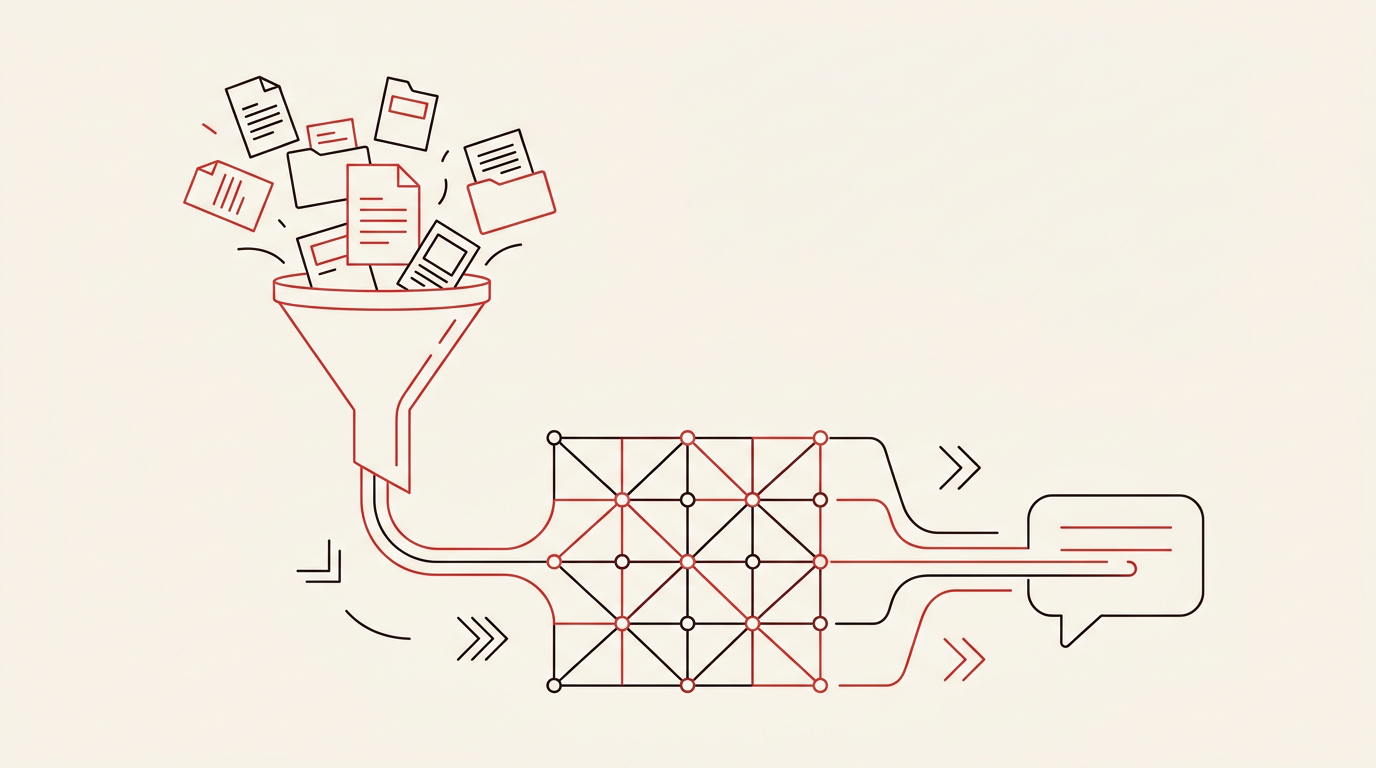
A RAG (retrieval-augmented generation) framework is a library or platform that handles the four core steps of retrieval-augmented generation: ingesting and parsing source data, chunking and embedding it into a searchable index, retrieving relevant context at query time, and feeding that context to an LLM along with the user's question. Some frameworks cover all four steps; others specialize in one part of the pipeline.
How is a RAG framework different from a vector database?
A vector database (Weaviate, Pinecone, pgvector, Qdrant, Milvus) stores and searches embeddings. A RAG framework is the layer above: it decides what to embed, how to chunk it, which retriever and reranker to use, how to assemble the prompt, and how to evaluate the result. You almost always use both: a RAG framework on top of a vector database. A few frameworks (txtai, Verba) bundle a default vector backend; most are agnostic.
How do I verify a RAG framework will scale?
Look for three signals. First, public benchmarks or case studies at the scale you care about: millions of chunks, hundreds of queries per second, multi-tenant isolation. Second, a clean separation between ingestion, retrieval, and generation, so you can scale each independently. Third, real evaluation tooling (or clean integration with RAGAS), because you will not catch quality regressions at scale without it. Marketing pages will not tell you the truth here; GitHub issues and Discord channels usually will.
How much do RAG frameworks cost in 2026?
The frameworks themselves are almost all open-source. Real costs are infrastructure (vector DB, compute, storage), LLM API or self-hosted model costs, and managed-tier fees if you adopt LlamaCloud, deepset Cloud, Dify Cloud, LangSmith, or TrueFoundry. For a mid-sized internal RAG app (say, ten million tokens of context, a few thousand queries a day), expect $500-$5,000 a month in 2026 depending on model choice and hosting.
How long does a RAG implementation take?
A working demo on clean documents takes a day with Dify, Verba, or LlamaIndex in a notebook. If you're already building on Claude and don't need a full framework, see our guide to building RAG directly with Claude's native documents API for an even faster path to citation-backed retrieval. A production-grade system (proper parsing, hybrid retrieval, reranking, evaluation, monitoring, access control, and multi-tenant isolation) is a 6-12 week project for a small team, longer if your data is messy or your compliance bar is high. The first month is almost always parsing and chunking, not retrieval.
Is RAGAS or another eval tool really necessary?
Yes. Without an eval harness you cannot tell whether a change to chunking, embeddings, retrievers, or prompts made things better or worse. You will ship regressions, and your users will find them before you do. RAGAS is the most common choice in 2026, but TruLens, DeepEval, and Arize Phoenix are credible alternatives. Pick one and put it in CI.
Should we use LangChain or LlamaIndex?
If your problem is fundamentally data (many sources, messy formats, advanced indexing), start with LlamaIndex. If your problem is fundamentally orchestration (agents, tools, multi-step flows), start with LangChain and LangGraph. Many production stacks use both: LlamaIndex for ingestion and indexing, LangChain or LangGraph for the agent and tool layer. They are not mutually exclusive.
Can a RAG framework train my internal team?
The frameworks themselves do not, but most have strong docs, courses, and community Discords. For internal enablement we usually pair a framework choice with a 2-4 week internal workshop: build one real RAG app together, set up RAGAS in CI, then hand off to the internal team with clear ownership. That handoff is part of every AY Automate AI agent development engagement, not an add-on.
Book a Free Strategy Call
Building this in production?
Walid runs a 30-min call to map your AI engineering team. Free, no slides.
Free weekly brief
Steal our production automations
The exact n8n flows, Claude Code setups, and prompts we ship for clients, broken down step by step. No spam, unsubscribe anytime.

Robel engineers production-grade automation pipelines at AY Automate, focused on integrations, reliability, and the systems that keep client workflows running.