Book a Free Strategy Call
Skip the read: talk to Walid in 30 min.
Free strategy call. We map your AI engineering team, you keep the notes.
Claude Code vs n8n: Which Should Run Your Automation? (2026)
Here is the short answer. Pick Claude Code when the outcome you need is software: a custom feature, a real codebase, an agent with logic no drag-and-drop tool can express. Pick n8n when the outcome is glue: structured data moving between tools you already use, on triggers you can name. And know that this is rarely an either-or decision. Most production automation stacks we ship use both, with n8n handling orchestration and integrations while Claude Code builds the custom logic n8n cannot express.
We are an agency that builds with both tools daily, for clients, in production. This is not an affiliate comparison written to sell you a subscription. It is the decision framework we actually use when a client asks "Claude Code or n8n?", including the honest cases where each one is the wrong choice.
By the end you will know which tool matches your bottleneck, what each costs at scale, when each breaks, and what the hybrid architecture looks like when you need both.
What is Claude Code, and what problem does it solve?
Claude Code is Anthropic's agentic coding environment. It runs in your terminal (and as an SDK), reads your codebase, writes and executes code, runs tests, iterates on failures, and refactors across files until the job is done. The full capability set is documented at docs.claude.com.
The problem it solves is a software bottleneck. If the thing standing between you and an automated business process is code that does not exist yet, Claude Code is the tool that produces it: custom integrations, internal tools, data pipelines with real business logic, agents that make judgment calls, features inside an existing monorepo.
Two properties matter for the comparison:
- It handles unstructured inputs well. Messy emails, PDFs, inconsistent data, vague requirements. Claude Code can reason its way through ambiguity because a language model sits at the core.
- It requires developer skill. Someone has to review the code, own the repository, manage deployments, and catch the cases where the model gets it wrong. Claude Code amplifies an engineer; it does not replace the need for one.
The cost model is per-token usage. You pay for the model's work while building. Once the software is built and deployed, there are no per-execution automation fees for the code itself.
Key takeaway: Claude Code is the right tool when the deliverable is working software, the inputs are messy, and you have (or hire) engineering judgment to direct it.
What is n8n, and what problem does it solve?
n8n is an open-source visual workflow automation platform. You build workflows on a canvas by connecting nodes: a trigger (a form submission, a webhook, a schedule), then a chain of actions across its 400+ integrations, with AI agent nodes available inside workflows. Documentation lives at docs.n8n.io.
The problem it solves is an integration bottleneck. Your CRM, your inbox, your database, your invoicing tool, and your Slack all hold pieces of a process, and a human is currently the glue. n8n replaces that human glue with a workflow you can see, audit, and hand to a non-developer to understand.
Its defining properties:
- It is best with structured data. Form fields, API responses, database records, spreadsheet rows. When data arrives in a predictable shape, n8n moves it reliably.
- It is self-hostable. You can run n8n on your own infrastructure, which matters for data residency, compliance, and cost control. n8n Cloud Pro runs around EUR 60 per month; self-hosting costs only your infrastructure.
- The skill floor is lower. A technical operator can build useful workflows without writing much code, though complex workflows still reward engineering discipline.
Key takeaway: n8n is the right tool when your process already lives in existing SaaS tools and the missing piece is reliable, visible plumbing between them.
Free weekly brief
Steal our production automations
The exact n8n flows, Claude Code setups, and prompts we ship for clients, broken down step by step. No spam, unsubscribe anytime.
How do Claude Code and n8n actually compare?
Here is the decision table we walk clients through. Read it by row: find the row that describes your situation, and the winning column usually becomes obvious.
| Dimension | Claude Code | n8n |
|---|---|---|
| Best for | Building custom software: features, agents, tools, refactors, deployments | Orchestrating existing tools: triggers, integrations, scheduled workflows |
| Inputs it handles well | Unstructured (messy documents, ambiguous requirements, mixed formats) | Structured (forms, API responses, database records, webhooks) |
| Skill needed | Developer skill required to direct, review, and deploy | Technical operator; low-code for most workflows |
| Cost model | Per-token while building; no per-execution fees once code is deployed | Cloud Pro around EUR 60/mo, or self-host for infra cost only |
| Self-host | Your code deploys wherever you choose | Yes, fully self-hostable open-source platform |
| When it breaks | No engineering ownership: unreviewed code, no tests, no deployment discipline | Logic too complex for nodes: deep branching, custom algorithms, heavy transformation |
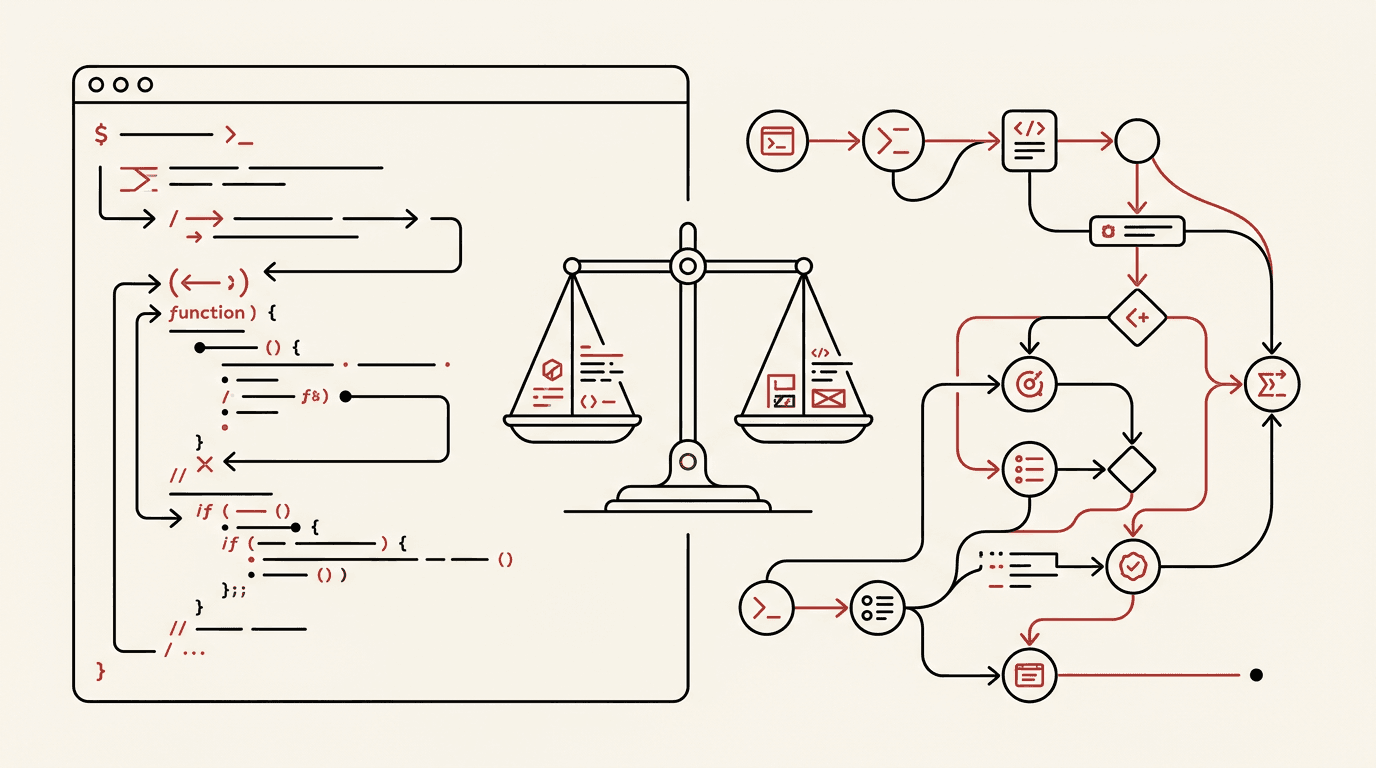
Notice what the table does not say. It does not say one tool is better. They sit at different layers of the stack. Claude Code produces software. n8n runs workflows. The real question is which layer your bottleneck lives in.
When is Claude Code the wrong choice?
We build AI agents and custom software with Claude Code every week, and we still tell some clients not to use it. It is the wrong choice when:
- Your process is pure integration. "When a Typeform comes in, enrich it, add it to HubSpot, notify Slack." Writing and maintaining custom code for this is overengineering. n8n does it in an afternoon and a non-developer can read the result.
- Nobody on your team can review code. Claude Code output still needs an engineer's eye before it touches production. Without that, you accumulate unowned software, which is worse than no software.
- You need a visual audit trail for operators. Ops teams often need to see the workflow, inspect failed runs, and rerun steps. A canvas of nodes with execution logs beats a repository they cannot read.
- The requirement is stable and shallow. If the logic fits in a handful of workflow nodes and will not change much, the flexibility of custom code buys you nothing and costs you maintenance.
Honesty here matters more than winning a comparison. A tool recommended for the wrong job fails, and the failure gets blamed on the tool instead of the fit.
When is n8n the wrong choice?
The same honesty applies in the other direction. We run custom n8n workflow automation for clients, and we regularly hit the platform's natural edges:
- The logic outgrows the canvas. Deep conditional branching, custom algorithms, or business rules with many exceptions turn a readable workflow into spaghetti. Past a certain complexity, code is clearer than nodes.
- Inputs are genuinely unstructured. n8n's AI nodes help, but when the core of the job is interpreting messy documents or making judgment calls across ambiguous data, you are fighting the platform instead of using it.
- The outcome is a product, not a process. If what you need is a customer-facing feature, an internal app, or an agent embedded in your codebase, a workflow tool cannot ship that. That is software, and software is Claude Code territory.
- Per-workflow overhead compounds. Dozens of interdependent workflows with shared logic become hard to version, test, and refactor compared to a codebase with real tests.
None of these are criticisms of n8n. They are boundaries. The SERP consensus on this comparison is right about one thing: the two tools solve different bottlenecks, and the mistake is forcing either one across the boundary.
What does the hybrid architecture look like?
The pattern we deploy most often in production is not a choice at all. It is a division of labor:
- n8n owns orchestration. Triggers, schedules, retries, and the 400+ integrations. It is the visible backbone: when X happens, run this pipeline.
- Claude Code builds the custom logic. The steps n8n cannot express become small services or scripts, written and maintained with Claude Code, that n8n calls via webhook or HTTP node.
- Each layer plays to its cost model. n8n's flat platform cost covers unlimited plumbing. The custom code runs without per-execution automation fees. Model usage is confined to the steps that genuinely need reasoning.
A concrete shape: an inbound lead hits a form, n8n catches the webhook, enriches the record, and writes to the CRM. Then it calls a custom scoring service (built with Claude Code) that reads the lead's messy free-text answers and returns a structured qualification. n8n takes the structured result and routes it: hot leads to a sales Slack channel, the rest into a nurture sequence.
Structured plumbing stays in n8n where operators can see it. Unstructured judgment lives in code where engineers can test it. If you want to experiment with the AI side cheaply first, our free models directory lists models you can point n8n's AI nodes at without an API bill.
How do you decide? A checklist
Run your automation project through these questions:
- Is the deliverable software or a workflow? A feature, app, or agent means Claude Code. Data moving between existing tools means n8n.
- Are the inputs structured? Predictable fields favor n8n. Messy documents and ambiguity favor Claude Code.
- Who maintains it in six months? An ops person maintains n8n workflows. Only an engineer maintains a codebase.
- How complex is the logic? If you cannot sketch it in under roughly a dozen nodes, it probably wants to be code.
- What does scale cost? High-volume workflows favor self-hosted n8n or deployed custom code, both of which avoid per-execution automation fees.
- Do you need both? If some steps are plumbing and some steps are judgment, you do. Split them along that line.
If three or more answers point the same direction, you have your tool. If they split, you have a hybrid architecture, which is normal.
What if you would rather skip the decision entirely?
Everything above assumes you want to build this yourself. Many of the people searching "Claude Code vs n8n" do not. They want the outcome: leads routed, invoices reconciled, support triaged, reports generated, without becoming the in-house automation team.
That is the work we do. AY Automate designs and ships production automation using both tools: n8n for the orchestration layer, Claude Code for the custom agents and logic, and the hybrid architecture above when the process demands both. You get the working system, documentation, and a team that has already made these tool decisions dozens of times, instead of a subscription and a learning curve.
If you are still comparing vendors rather than tools, our roundup of the best n8n agencies gives you the landscape, including where we sit in it.
Or start with a conversation. Book a consultation and bring the process you want automated. We will tell you which tool it needs, or whether it needs both, before any commitment.
For the exact process we run in production, see our n8n workflow builder workflow: steps, tools, and when not to use it.
Frequently asked questions
Can n8n replace Claude Code?
No, because they operate at different layers. n8n orchestrates existing tools and moves structured data; Claude Code produces custom software. n8n's AI agent nodes can handle bounded reasoning steps inside a workflow, but they cannot ship a feature, refactor a codebase, or build an application. If your bottleneck is missing software, no workflow platform replaces the tool that writes it.
Can I use Claude Code inside n8n?
Not directly as a node, but the practical pattern works well. You use Claude Code to build a small service or script, deploy it, and call it from n8n through a webhook or HTTP request node. Claude Code also ships as an SDK (documented at docs.claude.com), so the custom logic it builds can run anywhere n8n can reach. This is exactly the hybrid architecture most of our production builds use.
Which is cheaper at scale?
Neither wins universally; the cost models differ. Claude Code costs per token while building, and the resulting deployed code carries no per-execution automation fees, so high-volume custom logic gets cheap once built. n8n Cloud Pro runs around EUR 60 per month, and self-hosting reduces platform cost to infrastructure alone. At high volume, self-hosted n8n plus deployed custom code is the lean combination, which is one reason the hybrid stack is common.
Do I need a developer to use Claude Code?
Yes, in practice. Claude Code writes and executes code autonomously, but production use requires someone who can review its output, manage the repository, and own deployments. Without engineering judgment directing it, you accumulate software nobody understands. If you do not have that person, use n8n for what it covers, or have an agency like our AI agent development team own the code side for you.
Is n8n really free if I self-host?
The platform license cost drops away, but not the total cost. Self-hosted n8n means you pay for a server, updates, backups, and the time of whoever keeps it healthy. For many teams that is still far cheaper than per-task automation pricing elsewhere. Details on self-hosting live in the official docs at docs.n8n.io.
Should a non-technical founder pick n8n or Claude Code?
Start with n8n for anything it can express, because the skill floor is lower and the workflows stay legible to you. The moment a process needs custom logic, judgment over messy inputs, or a real application, bring in engineering help rather than forcing it into nodes. A custom workflow automation partner can also run the whole stack so you never touch either tool. A dedicated n8n agency can build, host, and maintain the n8n side so your team never has to.
What should I automate first?
Start with the process that is high-volume, rule-based, and currently done by hand, because it pays back fastest and its requirements are already well understood. Lead routing, data entry between tools, and report generation are typical first wins. Save the ambitious agentic projects for after the plumbing works.
Sources: n8n documentation, Claude Code documentation
Book a Free Strategy Call
Building this in production?
Walid runs a 30-min call to map your AI engineering team. Free, no slides.
Free weekly brief
Steal our production automations
The exact n8n flows, Claude Code setups, and prompts we ship for clients, broken down step by step. No spam, unsubscribe anytime.

Ex-IBM AI engineer and enterprise architect. Adel owns the technical architecture behind every automation and AI agent system AY Automate ships.