Book a Free Strategy Call
Skip the read: talk to Walid in 30 min.
Free strategy call. We map your AI engineering team, you keep the notes.
The Forward Deployed Engineer Business Model, Explained
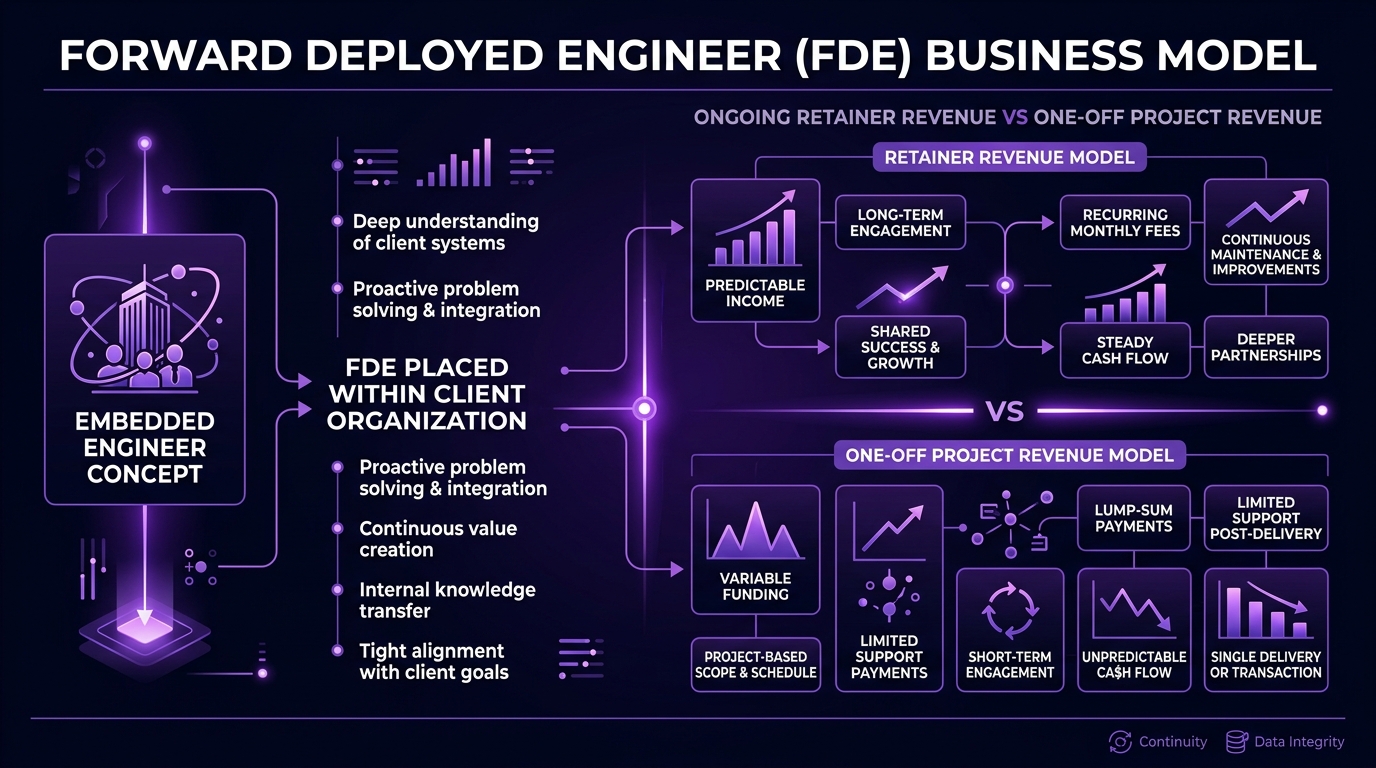
The forward deployed engineer business model gets paid to make a specific customer's deployment work, not to sell more seats of software. That single design choice explains why the model looks so different from a normal SaaS sales motion, and why frontier AI labs have been building these teams out fast.
Here is the model in plain terms: instead of shipping a general-purpose product and hoping the customer configures it correctly, you send an engineer to sit inside the customer's environment, build the specific thing that makes the product actually work for them, and get paid (in revenue, retention, or expansion) when it does.
TL;DR
- The FDE business model ties engineering effort directly to a customer's production outcome, not to a generic product roadmap.
- It runs on a repeatable loop: audit the real workflow, build an evaluation set, then deploy carefully with increasing autonomy, credited to the framework taught in Varick Agents' FDE-in-30-Days guide.
- The commercial logic is usage-based: the model pays for a deployment that actually works and drives usage, not for a closed contract regardless of outcome.
- The team stays small on purpose. OpenAI's own forward deployed engineering group reportedly grew from 2 to 39 people in a year while staying tightly scoped to problems worth real enterprise budget, not staffed up like a consulting bench.
- AY Automate runs this model through engineer placement: the commercial structure is an embedded engineer building toward your outcome, not a subscription you configure yourself.
Related Reads
Why the model exists
An AI model API, on its own, does not produce an enterprise outcome. Someone has to connect it to the customer's actual data, handle the failure modes that only show up at production scale, and get a skeptical stakeholder to trust that the system is right often enough to rely on. That gap between "we have a capable model" and "this works reliably inside our business" is what the forward deployed engineer business model is built to close.
Palantir built the model first, embedding roughly 120 engineers inside JPMorgan starting in 2009 because its government and defense customers could not hand over their data or their process for a remote team to interpret. The economics made sense there: the deployment work was the product. OpenAI adopted the same structure for enterprise AI, launching a dedicated deployment arm (through the Tomoro acquisition, announced May 2026) with around 150 forward deployed engineers and deployment specialists working alongside adopters that reportedly include HP, Intuit, Oracle, State Farm, and Uber.
Free weekly brief
Steal our production automations
The exact n8n flows, Claude Code setups, and prompts we ship for clients, broken down step by step. No spam, unsubscribe anytime.
How the commercial loop actually runs
The FDE model, as it is practiced at labs like OpenAI and taught in detail by Varick Agents, runs on a three-phase loop that repeats as trust builds:
- Audit. The engineer learns how the work really happens today, not the documented process. This produces an operating map: what the workflow looks like now versus with AI in it.
- Evals. Non-determinism gets turned into evidence. A golden dataset of real examples with hand-labeled correct outputs lets the team measure pass rates and failure categories instead of arguing about vibes.
- Deployment. The system ships on the customer's existing infrastructure, starting in a sandbox and increasing autonomy gradually as the evals hold up, with everything monitored.
In regulated industries this pilot-to-trust phase can run four months or longer before it reaches production. That is by design. The commercial model is not "close the deal and move on," it is "stay accountable until the thing works," which is also why the team stays small: paying for outcome ownership does not scale the same way paying for demo-and-handoff work does.
Where the money actually comes from
The commercial logic behind the FDE model is usage, not licenses. A traditional software sale monetizes seats or subscriptions regardless of whether the customer gets full value. The FDE model monetizes the deployment itself: the engineering work required to get an AI system embedded deeply enough into a customer's operations that it drives measurable usage, and the usage is what generates revenue on the other side.
Money follows working deployments, not shelfware, and the FDE's job is to make sure the deployment actually works before anyone talks about expansion.
What this means if you are buying, not building
If you are a company considering this model, the commercial question to ask is not "what does an FDE cost per hour." It is "what outcome is this engineer accountable for, and what happens if it does not ship." A vendor selling FDE-style work should be able to name the specific business metric the engagement is judged against, describe the evaluation process that will prove the system works, and explain what your team owns once the engagement ends.
AY Automate runs forward deployed engineers this way: engineer placement embeds an AI-native engineer in your team, working the same audit, evals, deployment loop, toward a defined outcome on your actual stack, and the engagement is judged on whether that outcome ships. For a full breakdown of the role itself, see our forward deployed engineer guide. For how the model compares to hiring a consultant, see our FDE vs consultant breakdown.
FAQ
What is the forward deployed engineer business model in one sentence?
It is a model that pays for a working, production deployment inside a specific customer's environment, rather than for generic product access, so the engineer's incentive is tied to the outcome actually shipping.
How is the FDE business model different from a normal software sale?
A normal software sale monetizes seats or subscriptions whether or not the customer gets full value. The FDE model monetizes the deployment itself, on the logic that a working deployment drives the usage that generates revenue.
Why do FDE teams stay small on purpose?
Because the model is not built around billable headcount. Paying a small team to own an outcome is a different economic bet than staffing a large team against billable hours, and frontier labs have kept their FDE teams tightly scoped even as demand grew.
Does AY Automate get paid based on the customer's usage under this model?
No. AY Automate is paid for the engineer placement itself, not a revenue share tied to downstream usage. The usage-based logic above explains how the FDE model is commercially justified at platform companies; it does not describe AY's own pricing structure.
How does AY Automate apply this business model?
Through engineer placement: an engineer embeds inside your team, builds against a defined outcome on your existing stack, and the engagement is judged on whether that outcome ships, not on hours logged.
Sources: Palantir Technologies on the origin of the FDE model at JPMorgan, OpenAI's Tomoro-based deployment arm as reported via officechai.com, OpenAI's forward deployed engineering practice via a ZenML LLMOps case study, and Varick Agents' FDE-in-30-Days guide.
Continue Reading
AI QA Testing Agents: What to Automate, Where QA Judgment Leads (2026)
What an AI QA testing agent does well (test generation, regression testing, cross-browser checks), where QA judgment still leads, and how this differs from agent evals.
GPT-6 Astra vs Claude Fable 5.1 vs Opus 5.5: Why Model Routing Wins
GPT-6 Astra and Claude Fable 5.1 both list at $10 and $50 per million tokens. Claude Opus 5.5, GPT-6 Sol and GPT-6 Luna, all released September 22, cost far less. Verified prices, one independent index and a task-by-task routing table, prices checked September 26, 2026.
Why 88% of AI Agent Pilots Never Reach Production (and How to Be in the Rest)
IDC, Forrester and Anaconda, and McKinsey all published separate 2026 research landing on the same number: roughly 9 in 10 AI pilots never reach production. Here is what the 12% that ship do differently.
Book a Free Strategy Call
Building this in production?
Walid runs a 30-min call to map your AI engineering team. Free, no slides.
Free weekly brief
Steal our production automations
The exact n8n flows, Claude Code setups, and prompts we ship for clients, broken down step by step. No spam, unsubscribe anytime.

Ex-IBM AI engineer and enterprise architect. Adel owns the technical architecture behind every automation and AI agent system AY Automate ships.