Book a Free Strategy Call
Skip the read: talk to Walid in 30 min.
Free strategy call. We map your AI engineering team, you keep the notes.
Most enterprise AI strategy work still starts the same way: a consulting firm sends a team to run workshops for six to eight weeks, produces a hundred-slide deck with a maturity curve and a use case matrix, and hands it over. The deck is thorough. It is also, in a large share of cases, the last time anyone looks at it. A December 2025 Gartner survey of CxOs found that only 27% of executives have a comprehensive AI strategy, and BCG's 2025 survey of 1,250 AI decision-makers across 25+ sectors, evaluated across 41 dimensions including strategy, technology, and talent, found that only about a third of companies are actually scaling AI, with the rest still stuck in pilot mode and minimal demonstrated return, a gap that lines up with MIT Media Lab's separate finding that just 5% of companies are extracting real bottom-line value from AI at scale.
The gap is not a strategy-quality problem so much as a strategy-format problem. A slide deck is not a strategy. A strategy is a small set of decisions someone is accountable for shipping, with a business case attached to each one. Here is the version of that process we run with teams building an enterprise AI strategy without handing the whole thing to an outside firm for six months.
What a consulting-firm AI strategy engagement actually costs
Before deciding whether to build this in-house, it helps to know what the alternative costs. Pricing varies by scope, but two independent 2026 market breakdowns land in a similar range: a standalone strategy assessment and roadmap typically runs $25,000 to $100,000, and a full enterprise-wide AI transformation program, including governance design, business case modeling, and a rollout roadmap, runs $100,000 to $500,000 or more, a range that lines up with a second source putting full transformation programs at $400,000 or more once every phase is billed. Senior consultants on these engagements bill $300 to $500 or more per hour, and the strategy phase alone can take two to three months before any implementation work starts.
That price buys structure and an outside perspective, which has real value for a first-time enterprise AI effort. It does not buy execution. The strategy document still has to survive contact with your actual systems, your actual data quality, and the actual people who have to change how they work. That part is the same amount of effort whether a consulting firm wrote the plan or you did.
Related Reads
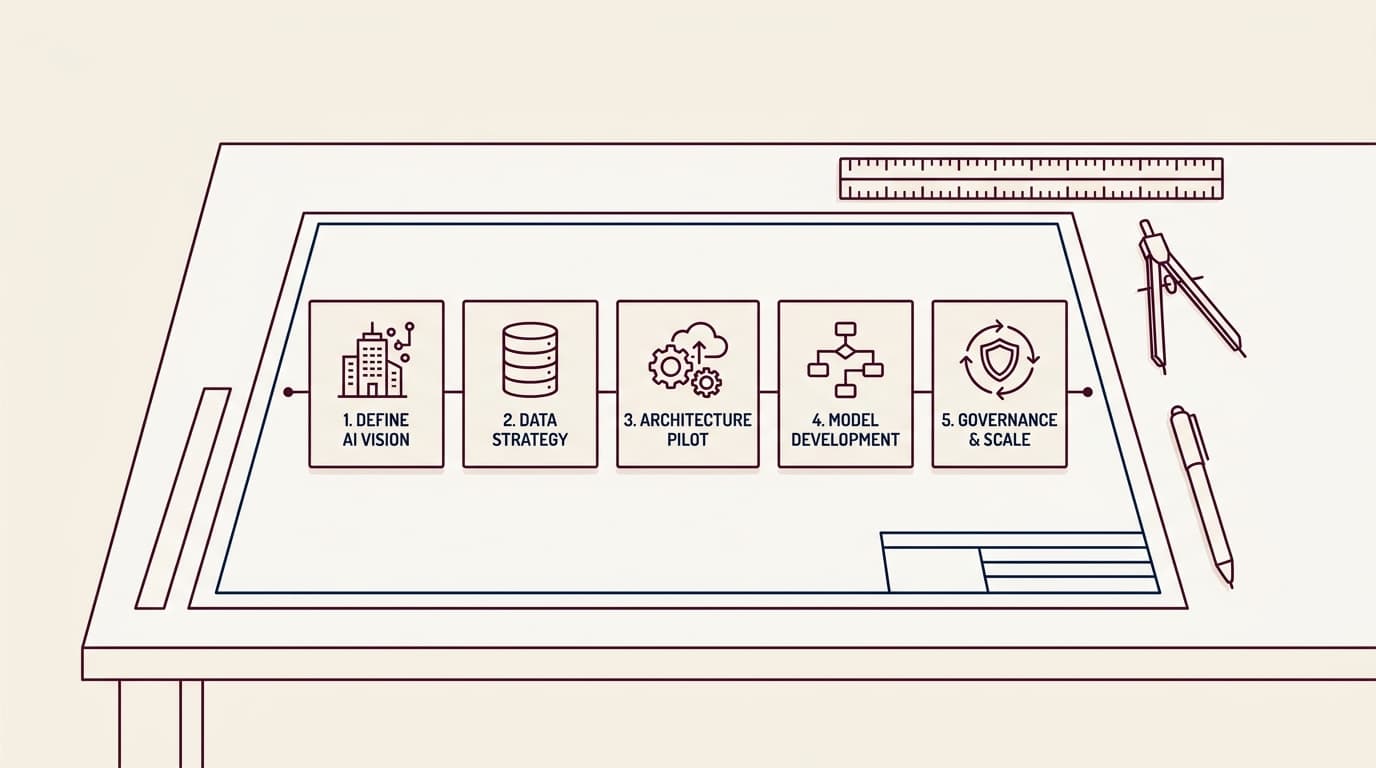
The five decisions that make up a real strategy
Skip the maturity curve. An enterprise AI strategy is five concrete decisions, each with an owner and a number attached.
| Decision | What it answers | Who should own it |
|---|---|---|
| Where to start | Which 2 to 3 workflows get built first, and why those and not others | A business unit leader, not IT |
| The business case | Expected cost saved or revenue moved, and how you will measure it | Finance, paired with the workflow owner |
| The operating model | Who builds, who maintains, who has final sign-off on production changes | CTO or head of engineering |
| The governance line | What requires human review before it ships, and what does not | Legal or compliance, plus the workflow owner |
| The timeline | Realistic dates for pilot, production, and the next workflow after this one | Whoever owns the P&L for the first workflow |
Every one of these needs a name next to it before the strategy is real. A strategy document with "the AI team" instead of a named accountable owner on each row is a wish list wearing a strategy's clothes.
Start narrow, on purpose
The instinct in a company-wide AI mandate is to list every department that could benefit from AI and sequence a rollout across all of them. Resist it. Pick two or three workflows with a clear, measurable outcome and a business owner who actually wants this to work, not one who was assigned it. Depth on one workflow that ships and compounds beats breadth across ten that stall in pilot. This is also the fastest way to build internal credibility: a single production win that a business owner can point to does more to unlock budget for the next ten workflows than any slide about AI's long-term potential.
Build the business case before you pick a vendor or a platform
The business case is a number, not a paragraph. What does the current process cost in hours, error rate, or missed revenue, and what would a 50% to 80% reduction in that cost actually be worth over a year? Write this down before evaluating any tool or platform. A business case built after the vendor is already chosen tends to get reverse-engineered to justify the purchase, not to test whether the workflow was worth automating in the first place.
Decide the operating model up front
Someone has to own the code and the models in production once the pilot works, not just the pilot itself. Decide now whether that is an in-house team, an embedded forward deployed engineer who builds alongside your team and hands off a system your engineers can maintain, or an ongoing partnership with the team that built it. Deciding this after the pilot succeeds is how a working prototype sits unmaintained for a year because nobody was assigned to own it.
Write the governance line before the first production rollout
You do not need a company-wide AI governance framework before starting one workflow. You do need, in writing, what requires a human sign-off before it ships and what the escalation path looks like when the system is uncertain. If you want the fuller version of this, including a maturity model to benchmark against, see our AI governance framework guide. Start with the minimum viable version for the workflow in front of you and expand it as you add workflows.
Set a timeline tied to evidence, not a calendar
A realistic timeline for one well-scoped workflow runs 4 to 6 weeks from kickoff to a monitored production rollout. Set the date for moving to the next workflow based on the first one hitting its production checkpoints, not a fixed quarter on a roadmap slide. A strategy that promises ten workflows live by year end, regardless of how the first one goes, is a calendar with an AI label on it.
Free weekly brief
Steal our production automations
The exact n8n flows, Claude Code setups, and prompts we ship for clients, broken down step by step. No spam, unsubscribe anytime.
DIY, consulting firm, or an automation-led partner
| Consulting-firm strategy engagement | Fully DIY | Automation agency-led strategy | |
|---|---|---|---|
| Typical cost | $25,000 to $500,000+ depending on scope | Internal team time only | Scoped to the first 2 to 3 workflows, usually a fraction of a full consulting engagement |
| Time to a decision | 2 to 3 months before implementation starts | Fast to start, slow to finish without outside experience | Weeks, because strategy and the first build happen together |
| What you get | A deck and a roadmap | Whatever your team already knows how to do | A working first workflow plus the operating model to repeat it |
| Biggest risk | The deck never gets implemented | Blind spots on governance, evals, and what "production-ready" actually means | Depends entirely on whether the partner ships production systems, not just decks |
The honest case for bringing in outside help is not that your team cannot think strategically. It is that most in-house teams have not shipped ten AI workflows to production and do not know yet what breaks at the handoff from pilot to production. An automation agency that builds the strategy and the first workflow together, instead of handing off a deck and disappearing, collapses the strategy phase and the proof-of-value phase into the same few weeks. If you want a sense of what that looks like end to end, here is how we scope and run that work.
What this means for you
- Write five decisions, not a hundred slides. Where to start, the business case, the operating model, the governance line, and the timeline. Everything else is detail underneath those five.
- Price the alternative before choosing DIY. A standalone strategy assessment runs $25,000 to $100,000, and a full enterprise transformation program runs $100,000 to $500,000 or more, and takes months before implementation starts; know that number before you decide it is worth doing in-house.
- Pick 2 to 3 workflows, not a company-wide mandate. Breadth without a shipped win first is the most common way this stalls.
- Assign an owner to every decision. A strategy with "the AI team" instead of a name on each row will not survive contact with the first hard tradeoff.
- Tie your timeline to production checkpoints, not a quarter. A date on a roadmap slide is not evidence that the first workflow actually works.
FAQ
How long does it take to build an enterprise AI strategy? A consulting-firm engagement for strategy alone typically runs two to three months before any implementation starts. Building the strategy alongside the first workflow, rather than as a standalone document, usually compresses this to a few weeks because the strategy gets tested against a real build instead of a hypothetical one.
How much does enterprise AI strategy consulting cost? A standalone strategy assessment and roadmap, without implementation, typically runs $25,000 to $100,000. Full enterprise transformation programs that include governance design and a rollout plan run $100,000 to $500,000 or more, consistent with a second source putting full programs at $400,000 or more once every phase is billed.
Do we need a company-wide AI strategy before starting our first project? No. You need the five decisions above answered for the first two or three workflows you are building. A company-wide strategy document is easier to write correctly once you have shipped a workflow or two and know what actually breaks between pilot and production.
What is the biggest reason enterprise AI strategies fail to get implemented? The strategy is written as a document instead of a set of owned decisions. MIT Media Lab's research found that only about 5% of companies extract real value from AI at scale, and BCG's related survey of AI decision-makers found the pattern among the roughly two-thirds still stuck in pilot mode is rarely a bad idea; it is a plan with no accountable owner attached to each decision, so nothing ships once the workshop ends.
Should we hire a consulting firm, build the strategy ourselves, or bring in an automation partner? It depends on whether your team has shipped AI workflows to production before. If yes, you likely have the internal muscle to run this yourselves. If not, an automation partner that builds the strategy and the first workflow together gives you a working system and a repeatable operating model in the same timeframe a consulting firm would spend just producing the deck. If you want that partner to stay on as ongoing AI leadership instead of handing off a deck, that's what our AI strategy consulting and fractional CAIO service adds on top.
What should be in the business case before we pick a platform or vendor? A number: what the current process costs today in hours, error rate, or missed revenue, and what a realistic reduction in that cost is worth over a year. Write this before evaluating tools, so the business case is testing the workflow's value, not justifying a purchase that already happened.
Sources: Gartner, "By 2027, 50% of Enterprises Without a People-Centric AI Strategy Will Lose Their Top AI Talent", BCG "Widening AI Value Gap" research via Forbes, Leanware, "How Much Does an AI Consultant Cost?", Solulab, "AI Consulting Cost in 2026"
Continue Reading
AI Facilities Management Tools: What to Automate, Where Judgment Leads (2026)
What AI facilities management tools automate well, how this differs from property management, and where facilities professional judgment still leads.
AI Vendor Management: What to Automate, Where Judgment Leads (2026)
Where AI genuinely helps in vendor management (contract tracking, risk monitoring, SLA tracking), and where negotiation and relationship judgment still lead.
AI Load Testing Tools: What to Automate, Where Engineering Judgment Leads (2026)
What AI load testing tools do well, how this differs from functional CI/CD testing, and where engineering judgment on results still leads.
Book a Free Strategy Call
Building this in production?
Walid runs a 30-min call to map your AI engineering team. Free, no slides.
Free weekly brief
Steal our production automations
The exact n8n flows, Claude Code setups, and prompts we ship for clients, broken down step by step. No spam, unsubscribe anytime.

Walid founded AY Automate to help businesses ship AI workflows that actually move revenue. He leads strategy and oversees every client engagement end-to-end.
Full Bio →