Book a Free Strategy Call
Skip the read: talk to Walid in 30 min.
Free strategy call. We map your AI engineering team, you keep the notes.
Hiring a senior AI engineer in 2026 costs more than most CTOs budget for. Before you post the job description, understand what you're actually signing up for: a $285,000 average total compensation package (Glassdoor, 2026), a 4.6-month average time-to-fill, and 3-6 months before that person ships anything production-ready. That's 7-10 months and roughly $200,000 spent before you see a single line of code in production.
AI staff augmentation flips that equation. You get a vetted engineer embedded in your team within days, not months, at a fraction of the fully loaded cost. This post breaks down the real numbers so you can make the decision with clear eyes.
Whether you're a CTO at a scaling SaaS, a VP Engineering at an enterprise digitizing workflows, or a founder who needs to move fast, the math here applies directly to your next hiring decision.
The True Cost of Hiring an In-House AI Engineer in 2026
Most hiring managers anchor on base salary. That's the wrong number.
A senior AI engineer's base in the US ranges from $200,000-$252,000 in major hubs (Bay Area average: $252K, New York: $235K, Austin: $198K). But base salary is only part of the story.
The Fully Loaded Annual Cost
| Cost Component | Annual Cost (Estimate) |
|---|---|
| Base salary (national avg senior AI) | $210,000 |
| Payroll taxes (FICA, FUTA, SUTA) | ~$16,000 |
| Health insurance (family plan) | ~$22,000 |
| 401(k) match (4% of base) | ~$8,400 |
| Equity / RSU vesting cost | ~$30,000-$84,000 |
| Paid time off (15 days) | ~$12,000 |
| Equipment + tooling (laptop, SaaS licenses) | ~$5,000 |
| Recruiting fees (15-20% of first-year salary) | ~$31,500-$42,000 (one-time) |
| Onboarding + ramp productivity loss (3-6 months) | ~$52,500-$105,000 (one-time) |
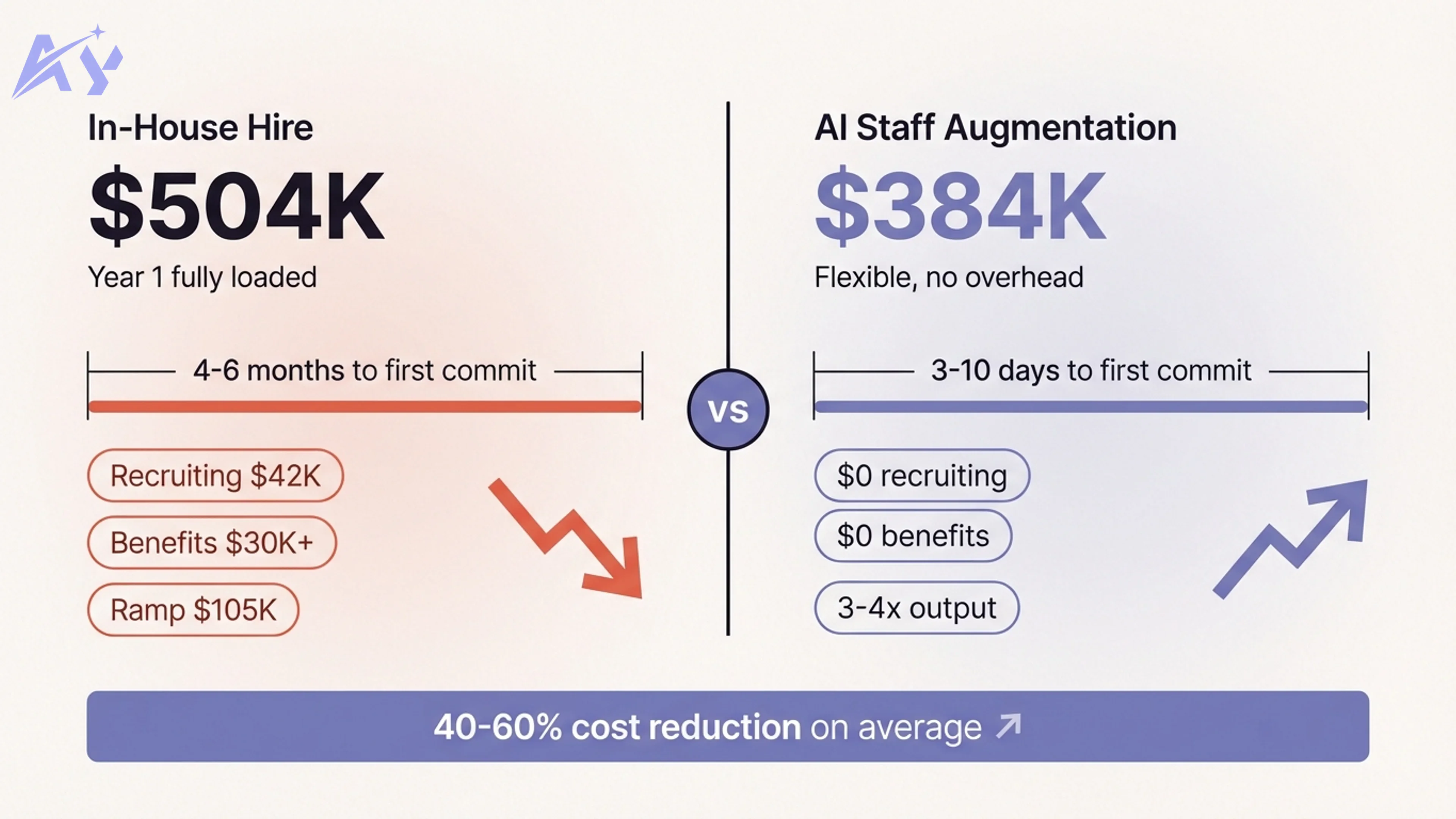
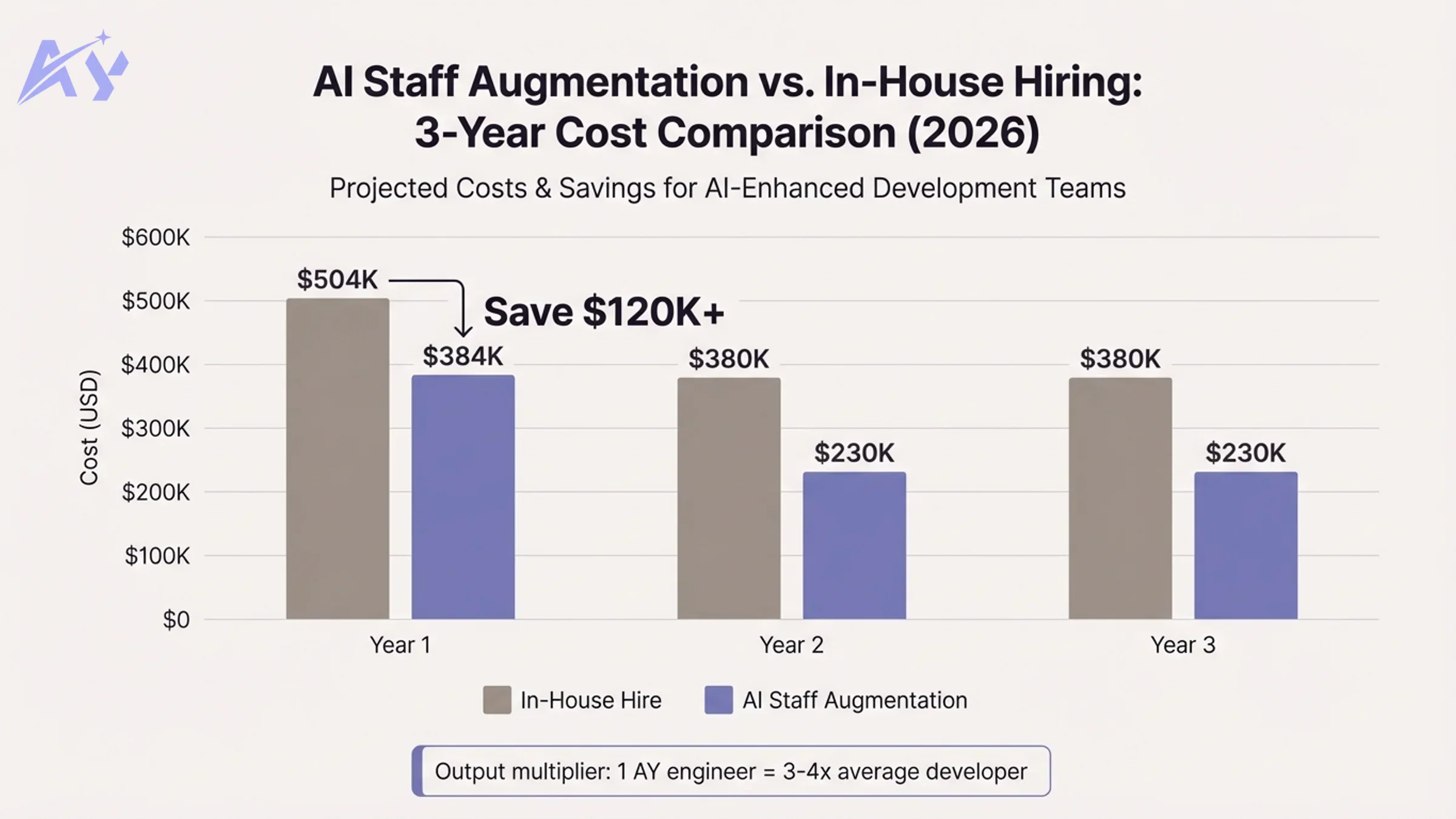
| Total Year 1 fully loaded cost | $387,000-$504,000 |
The recruiting fee and ramp loss are one-time costs, but they hit hardest in Year 1, which is when you most need velocity. And with a 40% first-year turnover rate for engineers, there's a real chance you're paying those one-time costs again in 18 months.
The Hidden Drag: Time
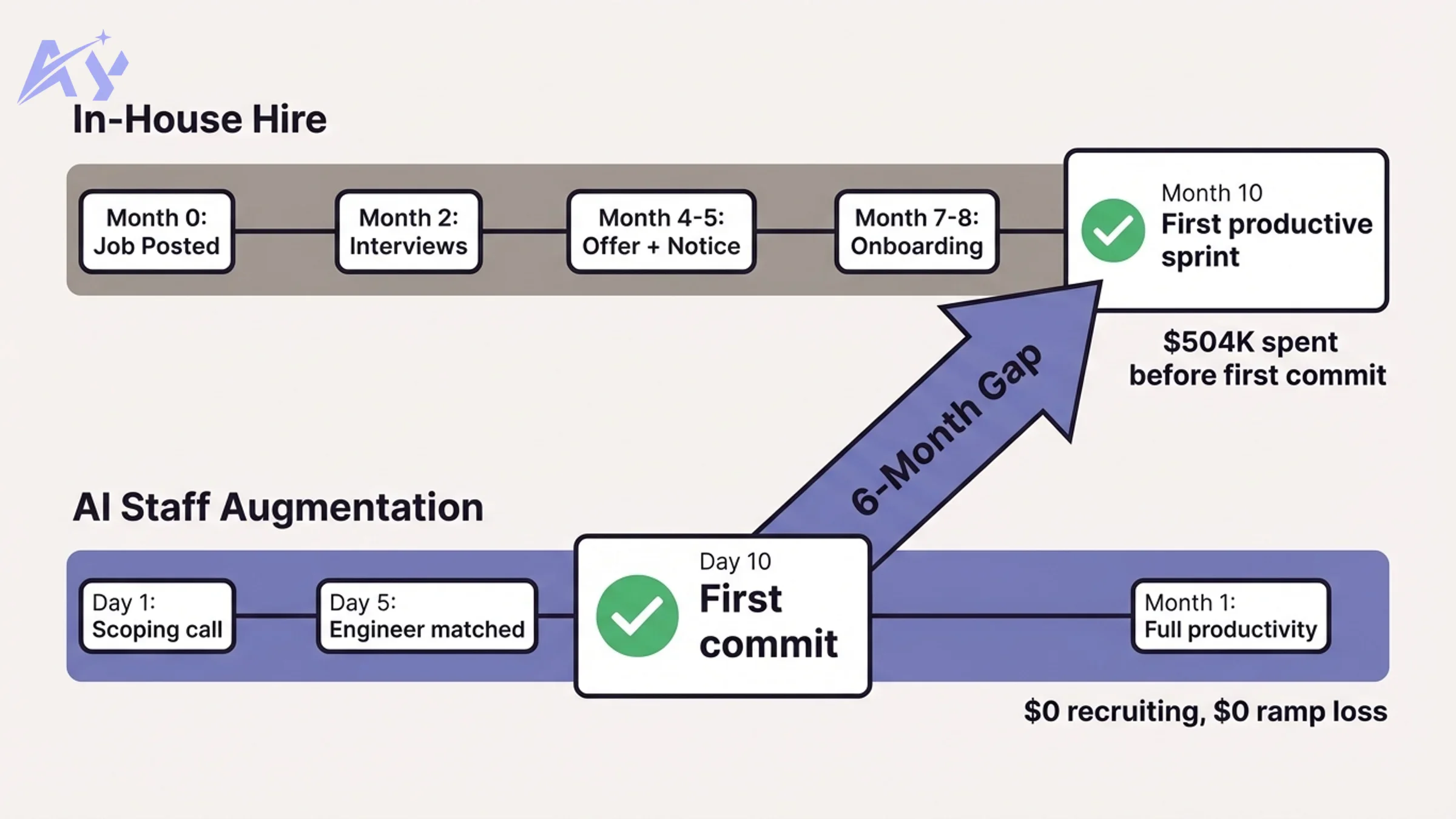
The average time to fill a senior AI engineer role with LLM or generative AI specialization is 54 days for mid-level and up to 114 days if your base offer is below $200,000. Factor in the interview process, offer negotiation, notice period, and onboarding, and you're realistically 4-6 months from posting to first productive sprint.
That's 4-6 months of engineering capacity you don't have. For most teams, that's the real cost.
Related Reads
What AI Staff Augmentation Actually Costs
AI staff augmentation places a vetted senior engineer into your team, typically within 2-10 business days. You get the output without the overhead.
Typical pricing for a US-based augmented AI engineer ranges from $120-$200/hour depending on specialization. At 160 hours per month, that's $19,200-$32,000/month, or $230,400-$384,000 annually.
That sounds comparable to a full-time hire at first glance. The difference is in what you're not paying for.
What You Don't Pay With Augmentation
- No recruiting fees ($31,500-$42,000 saved)
- No benefits package ($30,000+ saved per year)
- No equity dilution
- No 3-6 month ramp period (most augmented engineers are productive within days)
- No HR administration, performance review cycles, or termination liability
- No tooling provisioning or IT overhead
- No productivity loss during the hiring search
And critically: you pay for the hours you need. When a project ends or priorities shift, you scale down without severance, legal risk, or morale damage to the rest of the team.
The Output Multiplier
This is where the calculus shifts decisively. At AY Automate, our engineers are measured on a simple benchmark: 1 AY engineer delivers the output of 3-4 average developers. That's not a marketing claim. It's the result of AI-native engineering practices: Claude Code for accelerated development, Agno for agent orchestration, purpose-built RAG pipelines, and engineers who have shipped dozens of production AI systems.
If you hire three average engineers at $150K each ($450K/year in base alone), you're buying roughly the same output as one AY augmented engineer. Except the three-person team also costs you $150,000+ in overhead, 9-12 months of recruiting time, and significant management bandwidth.
Free weekly brief
Steal our production automations
The exact n8n flows, Claude Code setups, and prompts we ship for clients, broken down step by step. No spam, unsubscribe anytime.
Side-by-Side Comparison
| Factor | In-House Hire | AI Staff Augmentation |
|---|---|---|
| Time to first commit | 4-7 months | 3-10 days |
| Year 1 fully loaded cost | $387K-$504K | $230K-$384K |
| Ongoing annual cost | $280K-$380K | $230K-$384K (flexible) |
| Recruiting cost | $31,500-$42,000 | $0 |
| Ramp / onboarding loss | $52,500-$105,000 | Minimal (days, not months) |
| Flexibility to scale | Low (6+ months notice) | High (days) |
| Specialization depth | One generalist hire | Access to full AI specialty stack |
| Management overhead | High | Low (async, structured delivery) |
| First-year turnover risk | 40% | Contractually managed |
| Output vs avg developer | 1x | 3-4x (AY Automate benchmark) |
Addressing the Real Objections
"Will they understand our codebase?"
A legitimate concern. The answer depends entirely on the augmentation model. Generic offshore outsourcing often produces engineers who struggle with codebase context. AI staff augmentation at AY Automate is different: engineers embed directly in your team, join your Slack, attend standups, and work within your existing tools and Git workflow. Codebase onboarding typically takes 3-5 days for a senior engineer who has seen dozens of production systems.
We also deliver audit-ready documentation from day one, so institutional knowledge doesn't walk out the door.
"What about knowledge transfer and continuity?"
This is the strongest argument for full-time hiring, and it's worth taking seriously. If you have a 5-year roadmap that requires a single engineer to own an entire platform indefinitely, in-house may win on continuity.
But most teams don't have that problem. They have a 6-12 month build phase, followed by a maintenance phase with much lower headcount requirements. Augmentation aligns perfectly with that pattern. You bring in senior firepower for the sprint, then transition to a lighter engagement or hand off to a smaller in-house team with clear documentation.
Our automation maintenance and support service exists precisely for that post-build phase.
"Isn't this just outsourcing?"
No. Traditional outsourcing is project-based, spec-driven, and often produces a black box. AI staff augmentation is team integration: the engineer works in your environment, under your direction, with daily visibility. You see the work in real time. You own the code. There are no hidden deliverable hand-offs.
The difference between outsourcing and augmentation is the same as the difference between hiring a subcontractor who disappears for three months and a colleague who sits next to you on Slack every day.
When In-House Hiring Still Makes Sense
Augmentation isn't always the right answer. In-house hiring wins when:
- You need a long-term technical co-founder, not a contractor
- You are building a proprietary AI system where IP concentration in one employee is strategically important
- Your engineering culture requires deep cultural alignment over 2-3 years
- You have already found an exceptional candidate at below-market rates
For most scaling companies and enterprise teams in 2026, those conditions are rarely all true simultaneously.
The ROI Case: Running the Numbers
Assume you need to ship a production RAG pipeline and an AI agent for internal ops in the next 6 months.
Option A: Hire 2 in-house AI engineers
- Recruiting: 4-6 months, $63,000-$84,000 in fees
- Year 1 fully loaded cost for 2 engineers: $774,000-$1,008,000
- Actual productive time in first 6 months: 2-3 months per engineer after ramp
- Output: 2 engineers x reduced productivity = roughly 1.5 engineers' worth of shipped work
Option B: Augment with 1 AY senior AI engineer
- Time to start: 3-10 days
- 6-month cost at $160/hr, 160 hrs/month: $153,600
- Actual productive time: full 6 months from day 10
- Output: 1 AY engineer = 3-4 average developers in shipped work
The 6-month cost of Option B is less than the recruiting fees alone for Option A. And the output from Option B is on par with or exceeds Option A because of the AI leverage ratio.
If you need custom AI agent development or a RAG pipeline architecture built in a defined timeline, augmentation is the rational choice.
What the Best AI-First Teams Do in 2026
The teams moving fastest in 2026 are not choosing between in-house and augmentation as a binary. They are building AI-augmented hybrid teams: a small core in-house team (2-4 engineers) who own the architecture and roadmap, augmented by specialist engineers for specific build phases.
This model gives you:
- Continuity and institutional knowledge from the core team
- Speed and specialization from augmented engineers during build sprints
- Flexibility to scale down after launch without layoffs
- Access to niche skills (Claude Code, Agno, LLM fine-tuning, enterprise RAG) that are nearly impossible to hire full-time
AY Automate's AI strategy consulting team helps engineering leaders design exactly this kind of staffing architecture, including build-vs-buy decisions, team structure recommendations, and transition plans.
Key Takeaways
- The real Year 1 cost of an in-house senior AI engineer is $387K-$504K, not the $210K base most people budget for. Recruiting fees and ramp loss are the biggest surprises.
- AI staff augmentation saves 40-60% in Year 1 when fully loaded costs are compared, and delivers output from day 10, not month 7.
- The output multiplier changes the math entirely. If 1 augmented AY engineer delivers 3-4x average developer output, the cost-per-unit-of-shipped-work is dramatically lower than any full-time hire.
- Hybrid teams win. Small core in-house team plus specialist augmented engineers for sprints is the model used by the fastest-moving AI-first companies in 2026.
- Augmentation is not outsourcing. Full Slack integration, daily updates, your codebase, your tools, your direction.
If you're at the decision crossroads right now, the most productive next step is a free workflow audit: a 30-minute call where an AY architect maps your current stack and identifies where augmented AI engineering would accelerate your roadmap fastest.
Book your free workflow automation audit and talk to an AY engineer today.
Sources: Glassdoor Senior AI Engineer Salary 2026, KORE1 AI/ML Talent Map 2026, BLS Employee Cost Survey March 2026, DX AI Onboarding Research 2026, Second Talent Global AI Talent Shortage Statistics 2026
FAQ
Which is cheaper for a growing engineering team? For teams scaling past 2-3 AI engineers, staff augmentation usually wins on speed to capacity; past that, in-house ownership can win on cost. See our full cost breakdown and our guide to hiring AI engineers in-house.
What is AI staff augmentation? AI staff augmentation is a hiring model where you bring in external AI engineers who embed directly into your team on a contract basis. Unlike traditional outsourcing, augmented engineers work in your Slack, your codebase, and under your direction, with full daily visibility.
How much does it cost to hire an AI engineer in 2026? A senior AI engineer in the US commands $200,000-$252,000 in base salary. Fully loaded Year 1 cost typically runs $387,000-$504,000.
What is the difference between AI staff augmentation and outsourcing? Outsourcing is typically project-based with limited daily visibility. AI staff augmentation means the engineer joins your team, attends your standups, works in your tools, and reports to your leads. You retain full control of the work.
How long does it take to onboard an augmented AI engineer? Most augmented engineers are productive within 3-10 business days, compared to 3-6 months for an in-house hire to reach full productivity.
Is AI staff augmentation suitable for long-term projects? Yes. While most cost-efficient for defined build phases (3-12 months), many clients maintain augmented engineers long-term for ongoing development and automation maintenance.
What does AY Automate's engineer placement service include? AY Automate's engineer placement service matches your requirements to vetted senior AI engineers, provides onboarding support, and maintains active project oversight. Engineers deliver daily updates and produce audit-ready documentation throughout.
For context on what in-house hiring costs, see the AI engineer salary guide for 2026. If you want to explore a hybrid model first, the fractional AI engineer guide outlines how it works. And when you do decide to hire directly, how to hire AI engineers covers the full vetting process. Not sure augmentation is even the right call yet? 7 signs you need an AI-augmented development team lays out the specific triggers worth checking first.
Continue Reading
Why 88% of AI Agent Pilots Never Reach Production (and How to Be in the Rest)
IDC, Forrester and Anaconda, and McKinsey all published separate 2026 research landing on the same number: roughly 9 in 10 AI pilots never reach production. Here is what the 12% that ship do differently.
Your AI pilot isn't broken. Your deployment infrastructure is.
IDC finds 88% of enterprise AI pilots never reach production. McKinsey finds only 6% of companies see real ROI. Forkast finds 41% of the ones that do ship lose money within a year. None of it is the model's fault.
Responsible AI Framework for the Enterprise: How to Build One (2026)
What a responsible AI framework actually consists of, how it differs from scattered good practices, and how to build one that shapes real decisions.
Book a Free Strategy Call
Building this in production?
Walid runs a 30-min call to map your AI engineering team. Free, no slides.
Free weekly brief
Steal our production automations
The exact n8n flows, Claude Code setups, and prompts we ship for clients, broken down step by step. No spam, unsubscribe anytime.

Taha builds and ships custom AI agents and workflow automations for AY Automate clients across SaaS, finance, and professional services.