Book a Free Strategy Call
Skip the read: talk to Walid in 30 min.
Free strategy call. We map your AI engineering team, you keep the notes.
An AI-first engineer is a software professional whose primary skill is directing AI systems to produce production-grade output rather than writing every line of code by hand. They specify intent with precision, orchestrate tools like Claude Code and multi-agent frameworks, and review AI-generated output at the architecture level. You will also see the profile called an agentic AI developer or AI-native engineer.
The numbers explain why the definition matters. 4% of all global GitHub commits are now authored by Claude Code. By end of 2026, that figure is projected to reach 20%. Meanwhile, 3.2 companies are competing for every qualified AI engineer on the market, with over 1.6 million open positions and only 518,000 candidates available to fill them.
That talent gap is a definition problem, not a pipeline problem. Most hiring managers are still screening for the wrong profile. They are looking for engineers who write code well. What they actually need is engineers who direct AI with precision. Those are 2 fundamentally different skill sets.
This post defines the AI-first engineer clearly: what they do, how they think, what tools they use, and why this profile is non-negotiable for any engineering team that wants to stay competitive. If you are a CTO, technical founder, or engineering lead at a SaaS company or startup, this is the hiring framework you need going into 2026.
What Is an AI-First Engineer?
An AI-first engineer (also called an agentic AI developer or AI-native engineer) is a software professional whose primary skill is not writing code from scratch. It is orchestrating AI systems to produce production-grade output at speed.
The distinction matters. Traditional engineers treat AI tools as autocomplete. AI-first engineers treat AI as a junior team member they manage, direct, and review. They spend the majority of their time on system design, intent specification, and output validation rather than syntax and implementation.
This shift is structural, not cosmetic. At Anthropic internally, 100% of pull requests are now reviewed by Claude before human review. Engineers report delegating approximately 60% of their work to AI tooling, with a documented 50% productivity boost. The engineer's leverage multiplier has changed permanently.
The Intent Coding Paradigm
The clearest way to understand AI-first engineering is through the concept of intent coding: the practice of specifying what a system must do with precision, rather than writing every line of how it does it.
Intent coding is not vibe coding. Vibe coding means generating output with loose prompts and hoping it works. Intent coding is the opposite: it requires rigorous specification of inputs, outputs, constraints, edge cases, and acceptance criteria before a single line of AI-generated code is written.
An AI-first engineer practicing intent coding:
- Defines the system behavior contract in structured natural language before touching a tool
- Breaks work into atomic agent tasks with clear success conditions
- Validates output against predefined acceptance tests instead of vibes
- Iterates on specifications, not code, when output is wrong
- Maintains human judgment on architecture decisions and security boundaries
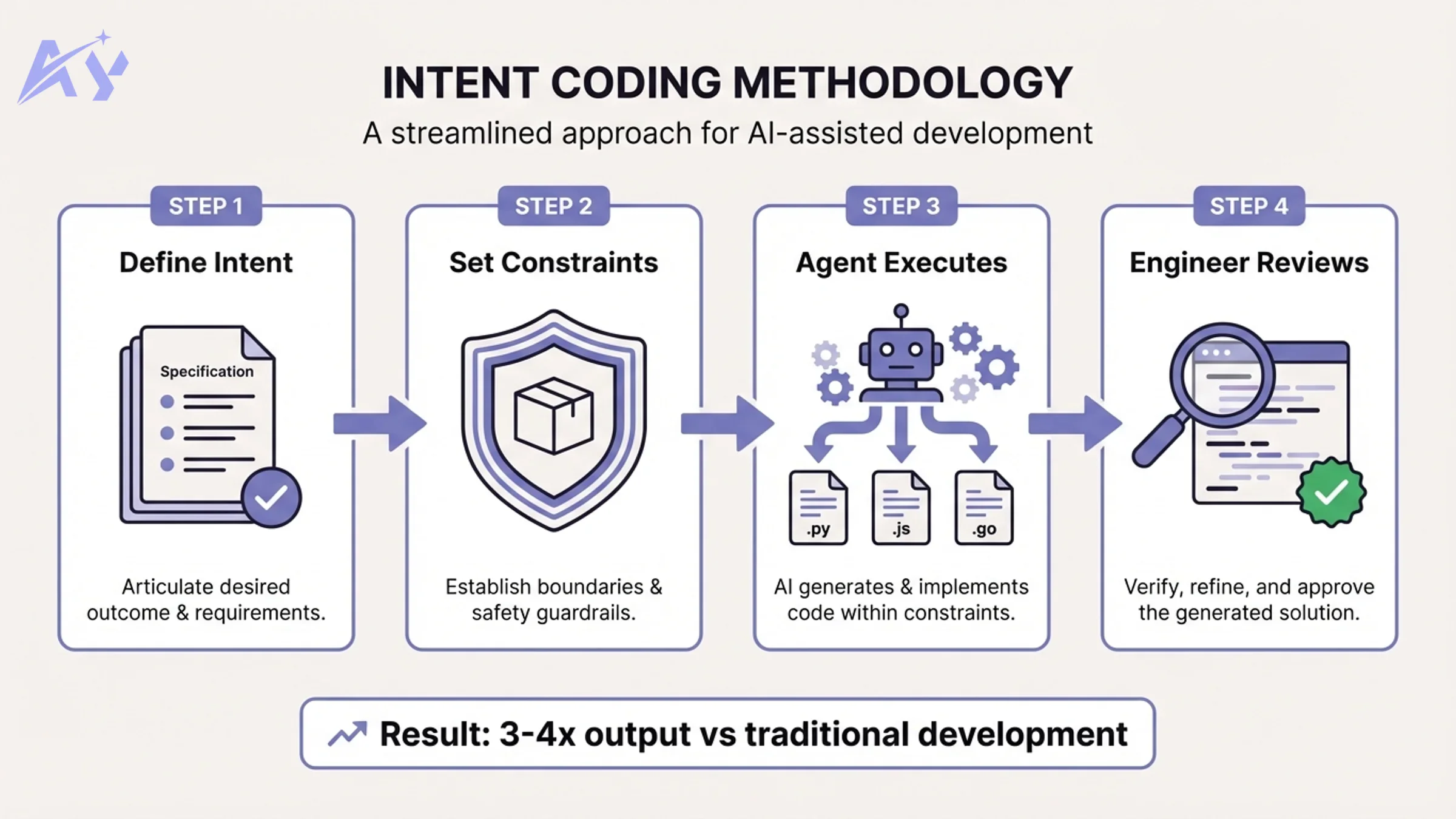
The result is dramatically higher output per engineer, with lower defect rates when done correctly. The engineers who master this workflow become force multipliers for the teams around them rather than getting replaced by AI.
Related Reads
AI-First Engineer vs. Traditional Developer
The performance gap between an AI-first engineer and a traditional developer is already measurable. Teams with high AI adoption are completing 21% more tasks and merging 98% more pull requests. But raw volume is not the real story.
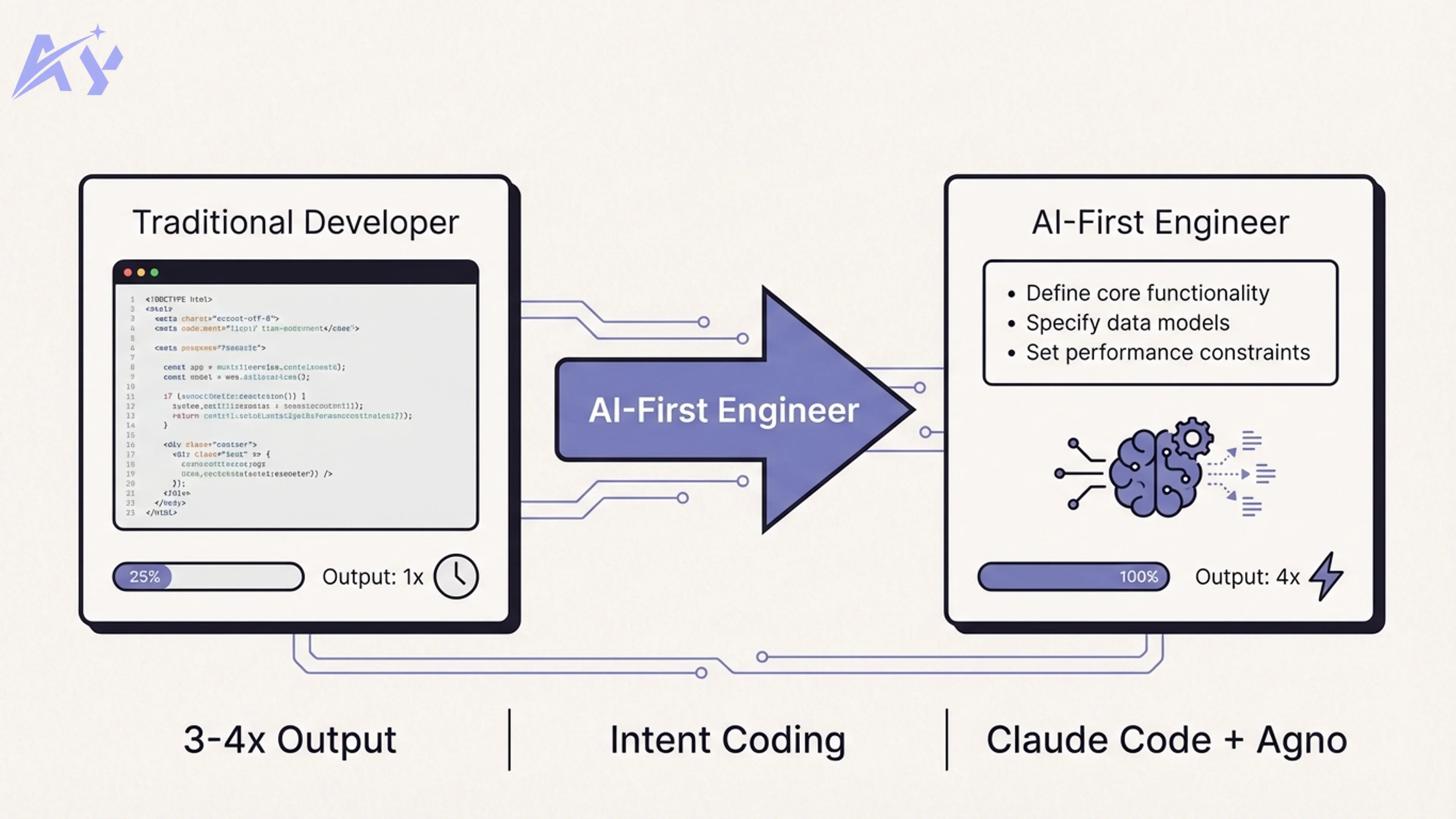
The real differentiation is leverage. An AI-first engineer operating with the right stack can architect, prototype, test, and ship features that would take a traditional team days, in hours. AY Automate's engineers consistently deliver output equivalent to 3-4 average developers on equivalent tasks.
Here is a direct comparison across the dimensions that matter most to technical leaders:
| Dimension | Traditional Developer | AI-First Engineer |
|---|---|---|
| Primary activity | Writing implementation code | Specifying intent, directing agents, reviewing output |
| Speed to prototype | Days to weeks | Hours to 1-2 days |
| Tool stack | IDE, linter, version control | Claude Code, Agno, n8n, RAG pipelines, multi-agent frameworks |
| Bottleneck | Writing capacity | Specification quality and review judgment |
| Code volume per sprint | Baseline | 3-5x higher with current tooling |
| Security posture | Manual review | Integrated audit checkpoints and access-controlled pipelines |
| Onboarding time | Weeks | Dramatically reduced (AI handles pattern matching) |
| Value ceiling | Linear with hours worked | Exponential with system design quality |
| Skill aging | 2-3 year cycle | Continuous, model-agnostic |
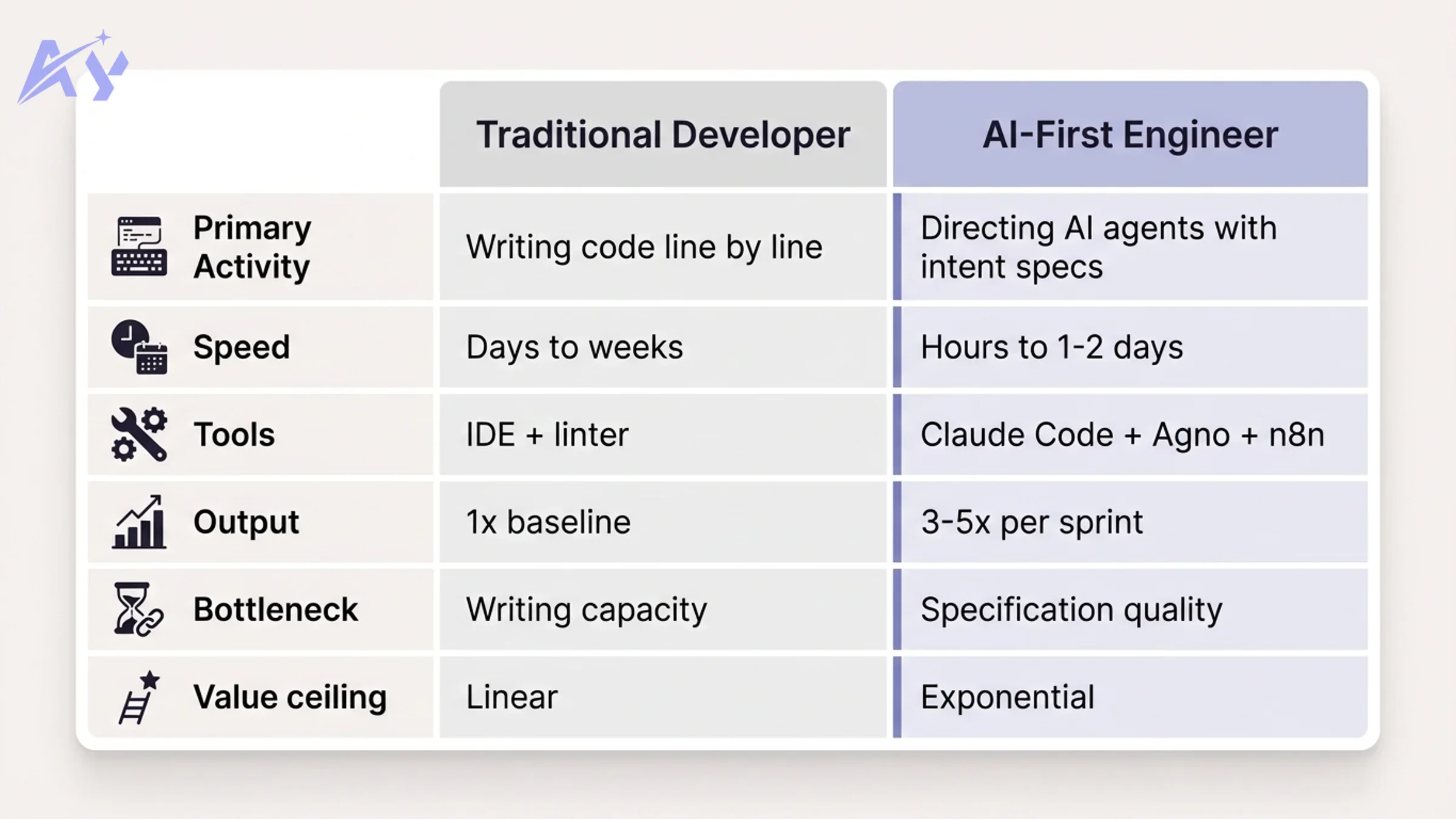
The hiring implication: hiring 3 traditional developers to match one skilled AI-first engineer is not a cost-effective strategy. The AI-first engineer will outpace them in output, adaptability, and architectural quality.
Free weekly brief
Steal our production automations
The exact n8n flows, Claude Code setups, and prompts we ship for clients, broken down step by step. No spam, unsubscribe anytime.
The 6 Core Skills an AI-First Engineer Must Have
Not every engineer who uses AI tooling qualifies as AI-first. The profile requires mastery across a specific set of capabilities. Here is what to screen for.
1. Claude Code
Claude Code is Anthropic's agentic coding tool that reads your codebase, edits files, runs terminal commands, and integrates across your development environment. It is the operating environment for AI-first development.
An AI-first engineer uses Claude Code as far more than an autocomplete. They know how to:
- Structure CLAUDE.md project context files for consistent agent behavior
- Manage token compounding across long sessions to avoid context degradation
- Chain multi-step agentic tasks with clear handoff conditions
- Use parallel sub-agents to accelerate independent workstreams
- Review AI-generated code at the architecture level, not line-by-line
Claude Code currently authors 4% of all global GitHub commits and is on track to reach 20% by end of 2026. Engineers who have not built fluency with this tool are already operating at a disadvantage.
2. Agno (Multi-Agent Framework)
Agno is a high-performance runtime for building, deploying, and orchestrating multi-agent systems. Where simple LLM calls answer questions, Agno agents execute complex, stateful workflows across tools, APIs, and databases.
An AI-first engineer using Agno can:
- Build agent teams where specialized sub-agents handle distinct task domains
- Implement Loop, Parallel, Condition, and Router workflow constructs for precise control flow
- Wire agents to knowledge bases, external APIs, and memory systems
- Deploy agents as scalable services rather than one-off scripts
- Monitor and manage agent behavior in production environments
Research by Anthropic found that multi-agent systems outperformed single agents by 90.2% on complex benchmarks. Knowing when and how to decompose a problem into a coordinated agent team is a defining AI-first skill.
For teams needing production-ready agent infrastructure, AI agent development is the fastest path from architecture to deployment.
3. RAG Pipeline Architecture
Retrieval-Augmented Generation (RAG) is the foundational pattern for making AI systems work with your organization's proprietary data. An AI-first engineer who cannot build RAG pipelines is limited to generic LLM behavior. That is not useful in enterprise contexts.
RAG competency means:
- Designing chunking strategies that preserve semantic meaning across document types
- Selecting and configuring vector databases (Weaviate, Qdrant, ChromaDB, Vertex AI Vector Search)
- Building hybrid retrieval systems that combine dense and sparse search
- Evaluating retrieval quality with recall and precision metrics
- Tuning pipelines for latency and cost at production scale
The latest development in this space is Google Gemini Embedding 2, which went into public preview in March 2026. It is Google's first natively multimodal embedding model, mapping text, images, video, audio, and PDFs into a single 3,072-dimensional vector space. It scores 68.32 on MTEB English benchmarks, delivers 70% latency reduction compared to multi-model pipelines, and improves retrieval recall by 20%.
AI-first engineers integrating Gemini Embedding 2 into RAG pipelines can unify document, image, and video retrieval in a single architecture. For organizations that need this infrastructure built correctly from day one, RAG pipeline architecture covers the full stack.
4. n8n Workflow Automation
n8n is the open-source workflow automation platform that has become standard infrastructure for AI-first teams. An AI-first engineer uses n8n to connect AI agents to real-world systems: CRMs, databases, communication platforms, APIs, and internal tools.
Key n8n competencies for the AI-first profile:
- Building agentic workflows where n8n nodes act as tool-calling infrastructure for LLM agents
- Designing multi-step approval and routing logic for business processes
- Integrating webhooks, scheduled triggers, and event-driven flows
- Building error handling and retry logic into production workflows
- Maintaining and versioning workflows as code
The combination of n8n and an AI agent framework like Agno creates a stack where AI generates decisions and n8n executes them across every system in your organization. Teams looking to implement this end-to-end can start with custom workflow automation.
5. Multi-Agent System Design
Building a single AI agent is a starting point. Designing multi-agent systems that coordinate reliably in production is an advanced engineering discipline. The AI-first engineer understands:
- Agent specialization: assigning distinct roles, tools, and context windows to each agent
- Orchestrator vs. worker patterns: which agent directs and which agents execute
- Inter-agent communication protocols and context passing
- Failure handling when sub-agents return incomplete or hallucinated results
- Security boundaries between agents that access different permission tiers
This skill separates engineers who build demos from engineers who build systems that stay running.
6. Google Gemini Embedding 2
Beyond RAG pipeline architecture, hands-on experience with Google Gemini Embedding 2 is becoming a differentiating skill for AI-first engineers. The model's multimodal architecture (text, images, video, audio, PDFs into one vector space) opens new application categories:
- Unified search across mixed-media knowledge bases
- Visual and textual product recommendations
- Cross-modal document classification and retrieval
- Multimodal customer support systems that process screenshots and text simultaneously
Engineers who understand how to use Gemini Embedding 2's 8,192-token input window, 6-image per request capacity, and 128-second video support are building applications that were not possible with previous-generation embedding models.
Why This Profile Is Scarce and Expensive
The market has recognized the value of AI-first engineers before most hiring pipelines have caught up. The data tells the story clearly:
- AI job postings have increased 78% year-over-year (LinkedIn Global Talent Insights, 2026)
- The talent pool has grown only 24% in the same period
- 3.2 companies compete for every qualified candidate
- Senior AI engineers with 6+ years earn $200K-$312K+ in the US
- LLM specialization commands a 25-40% premium above general ML salaries
For most companies, hiring full-time AI-first engineers is a 4-6 month process at minimum. By the time a candidate clears screening, completes technical assessments, negotiates, and onboards, the competitive advantage that prompted the hire has often eroded.
This is the core argument for AI staff augmentation: accessing a pre-vetted team of AI-first engineers on demand, without the hiring timeline, equity dilution, or overhead of full-time headcount.
What This Means for Your Engineering Team
The transition to AI-first engineering is not optional for competitive software organizations. It is already underway. Here is how to act on this today:
- Audit your current team's AI fluency. How many engineers have production experience with Claude Code, multi-agent frameworks, or RAG pipelines? This gap assessment is your starting point.
- Update your hiring criteria. Screen for intent coding capability alongside LeetCode performance. Ask candidates to demonstrate agent orchestration and specification-writing on top of algorithmic problem-solving.
- Build AI-first competency now. For teams that need to upskill existing engineers, structured corporate AI training delivers faster results than self-directed learning.
- Plug gaps with augmentation. If you cannot hire fast enough, place AI-first engineers from a firm that has already vetted them. AY Automate's engineer placement service puts production-ready AI-first engineers on your team from week one.
- Invest in your AI security posture. AI-generated code introduces novel attack surfaces. A Claude Code security audit identifies vulnerabilities in agentic systems before they reach production.
Sources: Agentic Engineering Guide 2026 (NxCode), METR Developer Productivity Study, AI Productivity Paradox (Faros AI), Claude Code Overview (Anthropic), Gemini Embedding 2 Launch (Google Blog), Agno Framework (agno.com), AI Talent Shortage Statistics 2026 (Second Talent), AI Engineer Salary Guide 2026 (KORE1), Multi-Agent Systems (n8n Blog)
FAQ
What is an AI-first engineer? An AI-first engineer (also called an agentic AI developer or AI-native engineer) is a software professional who specializes in directing AI systems to produce production-grade output, rather than writing all code manually. Their core skill is specifying intent with precision, orchestrating multi-agent workflows, and validating AI-generated output at an architectural level.
What is the difference between an AI-first engineer and a traditional developer? The primary difference is how they work. A traditional developer writes implementation code directly. An AI-first engineer designs systems, specifies requirements precisely, and directs AI agents to execute. AI-first engineers operating with the right stack consistently produce 3-5x more output per sprint than traditional developers on equivalent tasks.
What is intent coding? Intent coding is the practice of specifying what a system must do with precision before directing AI to build it. It includes defining input/output contracts, constraints, edge cases, and acceptance criteria in structured natural language. It is the opposite of vibe coding, which relies on loose prompts without formal specification.
What tools does an AI-first engineer need to know? The core stack for AI-first engineers in 2026 includes: Claude Code (agentic coding environment), Agno (multi-agent framework), n8n (workflow automation), RAG pipeline tools (vector databases, embedding models), Google Gemini Embedding 2 (multimodal embeddings), and multi-agent orchestration patterns.
How much does an AI-first engineer cost to hire in 2026? AI-first engineers in the US command salaries of $180K-$250K at mid-career levels, with senior engineers earning $200K-$312K+. LLM specialization adds a 25-40% premium above general ML salaries. The hiring timeline is typically 4-6 months in competitive markets.
Where can I hire AI-first engineers quickly? AY Automate's engineer placement and staff augmentation service provides on-demand access to pre-vetted AI-first engineers. Founded by ex-IBM architects, AY Automate engineers average 8+ years of experience and consistently deliver the output of 3-4 average developers. Engagements start from week one, with daily updates and no black-box processes.
For a technical reference on how AI-first engineers structure agent systems in production, see the agent swarms architecture breakdown.
Continue Reading
AI QA Testing Agents: What to Automate, Where QA Judgment Leads (2026)
What an AI QA testing agent does well (test generation, regression testing, cross-browser checks), where QA judgment still leads, and how this differs from agent evals.
CLAUDE.md vs AGENTS.md: What Changed When Claude Code Added AGENTS.md Support (2026)
Claude Code 2.1.277 reads AGENTS.md when a folder has no CLAUDE.md. Here is the exact precedence, the /config setting, what to do with old symlink and import workarounds, and how to verify it works.
AGENTS.md Explained: The Open Spec for AI Coding Agent Instructions
AGENTS.md is an open, cross-tool markdown file for giving AI coding agents project context: build commands, tests, and conventions. Codex, Cursor, and opencode read it natively, and since version 2.1.277 (September 18, 2026) Claude Code falls back to it when a folder has no CLAUDE.md.
Book a Free Strategy Call
Building this in production?
Walid runs a 30-min call to map your AI engineering team. Free, no slides.
Free weekly brief
Steal our production automations
The exact n8n flows, Claude Code setups, and prompts we ship for clients, broken down step by step. No spam, unsubscribe anytime.

Ex-IBM AI engineer and enterprise architect. Adel owns the technical architecture behind every automation and AI agent system AY Automate ships.