Book a Free Strategy Call
Skip the read: talk to Walid in 30 min.
Free strategy call. We map your AI engineering team, you keep the notes.
The best AI-native software development companies in 2026: AY Automate (site owner) for senior engineers who direct AI agents, Euristiq for published AI-native pricing, Ailoitte for agentic product engineering, Logiciel for governed production AI, First Line Software for its RACE delivery model, Azumo for nearshore AI teams, NineTwoThree for Boston-based custom AI, then LeewayHertz, BCG X, Accenture AI, DataRobot and Capgemini. We compared 12 companies on engineering model, agentic capability, delivery quality, transparency and commercial terms.
The market for AI software development services has matured fast. In February 2026, SemiAnalysis estimated that Claude Code authored 4% of public GitHub commits. The question for CTOs and technical founders is no longer whether to use AI-native development, but which partner can actually deliver it.
This ranking evaluates the best AI software development companies in 2026 based on one criterion above all others: are their engineers natively fluent in agentic AI workflows, or are they traditional developers who added AI tools to their existing process? That distinction matters more than headcount, logo, or case study count.
How We Ranked These Companies
Each company on this list was evaluated against five criteria:
- Engineering model: AI-first from day one, or traditional team retrofitting AI tools
- Agentic capability: Real experience with multi-agent orchestration, RAG pipelines, and production LLM deployment
- Delivery quality: Production-grade output, not demos and prototypes
- Transparency: Daily updates, visible progress, no black-box engagements
- Commercial model: Clear pricing, scope, and engagement terms
Disclosure and method. AY Automate publishes this list and ranks itself first. Our entry uses only facts published on our own service pages. On September 26, 2026 we added Euristiq, Ailoitte, Logiciel, First Line Software, Azumo and NineTwoThree. For those six we read each company's own website, and every number in their entries is the company's own published claim. We also rechecked the pricing figures for LeewayHertz and DataRobot on the same day. No hands-on testing is claimed for any entry.
Related Reads
1. AY Automate (Top Pick for AI-First Development)
Model: Senior engineers who direct AI agents through the build Published pricing: Engineer placement from $60,000 a year; fixed-price 30-day SaaS MVP sprint Proof: Five published case studies
AY Automate is our company, so read this entry with that in mind. The delivery model is one senior engineer working with a fleet of AI agents. On a SaaS MVP, that engineer scopes the smallest version that answers your core question, then directs the agents through a fixed-price 30-day sprint. By day 30, people can log in, pay, and give feedback.
For teams that want the engineer inside their own org, engineer placement starts at $60,000 a year, takes 2 to 4 weeks, and comes with a 90-day replacement guarantee. Five case studies are published on our site, so you can check the shipped work before a call.
What they build:
- Custom AI agent development: multi-agent systems, LLM-powered tooling, autonomous workflow orchestration using Claude Code and Agno
- Custom workflow automation: n8n pipelines, multi-system integrations, event-driven automation across SaaS stacks
- RAG pipeline architecture: knowledge retrieval, vector database setup, document ingestion
- SaaS MVP development: fixed-price 30-day sprint from scope to a product people can log in to and pay for
- AI strategy consulting: fractional CAIO engagements, transformation roadmaps, build-vs-buy analysis
- Corporate AI training: structured upskilling for engineering and operations teams
- AI staff augmentation: senior AI engineers placed into client teams
- Claude Code security audits: vulnerability assessment and safe deployment review for AI-generated codebases
Who they serve: Technical founders, CTOs at growth-stage and mid-market companies, and teams that need agentic AI built without the overhead of a Big Four consultancy.
Standout feature: Published entry prices. You know the engineer placement floor and the MVP format before the first call.
Pricing: Engineer placement from $60,000 a year. SaaS MVP as a fixed-price 30-day sprint, scoped on a free call. Details at ayautomate.com/services.
Watch out for: A small senior team is the point of the model. Skip AY Automate if you need a large on-site team or a multi-year legacy ERP integration program.
If this sounds like the right fit, our SaaS development agency page covers scope, process, and how an engagement starts.
Free weekly brief
Steal our production automations
The exact n8n flows, Claude Code setups, and prompts we ship for clients, broken down step by step. No spam, unsubscribe anytime.
2. Euristiq
Headquarters: Offices in Toronto (Canada), Warsaw (Poland) and Lviv (Ukraine) Positioning: "Custom software development company for the AI-native era" Published pricing: From $5,000 for architecture work; from $50,000 for AI product development
Euristiq calls itself a custom software development company for the AI-native era and builds applications where AI is part of how the product works from the start. Its AI-native page lists strategy workshops, custom AI-native application development, AI experience design, rapid prototyping and PoCs, AI readiness audits, and implementation consulting.
Euristiq prints price ranges on its own site, which makes it easy to budget against before a first call.
Who they serve: Product teams that want an AI-native app designed and built by one vendor, and buyers who need a price range before they book a call.
Standout feature: Published ranges: AI experience design at $5,000 to $150,000, AI-native architecture at $5,000 to $50,000, and AI product development from $50,000 (its pricing section, checked 2026-09-26).
Pricing: See the ranges above. Build-and-deploy timelines depend on scope, per the site.
Watch out for: The process on its site runs through a 1 to 2 week assessment workshop and a 3-month strategy roadmap before build and deploy. Skip it if you need working software in a month.
3. Ailoitte
Headquarters: Offices in Bengaluru (India) and Delaware (United States) Positioning: "AI-Native Product Engineering Company" Team: 70+ senior engineers (its own claim)
Ailoitte's homepage headline is "AI-Native Product Engineering Company," and it says AI is built into how it designs, codes and tests. Services cover AI consulting, AI agent development, generative AI, mobile and web apps, UI/UX design, machine learning, computer vision, product discovery, and dedicated team hiring.
The company claims 300+ products delivered and a 93% returning-client rate. It says it works on a fixed-price outcome model, with a senior architect owning each build, and that dedicated hires are onboarded and productive in 48 hours. Those are its own claims, not figures we measured.
Who they serve: Startups and product companies that want web, mobile and AI features from one team, and companies that want to add dedicated engineers fast.
Standout feature: Breadth. One vendor for AI agents, mobile apps and UI/UX, sold on a fixed-price outcome model.
Pricing: Not published on its site.
Watch out for: No rates on the site, so you cannot compare cost until after a scoping call. Skip it if you need a price range before you talk to anyone.
4. Logiciel Solutions
Headquarters: Huntington Beach, California Positioning: "AI-Native Services"; "Not just what we ship. How we build." Track record: 80+ clients and 15 years of engineering (its own claims)
Logiciel's homepage pitches "the engineering firm for teams who need AI in production" and groups its offer under "AI-Native Services." Services include applied AI product development, agentic systems, AI-ready data foundations, product engineering, legacy modernization, QA and test automation, AI governance and security, and cloud and DevOps.
The engagement model on its site puts engineers inside your Slack, Jira and architecture calls from day one. Governance and security sit in the same offer as the build, which fits regulated work. Its client stories include a healthcare build it describes as "100% audited, zero findings."
Who they serve: Product and platform teams in regulated or audited industries that need AI features running in production, not a demo.
Standout feature: Build, governance and security under one engineering team, with day-one access through your own tools.
Pricing: Not published on its site.
Watch out for: The pitch centers on production systems with audit trails. Skip it if you only need a throwaway prototype to test an idea.
5. First Line Software
Headquarters: Cambridge, Massachusetts, with offices in the UK, Germany, the Netherlands, Australia, Slovakia, Czech Republic, Montenegro and Serbia Positioning: "AI Engineering Company"; RACE, "an AI-native, intent-driven engineering model" Partner status: Anthropic Select Partner (its own claim)
First Line Software describes itself as an AI engineering company focused on moving projects from pilot to production. Its RACE delivery model is described on its own blog as "an AI-native, intent-driven engineering model," and its homepage claims about 3x throughput sustained week after week.
Other services include Managed AI Services (model selection, fine-tuning, deployment and performance management), Claude enablement for non-technical teams, and AI-accelerated legacy modernization. It lists ISO 42001 certification on its site.
Who they serve: Companies with stalled AI pilots, and teams in real estate, healthcare and hotel chains, the three sectors its site focuses on.
Standout feature: A named AI-native delivery model (RACE) plus a managed service to run AI systems after launch.
Pricing: Not published on its site.
Watch out for: Its reusable components and case work center on real estate, healthcare and hotel chains. Skip it if you want a partner with prebuilt material for another sector.
6. Azumo
Headquarters: San Francisco, California; its site says "many of our developers reside in Argentina" Positioning: "AI NATIVE. NEARSHORE" and "The Software Development Company for AI" Track record: "Building production AI since 2016" (its own claim)
Azumo pairs a San Francisco headquarters with nearshore engineers. Its site says Argentina is one hour ahead of US Eastern time, which gives US teams real-time overlap. Services cover AI development (LLMs, generative AI, RAG, NLP, computer vision), custom software, data engineering, mobile apps and staff augmentation.
Engagement models on the site are dedicated teams, staff augmentation, project-based builds and a virtual CTO. It lists SOC 2 certification.
Who they serve: US companies that want nearshore AI engineers working in their time zone, either embedded in the team or as a full project team.
Standout feature: Four engagement models under one vendor, from a single augmented engineer to a full project team.
Pricing: Not published. Its site says pricing depends on scope, seniority and engagement model.
Watch out for: The overlap the site describes is with US hours. Skip it if your team sits in Europe or Asia and needs a full shared workday.
7. NineTwoThree AI Studio
Headquarters: Boston, Massachusetts Positioning: "We help your company become AI native" Team: 70+ people and 150+ projects delivered (its own claims)
NineTwoThree builds custom AI for established brands and funded startups. Its services include AI consulting and strategy, conversational AI, AI agents and workflow automation, machine learning, computer vision, custom web apps, data integration, and secure and compliant AI implementation.
Its site says "Building products since 2012," and the company says it holds SOC 2 and HIPAA compliance. It also claims a 98% on-time delivery rate. All of these are its own figures.
Who they serve: Established brands and funded startups, including teams with compliance requirements such as HIPAA.
Standout feature: A long product-studio history combined with a current AI agent and conversational AI practice.
Pricing: Not published. The site offers a free consultation and a custom proposal.
Watch out for: Its "AI native" language describes what it helps clients become, not a named AI-native build method. Skip it if you want to see how the vendor's own engineers use agents before you sign.
8. LeewayHertz
Headquarters: Gurugram, India (per its Clutch profile) Parent: The Hackett Group (per the LeewayHertz website footer) Founded: 2007
LeewayHertz is one of the longer-running AI development firms on this list. Its site cites over 15 years of industry experience and a broad portfolio spanning generative AI, custom ML models, and enterprise AI consulting.
Their services cover strategic AI consulting, LLM application development, AI agent builds, RAG implementations, and team extension engagements. They have meaningful depth in data engineering, which makes them a reasonable choice when the AI build depends on complex data pipeline work upstream.
Who they serve: Enterprises and funded startups that need an agency with documented delivery history and a broad technical bench.
Standout feature: Deep data engineering capability that complements their AI development work.
Pricing: Not published on its own site. Its Clutch profile lists $50 to $99 per hour and a $10,000+ minimum project (checked 2026-09-26).
Watch out for: LeewayHertz is now part of The Hackett Group, a consulting firm. If you want a lean, senior-only engagement, ask who will actually staff your project.
9. BCG X
Headquarters: Global (Boston Consulting Group's tech build arm) Team size: 3,000+ technologists, designers, and data scientists Parent: Boston Consulting Group
BCG X is the engineering and product build division of BCG, combining consulting strategy with product and AI development execution. On February 23, 2026, BCG and OpenAI announced a multiyear expansion of their partnership through OpenAI's Frontier Alliance.
BCG X handles the AI strategy heavy lifting at the C-suite level and then builds toward it with an embedded team of engineers. Their proprietary platforms are layered with OpenAI models and purpose-built analytics infrastructure.
Who they serve: Large enterprises requiring integrated strategic and technical AI transformation.
Standout feature: The combination of BCG's strategy consulting credibility and a 3,000+ strong technical team.
Pricing: Enterprise consulting pricing, quoted per engagement. Not published.
Watch out for: BCG X is optimized for Fortune 500-scale transformation. Pricing and timelines are quoted per engagement; ask for a dated plan.
10. Accenture AI
Headquarters: Dublin, Ireland (global delivery) Team size: 700,000+ employees globally OpenAI partnership: Launch partner for OpenAI Frontier (per Accenture's OpenAI page)
Accenture is the largest systems integrator on this list. Their AI practice covers end-to-end enterprise AI lifecycle: from initial strategy through data architecture modernization, scaled deployment, change management, and long-term operations. In December 2025, Accenture said it would equip tens of thousands of its professionals with ChatGPT Enterprise and build the largest group upskilled through OpenAI Certifications.
Who they serve: Large enterprises and government organizations running complex legacy environments where AI integration requires careful systems architecture and extensive change management.
Standout feature: A global delivery bench. Pricing and timelines are quoted per engagement; ask for a dated plan.
Pricing: Enterprise pricing, quoted per engagement. Not published.
Watch out for: Pricing and timelines are quoted per engagement; ask for a dated plan.
11. DataRobot
Headquarters: Boston, MA Business model: Platform vendor with service-led delivery Market position: Agent Workforce Platform
DataRobot occupies a different position from the agencies above: it is primarily a platform company. Its Agent Workforce Platform enables enterprises to build, deploy, and govern AI agents with automated ML pipelines, generative AI app building, and production monitoring baked in.
Its own homepage cites customer outcomes such as a $200M ROI for a global energy company and a $70M ROI for a top 5 global bank (its claims, checked 2026-09-26).
Who they serve: Enterprises that want a platform-first approach to AI deployment with optional service-led delivery.
Standout feature: End-to-end governance and monitoring built natively into the platform. Strong for regulated industries.
Pricing: Not published. DataRobot's pricing page lists no dollar figures and routes buyers to sales (checked 2026-09-26).
Watch out for: DataRobot is a platform, not a custom development agency. If your requirement is bespoke AI agent development, you will need to augment their platform with external development resources.
12. Capgemini
Headquarters: Paris, France (global delivery) Team size: 420,000 (its own figure, per its Q1 2026 release) Frontier Alliance: Founding member (Capgemini, February 23, 2026)
Capgemini is a founding member of OpenAI's Frontier Alliance (Capgemini, February 23, 2026). Its RAISE (Reliable AI Solution Engineering) framework targets moving AI from pilot to production.
Who they serve: Large enterprises, particularly in financial services, utilities, and manufacturing.
Standout feature: The RAISE framework provides a modular, enterprise-grade accelerator for moving agentic AI from pilot to production.
Pricing: Enterprise pricing, quoted per engagement. Not published.
Watch out for: Pricing and timelines are quoted per engagement; ask for a dated plan.
Company Comparison Table
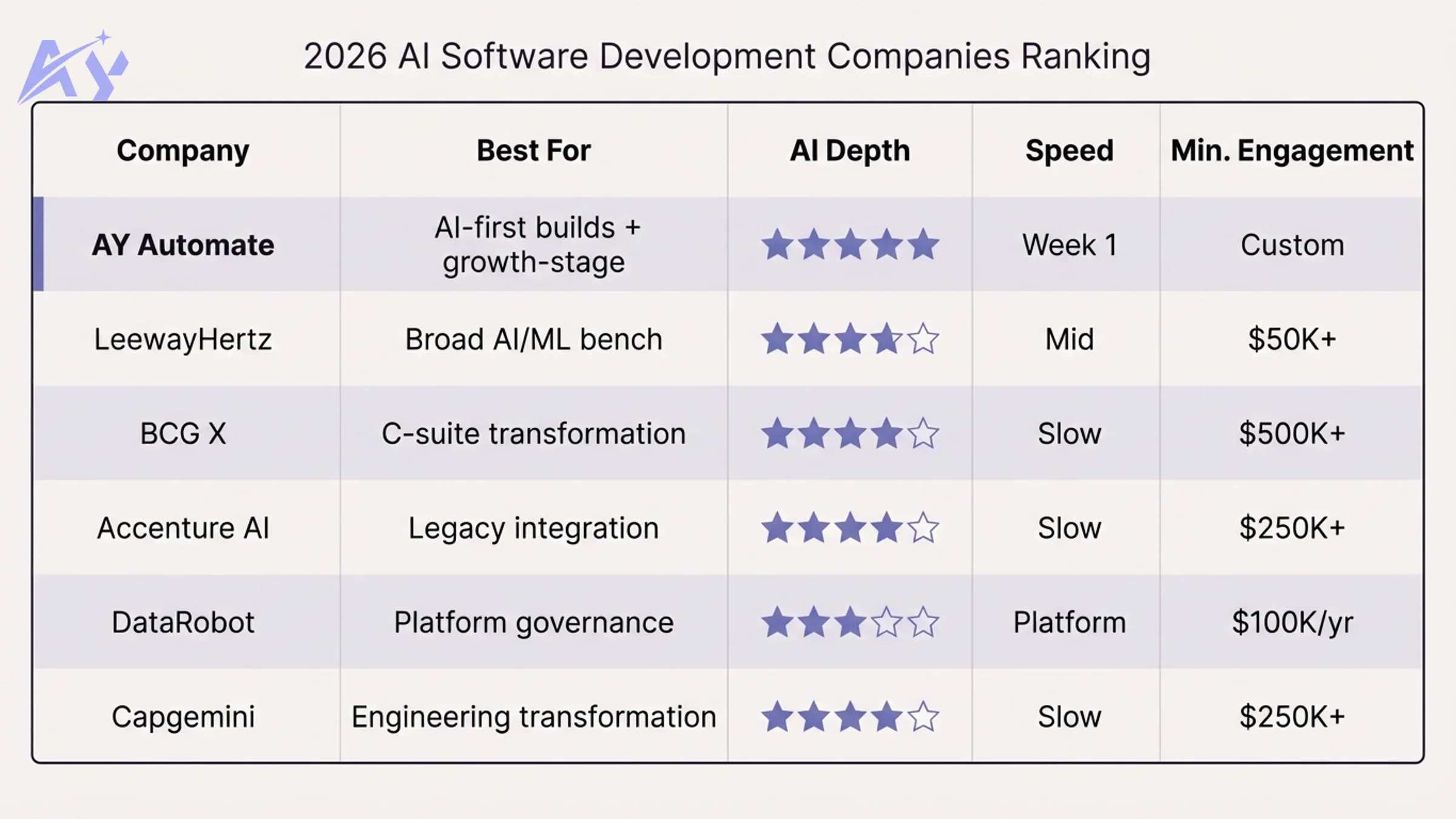
| Company | Best For | Agentic AI Depth | Pricing Model | Delivery Speed | Published Price |
|---|---|---|---|---|---|
| AY Automate | AI-first builds, agentic systems, growth-stage to mid-market | Native (Claude Code, Agno) | Placement + fixed-price sprint | 30-day MVP sprint | Placement from $60K/yr |
| Euristiq | AI-native apps with a budget range up front | Native (AI-native positioning) | Fixed ranges by service | Workshop, roadmap, then build | From $5K; product from $50K |
| Ailoitte | Web, mobile and AI features from one team | Native (agentic build process) | Fixed-price outcome model | "Weeks, not quarters" (its claim) | Not published |
| Logiciel | Governed production AI in regulated industries | Native (AI-native services) | Embedded engineering | Embedded from day 1 | Not published |
| First Line Software | Stalled pilots, real estate, healthcare, hotels | Native (RACE model) | Delivery + managed AI services | ~3x throughput (its claim) | Not published |
| Azumo | US teams wanting nearshore AI engineers | Native (AI-native nearshore) | Dedicated team, augmentation, project | US time zone overlap | Not published |
| NineTwoThree | Brands and funded startups needing custom AI | Strong | Custom proposal | 98% on time (its claim) | Not published |
| LeewayHertz | Established firms needing broad AI/ML bench | Strong | Hourly | Mid | $50-$99/hr (Clutch) |
| BCG X | C-suite-led transformation programs | Strong (OpenAI Frontier) | Enterprise consulting | Quoted per engagement | Not published |
| Accenture AI | Legacy systems integration, change management | Strong (OpenAI Frontier) | Enterprise | Quoted per engagement | Not published |
| DataRobot | Platform-driven AI governance | Platform-native | Platform license | Platform-paced | Not published |
| Capgemini | Large-scale engineering transformation | Strong (OpenAI Frontier) | Enterprise consulting | Quoted per engagement | Not published |
Prices in the last column come from each company's own site, except LeewayHertz, which comes from its Clutch profile. All checked 2026-09-26.
Which AI-native company fits your situation
AY Automate fixed-price sprint
Euristiq or AY Automate
Ailoitte
Logiciel or NineTwoThree
First Line Software
Azumo, or AY engineer placement
BCG X, Accenture or Capgemini
DataRobot
Based on each company's own website, checked 2026-09-26.
What Separates AI-Native From AI-Enabled
The companies above fall into two distinct categories that matter when you are making a hiring decision.
AI-native agencies (AY Automate, Euristiq, Ailoitte, Logiciel, First Line Software and Azumo, and to a degree NineTwoThree and LeewayHertz) were built around agentic development as a first-order capability or describe their build process that way. Each describes AI-native or agentic development as part of how it builds, on its own site.
AI-enabled large firms (Accenture, BCG X, Capgemini) have AI capabilities grafted onto mature consulting and systems integration practices. This is not a weakness for every buyer. If your requirement is wiring AI into a 20-year-old SAP environment at a company with 50,000 employees, the systems integration depth of an Accenture matters far more than whether their engineers use Claude Code.
The question to ask your shortlist: "Show me an agentic system you built and deployed to production in the last six months. Walk me through the architecture."
The answer to that question will tell you everything.
Key Takeaways for CTOs and Technical Founders
- The "AI-native vs. AI-enabled" distinction is the most important filter.
- Speed to value matters more than size.
- Security cannot be an afterthought. Any agency building AI agents with access to your data should provide audit-ready documentation from day one. AI code security audits are now a baseline expectation.
- Pricing is not a proxy for quality. Most companies on this list do not publish prices at all. Euristiq's AI product development from $50,000 and an enterprise platform license can end up solving the same problem, so compare on scope, not on logo.
- Train your internal team in parallel. Corporate AI training alongside any agency engagement reduces long-term dependency.
- Compare against the wider field. Our AI software development companies ranking and AI agent development agencies list cover firms that are not AI-native by design.
For further context: how to hire AI engineers covers sourcing and technical vetting end-to-end; the AI engineer salary guide for 2026 shows what you should expect to pay; and top Claude Code agencies lists teams building natively with agentic tooling.
Sources: Capgemini Frontier Alliance release (February 23, 2026), Capgemini RAISE page and Q1 2026 revenue release, BCG press release (February 23, 2026), Accenture OpenAI partner page and December 1, 2025 release, SemiAnalysis (February 5, 2026), LeewayHertz website and Clutch profile, DataRobot homepage and pricing page, and the websites of Euristiq, Ailoitte, Logiciel Solutions, First Line Software, Azumo and NineTwoThree (all checked 2026-09-26)
FAQ
What is an AI-native software development company? An AI-native software development company is one where engineers use agentic AI tools as their primary development method (intent-driven development with tools like Claude Code and Agno), not as a productivity layer on top of traditional coding practices.
How much does it cost to hire an AI software development company in 2026? Pricing varies widely, and most firms do not publish it. Euristiq lists AI-native architecture from $5,000 and AI product development from $50,000. AY Automate lists engineer placement from $60,000 a year. LeewayHertz's Clutch profile shows $50 to $99 per hour. Accenture, BCG X, Capgemini and DataRobot quote per engagement.
Which AI-native software development companies publish their prices? On the company websites we checked on September 26, 2026, Euristiq and AY Automate publish prices. Euristiq lists AI experience design at $5,000 to $150,000, AI-native architecture at $5,000 to $50,000 and AI product development from $50,000. AY Automate lists engineer placement from $60,000 a year. The others ask for a scoping call first.
How long does an AI-native company take to ship an MVP? It depends on the process. AY Automate runs a fixed-price 30-day SaaS MVP sprint that ends with a product people can log in to and pay for. Euristiq's site describes a 1 to 2 week assessment and a 3-month roadmap before the build. Ailoitte promises "weeks, not quarters." Ask each vendor for a dated plan.
Should I hire an AI-native agency or place an AI engineer in my team? Hire an agency when you want a defined product delivered. Place an engineer when the work never ends and you want the skills in-house. AY Automate places engineers from $60,000 a year in 2 to 4 weeks with a 90-day replacement guarantee. Azumo and Ailoitte also offer staff augmentation and dedicated team models.
How can I tell if a company is really AI-native? Ask how they build, not only what they build. Request a production agentic system shipped in the last six months and a walkthrough of the workflow their engineers use. Named methods help, such as First Line Software's RACE model. Treat homepage stats as the company's own claims until a reference confirms them.
Which AI development company is best for startups? For early-stage startups that need a working product fast, AY Automate's fixed-price 30-day MVP sprint is one option; compare it with Euristiq's published ranges and Ailoitte's fixed-price model. The AY sprint ends with a product real users can log in to and pay for, and five published case studies show the shipped work.
What questions should I ask an AI software development company before hiring them? (1) Show me a production agentic system you shipped in the last six months. (2) What is your daily communication protocol? (3) How do you handle security for AI agents with production data access? (4) What does handoff documentation look like? (5) What is your experience with our specific stack?
Continue Reading
AI QA Testing Agents: What to Automate, Where QA Judgment Leads (2026)
What an AI QA testing agent does well (test generation, regression testing, cross-browser checks), where QA judgment still leads, and how this differs from agent evals.
Vector Databases for AI Agents: When You Actually Need One (2026)
What a vector database does differently from a traditional database, when an AI agent genuinely needs one, and what to consider when choosing between options.
Synthetic Data Generation for AI Training: A Practical Guide (2026)
What synthetic data is actually useful for, the main generation approaches, and where it falls short of real-world validation before a launch.
Book a Free Strategy Call
Building this in production?
Walid runs a 30-min call to map your AI engineering team. Free, no slides.
Free weekly brief
Steal our production automations
The exact n8n flows, Claude Code setups, and prompts we ship for clients, broken down step by step. No spam, unsubscribe anytime.

Taha builds and ships custom AI agents and workflow automations for AY Automate clients across SaaS, finance, and professional services.