Book a Free Strategy Call
Skip the read: talk to Walid in 30 min.
Free strategy call. We map your AI engineering team, you keep the notes.
A company posting three engineering jobs this week has budget approved, a team under strain, and a problem they need to solve fast. That is your best prospect. Not someone who clicked an ad. Not a lead scraped from a trade show list. A company publicly declaring, right now, that they are growing faster than they can handle.
Most sales teams scroll LinkedIn, buy intent data subscriptions, and pay $4,000 a month for tools like Clay to surface exactly this signal. But there is an open-source tool built for job seekers (called career-ops) that already does the hard part for free. It scans 45+ job boards, scores companies by role, and outputs structured data. The only thing it was designed to do differently is help you apply. Flip the target, and you have one of the most precise B2B sales signal engines available in 2026.
This post walks through the logic, the setup, and the outreach workflow, whether you are a founder looking for your next 20 clients or a sales team trying to cut prospecting costs without sacrificing signal quality.
The Insight: Hiring Is the Clearest Buying Signal in B2B
Hiring data is intent data. When a company posts a job, it is not speculating about future investment. It has already committed budget. Leadership has approved headcount. The team is at capacity, growing, and feeling pain.
This is why tools like ZoomInfo, Apollo, and 6sense all include hiring signals as a core feature. Research from Autobound shows that companies in active hiring mode for specific roles are 3-5x more likely to convert on outreach tied to that function than cold prospects with no signal. The logic is simple:
- A company hiring 3 engineers is overloaded. They need tools, contractors, automation, infrastructure.
- A company hiring a Head of RevOps is building out a revenue function. They will be evaluating CRMs, enrichment tools, and reporting platforms.
- A company hiring a VP of Marketing will make a new tool stack decision within 90 days of that hire starting.
The signal is the job posting. The urgency is the hiring velocity. The more roles they are filling, the more acutely they need help.
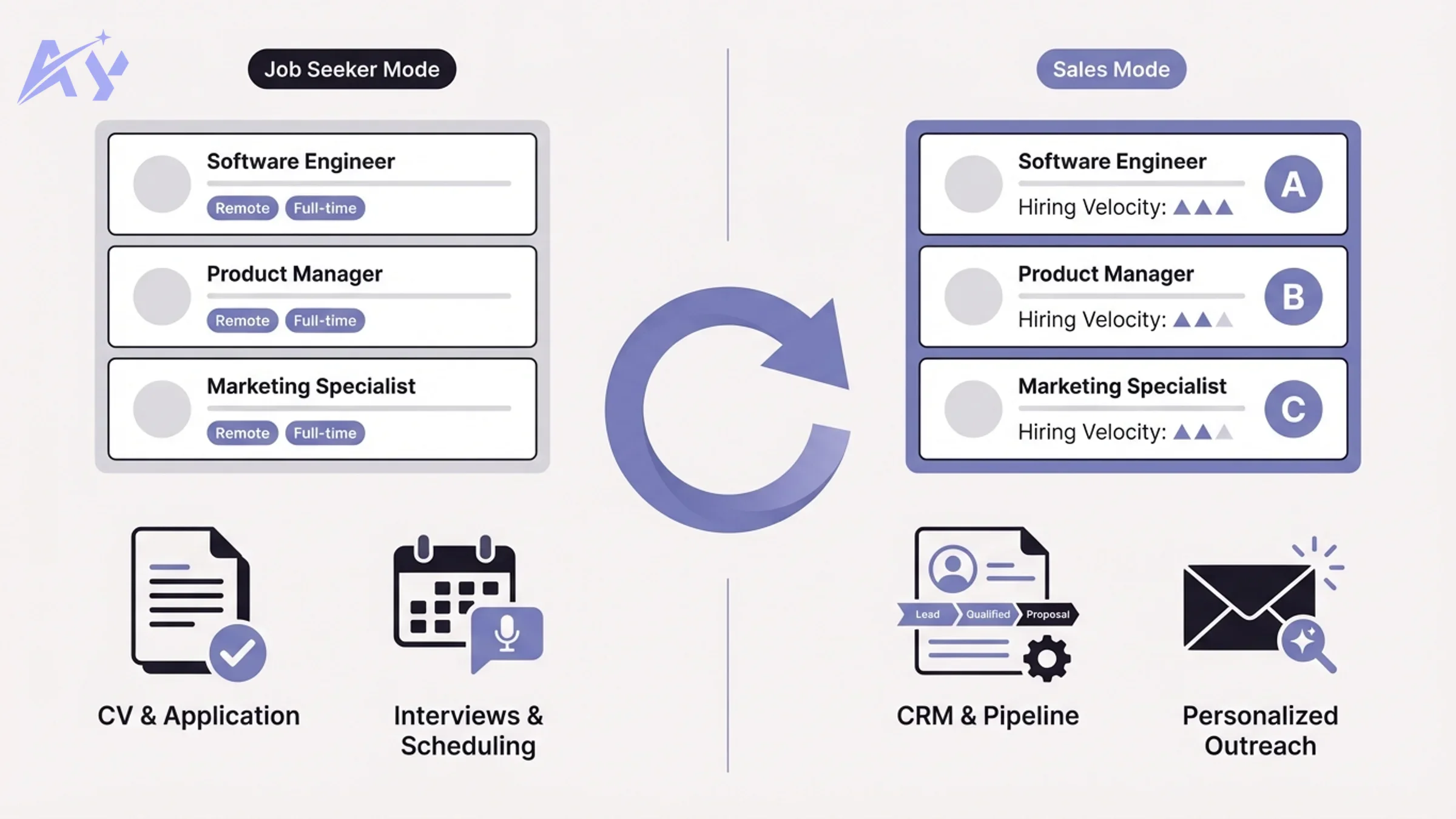
Where most sales teams fall short is in collecting this signal systematically. They rely on LinkedIn Sales Navigator alerts (expensive, delayed) or manual job board checks (slow, inconsistent). career-ops was built to automate exactly this collection at scale.
Related Reads
What Is career-ops?
career-ops is an open-source, AI-powered job search system built on Claude Code. It was created by Santiago Ferrero, who used it to evaluate 740+ job offers, generate 100+ tailored CVs, and land a Head of Applied AI role.
The system has 14 skill modes, each a Claude Code slash command with its own context and rules. Its core capabilities include:
- Portal scanning: Monitors 45+ pre-configured company career pages across Greenhouse, Ashby, Lever, and direct company portals
- Batch evaluation: Processes multiple job postings simultaneously using parallel sub-agents
- A-F scoring: Evaluates each opportunity across 10 weighted dimensions
- Structured output: Produces a deduplicated, normalized tracker with status fields, company metadata, and evaluation reports
- CV generation: Creates ATS-optimized PDFs tailored to specific job descriptions (useful for the job seeker use case)
The portal list is fully configurable. That is the key detail for the sales use case: you define which companies to monitor, and the system handles the scanning, deduplication, and data normalization.
You can fork career-ops and replace the job seeker profile with your ICP (ideal customer profile) target list. The system does not care whether the output is "jobs I should apply to" or "companies I should call."
Free weekly brief
Steal our production automations
The exact n8n flows, Claude Code setups, and prompts we ship for clients, broken down step by step. No spam, unsubscribe anytime.
The Flip: From Job Search Tool to Sales Intelligence Engine
The original use case for career-ops is straightforward: give it your CV, point it at job boards, and it tells you which roles are worth applying to. The system's intelligence lives in its evaluation layer. It reads a job posting, scores it against your profile, and outputs a ranked report.
Now invert the question.
Instead of asking "which of these jobs fits my skills?", ask "which companies are hiring in ways that signal they need my product or service?"
| Original Question | Flipped Question |
|---|---|
| Find jobs I should apply to | Find companies that are hiring right now |
| Score by fit to my CV | Score by hiring velocity and role type |
| Generate a tailored CV | Generate a personalized outreach message |
| Track application status | Track prospect pipeline status |
| Interview prep | Discovery call prep |
The infrastructure is identical. The career portal scanner runs headlessly, continuously, and outputs structured data. The only change is what you do with that data downstream.
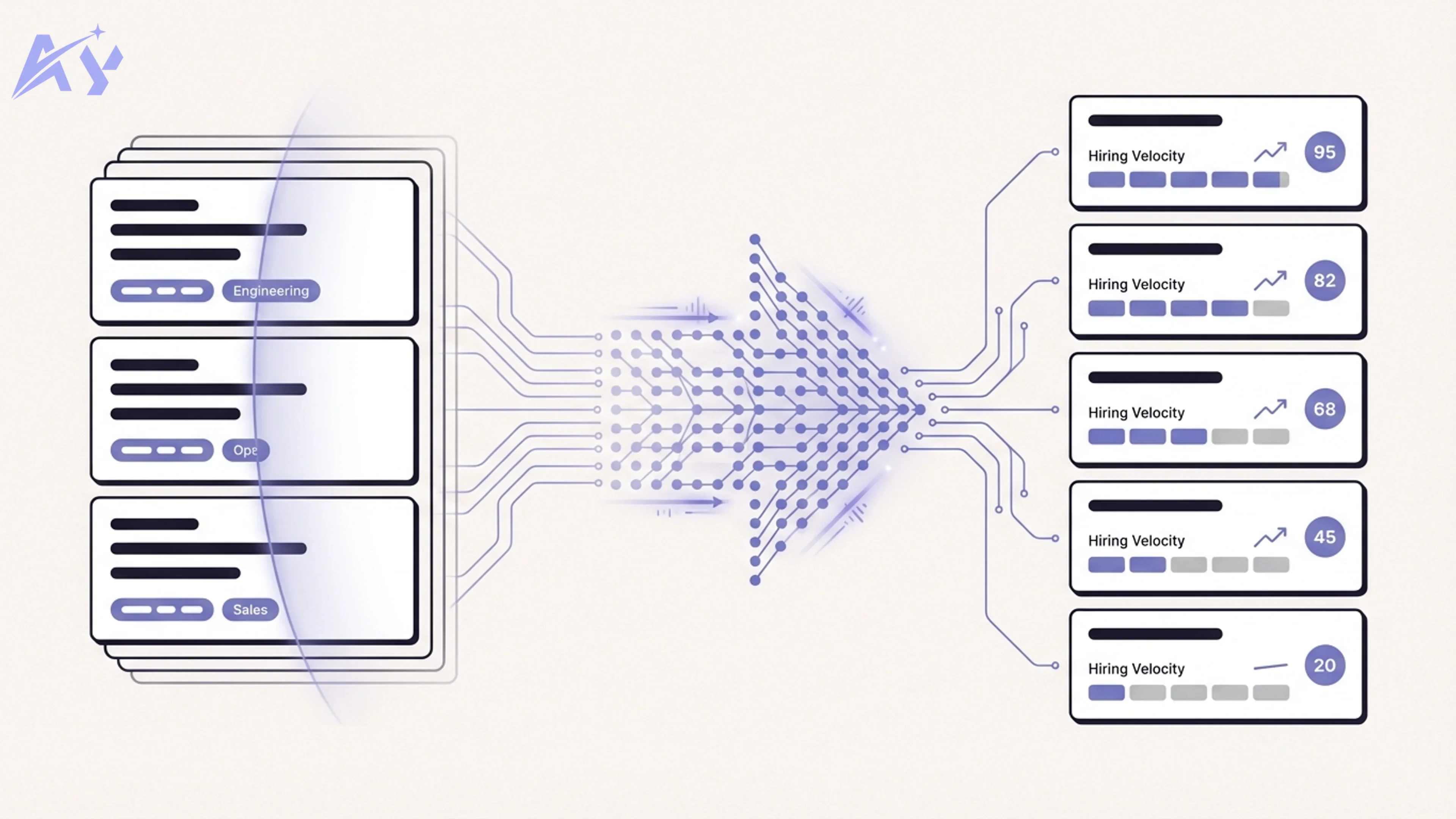
A concrete example: if you sell custom workflow automation to engineering teams, you configure career-ops to monitor the career pages of 100 mid-market SaaS companies. When three or more engineering roles appear at the same company in the same week, that company fires as a high-velocity signal. Your SDR gets an alert, enriches the contact, and reaches out with a message anchored to the company's visible growth pain.
This is what paid tools like Clay charge $149-$800 per month to do. career-ops does the scanning layer for free.
How to Score Companies by Hiring Velocity
Not all hiring signals are equal. A single job posting is weak signal. A cluster of related hires in a short window is strong signal. Hiring velocity is the measure of how quickly a company is adding headcount in a specific function.
Here is a simple scoring framework to prioritize your outreach:
| Hiring Signal | Velocity Score | Interpretation | Action |
|---|---|---|---|
| 1 role posted | Low (1) | Normal backfill or slow growth | Monitor, low priority |
| 2-3 roles in same function | Medium (2-3) | Team expansion underway | Add to nurture list |
| 4+ roles across multiple functions | High (4-5) | Scaling phase, budget unlocked | Priority outreach |
| New C-suite or VP hire posted | High (4-5) | New buyer, tool review coming | Fast outreach within 30 days |
| 5+ engineering + ops roles simultaneously | Critical (5) | Hypergrowth, maximum pain | Same-day outreach |
The C-suite signal deserves special attention. Research from SyncGTM finds that new executive hires make 70% of their first-year tool purchasing decisions within the first 90 days. A company posting a "VP of Engineering" role is 6-8 weeks away from a new buyer who will audit the entire tech stack. That is your window.
Combine velocity scoring with role-type filtering to target by your ICP. If you serve early-stage SaaS companies, filter for companies posting their first DevOps, data engineering, or growth marketing roles. These signal a transition from scrappy startup to scaling company, which is often the exact moment your product becomes relevant.
Step-by-Step: Setting Up career-ops as a Sales Scanner
Here is how to configure career-ops for sales prospecting rather than job searching.
Step 1: Define your ICP portal list
Fork career-ops and replace the default company portal list with your target accounts. The system supports Greenhouse, Ashby, Lever, and direct career page URLs. Build a list of 50-200 companies that match your ICP: industry, size, tech stack, geography.
If you are doing outbound for an AI agent development practice, your list might include: mid-market SaaS companies in fintech, healthtech, and ecommerce that have raised a Series A or B in the past 18 months.
Step 2: Define your signal filters
Edit the evaluation criteria to score companies instead of jobs. Instead of matching roles to a CV, you are scoring companies by:
- Number of open roles (raw count)
- Role types (engineering, ops, sales, marketing), filtered to your ICP's buying function
- Rate of posting (new roles this week vs. last week)
- Seniority of hires (VP/C-suite triggers a higher score)
Step 3: Run batch scans on a schedule
career-ops supports headless, scheduled execution via Claude Code's /loop and /scheduler commands. Configure a daily or twice-weekly scan that outputs a fresh signal report. The system deduplicates across runs, so you only see net-new postings.
Step 4: Pipe output to your CRM
The system outputs a structured tracker (CSV or JSON). Connect this to your CRM via a simple n8n or Make workflow. New high-velocity companies auto-create a prospect record. Your SDR queue is populated without manual research.
This is where custom n8n automation connects the loop: career-ops collects the signal, an automation layer routes and enriches it, and your CRM holds the qualified prospect.
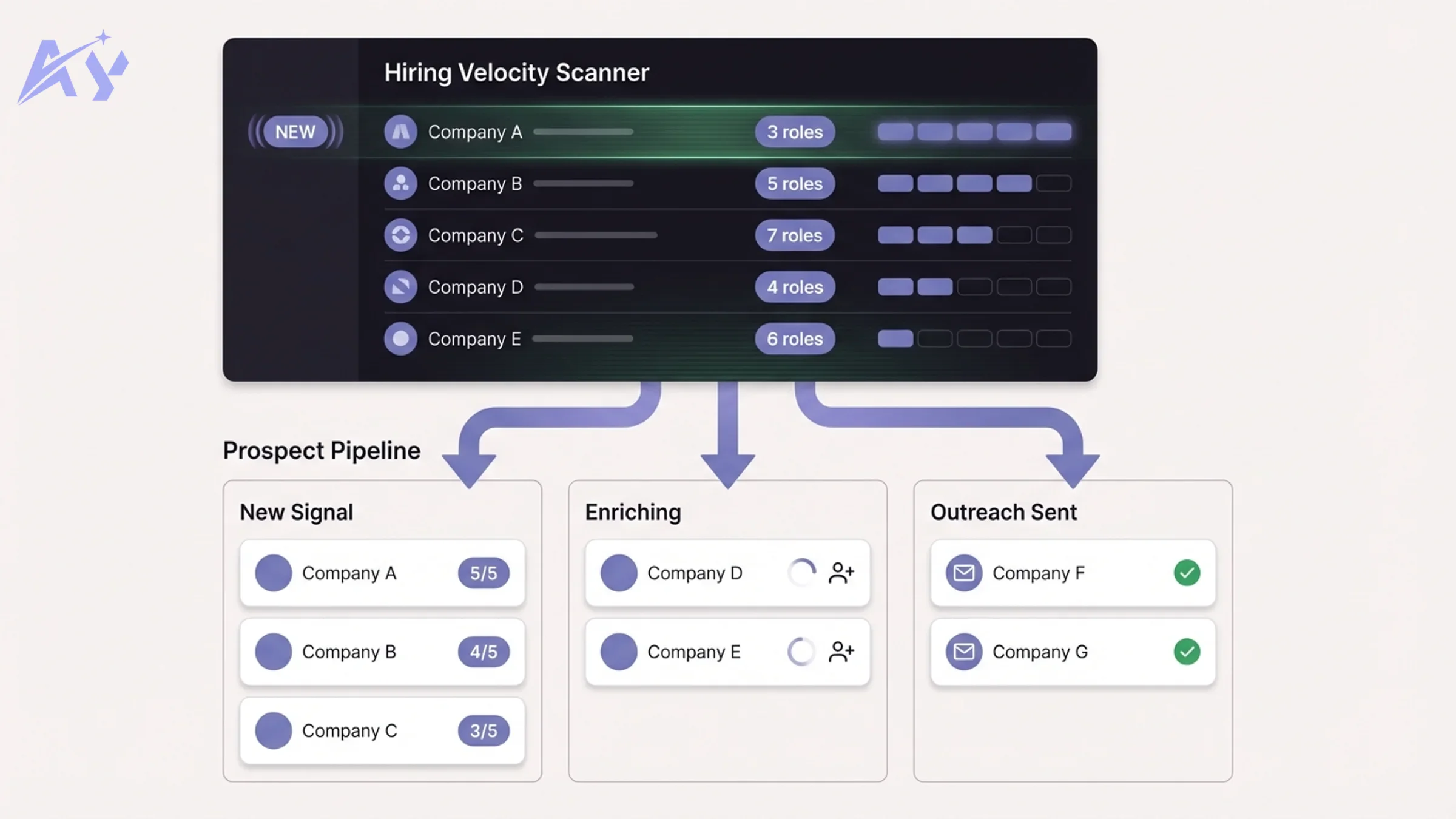
Step 5: Enrich and qualify
career-ops gives you the company name and role data. To reach a human, you need contact enrichment. Layer in Apollo.io (free tier covers basic enrichment) or Clearbit to get decision-maker emails from the companies that fire a high-velocity signal.
The full stack ends up looking like:
- career-ops: signal detection (free)
- Apollo.io or Clay: contact enrichment ($49+/month or free tier)
- Your CRM: pipeline management
- Claude Code: personalized outreach drafting
What to Do With the Signal: Outreach Workflow
Hiring signals are only valuable if your outreach is anchored to them. A generic cold email sent to a company that happens to be hiring is no better than a cold email sent to anyone. The signal becomes powerful when it drives the message.
The framework is simple: name the pain that the hiring signals reveal.
A company hiring three backend engineers has a specific problem. They are building something, and they are behind on it. Your outreach does not say "I saw you are hiring." It says: "Teams scaling engineering headcount this fast usually run into [specific bottleneck]. Here is how we helped [similar company] solve it."
Outreach sequence structure
- Day 0 (signal fires): Research the company. Read recent blog posts, press releases, product launches. Identify the specific growth story behind the hiring.
- Day 1: First touch. Email or LinkedIn message anchored to the hiring pain. One sentence on the signal, two sentences on the outcome you deliver, one clear CTA (15-minute call).
- Day 4: Follow-up with a different angle: a case study, a specific insight, or a relevant question about their stack.
- Day 10: Third touch. Share a resource (playbook, article, tool) relevant to the challenge they are visibly facing.
- Day 20: Break-up message. Short, direct, no pressure.
The first message should reference the signal without being creepy about it. "I noticed you have five open engineering roles" can read as surveillance. "Teams scaling as fast as yours often run into X" reads as relevant expertise. Lead with the insight, not the data.
For teams building this outreach workflow systematically, AI strategy consulting can help you design the full signal-to-pipeline architecture at an organizational level.
career-ops vs. Clay vs. ZoomInfo: The Real Cost Comparison
Paid intent data platforms are powerful, but the cost is significant. Here is an honest comparison:
| Tool | Monthly Cost | Hiring Signal Coverage | Contact Enrichment | Outreach Automation | Customization |
|---|---|---|---|---|---|
| career-ops (self-hosted) | Free | 45+ job boards, fully configurable | No (manual or layered) | Via Claude Code | Full (open source) |
| Clay | $149-$800/mo | Yes (LinkedIn + boards) | Yes (50+ sources) | Yes (built-in) | Limited |
| Apollo.io | $49-$99/mo | Partial | Yes | Yes | Limited |
| ZoomInfo | $15,000+/yr | Yes (deep) | Yes (enterprise-grade) | Yes | Limited |
| LinkedIn Sales Navigator | $99/mo | LinkedIn only | Limited | No | None |
career-ops covers the signal detection layer completely. The gap is enrichment and outreach automation, both of which you can fill with Apollo's free tier and a simple Claude Code prompt.
For founders and small sales teams, the career-ops stack delivers roughly 80% of what Clay provides at 5-10% of the cost. The trade-off is setup time and the absence of a polished UI. If you have a technical co-founder or an in-house automation resource, the setup takes one to two days and runs continuously from there.
If your team needs help building this system end-to-end (from signal collection through CRM integration and outreach automation), our SaaS MVP development team has built exactly this kind of internal tooling for several clients.
What This Means for You
- If you are a founder prospecting for clients: Configure career-ops against your top 100 target accounts this week. Set up a weekly scan. Your SDR queue will be pre-qualified with companies actively in a growth phase, no list buying required.
- If you run a sales team: Hiring velocity scoring gives your reps a prioritization framework that is more reliable than engagement scoring alone. A company actively hiring into the function you serve is a better bet than one that downloaded a whitepaper six months ago.
- If you are an AI builder: career-ops is an excellent reference architecture for multi-agent Claude Code systems. The pattern (configurable portal list, parallel evaluation workers, structured output tracker) applies to dozens of signal-monitoring use cases beyond job boards.
- If you are evaluating Clay or ZoomInfo: Run career-ops for 30 days first. Measure how many of your closed deals this quarter came from companies that were in active hiring mode when you first reached out. The data will tell you how much of the paid tool's value you can replicate for free.
The best sales signal is a publicly declared problem. Job postings are exactly that.
Sources: How to Use Hiring Signals to Time Your Sales Outreach Perfectly in 2026 (SyncGTM), Hiring Signals for Sales Prospecting (Autobound), B2B Prospecting in 2026: The Signal-Based Framework That Actually Works (Salesmotion), GitHub: santifer/career-ops, I Built a Multi-Agent Job Search System with Claude Code (DEV Community)
FAQ
What are hiring signals in B2B sales? Hiring signals are data points from company job postings that indicate budget allocation, team growth, and strategic investment. When a company posts multiple roles in a specific function, it is publicly declaring that it has approved budget and is actively building in that area. Sales teams use these signals to prioritize outreach to companies that are actively in a buying mode.
How do job postings predict buying intent? A job posting is a commitment, not a survey. It means leadership has approved headcount, budget is unlocked, and the team is under enough strain to justify a hire. Research shows that new hires make most of their tool purchasing decisions within 90 days. The combination of a new VP or department leader plus active hiring in their function is one of the most reliable indicators of an upcoming vendor evaluation.
What is career-ops and how does it work? career-ops is an open-source AI job search system built on Claude Code by Santiago Ferrero. It uses 14 Claude Code skill modes to scan 45+ company career portals, evaluate job postings against a scoring framework, generate ATS-optimized CVs, and maintain a deduplicated application tracker. The entire system runs from the command line and is fully configurable. You can fork it and redirect its scanning capability toward sales prospecting by replacing the job seeker profile with an ICP target list.
Can I use career-ops for sales prospecting instead of job searching? Yes. The core scanning infrastructure (configurable portal list, parallel evaluation workers, structured output tracker) works identically for prospecting. You configure which company career pages to monitor, define your signal scoring criteria (hiring velocity, role types, seniority level), and let the system run on a schedule. The output is a prioritized list of companies actively hiring in ways that signal they need your product or service.
Is career-ops a free alternative to Clay? For the signal detection layer, yes. career-ops scans job boards and company career pages for free with no subscription cost. Clay adds contact enrichment from 50+ data sources, a polished UI, and built-in outreach sequencing. career-ops covers roughly the hiring signal portion of Clay's value. For enrichment, you can layer in Apollo.io's free tier. The full stack costs a fraction of Clay while covering the highest-signal data source: active job postings.
What is hiring velocity and why does it matter for outreach timing? Hiring velocity is the rate at which a company is adding headcount in a specific function over a given period. A company posting five engineering roles in two weeks has higher hiring velocity than one posting a single role over three months. High velocity means the team is growing faster than it can manage, which correlates directly with tool and service buying decisions. Timing outreach to high-velocity signals increases conversion rates by 25-30% compared to cold outreach with no behavioral signal.
How do I turn hiring data into a sales pipeline? The workflow has four steps: scan job boards for target companies using career-ops, score companies by hiring velocity and role type, enrich contacts using Apollo or Clay to get decision-maker details, and send outreach anchored to the specific pain the hiring signals reveal. Connect the career-ops output to your CRM via an automation layer (n8n, Make, or Zapier) so that high-velocity prospects automatically populate your SDR queue.
What types of companies should I target based on their job postings? Target companies whose hiring patterns align with your ICP's buying triggers. If you sell to engineering teams, prioritize companies posting multiple backend, DevOps, or platform engineering roles. If you sell marketing tools, prioritize companies hiring their first demand generation or marketing operations role, which signals a shift from founder-led growth to scalable marketing. The specific role being hired tells you exactly which problem the company is trying to solve and which budget has been unlocked.
To convert those signals into a predictable pipeline, how to qualify sales leads covers scoring models that filter noise from genuine buyers, and our lead qualification workflow shows the actual capture-enrich-score-route pipeline we build. For tooling that automates the enrichment step, best AI sales automation tools compares platforms that run this at scale. And once you close those accounts, best AI agents for customer support shows how to keep them without adding headcount.
Continue Reading
AI Facilities Management Tools: What to Automate, Where Judgment Leads (2026)
What AI facilities management tools automate well, how this differs from property management, and where facilities professional judgment still leads.
AI Vendor Management: What to Automate, Where Judgment Leads (2026)
Where AI genuinely helps in vendor management (contract tracking, risk monitoring, SLA tracking), and where negotiation and relationship judgment still lead.
AI Load Testing Tools: What to Automate, Where Engineering Judgment Leads (2026)
What AI load testing tools do well, how this differs from functional CI/CD testing, and where engineering judgment on results still leads.
Book a Free Strategy Call
Building this in production?
Walid runs a 30-min call to map your AI engineering team. Free, no slides.
Free weekly brief
Steal our production automations
The exact n8n flows, Claude Code setups, and prompts we ship for clients, broken down step by step. No spam, unsubscribe anytime.

Ex-IBM AI engineer and enterprise architect. Adel owns the technical architecture behind every automation and AI agent system AY Automate ships.