Book a Free Strategy Call
Skip the read: talk to Walid in 30 min.
Free strategy call. We map your AI engineering team, you keep the notes.
What Is AI Recruiting Software? How It Works in 2026
AI recruiting software is software that uses machine learning and large language models (LLMs) to automate or assist parts of the hiring process: sourcing candidates, screening and ranking applicants, scheduling interviews, and keeping candidates engaged. Instead of relying on recruiters to manually read every resume or send every follow-up, these tools surface the most relevant people, handle repetitive coordination, and feed recruiters a shorter, better-qualified shortlist. Interest in the category spiked sharply in late 2025, per Google Trends, then cooled through 2026 as hiring teams moved from evaluating these tools to actually running them.
This guide explains what the software actually does, the main types you will encounter, the honest benefits, and the real compliance risks you need to understand before you buy.
TL;DR
- AI recruiting software applies machine learning and LLMs to hiring tasks like sourcing, screening, scheduling, and candidate communication.
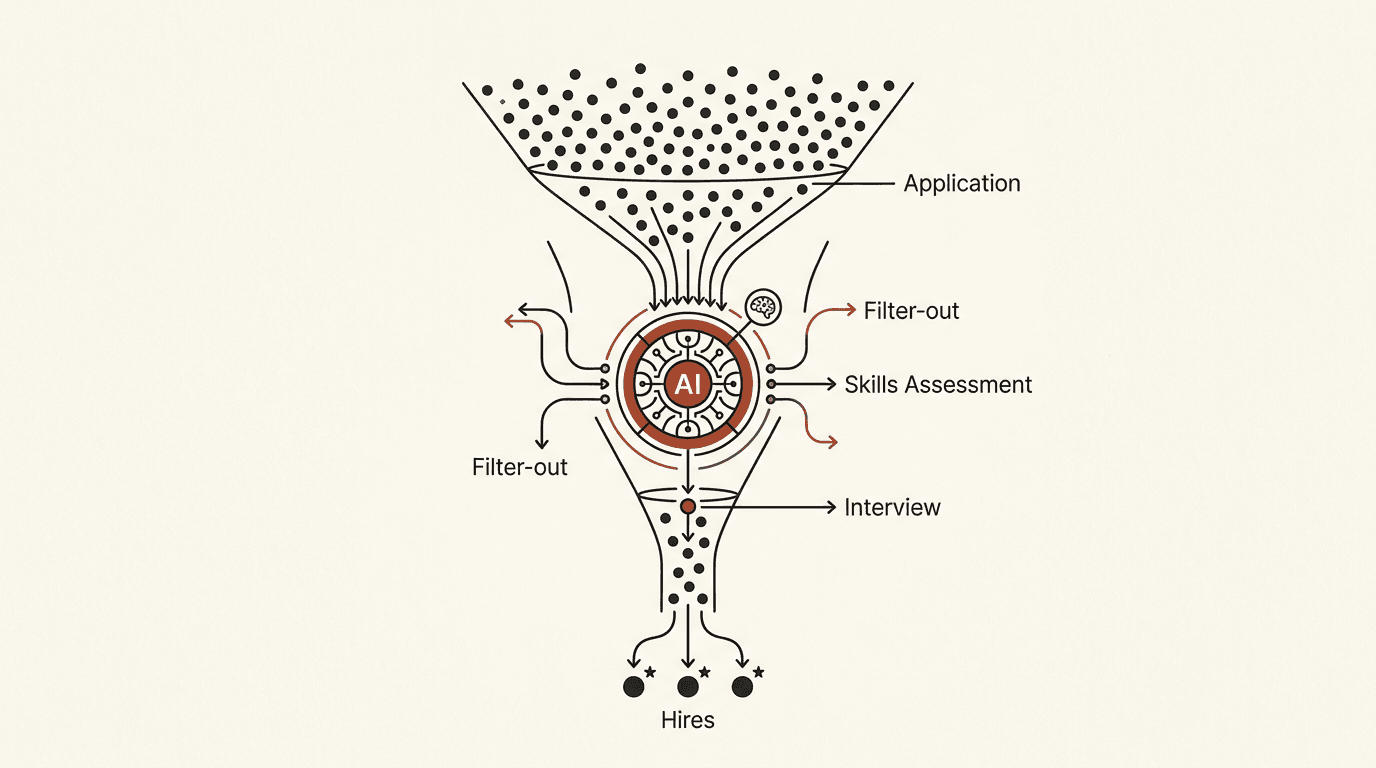
- It works across the hiring funnel, narrowing a large pool of applicants down to a ranked shortlist while automating coordination.
- The main categories are AI sourcing tools, AI screening and assessment, conversational recruiting, talent intelligence platforms, and ATS systems with AI features.
- Benefits center on speed, consistency, candidate experience, and sourcing reach, not magic outcomes.
- Real risks include algorithmic bias and the need for human oversight, plus regulations like NYC Local Law 144, the EU AI Act, and EEOC guidance.
How AI recruiting software works
Most tools map to stages of the recruiting funnel. Here is what happens at each stage.
Sourcing
At the top of the funnel, AI sourcing tools search large candidate databases, job boards, and professional networks to find people who match a role. They parse a job description, infer the skills and experience that matter, and return a ranked list of potential candidates, including passive ones who are not actively applying. This widens reach without a recruiter manually running dozens of boolean searches.
Screening and ranking
Once applications arrive, screening and ranking models read resumes and applications, extract skills and experience, and score candidates against the role requirements. The goal is to push the strongest matches to the top so recruiters spend time on people who are genuinely qualified. This is also the stage with the highest compliance stakes, because automated ranking can influence who advances. Human review of the shortlist remains essential.
Interview scheduling
AI scheduling removes the back-and-forth of finding a time. The software checks interviewer availability, offers slots to candidates, books the meeting, sends invites, and handles reschedules. This is one of the most reliable wins because it automates pure coordination work with low risk of bias.
Candidate engagement and outreach
Conversational tools and chatbots answer candidate questions, collect basic information, nudge applicants who go quiet, and keep people informed about where they stand. Good engagement reduces drop-off, since candidates lose interest when they hear nothing for days. LLMs make these interactions feel more natural than older rule-based bots.
Analytics and reporting
Finally, analytics features track metrics like time-to-fill, source effectiveness, funnel conversion, and pipeline health. This helps talent teams see where candidates drop off and which channels actually produce hires, turning recruiting into something you can measure and improve.
Free weekly brief
Steal our production automations
The exact n8n flows, Claude Code setups, and prompts we ship for clients, broken down step by step. No spam, unsubscribe anytime.
Types of AI recruiting software
The category is broad. Most products fall into one of these groups, and some platforms combine several.
- AI sourcing tools: Find and surface candidates from large databases and networks, including passive talent, based on a role's requirements.
- AI screening and assessment: Parse resumes, score applicants against requirements, and sometimes run skills assessments to rank candidates.
- Conversational and chatbot recruiting: Use LLM-powered chat to answer questions, pre-screen applicants, and keep candidates engaged across web, SMS, or messaging.
- Talent intelligence platforms: Aggregate data on skills, market supply, and internal talent to inform sourcing strategy and workforce planning.
- ATS with AI features: Applicant tracking systems that layer AI on top of the system of record, adding matching, ranking, and automation to the workflow recruiters already use.
If you want a side-by-side look at specific products in these groups, see our roundup of the best AI recruiting software.
Benefits
When implemented well and supervised by people, AI recruiting software offers several honest advantages.
- Speed: Automating sourcing, screening, and scheduling compresses the parts of hiring that usually create delay, which can shorten time-to-fill.
- Consistency: Applying the same screening criteria across every applicant reduces ad-hoc judgment calls, as long as the criteria themselves are sound and audited.
- Candidate experience: Faster responses, easy scheduling, and proactive updates keep candidates engaged and reduce the silence that drives drop-off.
- Sourcing reach: AI can surface qualified candidates a recruiter might never find manually, including passive talent who are not browsing job boards.
Note what is not on this list: guaranteed better hires or hard percentage improvements. Results depend heavily on your data, your criteria, and your oversight. For a deeper operational view, read our AI recruiting automation guide.
Risks and compliance
AI in hiring touches legally protected decisions, so the risks are real and the rules are tightening.
Bias is the central concern. Models learn from historical data, and if that data reflects past discrimination, the model can reproduce or amplify it. This is why human oversight is not optional: a person should review shortlists and decisions rather than rubber-stamping the algorithm's output.
Several real regulations already apply or are coming into force:
- NYC Local Law 144: New York City requires employers using automated employment decision tools (AEDTs) to conduct an independent bias audit, publish a summary of the results, and notify candidates. Enforcement began in July 2023.
- EU AI Act: The EU's AI Act classifies AI systems used in recruitment and employment decisions as high-risk, which brings obligations around risk management, data governance, transparency, and human oversight for systems in scope.
- US EEOC guidance: The Equal Employment Opportunity Commission has issued guidance reminding employers that existing anti-discrimination law, including the Americans with Disabilities Act and Title VII, applies when AI and algorithmic tools are used in hiring. Employers remain responsible for discriminatory outcomes, even when a vendor's tool produces them.
The practical takeaway: treat any tool that scores, ranks, or filters candidates as something you must audit, document, and supervise. Ask vendors directly how they handle bias testing and what audit support they provide.
How to choose
Start with the stage of the funnel where you feel the most pain, sourcing, screening, scheduling, or engagement, and evaluate tools that solve that specific problem rather than buying a do-everything suite you will not fully use. Check how a tool integrates with your existing ATS, what data it trains on, and whether it provides the bias audit documentation you need for compliance. Then compare a short list of real products before committing.
For a hands-on comparison of specific tools, see our guide to the best AI recruiting software. If you run a staffing or recruiting firm, our piece on AI recruiting software for staffing agencies covers the patterns that matter at agency scale.
Frequently Asked Questions
What is AI recruiting software in simple terms? It is software that uses machine learning and LLMs to do or assist hiring tasks: finding candidates, screening and ranking applications, scheduling interviews, and communicating with applicants. It aims to give recruiters a shorter, better-qualified shortlist with less manual work.
Does AI recruiting software replace recruiters? No. It automates repetitive tasks and surfaces candidates, but humans still own judgment, relationship-building, and final decisions. Because of bias and compliance risks, human oversight of shortlists and decisions is required, not optional.
Is AI recruiting software legal to use? Yes, but it is regulated. Tools that make or heavily influence hiring decisions can fall under rules like NYC Local Law 144, the EU AI Act, and existing EEOC-enforced anti-discrimination law. Employers stay responsible for outcomes and may need to run bias audits and notify candidates.
What is an automated employment decision tool (AEDT)? It is the term used in NYC Local Law 144 for tools that use machine learning or similar techniques to substantially assist or replace human decision-making in hiring or promotion. Employers using AEDTs in NYC must conduct an independent bias audit and disclose its results.
How is AI recruiting software different from an ATS? An applicant tracking system is the system of record that stores candidates and manages the hiring workflow. AI recruiting software adds intelligence on top, such as matching, ranking, sourcing, and conversational engagement. Many modern ATS platforms now include AI features directly.
Want a tailored hiring workflow rather than an off-the-shelf product? Explore our custom automation services, or if you need vetted talent placed directly, see our engineer placement service.
Book a Free Strategy Call
Building this in production?
Walid runs a 30-min call to map your AI engineering team. Free, no slides.
Free weekly brief
Steal our production automations
The exact n8n flows, Claude Code setups, and prompts we ship for clients, broken down step by step. No spam, unsubscribe anytime.

Ex-IBM AI engineer and enterprise architect. Adel owns the technical architecture behind every automation and AI agent system AY Automate ships.