Book a Free Strategy Call
Skip the read: talk to Walid in 30 min.
Free strategy call. We map your AI engineering team, you keep the notes.
Choosing an AI agent development service is difficult because agencies, embedded engineers, software platforms and general AI consultancies solve different problems. The right option depends on your workflow, internal skills, integration needs and plans for support after launch. For most B2B, SaaS and ecommerce teams with a defined operational process, a custom development service is the practical starting point because it can connect an agent to the tools where the work already happens.
This guide compares four kinds of options rather than ranking named providers. Public information was not consistent enough to support a fair provider ranking. An AI agent is software that can interpret a goal, choose actions, use approved tools and complete work within defined limits. Use the sections below to decide which delivery model fits your team before you compare proposals.
The short answer
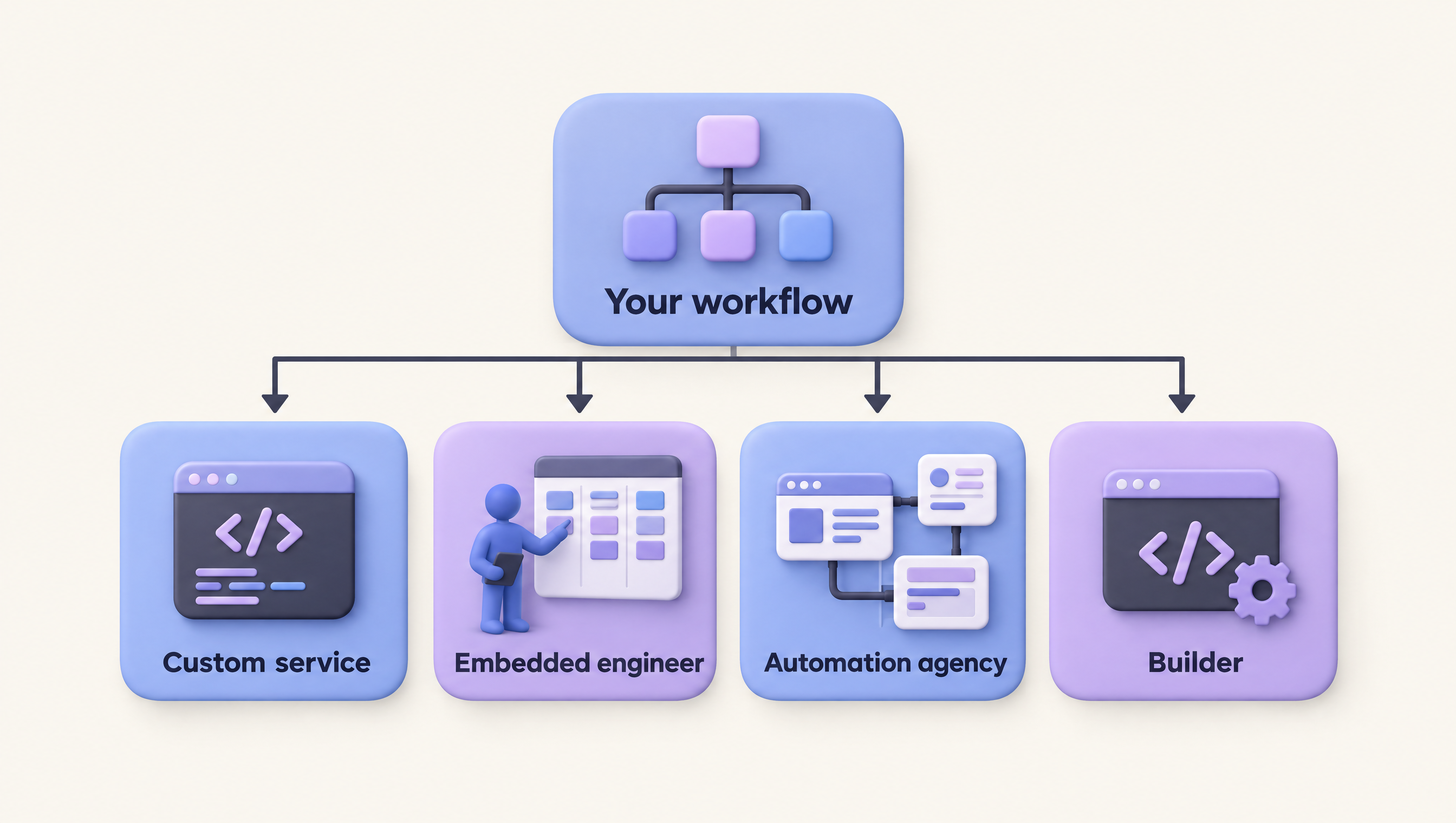
The four useful options differ mainly in who designs the system, who builds it and who owns it after launch.
- Custom AI agent development service: Best for a defined workflow that crosses several business systems and needs tailored logic.
- Embedded AI engineer: Best for teams that want technical delivery inside their existing product or operations group.
- AI automation agency: Best for operational processes that combine agents with rules, integrations and conventional workflow automation.
- AI agent builder or framework: Best for teams with developers who want to create and maintain the system themselves.
| Name | What it does | Best for | Pricing basis |
|---|---|---|---|
| Custom AI agent development service | Designs and builds an agent around a specific workflow and tool set | Cross-system, multi-step work | Not published |
| Embedded AI engineer | Works within your team to understand workflows and build the system with you | Ongoing internal delivery | Not published |
| AI automation agency | Combines agents, workflow automation and API integrations | Operations with both fixed rules and AI decisions | Not published |
| AI agent builder or framework | Gives developers tools for creating and managing agents | Teams with internal engineering capacity | Not published |
How we assessed these options
We assessed each option by delivery ownership, fit for existing systems, internal skill requirements, support model and suitability for multi-step work. We also considered whether an option can cover the wider workflow around an agent, since many business processes require deterministic rules and system integrations as well as model decisions.
This is not a ranked review of named providers. Comparable pricing, delivery scope, support terms and independently verified results were not available across a suitable set of companies. We have therefore avoided presenting a score or calling one provider the best without a common evidence base.
AY Automate provides custom agent development, automation agency services and embedded engineering, so we have a commercial relationship with several option types discussed here. We describe those models by fit rather than placing AY Automate first in a provider ranking.
Use these criteria when you examine proposals:
- Workflow definition: Can the provider state where the agent starts, which actions it may take and when a person must intervene?
- Integration depth: Can it work with your current data sources, APIs, permissions and business systems?
- Evaluation plan: Will the team define test cases using realistic inputs before release?
- Operational ownership: Who monitors failures, changes prompts, updates integrations and responds when an external system changes?
- Security boundaries: Which information may the agent access, and what actions require approval?
- Handover: Will your team receive documentation and enough access to understand how the system works?
Do not compare companies on a polished demonstration alone. A short demo can show a model producing a useful response, but it does not establish how the full workflow behaves when data is missing, a tool fails or a request falls outside the expected pattern.
Free weekly brief
Steal our production automations
The exact n8n flows, Claude Code setups, and prompts we ship for clients, broken down step by step. No spam, unsubscribe anytime.
What should you look for in an AI agent development service?
A suitable service should begin with the work, not with a preferred model or framework. Ask the provider to map the trigger, inputs, decisions, tool calls, outputs, exceptions and approval points. This makes the proposed scope easier to test and reduces the risk of buying an impressive interface that does not complete the underlying job.
Start with one workflow that has a clear owner. The owner should be able to explain the current process, identify acceptable outcomes and review edge cases. If nobody owns the process, the provider may have to make business decisions that belong with your team.
A defined operating boundary
The proposal should distinguish between actions the agent may take automatically and actions that need approval. You should also know what happens when the agent lacks information or receives conflicting instructions.
Ask for plain answers to these questions:
- What event starts the workflow?
- Which systems can the agent read from or write to?
- Which actions need human approval?
- How does the system handle an unavailable tool?
- Where are outputs and errors recorded?
- Who can change the agent's instructions?
The answers become part of your acceptance criteria. They also help legal, security and operations teams review the plan before development expands.
Architecture that matches the work
GenAI agent architecture is the arrangement of the model, instructions, business data, tools, workflow state and controls used to complete a task. You do not need the most elaborate design. You need an architecture that makes each important decision and system action observable enough to test.
For knowledge-heavy work, ask whether the agent needs a private retrieval layer. AY Automate's service includes private retrieval pipeline architecture intended to ground answers in a client's information, according to its AI automation agency service. For action-heavy work, focus more closely on permissions, API behaviour, retries and approval steps.
Testing on realistic inputs
Ask how the provider will evaluate normal requests, incomplete requests and unsafe or unsupported actions. A good plan names the test cases, expected outcomes and person responsible for accepting the result. It should also separate model quality from integration reliability, because a correct decision can still fail when a connected system rejects an action.
AY Automate states that it tests automations on real data and maintains them after launch. That service also uses the client's existing stack, n8n and Claude Code, as described on its AI automation agency page.
Maintenance after release
An agent is connected to changing systems, instructions and business processes. Before signing, establish who handles these changes and how requests are prioritised. Ask whether maintenance is part of the initial engagement, a separate agreement or your team's responsibility after handover.
Review access ownership as well. Your business should understand where credentials, logs, configuration and documentation are kept. If the service ends, you need a clear path for operating, transferring or retiring the system.
What are the main kinds of AI agent development options?
The main options are a custom development service, an embedded engineer, an automation agency and a self-managed builder or framework. They overlap, but their ownership models differ. Choose according to the capability you already have and the work your team wants to retain after launch.
AI agents explained: Build your first agent in 8 minutesWatch "AI agents explained: Build your first agent in 8 minutes" on YouTube
Custom AI agent development service
A custom service designs an agent for a particular business process. It usually suits work that requires company-specific instructions, internal knowledge, several system connections or actions that cannot be covered by an off-the-shelf assistant. The service provider handles more of the initial architecture and implementation than a software platform would.
AY Automate develops custom agents and internal knowledge bases for multi-step work, rather than limiting the system to question answering, according to its AI agent development service. Its published approach also connects agents to the tools a business already uses.
Best for
- A defined workflow with company-specific logic
- Teams that need delivery rather than a tool alone
Strengths
- The design can follow your process and permission model.
- The provider can cover integrations and agent behaviour in one scope.
- A private knowledge layer can be included where the use case needs one.
Limits
- Scope can expand quickly when the original workflow is unclear.
- You depend on the provider unless ownership and handover are planned.
- Pricing cannot be compared fairly without matching deliverables.
Who should skip it: Teams that only need a basic internal experiment, or teams with developers who already have time and experience to build and support the agent.
Embedded AI engineer
An embedded engineer works inside your team rather than taking a fixed brief away for delivery. This model can fit a SaaS company with an existing product group, or an operations team where the workflow must be learned through regular contact with its users. Your team stays close to technical choices and can adjust priorities as it learns.
AY Automate describes embedded engineering as placing an engineer inside the client's team to learn workflows and build AI systems. The model still needs an internal owner who can make decisions, provide access and review completed work.
Best for
- Teams building an ongoing AI capability
- Work that needs close contact with product or operations staff
Strengths
- The engineer can learn the process directly from its owners.
- Your internal team remains involved in architecture and delivery.
- Priorities can be reviewed as evidence emerges from real use.
Limits
- It requires regular attention from your staff.
- One embedded role may not cover every security, data and product need.
- Progress slows when internal decisions or system access are delayed.
Who should skip it: Teams that cannot provide a workflow owner, technical access or time for regular decisions. A fixed, narrow project may also be easier to buy as a defined custom build.
AI automation agency
An AI automation agency treats the agent as one component within a larger operating process. It can use fixed workflow steps for predictable actions and reserve model decisions for work that needs interpretation. This is often a practical fit when the main problem is a chain of manual handoffs rather than the absence of a conversational assistant.
AY Automate provides API integration and workflow engineering intended to replace manual handoffs between systems. It also builds n8n workflows and autonomous agents connected to existing business tools, according to its published agency service.
Best for
- Operational workflows spanning several tools
- Processes that mix fixed rules with AI decisions
Strengths
- The wider process receives attention, not only the model response.
- Conventional automation can handle predictable steps.
- Integrations can connect the agent to existing systems.
Limits
- An automation-first provider may be less suitable for a research-heavy AI product.
- Poorly documented processes still require discovery before development.
- Every connected system adds permissions and failure cases to manage.
Who should skip it: Teams seeking only a standalone AI product feature with no operational workflow around it. Those teams may need product engineering or an embedded engineer instead.
AI agent builder or framework
A builder or framework gives your developers the components needed to create an agent themselves. This offers more direct control over architecture and code, but your team also takes responsibility for evaluation, integrations, deployment and maintenance. It is not a substitute for engineering capacity.
You can review AY Automate's directories of AI agent builders and its guide to open source AI agent frameworks when comparing the build-it-yourself route.
The video below shows how an agent can be assembled and explains the basic concept through a first build.
Best for
- Engineering teams that want direct implementation control
- Prototypes that will be owned and extended internally
Strengths
- Your developers can choose and change the architecture.
- The team retains direct access to configuration and code.
- A framework can support custom product requirements.
Limits
- Your team owns testing, monitoring and incident response.
- A quick prototype does not remove production engineering work.
- Framework selection can distract from defining the workflow.
Who should skip it: Teams without developers available for ongoing ownership. If your staff can configure a demo but cannot support integrations or failures, use a service model instead.
How do you choose the right option?
Choose based on the work you need completed and the capability you want to own. Start with the workflow, then decide whether you need a delivered system, a person inside your team, wider process automation or tools for your own developers. Do not begin with a provider shortlist.
Choose a custom service for a defined multi-system workflow
Use a custom AI agent development service when the outcome is clear but your team cannot design and implement the full system. Prepare a process map, sample inputs, required integrations and a list of actions that need approval. Ask each provider to propose against the same scope so you can compare like with like.
The proposal should explain what will be delivered, how acceptance works and who supports the system after launch. Avoid open-ended descriptions such as an intelligent assistant for the whole company. A narrow first workflow gives you clearer tests and exposes integration constraints earlier.
Choose embedded engineering for ongoing product work
Use an embedded engineer when AI development will continue beyond one project and your team wants to stay involved in daily decisions. This can suit a SaaS product team adding agent behaviour to an existing application or an operations group with several related processes.
Name an internal owner before the engineer starts. That person should control priorities, obtain access and decide whether observed behaviour is acceptable. Embedded delivery cannot compensate for unresolved ownership inside your business.
Choose an automation agency for handoffs and operations
Use an automation agency when staff spend time moving information between systems, checking routine conditions and triggering follow-up work. Some steps may need an agent, while others should remain fixed and predictable.
Ask the agency to identify which decisions require a language model and which do not. This keeps the design easier to test and avoids placing variable AI behaviour in steps where a standard rule would be clearer.
Choose a builder or framework when your developers will own it
Use a builder or framework when you have developers who can build integrations, define evaluations and maintain the finished system. Compare options against your deployment environment, access controls and observability needs rather than the speed of a demonstration.
Plan for ownership from the beginning. The person who builds the first version may not be the person supporting it later, so record the workflow, permissions, dependencies and expected failure behaviour.
If you want help mapping a process before choosing a delivery model, discuss the workflow with an AI development team and ask for a bounded first scope. The output should be a decision you can inspect, not a promise that an agent can automate everything.
Before committing, compare proposals using one worksheet:
| Decision | What to record |
|---|---|
| Business outcome | The completed work you expect to observe |
| Starting event | The event or request that begins the process |
| Systems | Every source and destination the agent needs |
| Permissions | Read, write and approval boundaries |
| Test cases | Normal, incomplete and unsupported requests |
| Ownership | People responsible before and after release |
| Exit plan | Access, documentation and transfer arrangements |
A provider should be able to work through this information with you. If the conversation stays focused on model names while workflow ownership, testing and support remain vague, pause the purchase.
FAQ
Ai agent development service reviews
Useful AI agent development service reviews should explain the reviewed workflow, integrations, delivery scope and support arrangement. Treat broad praise or a short demonstration as weak evidence if you cannot tell what was tested. Compare providers using the same process description, acceptance tests and maintenance questions.
GenAI agent architecture
GenAI agent architecture is the arrangement of a model, instructions, business data, tools, workflow state and controls used to complete a task. A suitable design makes important actions testable and limits the systems or information the agent can access. The architecture should match the workflow rather than add components without a clear job.
Markovate agentic ai
Markovate presents custom AI agent development for customer interactions and enterprise workflows on its AI agent development page. Evaluate it with the same checks used for any provider, including scope, integrations, testing, access ownership and post-launch support. This page does not rank Markovate because comparable provider data was not available.
Agentic AI project structure
An agentic AI project should be structured around discovery, workflow boundaries, architecture, integration, evaluation, release and maintenance. Assign an owner to each stage and define acceptance conditions before implementation. Keep the first release narrow enough that your team can inspect decisions, tool actions and exceptions.
Components of agentic AI
Common functional components include instructions, a model, approved tools, business data, workflow state and controls. A production system may also need integrations, records of actions and a route for human review. Include only the components required by the selected workflow and its risk boundaries.
AI Consulting near me
A nearby AI consultant can help when workshops or on-site access matter, but location should not replace delivery fit. Compare consultants on workflow understanding, integration experience, testing practice, ownership terms and maintenance. AY Automate states that it serves clients in the United States, Europe and worldwide.
How much does an AI agent development service cost?
Pricing depends on the workflow, integrations, data access, testing scope and support arrangement. Ask providers to quote against the same written scope and separate initial delivery from ongoing maintenance. Public pricing was not available for the service models compared here.
Should I use an AI agent development company or build in-house?
Use a development company when you need delivery skills or integration capacity that your team does not have available. Build in-house when developers can own architecture, evaluation, deployment and support. An embedded engineer is a middle option when you want outside capability working within your team.
If you have a specific workflow in mind, ask AY Automate to assess whether it needs an agent, conventional automation or a combination of both. Start with one bounded process and define how you will judge the result.
Sources
- AY Automate
- AY Automate AI automation agency
- AY Automate AI agent development
- Markovate AI agent development
- AI agents explained: Build your first agent in 8 minutes
Last checked: 2026-10-19
Book a Free Strategy Call
Building this in production?
Walid runs a 30-min call to map your AI engineering team. Free, no slides.
Free weekly brief
Steal our production automations
The exact n8n flows, Claude Code setups, and prompts we ship for clients, broken down step by step. No spam, unsubscribe anytime.

Taha builds and ships custom AI agents and workflow automations for AY Automate clients across SaaS, finance, and professional services.