Book a Free Strategy Call
Skip the read: talk to Walid in 30 min.
Free strategy call. We map your AI engineering team, you keep the notes.
Claude Cowork and Claude Code both run on the same Claude models and the same plan-act-check agentic loop. That's where the similarity ends. Anthropic built them for two different jobs: Claude Code writes and ships software, Cowork does everything else, research, reports, spreadsheets, document work, the parts of a business that never touch a terminal. Picking the wrong one wastes a setup you didn't need to do, or hands a non-technical team a tool built for engineers.
This isn't a "which is better" question. It's a "which job are you doing" question, and most teams that use one seriously end up using both.
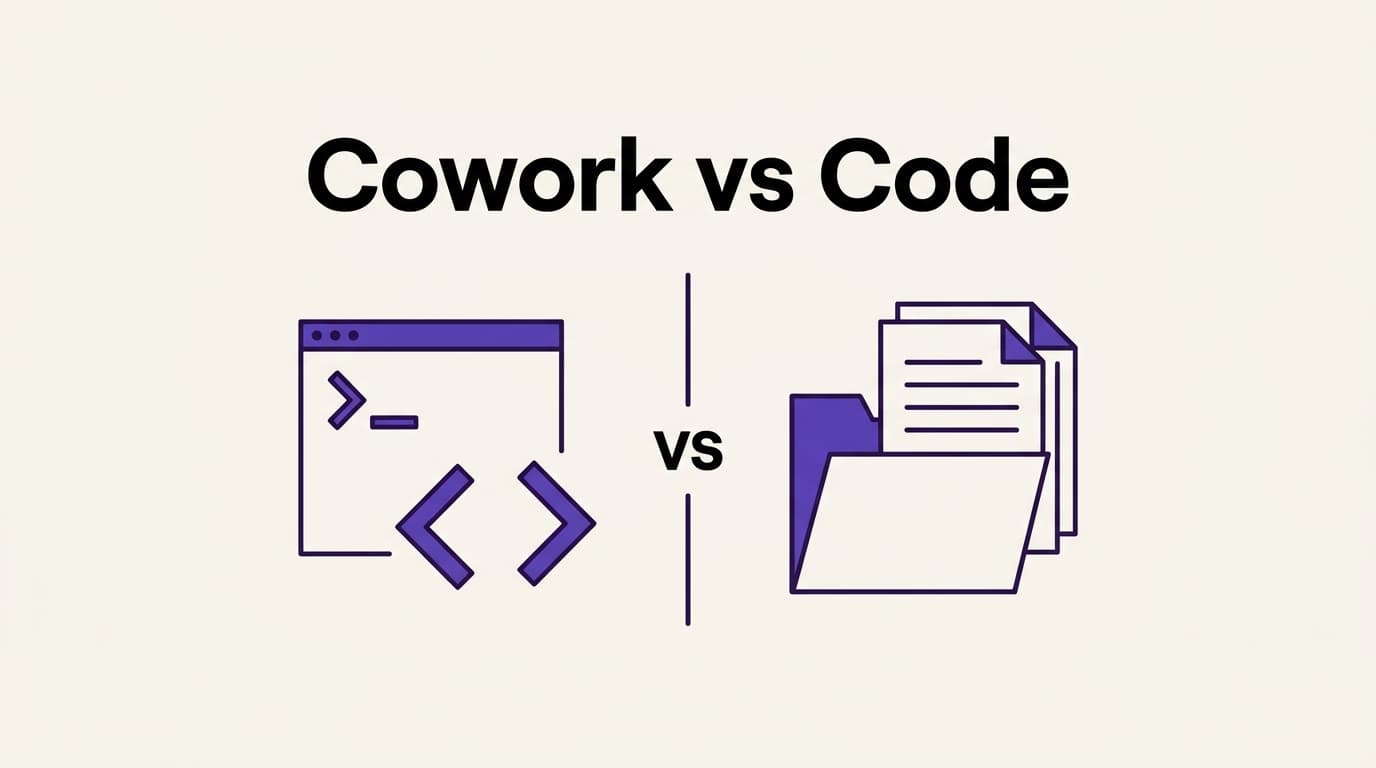
The one-line difference
Claude Code targets software engineering: writing, debugging, and shipping code, run from a terminal, an IDE, or Claude Tag in Slack. Claude Cowork targets non-coding knowledge work: research, analysis, and document creation, run from the Claude Desktop app, and now web and mobile in beta, with no command line involved.
Related Reads
Feature comparison
| Claude Code | Claude Cowork | |
|---|---|---|
| Primary interface | Terminal, IDE, Claude Tag (Slack) | Claude Desktop app, web (beta), mobile (beta) |
| Built for | Writing, debugging, and shipping code | Research, documents, spreadsheets, business process work |
| Setup | Install the CLI, learn terminal workflows, configure scope and permissions | Download the desktop app, connect a folder, describe the task |
| Starting toolkit | 5 built-in skills, zero pre-installed MCP servers, you build the rest | Pre-built skills, connectors, and plugins (including Brand Voice, Legal, and Finance) ready on day one |
| App integrations | Whatever MCP servers you configure | Slack connector, CRM and email/calendar tools, plus Bedrock, Google Cloud, and Microsoft Foundry deployment options |
| Runs unattended | Depends on your own orchestration | Yes, scheduled tasks (/schedule) run remotely without the app open |
| Control model | Full visibility, intervene at any step, requires technical fluency | Manual, Auto, or Skip permission modes; less granular, far less setup |
| File access | Whatever your OS and shell allow | Only folders you explicitly connect, with configurable network egress |
| Who it's for | Developers comfortable in a terminal | Operators, analysts, chiefs of staff, non-technical teams |
Free weekly brief
Steal our production automations
The exact n8n flows, Claude Code setups, and prompts we ship for clients, broken down step by step. No spam, unsubscribe anytime.
Pricing
Both are included in the same plans. Neither has a standalone price.
| Plan | Price | Includes |
|---|---|---|
| Free | $0 | Chat only, no Code or Cowork |
| Pro | $17/month annual, $20/month monthly | Claude Code and Claude Cowork |
| Max 5x | From $100/month | Claude Code and Claude Cowork, higher usage |
| Max 20x | From $100/month (same starting price as 5x, the 20x is a usage multiplier, not a separate price tier) | Claude Code and Claude Cowork, highest individual usage |
| Team | $20-25/month per standard seat, $100-125/month per premium seat | Claude Code and Claude Cowork |
| Enterprise | $20/seat plus API-rate usage, custom | Both, plus admin controls and analytics |
There's no scenario where you pay more for one over the other. The decision is entirely about fit, not budget. (If you're also weighing which Anthropic model tier is worth paying for beyond plan choice, our breakdown of Claude Fable 5 pricing covers that separately, model cost is a different question from which Claude product to run it through.)
How to choose
If your team writes and ships code, start with Claude Code. It gives full control over a coding workflow: every step visible, every action interruptible, direct access to whatever your OS and shell allow. The tradeoff is real technical setup: installing the CLI, learning terminal patterns, and configuring permission scope before it's genuinely productive.
If your team's bottleneck is documents, reports, and business process work, start with Cowork. Anthropic's own data, sampled from 1.2 million sessions across more than 600,000 organizations in May 2026, found business process and operations work made up 33.4% of Cowork usage, and content or copywriting work another 16.4%. Software development was 8.7%, the long tail, not the point. Cowork's setup is a folder connection and a plain-language task description, not a CLI install.
If you're not sure, look at who's asking for it. A developer wanting to automate a repetitive engineering task wants Claude Code. An ops lead who wants scattered weekly updates turned into one clean report wants Cowork. Most organizations end up running both in parallel: engineering keeps Claude Code, and the rest of the business runs recurring reporting, research, and document work through Cowork.
Where an implementation partner fits
Neither tool configures itself around your actual stack. A team adopting Claude Code still has to decide what MCP servers to wire in, how to scope permissions across repos, and how to keep a growing set of custom skills from becoming unmaintainable. A team adopting Cowork still has to figure out which recurring reports are worth automating, how to connect it safely to Slack, Google Workspace, or a CRM without over-granting access, and how to turn a good first task into a repeatable, scheduled one across a whole department. That setup work is exactly what an embedded AI engineer does: instead of your team learning both tools from scratch through trial and error, AI engineer placement puts someone on your team who has already run this stack and builds the workflows around it, so Cowork and Claude Code start paying off in weeks instead of months.
FAQ
Is Claude Cowork better than Claude Code? Neither is better in general. Claude Code is for writing and shipping software; Cowork is for research, documents, and business process work. Most serious users of either eventually use both, for different jobs.
Can Claude Code do what Cowork does, or vice versa? Not well. Claude Code can technically touch files and run scripts, but it assumes terminal fluency and a coding context. Cowork can technically help draft code, but it's built around a folder-and-goal workflow, not a development environment, and it isn't the tool a working engineer would reach for.
Do I need to buy both separately? No. Every paid Claude plan, Pro and above, includes both Claude Code and Claude Cowork at the same price. The choice is about which one fits the task, not which one costs more.
Which one is easier to set up? Cowork, by a wide margin. It's a desktop app download, a folder connection, and a plain-language task description. Claude Code requires installing a CLI, learning terminal workflows, and configuring permission scope, which assumes some baseline technical comfort. See our step-by-step Cowork setup guide for the full process, including the permissions model worth understanding before your first task.
Can non-technical teams use Claude Code? Not easily. It's built for developers who are comfortable in a terminal and understand scope and permissions. A non-technical operator trying to use Claude Code will likely find Cowork does the same underlying job with far less friction.
Which one should an agency or consulting team recommend to a client? It depends entirely on the client's bottleneck. A software team shipping product wants Claude Code. An operations-heavy business drowning in reports and manual document work wants Cowork. An AI engineer placement engagement typically starts by mapping which recurring tasks actually justify automation before recommending either tool.
Does Cowork replace hiring an engineer or an ops person? No. It removes the repetitive, tedious middle of a task (extracting, compiling, reconciling, reformatting), not the judgment calls around what to build, what data to trust, or how a workflow should actually run. Teams that get the most value typically still have someone who owns the setup and keeps it maintained.
Sources: Claude Cowork product page, How people are using Claude Cowork, Claude pricing, Claude Cowork on web and mobile
Continue Reading
AI Vendor Management: What to Automate, Where Judgment Leads (2026)
Where AI genuinely helps in vendor management (contract tracking, risk monitoring, SLA tracking), and where negotiation and relationship judgment still lead.
AI QA Testing Agents: What to Automate, Where QA Judgment Leads (2026)
What an AI QA testing agent does well (test generation, regression testing, cross-browser checks), where QA judgment still leads, and how this differs from agent evals.
GPT-6 Astra vs Claude Fable 5.1 vs Opus 5.5: Why Model Routing Wins
GPT-6 Astra and Claude Fable 5.1 both list at $10 and $50 per million tokens. Claude Opus 5.5, GPT-6 Sol and GPT-6 Luna, all released September 22, cost far less. Verified prices, one independent index and a task-by-task routing table, prices checked September 26, 2026.
Book a Free Strategy Call
Building this in production?
Walid runs a 30-min call to map your AI engineering team. Free, no slides.
Free weekly brief
Steal our production automations
The exact n8n flows, Claude Code setups, and prompts we ship for clients, broken down step by step. No spam, unsubscribe anytime.

Ex-IBM AI engineer and enterprise architect. Adel owns the technical architecture behind every automation and AI agent system AY Automate ships.