Book a Free Strategy Call
Skip the read: talk to Walid in 30 min.
Free strategy call. We map your AI engineering team, you keep the notes.
The best AI agents for customer support in 2026: Intercom Fin for enterprise ticket deflection, Zendesk AI for large-scale routing and automation, Freshdesk Freddy for mid-market support, Ada for self-service resolution, and Forethought for intelligent triage. Full breakdown by use case, platform, and pricing below.
Customer support has evolved far beyond scripted responses. Today, the focus is on delivering intelligent, autonomous resolutions at scale. While traditional chatbots were limited to following predefined conversational flows, modern AI agents can reason, access backend systems, and independently solve complex customer problems 24/7. This transition opens significant opportunities for businesses to reduce operational costs, boost customer satisfaction scores, and free human support teams to focus on high-value, strategic tasks.
However, the market for self-serve AI support software is crowded and complex. Sorting through the mix of SaaS platforms and specialized AI-native tools can be overwhelming for founders, CTOs, and operations leaders. How do you select one of the best ai agents for customer support that aligns with your specific technical stack and business objectives? More importantly, how do you ensure it generates a tangible return on investment instead of becoming just another monthly expense? If you would rather hire an agency to build and manage a custom agent instead of self-serving a platform, see our best AI customer support agencies guide instead.
This guide cuts through the marketing noise to provide a clear, practical roadmap for evaluation and implementation. We have compiled a detailed roundup of the top 11 AI agent solutions, complete with direct links and screenshots. Each entry analyzes key features, ideal use cases, security considerations, and pricing, so you can make an informed decision. We also explore options for teams seeking to build a competitive edge through AI team augmentation, AI-adopted engineer placements, and intensive AI workshops (e.g., Weavy.ai workshops, Cursor coding sessions, Claude model deep dives) to upskill existing development teams. Consider this your definitive resource for finding the perfect AI support solution.
1. Intercom (Fin AI Agent)
Intercom's Fin is a powerful, production-ready AI agent designed to move beyond simple answers and toward autonomous resolutions. It integrates directly with your knowledge base and external systems to handle customer queries from start to finish. This makes it one of the best AI agents for customer support teams looking for a tool that can take concrete actions, not deflect tickets alone. Fin can process returns, update account details, or check order statuses by connecting to your existing business tools.
The platform excels in its hybrid approach, allowing Fin to manage a significant portion of inbound conversations while smoothly handing off complex issues to human agents. This is augmented by a Copilot feature that provides AI assistance directly to your support team, helping them draft faster, more consistent responses.
Key Considerations
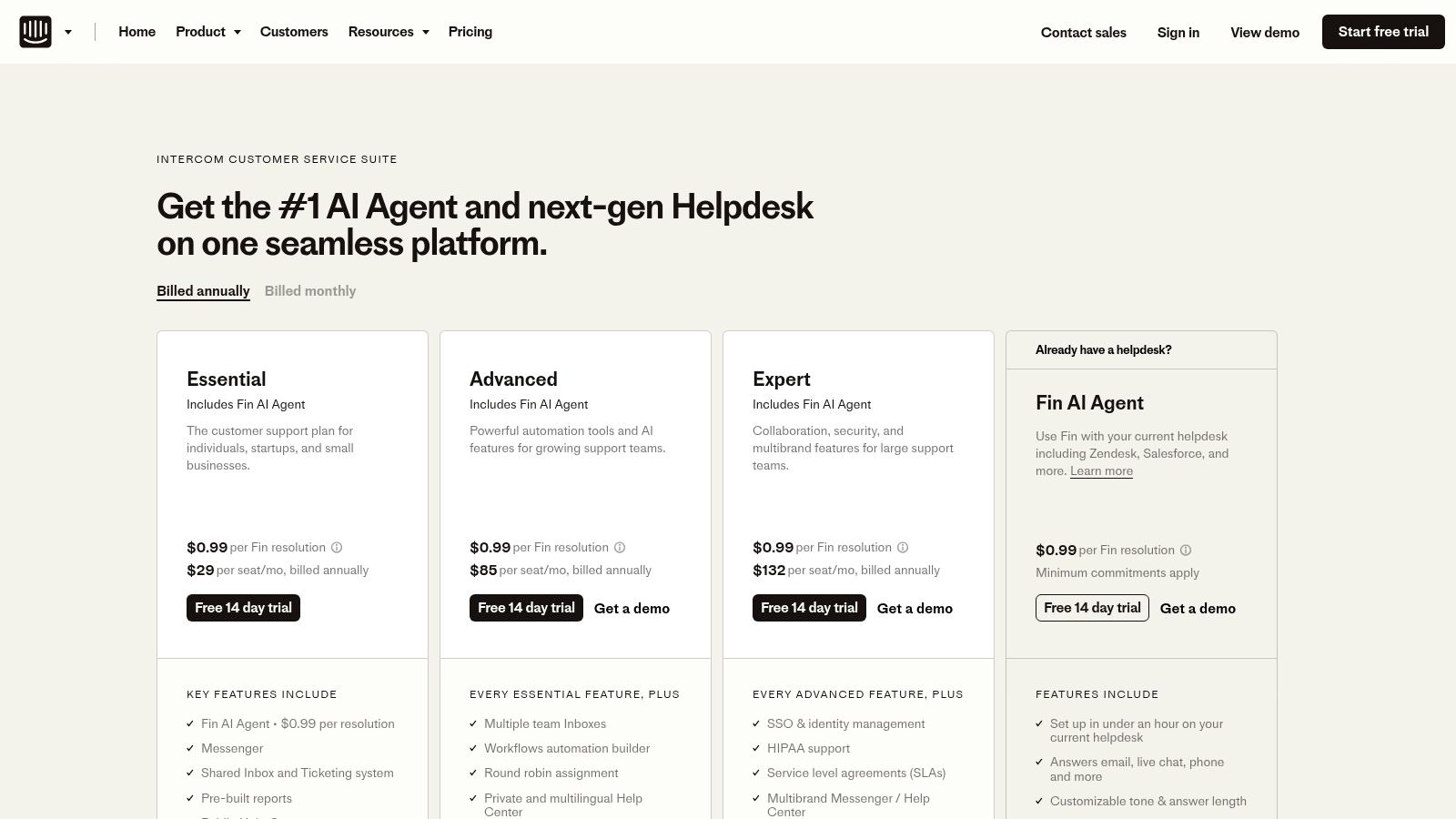
Intercom’s standout feature is its transparent, resolution-based pricing model, starting at $0.99 per resolution. This performance-based cost structure provides a clear path to ROI, as you only pay when the AI successfully closes a query.
- Ideal Use Case: Scaling e-commerce and SaaS companies that need an AI agent capable of performing actions (like order management) and integrating deeply with their existing helpdesk, whether it's Intercom, Zendesk, or Salesforce.
- Pricing: Starts with seat-based plans for the core platform, with Fin AI Agent available as an add-on. The $0.99 per resolution model is a key differentiator, though minimum commitments may apply for use on third-party helpdesks.
- Deployment: Fully SaaS. A 14-day trial is available, and setup is notably fast, often taking minutes to connect a help center and go live.
- Limitations: The combined cost of platform seat fees and per-resolution pricing can become substantial for very high-volume support teams. Understanding the nuances of what constitutes a "resolution" is essential for accurate budget forecasting.
For teams exploring various deployment strategies, understanding the difference between SaaS solutions and custom builds is essential; you can find more details in this guide to AI agents for business.
Website: https://www.intercom.com/pricing
Related Reads
2. Zendesk (Suite + AI Agents and Copilot)
Zendesk offers a mature, full-service CX platform loaded with AI, making it a powerful contender for teams already invested in its ecosystem. Its approach integrates autonomous AI agents and an agent-facing Copilot directly into the omnichannel Zendesk Suite. This allows support teams to handle queries across channels while using AI for both full resolution and agent assistance, positioning it as one of the best AI agents for customer support within a unified platform. The AI is designed to work natively with Zendesk's mature ticketing, reporting, and admin tools.
The platform's strength lies in its breadth. Beyond the chatbot, Zendesk provides integrated AI for quality assurance and workforce management as add-ons. This allows businesses to build a highly cohesive and intelligent support operation on a single foundation, where the AI not only resolves customer issues but also helps manage the human team responsible for complex escalations. The extensive marketplace further extends its capabilities, ensuring it can adapt to specific business needs.
Key Considerations
Zendesk's standout feature is its ability to offer an end-to-end, AI-enhanced customer service solution from a single vendor. The convenience of a tightly integrated system is a major draw for companies looking to minimize complexity and ensure smooth data flow between their chatbot, helpdesk, and agent-assist tools.
- Ideal Use Case: Mid-market to enterprise companies that need a complete, omnichannel customer support suite with deeply integrated AI capabilities for both autonomous resolution and agent productivity. It's particularly strong for existing Zendesk customers looking to add advanced AI.
- Pricing: Suite plans start with foundational features, with Copilot access included in higher tiers. The advanced autonomous AI agents are available as a separate add-on, typically requiring a conversation with sales.
- Deployment: Fully SaaS. Many core plans can be purchased directly online, offering straightforward setup for standard helpdesk functionality.
- Limitations: The total cost can become complex and significant when factoring in the core suite, AI agent add-ons, and other modules like QA or WFM. New users have reported a learning curve when configuring the platform's extensive features.
For teams looking to improve agent efficiency, it’s useful to understand how to automate repetitive tasks beyond just customer-facing interactions.
Website: https://www.zendesk.com/pricing/
Free weekly brief
Steal our production automations
The exact n8n flows, Claude Code setups, and prompts we ship for clients, broken down step by step. No spam, unsubscribe anytime.
3. Salesforce Service Cloud (Agentforce for Service)
Salesforce Service Cloud integrates generative AI natively into the world’s leading CRM, offering a suite of tools under "Agentforce for Service." This platform draws on deep customer data to automate replies, generate case summaries, and surface relevant knowledge articles. Its strength lies in its CRM-native context, allowing the AI to understand the full customer journey and provide highly personalized support, making it one of the best AI agents for customer support for teams already embedded in the Salesforce ecosystem.
The agent automates key service workflows, including case classification, intelligent routing, and providing next-best-action suggestions to human agents. By operating directly within the CRM, it eliminates the data silos that can hinder other third-party tools, ensuring every interaction is informed by a complete customer history.
Key Considerations
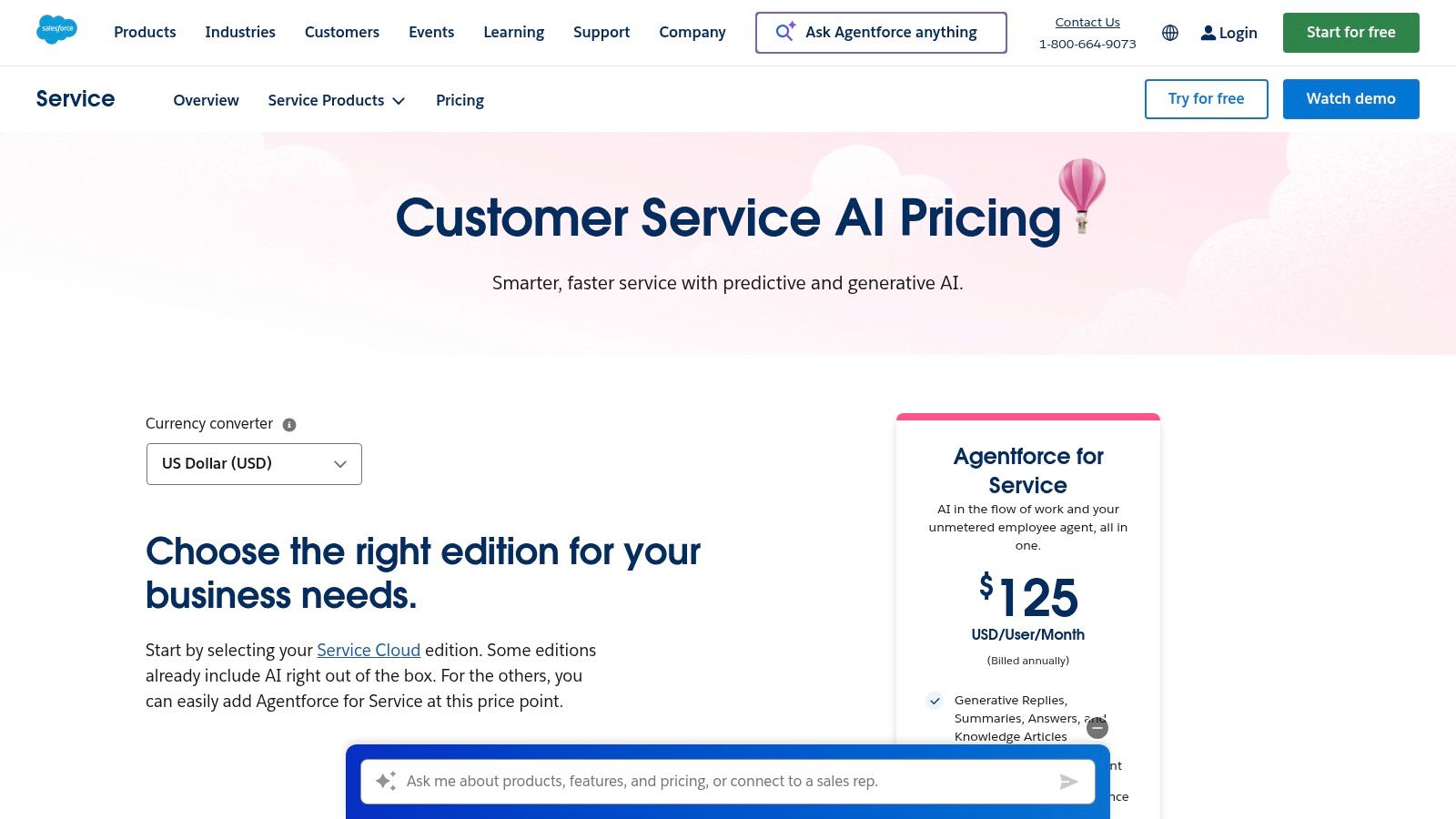
Salesforce's key differentiator is providing an unmetered employee agent for each licensed user on certain tiers, which simplifies cost forecasting for internal use cases. The platform's vast AppExchange ecosystem also allows for extensive customization and integration with other business-critical applications.
- Ideal Use Case: Mid-market and enterprise companies heavily invested in the Salesforce platform that want to augment their service teams with AI capabilities directly within their existing CRM workflows.
- Pricing: Service Cloud pricing starts per user, per month. The Agentforce AI add-on is available at a published starting price, but overall costs can increase significantly with higher-tier editions and additional features.
- Deployment: Fully SaaS. Configuration can be complex and may require specialized expertise, especially for complex automation and multi-cloud environments.
- Limitations: The total cost of ownership can be high for teams not already utilizing the broader Salesforce platform. The complexity of setup and customization may present a barrier for smaller businesses without dedicated IT resources.
For organizations planning their AI adoption, understanding the strategic steps is essential; you can find guidance on how to implement AI in business in this detailed guide.
Website: https://www.salesforce.com/service/ai/pricing/
4. Freshdesk by Freshworks (Freddy AI)
Freshdesk by Freshworks offers a full helpdesk solution powered by its proprietary Freddy AI. It’s designed to enhance both agent productivity and customer self-service through a combination of ticketing, a solid knowledge base, and intelligent automation. Freddy AI assists human agents with response suggestions and streamlines workflows, while also powering chatbots to provide instant answers, making it a strong contender for teams seeking an all-in-one platform. The platform is built to unify customer conversations across multiple channels into a single, manageable interface.
The main advantage of Freshdesk is its integrated approach, where AI is an add-on and a core part of the support ecosystem. Freddy AI can be configured to handle common queries, guide customers to relevant knowledge base articles, and collect necessary information before escalating an issue to a human agent. This makes it one of the best AI agents for customer support teams that need a cost-effective, scalable solution with a clear path from a free plan to advanced enterprise features.
Key Considerations
Freshdesk’s standout feature is its accessibility, with a free tier for up to 10 agents and a transparent, metered pricing model for its AI capabilities. This structure allows businesses to adopt AI support without a massive upfront investment, paying only for the "Freddy AI Agent Sessions" they consume.
- Ideal Use Case: Small to mid-sized businesses looking for an affordable, full-featured helpdesk with integrated AI. It's particularly well-suited for teams that want to start small and scale their AI usage gradually as their support volume grows.
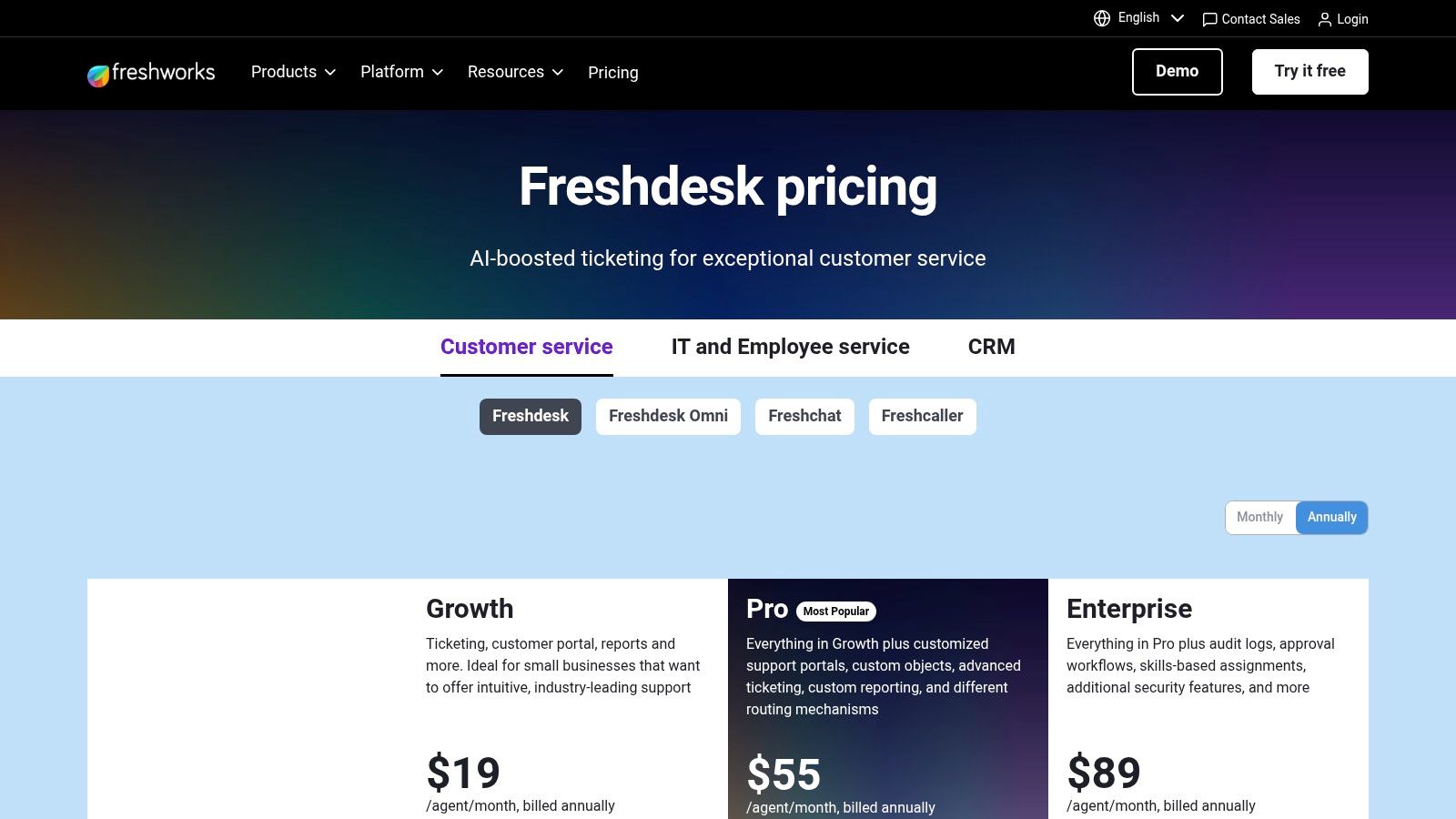
- Pricing: A free plan is available. Paid plans start at $15 per agent/month (billed annually), with Freddy AI Agent Sessions available as an add-on. Plans come with a certain number of sessions included, and additional sessions are charged on a pay-as-you-go basis.
- Deployment: Fully SaaS. A 14-day free trial is available for paid plans, allowing teams to test the full suite of features and AI capabilities before committing.
- Limitations: The per-session AI pricing, while transparent, can become costly for high-volume teams that exceed their plan's included sessions. Advanced customization and automation features are often reserved for higher-tier plans, which may be a consideration for rapidly scaling companies.
Website: https://www.freshworks.com/freshdesk/pricing/
5. Ada
Ada delivers an enterprise-grade AI agent designed for end-to-end customer service automation across chat, email, and voice channels. It stands out by moving beyond simple chatbots, employing multi-model reasoning to handle complex queries. This allows it to deeply integrate with business systems to perform actions, not provide information from a knowledge base alone. You can configure the agent’s persona and tone to ensure brand alignment, making it one of the best AI agents for customer support in large organizations seeking consistency.
The platform is built for global scale, offering auto-translation across more than 50 languages and providing omnichannel coverage from a single, no-code platform. This focus on enterprise needs, combined with built-in measurement for metrics like CSAT and automated resolution rates, positions Ada as a powerful tool for large-scale support operations.
Key Considerations
Ada’s strength lies in its enterprise focus, providing a stable, scalable solution that can be tailored with specific step-by-step instructions for complex processes. This makes it a strong contender for companies that require a high degree of control and customization over their automated support interactions.
- Ideal Use Case: Mid-market to enterprise companies requiring an omnichannel AI agent with multi-language support and deep integration capabilities for systems like Salesforce, Shopify, and Zendesk.
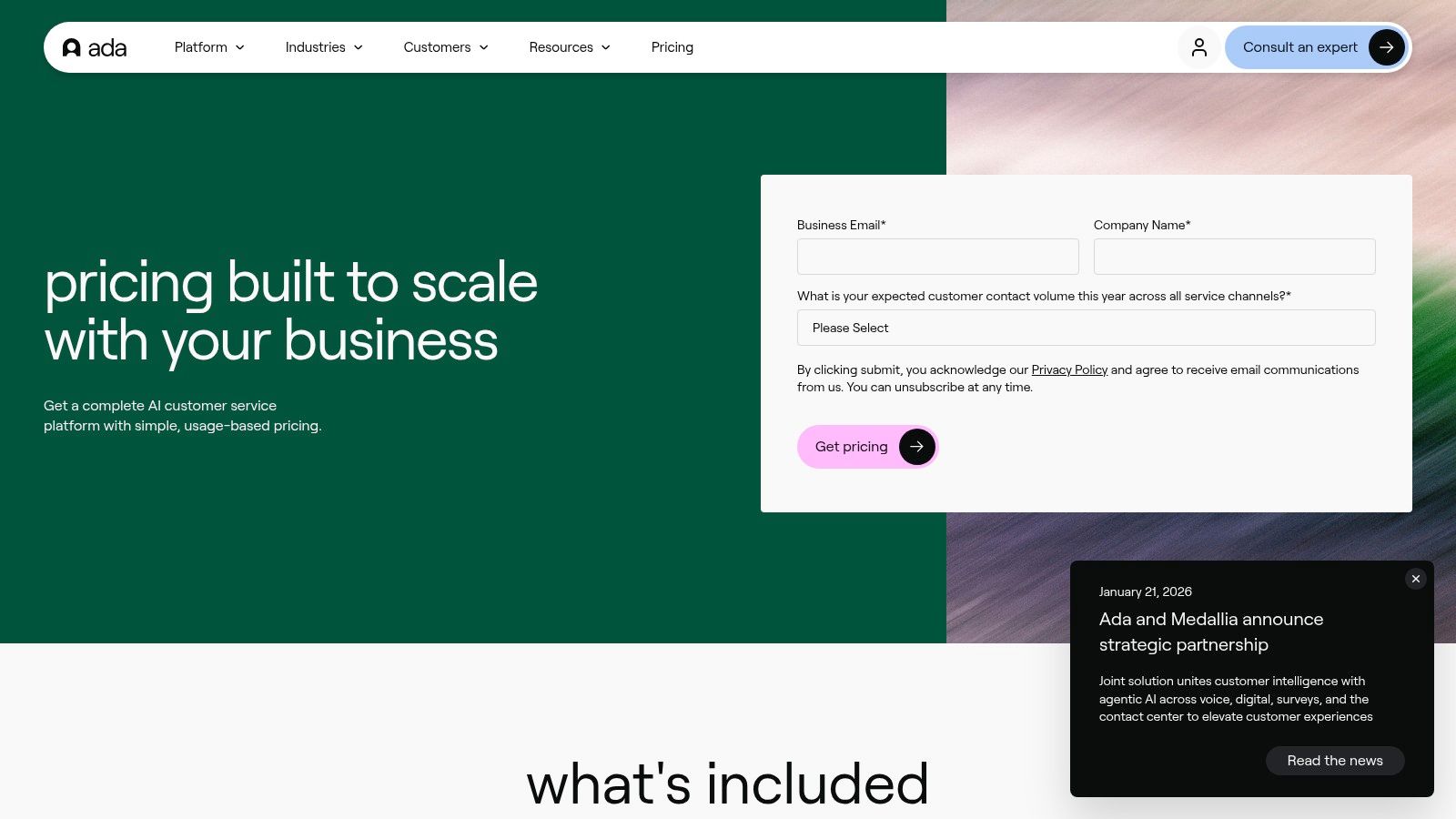
- Pricing: Pricing is not publicly available and requires a custom quote obtained through their sales team, reflecting its enterprise positioning. This model is suited for organizations with specific needs and larger budgets.
- Deployment: Fully SaaS. The platform emphasizes a no-code environment, which simplifies the initial setup and ongoing management for non-technical teams.
- Limitations: The lack of transparent pricing and a primary focus on the enterprise market may make it less accessible for startups or small businesses. The platform’s extensive capabilities may also represent a steeper learning curve compared to simpler solutions.
For a deeper understanding of how to implement such systems, exploring an AI workshop can provide valuable insights for development teams.
Website: https://www.ada.cx/pricing/
6. Forethought
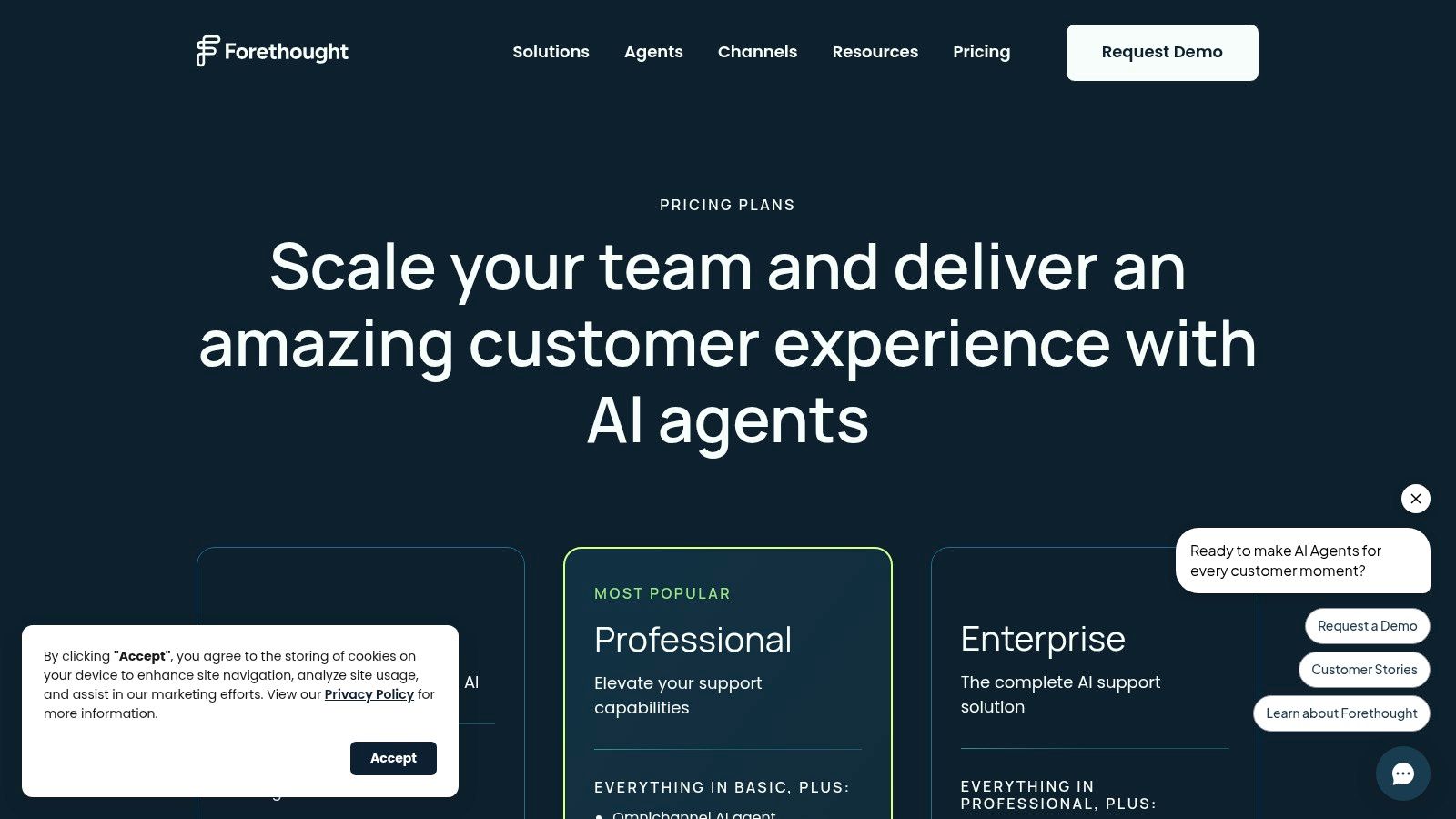
Forethought offers a complete, multi-agent platform designed to automate the entire customer support lifecycle, from initial contact to resolution. Its "Triage" agent automatically routes, tags, and prioritizes incoming tickets, while "Autoflows" provides no-code tools to build fully autonomous resolution paths. This makes it one of the best AI agents for customer support operations looking to streamline complex workflows and reduce manual case handling. The platform focuses heavily on outcome-based automation rather than just deflection.
In addition to its automation capabilities, Forethought enhances the human agent experience with an "Assist" copilot that suggests responses and surfaces relevant knowledge in real-time. Higher-tier plans introduce advanced features like knowledge gap detection, which automatically identifies missing information in your help center and can even generate draft articles to fill those voids. This proactive approach helps continuously improve both self-service and agent-led support.
Key Considerations
Forethought's strength lies in its modular, outcome-focused packaging, allowing companies to adopt the specific AI agents that address their most pressing needs, from triage to complete resolution. This modularity, combined with enterprise-grade security, makes it a strong contender for established teams.
- Ideal Use Case: Mid-market to enterprise companies with complex support workflows that can benefit from intelligent ticket triage, routing, and proactive knowledge management. Its modularity suits teams wanting to adopt AI incrementally.
- Pricing: Quote-based only. Pricing is customized based on the specific modules (Triage, Autoflows, Assist) and support volume, requiring direct contact with their sales team for a proposal.
- Deployment: Fully SaaS. Forethought offers deep integrations with major helpdesks like Zendesk, Salesforce Service Cloud, and ServiceNow.
- Limitations: The lack of public pricing makes initial budget estimation difficult and may not be ideal for smaller teams seeking transparent, predictable costs. Access to the most powerful features, like automatic article generation, is gated behind higher-tier, enterprise-focused plans.
Website: https://forethought.ai/pricing
7. LivePerson Conversational Cloud
LivePerson’s Conversational Cloud is an enterprise-grade platform designed for large-scale, messaging-first customer engagement. Rather than focusing on a single bot, it provides a full orchestration engine that manages interactions across numerous channels and connects with both native and third-party AI agents. This makes it one of the best AI agents for customer support operations that require a unified view across web, mobile apps, SMS, WhatsApp, and social messaging platforms.
The platform excels at routing conversations to the right resource, whether it's a human agent, a Dialogflow bot, or its own AI. Its strength lies in managing complexity and providing deep analytics to optimize conversational outcomes. This orchestration layer allows businesses to plug in specialized AI for different tasks while maintaining a consistent customer experience and centralized control.
Key Considerations
LivePerson’s standout feature is its powerful omnichannel orchestration, allowing enterprises to manage a complex ecosystem of bots and human agents from a single hub. It is designed for businesses that view conversational AI as a core component of their entire customer lifecycle, not a support deflection tool alone.
- Ideal Use Case: Large enterprises in retail, financial services, or telecommunications that need to manage high-volume, multi-channel customer conversations and integrate various specialized AI bots (e.g., for sales, service, or marketing).
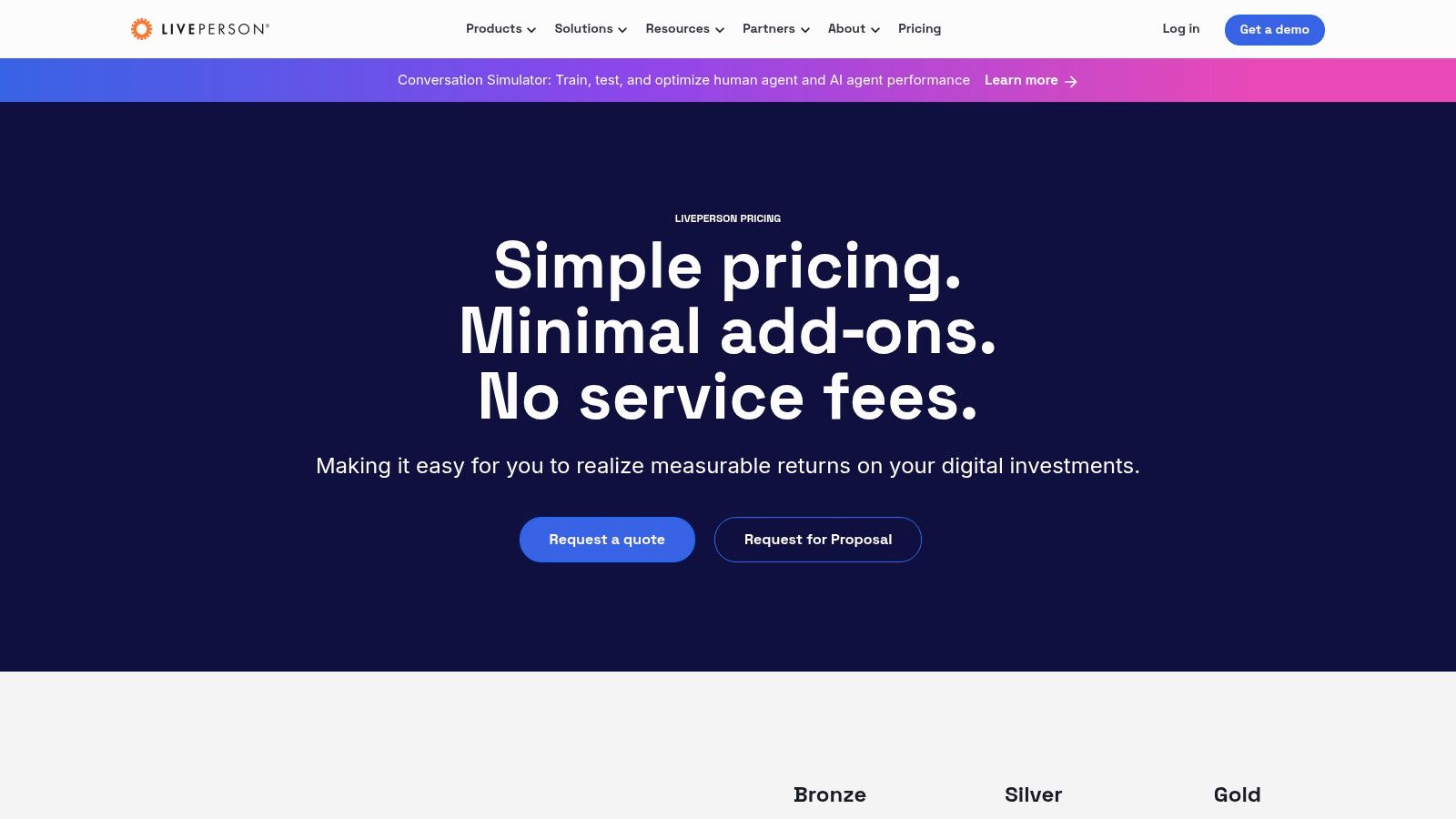
- Pricing: Quote-based. LivePerson offers outcome-focused packaging tiers (Bronze, Silver, Gold), but pricing is not publicly listed and typically requires a consultation to align with specific business goals.
- Deployment: Fully SaaS. Implementation is often a structured project that may involve LivePerson's professional services to ensure successful integration with existing enterprise systems and third-party bots.
- Limitations: The platform's breadth and enterprise focus can be overly complex and costly for small to mid-sized businesses. The reliance on professional services for setup can also mean a longer time-to-value compared to more self-serve solutions.
Website: https://www.liveperson.com/pricing/
8. Genesys Cloud CX (Genesys AI)
Genesys Cloud CX offers a complete contact center solution with deeply integrated native AI capabilities. It moves beyond simple chatbots to provide a full suite of tools, including virtual agents for automated conversations, predictive engagement for proactive support, and intelligent routing to connect customers to the right agent. This makes it one of the best AI agents for customer support operations looking for an all-in-one platform rather than a point solution. The system is designed to manage the entire customer journey with AI-driven insights.
The platform also equips human agents and supervisors with powerful copilot features, enhanced by speech and text analytics for real-time guidance and quality management. A key element of its model is the inclusion of "AI Experience" tokens with its plans, allowing organizations to flexibly apply AI capabilities across different channels and use cases without purchasing each feature separately. This unified approach simplifies deployment and management for complex support teams.
Key Considerations
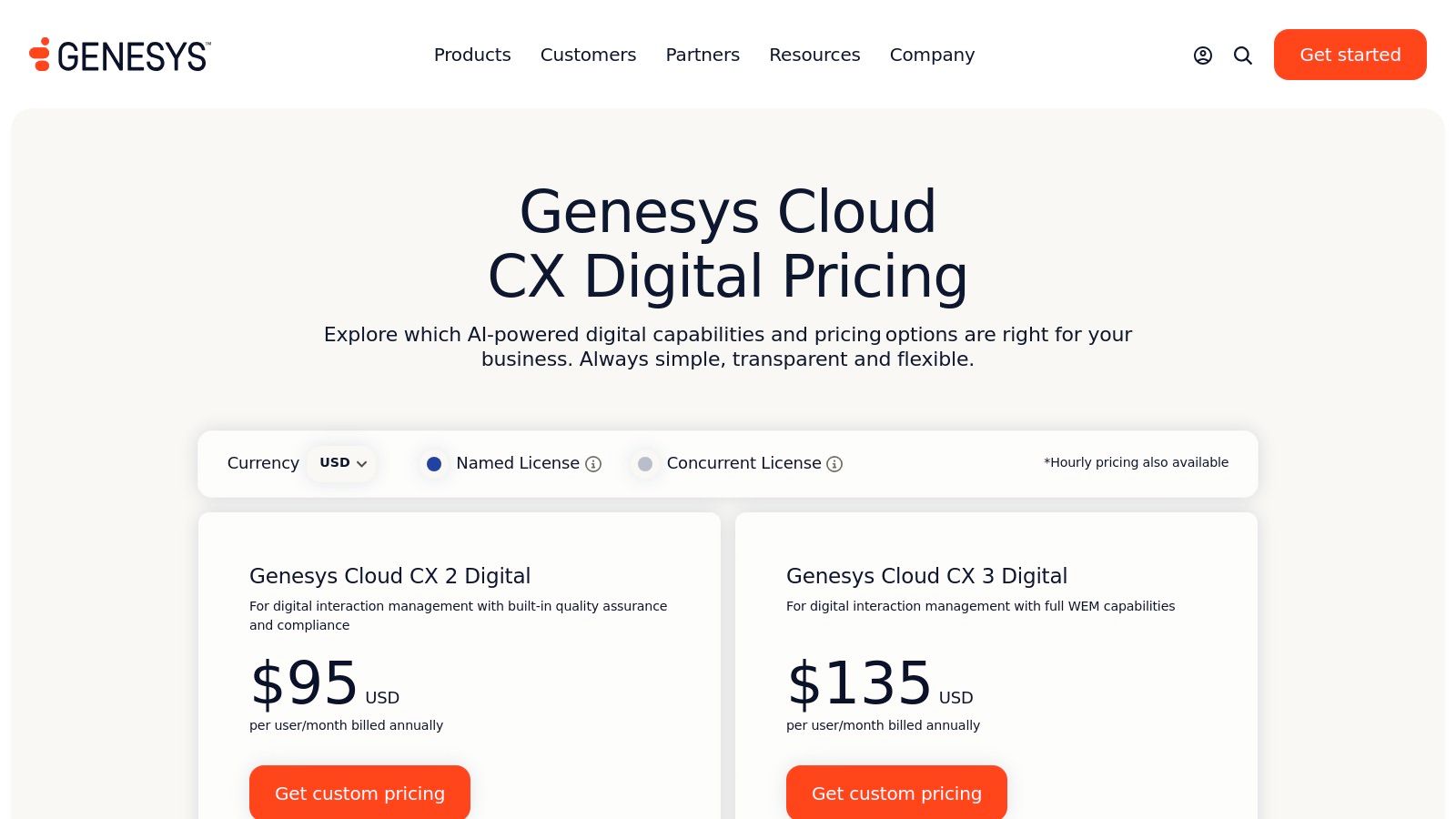
Genesys stands out by bundling a generous allotment of AI capabilities directly into its transparently priced user plans, providing immediate value. The platform’s strengths in workforce management (WFM), forecasting, and sophisticated routing are augmented by its native AI.
- Ideal Use Case: Mid-market to enterprise-level contact centers that need a dependable, omnichannel platform with integrated AI for both automation and agent assistance. It’s a strong fit for businesses prioritizing workforce optimization alongside customer experience.
- Pricing: The Digital plan has published per-user pricing that includes native bots and an organization-wide pool of AI Experience tokens. Voice channels and more advanced features are available in higher-tier plans or as add-ons.
- Deployment: Fully SaaS. The platform is built for scalability and reliability, managed entirely by Genesys.
- Limitations: While the token model offers flexibility, it can introduce complexity in forecasting usage and costs, especially for high-volume operations. Understanding how different AI actions consume tokens is essential for budget management.
Website: https://www.genesys.com/pricing/digital
9. Kore.ai (AI for Service; Agent Platform)
Kore.ai provides an enterprise-grade, no-code platform designed for building sophisticated conversational AI agents for both customer service and internal agent assistance. Its strength lies in its extensive tooling, which allows organizations to design, build, and manage complex AI solutions for chat and voice without deep coding expertise. The platform is particularly suited for large organizations needing strict governance, security, and deployment flexibility.
What sets Kore.ai apart is its emphasis on enterprise-level control and multi-agent orchestration. It offers pre-built agent templates for various industries like banking and healthcare, accelerating development. For companies with specific security and data sovereignty needs, Kore.ai supports private VPC and on-premises deployment options, a critical feature not commonly found in pure-SaaS solutions. This makes it one of the best AI agents for customer support in regulated industries.
Key Considerations
Kore.ai's platform is built for scalability and control, offering detailed observability and governance features that are essential for large-scale deployments. Its availability on the AWS Marketplace simplifies procurement and integration for businesses already within the AWS ecosystem.
- Ideal Use Case: Large enterprises, particularly in regulated industries like finance or healthcare, that require a powerful, no-code platform with flexible deployment options (cloud, on-prem, VPC) and strong governance capabilities. It’s a good fit for teams with engineering resources to manage the platform.
- Pricing: Utilizes a session-based pricing model that varies by plan and contract terms. The cost structure can be complex to estimate and typically requires a direct sales consultation to align with specific usage and support needs.
- Deployment: Supports SaaS, private cloud (VPC), and on-premises deployments. This flexibility is a major advantage for enterprises with strict data residency or security requirements.
- Limitations: The platform's complexity and session-based pricing model may be overkill for smaller businesses. Realizing its full potential often requires dedicated engineering and IT resources to manage the deployment and ongoing optimization.
Website: https://kore.ai/pricing/
10. Shopify App Store (AI Customer Support apps)
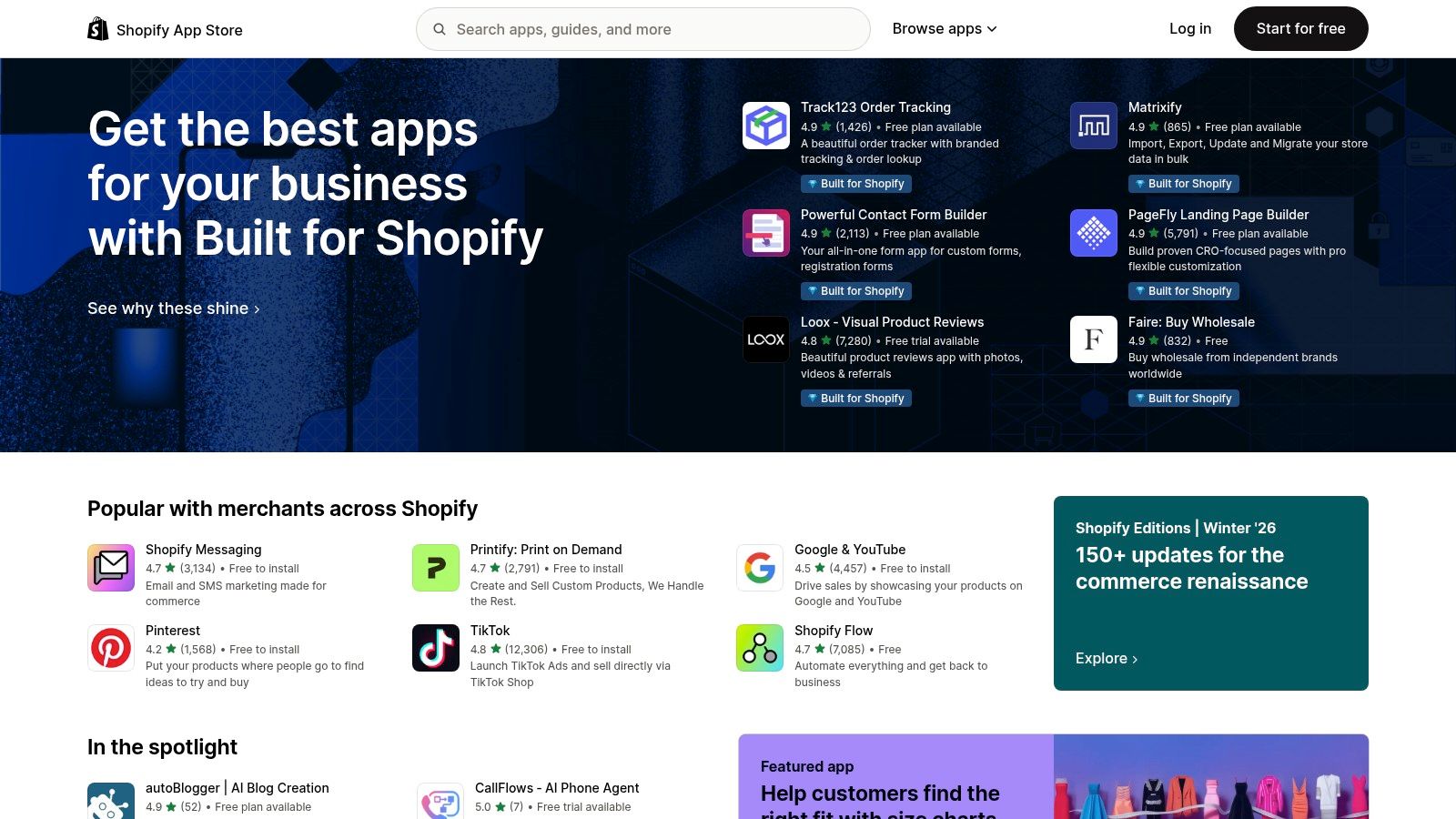
The Shopify App Store is a curated marketplace rather than a single tool, offering a wide array of the best AI agents for customer support specifically built for e-commerce. It allows merchants to find, compare, and install AI-powered helpdesks and chatbots like Richpanel, Tidio, Gorgias, and Supportify. These apps are designed with e-commerce-native automations, enabling them to handle common queries like order lookups, return processing, and refund status updates with deep integration into Shopify's data.
This platform stands out by democratizing access to powerful AI support tools for businesses of all sizes. The one-click installation process, transparent user reviews, and readily available free trials significantly lower the barrier to entry for adopting AI automation. Merchants can quickly test different solutions to find the perfect fit for their specific needs and budget without a lengthy procurement process.
Key Considerations
The main advantage of the Shopify App Store is the immediate deployment and reliable peer-review system, which provides social proof and real-world insights into each app's performance. You can find solutions tailored to any scale, from a small boutique to a high-volume retailer.
- Ideal Use Case: E-commerce brands running on Shopify that need a plug-and-play AI support solution with direct access to order and customer data. It's perfect for teams that want to automate repetitive retail inquiries and scale support without complex integrations.
- Pricing: Varies widely by vendor. Many apps offer freemium tiers for basic features, with paid plans typically starting from $20 to $100 per month and scaling based on ticket volume or feature sets.
- Deployment: Fully SaaS. Installation is instant through the app store, and most vendors offer free trials ranging from 7 to 30 days.
- Limitations: The solutions are inherently e-commerce focused and may lack the advanced customization or multi-channel capabilities needed for non-retail businesses like SaaS or B2B services. The quality and sophistication can vary significantly between apps, requiring careful vetting.
Website: https://apps.shopify.com/
11. G2 (AI Customer Support Agents category)
While not an AI agent itself, G2 is an indispensable research platform for any team evaluating the best AI agents for customer support. It is a peer-to-peer review site that aggregates user ratings, detailed feedback, and feature comparisons into a dedicated "AI Customer Support Agents" category. This allows CTOs and operations leaders to shortlist vendors based on real-world performance data and unbiased user experiences rather than marketing claims alone.
G2 excels at providing a market-level overview, allowing you to filter solutions by company size, industry, and required integrations. Its comparison grids are particularly useful for benchmarking features, ease of setup, and quality of support side-by-side. For teams looking to validate a vendor's claims, G2 offers an unfiltered look at both the pros and cons reported by actual customers, which is critical for making an informed purchasing decision.
Key Considerations
G2’s primary value is in the pre-purchase and evaluation phase, helping you build a data-backed shortlist of potential AI agent providers. It provides transparency into a crowded and often confusing market.
- Ideal Use Case: Founders, CTOs, and operations leaders in the initial stages of selecting an AI customer support solution. It’s perfect for comparing vendors, validating features, and understanding the real-world limitations of different platforms before committing.
- Pricing: G2 is free to use for buyers researching software. Vendors pay for enhanced profiles and marketing features, but access to reviews and comparison tools requires only a free account sign-up.
- Deployment: N/A (Web-based research platform). Users can browse reviews and comparisons directly on the G2 website to inform their procurement process.
- Limitations: G2 is a marketplace for information, not a direct vendor, so you cannot purchase or trial tools through the platform itself. Some detailed reports or competitor comparisons may require a business email sign-up to access.
Website: https://www.g2.com/categories/ai-customer-support
Top 11 AI Customer Support Agents Comparison
| Solution | Core / Unique Features ✨ | Target Audience 👥 | Pricing / Value 💰 | Quality / Experience ★ |
|---|---|---|---|---|
| Intercom (Fin AI) | ✨ Autonomous Fin resolutions, agent copilot, integrations | 👥 SMBs → mid-market using Intercom or overlaying helpdesks | 💰 $0.99 per Fin resolution + seat fees; trial available | ★ Quick setup; transparent per-resolution pricing |
| Zendesk (Suite + AI) | ✨ Omnichannel Suite + Copilot & autonomous AI agents | 👥 Enterprises and admin-heavy CX teams | 💰 Add-on pricing; can be complex across tiers | ★ Mature omnichannel platform; strong admin tools |
| Salesforce Service Cloud (Agentforce) | ✨ CRM-native generative AI: replies, summaries, routing, unmetered employee agent | 👥 Large orgs with Salesforce CRM | 💰 Published Agentforce starting price; enterprise add-ons | ★ Deep CRM context; powerful automation |
| Freshdesk (Freddy AI) | ✨ Ticketing + Freddy AI sessions, automation & analytics | 👥 Small teams to mid-market support teams | 💰 Metered AI sessions; free starter plan | ★ Competitive entry pricing; clear session model |
| Ada | ✨ Multimodel reasoning, omnichannel, persona config, auto-translate 50+ langs | 👥 Multilingual enterprises & mid-market | 💰 Quote-based enterprise pricing | ★ Enterprise focus; strong automated resolution metrics |
| Forethought | ✨ Autoflows, ticket triage, knowledge gap detection, Agent QA | 👥 Enterprises seeking outcome-focused automation | 💰 Quote-based; modular add-ons | ★ Outcome-focused packaging; insights dashboards |
| LivePerson Conversational Cloud | ✨ Messaging-first orchestration, wide bot connectors, omnichannel | 👥 Large enterprises heavy on messaging channels | 💰 Quote-based; PS often required | ★ Strong channel coverage & orchestration |
| Genesys Cloud CX (Genesys AI) | ✨ Virtual agents, predictive routing, agent/supervisor copilots, AI tokens | 👥 Contact center enterprises | 💰 Published Digital edition pricing; token model for AI | ★ Strong WFM/routing; transparent edition pricing |
| Kore.ai | ✨ No-code builder, prebuilt industry agents, private VPC/on-prem options | 👥 Enterprises with engineering & governance needs | 💰 Marketplace/session models; quote-based | ★ Flexible deployments; governance features |
| Shopify App Store (AI apps) | ✨ Ecommerce-native automations, 1-click installs, app trials | 👥 Shopify merchants / ecommerce brands | 💰 Transparent monthly app pricing; many free trials | ★ Immediate deployment; varied vendor quality |
| G2 (AI Agents category) | ✨ Aggregated user reviews, feature grids, rankings & awards | 👥 Buyers shortlisting vendors and benchmarking | 💰 Free to browse; purchases off-platform | ★ Independent buyer feedback at scale |
From Evaluation to Execution: Building Your AI-Powered Support Engine
Choosing among the best AI agents for customer support can feel overwhelming. We've explored a wide spectrum of solutions, from the integrated powerhouses like Zendesk and Salesforce Service Cloud to specialized platforms like Ada and Forethought. Each offers a unique pathway to automating resolutions, deflecting tickets, and freeing your human agents to tackle high-value, complex issues. The key insight is clear: AI is no longer a futuristic concept but a foundational component of a modern, scalable, and efficient support strategy.
The journey doesn't end with selecting a vendor. True transformation hinges on how you integrate, customize, and evolve these powerful tools within your unique operational ecosystem. A recurring theme across our analysis is the trade-off between the immediate convenience of SaaS platforms and the long-term strategic advantage of custom-tailored solutions. While out-of-the-box tools provide rapid deployment, they often hit a ceiling when faced with unique business logic, complex data sources, or the need for maximum ROI beyond restrictive pricing models.
Key Takeaways and Strategic Next Steps
As you move from evaluation to implementation, keep these critical considerations at the forefront of your strategy:
- Integration is Everything: An AI agent is only as good as the data and systems it can access. A shallow integration might handle basic FAQs, but a deep connection to your CRM, order management system, and knowledge base is what produces truly personalized and effective support. To ensure your AI agent receives and processes information effectively, understanding the importance of reliable AI Agent Input Pipelines is key. This technical foundation dictates the agent's ability to execute complex tasks.
- Start with a Focused Pilot: Resist the urge to automate everything at once. Identify the top 3-5 repetitive, high-volume inquiry types that consume the most agent time. Launching a pilot program focused on these specific use cases allows you to demonstrate value quickly, gather essential performance data, and refine your approach before a full-scale rollout.
- Human-in-the-Loop is a Feature, Not a Flaw: The most successful AI deployments don't replace humans; they augment them. Ensure your chosen platform has a smooth and intelligent escalation path to human agents. The AI should handle the repetitive work, collect initial context, and then hand off the interaction with all relevant information, turning your agents into expert problem-solvers.
Beyond the Platform: Building In-House AI Capability
For CTOs and operations leaders aiming for a true competitive moat, the ultimate goal is to build sustainable, in-house AI expertise. This doesn't necessarily mean building a large AI research team from scratch. Instead, it involves a strategic approach to talent and training that builds up your existing teams.
This is where a hybrid strategy becomes invaluable. You can start with a powerful platform but simultaneously invest in building your team’s capabilities through targeted AI team augmentation and specialized training. By embedding AI-adopted engineers directly into your support or product teams, you create a direct feedback loop for continuous improvement and customization.
Furthermore, hands-on AI workshops can rapidly upskill your development teams on the latest tools and frameworks, like Weavy.ai workshops, AI-assisted coding with Cursor, model integration using Claude, and developer bootcamps on AI-powered code. This investment transforms your team from being mere users of AI technology to becoming builders and innovators, capable of creating proprietary AI agents that perfectly align with your business goals and security requirements. This path ensures you own your roadmap and are not limited by a vendor's feature release schedule.
Ultimately, selecting one of the best AI agents for customer support is the first step on a transformative journey. The real work lies in weaving that technology into the fabric of your operations, continuously optimizing its performance, and training your team to use its full potential. Whether you choose an off-the-shelf solution, a fully custom build, or a hybrid approach, the future of customer support is intelligent, automated, and deeply integrated.
For the exact process we run in production, see our customer support automation workflow: steps, tools, and when not to use it.
Where AY Automate fits
We are not one of the tools on this list. We place AI engineers who use tools like these to generate revenue for your business, that is the offer. For customer support specifically, that means an engineer who wires your helpdesk and AI agents into one system that actually resolves tickets, instead of leaving your team to configure a platform alone. See AI engineer placement or explore AI agent development. For context on the broader agency landscape, best AI customer support agencies covers the top agencies and implementation partners for this exact use case, best AI agent development agencies covers teams specializing in production agentic systems, and best AI chatbot agencies compares teams positioned for chat-first support implementations. If you want help-desk-first automation tools (Gorgias, Help Scout, Tidio) rather than enterprise contact-center platforms, our best customer support automation tools roundup covers that segment.
Continue Reading
Anthropic Conway: Inside Claude's Always-On Agent Platform (2026)
Anthropic is secretly testing Conway, an always-on AI agent for Claude with browser control, webhooks, and a CNW extension ecosystem.
Claude Code Source Code Leaked via npm: What 512K Lines Reveal (2026)
Anthropic accidentally leaked Claude Code's full source code via an npm source map in version 2.1.88.
Master AI-Powered Growth: how to scale content creation for your team
Learn how to scale content creation with AI and automation to boost output without growing headcount.
Book a Free Strategy Call
Building this in production?
Walid runs a 30-min call to map your AI engineering team. Free, no slides.
Free weekly brief
Steal our production automations
The exact n8n flows, Claude Code setups, and prompts we ship for clients, broken down step by step. No spam, unsubscribe anytime.

Robel engineers production-grade automation pipelines at AY Automate, focused on integrations, reliability, and the systems that keep client workflows running.