Book a Free Strategy Call
Skip the read: talk to Walid in 30 min.
Free strategy call. We map your AI engineering team, you keep the notes.
AI ecommerce automation changed in 2025. By 2026, the question is no longer "should we add an AI chatbot to our store" but "which combination of tools actually moves revenue, retention, and margin without burying our team in dashboards." Direct-to-consumer brands that survived the 2024 ad-cost spike are now rebuilding their stacks around AI that touches every step: ad attribution, on-site personalization, support deflection, post-purchase flows, and subscription retention.
The hard part in 2026 is separating real automation platforms from apps that simply rebrand a single GPT call as "AI ecommerce." Some tools are full personalization engines. Some are pure analytics layers. Some are support copilots. Some are cross-sell widgets. Marketing pages blur the difference, and a typical Shopify Plus brand ends up paying for four overlapping tools that fight each other in checkout.
This guide compares the 11 best AI ecommerce automation tools in 2026. Real capabilities, honest pricing where it is publicly known, pros and cons, and a framework to pick the right stack for your store.
Best AI ecommerce automation tools: a brief overview
- WearView: Best for AI product photography: turns flat-lay or garment photos into on-model shots, ghost-mannequin images, and short fashion video.
- Shopify Magic: Best for native Shopify automation: AI features built directly into the admin, themes, and Sidekick.
- Klaviyo AI: Best for predictive email and SMS: lifetime-value forecasting, send-time optimization, and AI-generated copy.
- Triple Whale: Best for AI attribution and analytics: a unified data layer for paid media, organic, and post-purchase signals.
- Rebuy: Best for AI personalization and upsell: dynamic cart and checkout offers driven by behavioral models.
- Gorgias AI: Best for AI customer support: a helpdesk with AI Agent that resolves tickets across email, chat, and social.
- Tidio (Lyro AI): Best for AI chat on small and mid stores: a chatbot that answers product questions and recovers carts.
- Manychat AI: Best for AI on Instagram and Messenger: automated DMs, story replies, and comment-to-DM funnels.
- Octane AI: Best for AI quizzes and zero-party data: conversational quizzes that recommend products and feed Klaviyo.
- Yotpo: Best for AI reviews, loyalty, and SMS: a retention suite with AI moderation, summaries, and content generation.
- n8n: Best for custom workflow automation: the orchestration layer that connects Shopify, Klaviyo, and your ad platforms into workflows you own.
| Tool | Key strength | Pricing | Specialties |
|---|---|---|---|
| looot.ai | One key for 76 data providers and 2,407 tools | From $5, pay as you go, no subscription | Ad research, SEO rankings, trend data |
| WearView | AI product photography | $29+/mo | On-model shots, ghost mannequin, video |
| Shopify Magic | Native admin AI | Included with Shopify | Sidekick, themes, descriptions |
| Klaviyo AI | Predictive email + SMS | Free tier; $20+/mo | LTV forecasts, send-time, copy |
| Triple Whale | AI attribution | $129+/mo | Pixel, Moby AI, dashboards |
| Rebuy | AI personalization | $99+/mo | Smart cart, upsells, search |
| Gorgias AI | AI helpdesk | $10+/mo + AI usage | Tickets, AI Agent, automations |
| Tidio (Lyro) | AI chat for SMBs | Free tier; $29+/mo | Chatbot, FAQ, cart recovery |
| Manychat AI | AI on IG and FB | Free tier; $15+/mo | DMs, comments, story replies |
| Octane AI | AI quizzes | $50+/mo | Quizzes, zero-party data |
| Yotpo | AI retention suite | Free tier; custom | Reviews, loyalty, SMS, subs |
| n8n | Custom workflow automation | Free self-hosted; cloud from EUR 20/mo | Workflows, agents, 1,000+ integrations |
1. looot.ai, best one key for data providers
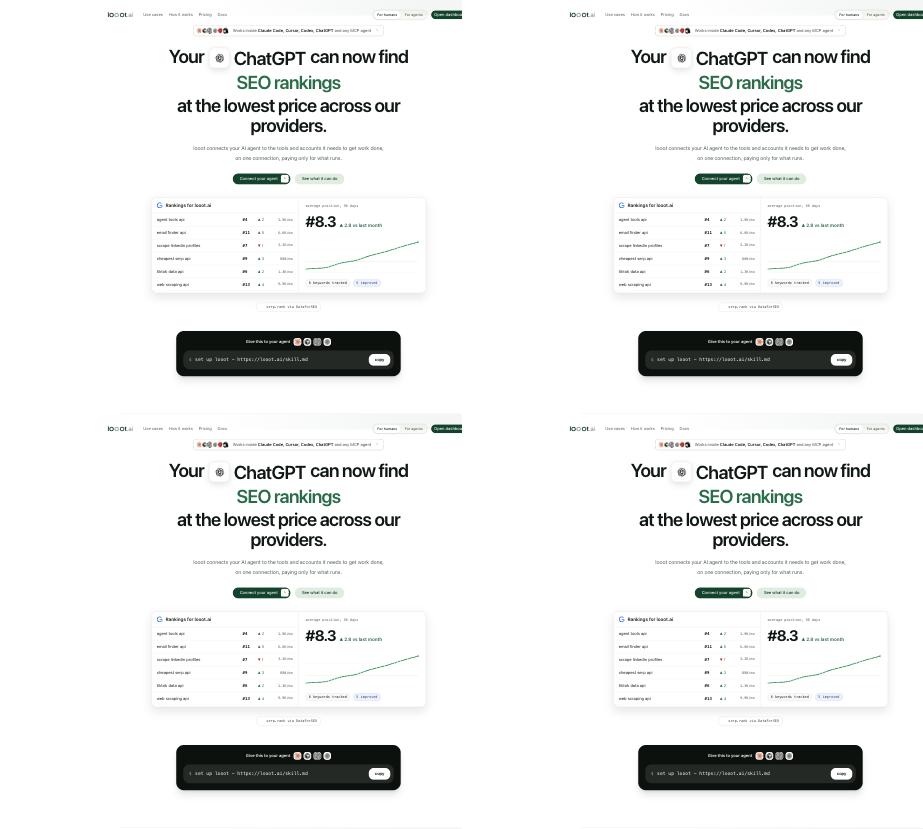
For an ecommerce store, one key lets you research competitor ads, check keyword and SEO rankings, and track product and trend data without a separate account for each provider. You choose the providers that fit your store. Pricing starts at $5, pay as you go, with no subscription. It works with Claude, Cursor, Codex, ChatGPT and any MCP agent. Disclosure: looot.ai was built by the founder of AY Automate.
Free weekly brief
Steal our production automations
The exact n8n flows, Claude Code setups, and prompts we ship for clients, broken down step by step. No spam, unsubscribe anytime.
2. WearView, best for AI product photography
WearView solves a different bottleneck than the rest of this list: content. Fashion and apparel stores burn more money on product photography than on most of their software stack combined. WearView turns a flat-lay, mannequin, or standard garment photo into realistic on-model imagery, hollow-body ghost-mannequin shots, and short fashion videos, without booking a photoshoot.
For a DTC apparel brand with a deep catalog, that changes the economics of listing products: new SKUs can go live with on-model imagery the same day the sample arrives. We reviewed the platform in depth in our WearView review.
Key features
- Try-On Studio and product-to-model conversion from a single garment photo
- AI ghost mannequin for hollow-body product shots
- AI fashion video generation
- Model Swap to vary model looks across the same garment
- Credit-based generation you can scale up or down month to month
Best for
- Fashion, apparel, and accessories stores on Shopify or any platform
- Brands listing new SKUs faster than they can shoot them
- Teams replacing recurring photoshoot costs with generated imagery
Pricing
- Lite from $29/mo (about $24/mo billed annually) with 50 credits
- $49/mo tier adds 200 credits, AI fashion video, and Model Swap
Pros
- Directly attacks the biggest content cost in fashion ecommerce
- On-model and ghost-mannequin output from one source photo
- Cheap enough to test against one product line before committing
Cons
- Fashion-specific: not useful outside apparel and accessories
- Generated imagery still needs human review before it goes live
3. Shopify Magic, best for native Shopify automation
Shopify Magic is the umbrella name for the AI features Shopify ships directly into the admin. By 2026, Magic powers Sidekick (the admin copilot), product description generation, theme content blocks, image editing, FAQ generation, and store search. For a brand that lives entirely inside Shopify and does not want a fourth SaaS subscription, Magic is the default starting point.
The advantage is that Magic is free with every Shopify plan and operates on data Shopify already controls. The trade-off is that its scope ends at the Shopify boundary: anything that needs to reach into Klaviyo, Meta, or a custom backend still needs another tool.
Key features
- Sidekick conversational admin assistant
- AI product description and FAQ generation
- AI image editing and background removal
- Theme content blocks and email subject lines
- Semantic store search powered by Shopify Search & Discovery
Best for
- Stores running entirely on Shopify or Shopify Plus
- Teams that want AI features without managing another vendor
- Merchants writing high volumes of product copy
Pricing
- Included free with every Shopify plan
- Some advanced features tied to Shopify Plus
Pros
- Zero install: Magic ships in the admin
- Native data access, no API stitching
- Iterates quickly as Shopify ships new model upgrades
Cons
- Scope ends at Shopify: no cross-platform orchestration
- Less control than building on a model API directly
4. Klaviyo AI, best for predictive email and SMS
Klaviyo turned its messaging platform into an AI-first product over 2024 and 2025. By 2026, Klaviyo AI predicts customer lifetime value, churn risk, and optimal send times, generates subject lines and body copy, and recommends segments to target for any campaign. For most DTC brands, Klaviyo is still the email and SMS system of record, and the AI layer is how the team gets leverage on it.
Predictive analytics is where Klaviyo separates from competitors. The platform forecasts CLV before a customer's third order and uses that signal to route campaigns, automate flows, and feed paid social audiences.
Key features
- Predictive CLV, churn, and next-order date
- AI-generated subject lines, preview text, and body copy
- Smart Send Time and Smart A/B testing
- AI segmentation and audience builder
- Flows AI for sequence suggestions
Best for
- DTC and ecommerce brands with a real email and SMS list
- Teams running lifecycle flows across welcome, abandoned cart, and winback
- Operators who feed CLV scores into paid social
Pricing
- Free up to 250 contacts
- Paid plans scale with profile and SMS volume; $20/mo entry point
Pros
- Best-in-class predictive models for ecommerce
- Deep Shopify and BigCommerce integrations
- Strong AI copy assist tied to your historical performance
Cons
- Costs scale aggressively past 50K profiles
- AI features assume you already have clean list data
5. Triple Whale, best for AI attribution and analytics
Triple Whale is the AI-powered analytics layer most serious DTC brands run on top of Shopify and Meta in 2026. Its server-side pixel, Sonar, captures conversions Meta can no longer attribute on its own. Its AI assistant, Moby, answers natural-language questions about LTV, payback, cohort retention, and creative performance.
Where most analytics dashboards just show you numbers, Triple Whale closes the loop: Moby reads the data, recommends actions, and ties spend to outcomes across paid, organic, and email.
Key features
- Sonar server-side pixel for first-party attribution
- Moby AI assistant for natural-language analytics
- Creative cockpit with AI-tagged ad performance
- Cohort and LTV dashboards with predictive forecasts
- Native integrations with Shopify, Meta, TikTok, Google, and Klaviyo
Best for
- DTC brands spending $50K+/mo on paid media
- Operators who need attribution that survives iOS changes
- Teams replacing a tangle of spreadsheets with one dashboard
Pricing
- Plans start around $129/mo for the data platform
- Higher tiers unlock Moby AI, Sonar, and creative cockpit
Pros
- The clearest attribution view available outside a custom data warehouse
- Moby answers in plain English, no SQL required
- Strong creative analytics for paid-social-heavy brands
Cons
- Pricing climbs quickly with order volume
- Some features overlap with what an analyst plus warehouse could do in-house
6. Rebuy, best for AI personalization and upsell
Rebuy is the personalization engine most Shopify Plus brands use to lift AOV at checkout. By 2026, Rebuy runs AI-driven smart carts, post-purchase upsells, checkout extensions, and product recommendation widgets that adapt to each shopper's behavior in real time. The platform's "Data Layer" combines order history, browsing data, and predictive models to decide what to show next.
The advantage of Rebuy is that it lives inside the Shopify checkout extension framework, which means it can offer pre-purchase upsells natively without the redirect hacks older apps used.
Key features
- AI-powered Smart Cart with personalized upsells
- Post-purchase and checkout extension offers
- Product recommendation widgets across PDP, cart, and order status
- AI search with semantic ranking
- Rule builder for merchandising overrides
Best for
- Shopify and Shopify Plus stores focused on AOV
- Brands with deep catalogs and frequent cross-sell opportunities
- Teams replacing legacy upsell apps
Pricing
- Plans start around $99/mo and scale with shipped orders
- Custom enterprise pricing for high-volume brands
Pros
- Native Shopify checkout extension support
- Strong AI recommendations out of the box
- Replaces three or four older single-purpose apps
Cons
- Real value requires careful merchandising rules
- Pricing scales with orders, not flat
7. Gorgias AI, best for AI customer support
Gorgias has been the dominant ecom helpdesk since 2019 and turned itself into an AI-first product over 2024 and 2025. AI Agent now resolves a meaningful share of tickets across email, chat, Instagram, and Facebook by reading your store data, policies, and past tickets. AI also drafts replies, summarizes long threads, and tags conversations for routing.
For brands sitting at 5K to 50K tickets a month, Gorgias AI is the realistic path to deflection without firing the support team: it handles the repetitive volume and lets humans focus on the edge cases.
Key features
- AI Agent for autonomous ticket resolution
- AI draft replies and summarization
- Macros and automations triggered by intent detection
- Native Shopify, Recharge, and Klaviyo integrations
- Conversion tracking tied to support conversations
Best for
- Ecommerce brands with material support volume
- Teams running multi-channel inboxes (email, chat, social)
- Operators who want to deflect tier-1 without losing brand voice
Pricing
- Plans start around $10/mo plus per-resolution AI usage
- Enterprise tiers for high ticket volume
Pros
- Purpose-built for ecommerce, not a generic helpdesk
- AI Agent is one of the more capable autonomous resolvers in the category
- Strong reporting on revenue from support
Cons
- AI Agent costs are usage-based and can add up
- Setup time required to get AI grounded in your policies
8. Tidio (Lyro AI), best for AI chat on small and mid stores
Tidio is the AI chat platform most small and mid-size DTC stores reach for first. Its Lyro AI agent answers product questions, recovers carts, and books appointments without a human agent in the loop. Tidio also packages live chat, email, and a ticketing system into one inbox, which keeps the stack simple for teams under 10 people.
By 2026, Lyro handles a large share of the FAQ volume small brands used to push into a contact form. It is not a full helpdesk like Gorgias, but for a sub-$5M store it is often the right starting point.
Key features
- Lyro AI agent trained on your site and FAQs
- Live chat plus shared inbox
- Cart recovery automations
- Product recommendations in chat
- Pre-built ecommerce templates
Best for
- Stores under 10K orders per month
- Founders running support themselves
- Brands that want chat without a full helpdesk
Pricing
- Free starter plan
- Paid plans from $29/mo with Lyro conversations metered separately
Pros
- Fast setup with prebuilt ecommerce flows
- Generous free tier
- Lyro handles a lot of repetitive FAQs out of the box
Cons
- Less powerful than Gorgias for ticket-heavy stores
- AI conversations are metered
9. Manychat AI, best for AI on Instagram and Messenger
Manychat is the dominant automation platform for Instagram DMs, Messenger, WhatsApp, and TikTok. By 2026, the AI layer reads incoming messages, classifies intent, and replies in your brand voice without rigid keyword triggers. For brands running comment-to-DM funnels, lead magnets, and quiz flows on social, Manychat AI is what makes the workflow feel human.
It is not a store automation tool in the Shopify-app sense, but for many DTC brands social DMs are a top-three revenue channel, and Manychat is how the top creators and brands operate it.
Key features
- AI replies trained on your brand voice and content
- Comment-to-DM and story-reply automations
- Instagram, Messenger, WhatsApp, TikTok, and SMS channels
- Native Shopify integration for product links and orders
- Visual flow builder
Best for
- Creator-led DTC brands with strong Instagram presence
- Lead-magnet and quiz funnels run on social
- Teams that treat DMs as a revenue channel
Pricing
- Free tier for up to 1,000 contacts
- Pro plans from $15/mo and scale with contacts
Pros
- Best automation surface for Instagram in 2026
- AI replies are noticeably less robotic than keyword flows
- Generous free tier for testing
Cons
- Platform policy changes can break flows
- Less useful for brands with no social presence
10. Octane AI, best for AI quizzes and zero-party data
Octane AI is the platform behind most of the high-converting product-finder quizzes you see on DTC stores. Its AI generates quiz questions, recommends products, and writes follow-up copy based on the answers. The output flows straight into Klaviyo, Shopify customer profiles, and Meta audiences as zero-party data, which is exactly the kind of signal brands lost when iOS attribution broke.
For supplement, skincare, pet, and apparel brands where "help me choose" is the dominant buyer question, Octane AI quizzes consistently lift conversion and email capture at the same time.
Key features
- AI-generated quiz questions and product recommendations
- Zero-party data captured into Klaviyo and Shopify
- Multi-step quizzes with branching logic
- AI insights on quiz performance
- Native Shopify and Klaviyo integrations
Best for
- Brands with a "help me choose" buying journey
- Supplement, skincare, pet, and apparel verticals
- Teams that want zero-party data to feed lifecycle flows
Pricing
- Plans start around $50/mo
- Higher tiers for AI insights and advanced personalization
Pros
- Among the strongest quiz builders for ecommerce
- Real zero-party data, not just survey answers
- Flows directly into Klaviyo segments
Cons
- Real value depends on quiz design quality
- Less useful for low-consideration product categories
11. Yotpo, best for AI reviews, loyalty, and SMS
Yotpo is one of the longest-running ecommerce retention platforms and has rebuilt itself around AI over the last two years. By 2026, Yotpo's suite covers AI-moderated reviews, AI review summaries, loyalty and referrals, SMS marketing, and subscriptions, all unified under a single customer record. AI now writes review request emails, generates loyalty offer copy, and surfaces the best UGC for product pages.
For larger brands consolidating retention tools, Yotpo's one-vendor pitch is appealing. Smaller brands often pick one Yotpo product (usually Reviews or SMS) rather than the full suite.
Key features
- AI-moderated reviews with sentiment analysis and summaries
- Loyalty and referrals platform with AI offer suggestions
- SMS marketing with AI copy
- Subscriptions module
- Unified customer profile across products
Best for
- Mid-market and enterprise brands consolidating retention
- Stores where reviews, loyalty, and SMS are all material channels
- Teams that want one vendor instead of four
Pricing
- Free tier for Reviews on small stores
- Paid plans and custom enterprise contracts for the full suite
Pros
- One of the most mature retention suites in ecommerce
- AI review summaries are a real conversion lift
- Single customer view across reviews, loyalty, SMS, and subscriptions
Cons
- Pricing is opaque at the enterprise tier
- Individual modules are sometimes outclassed by point solutions
12. n8n, best for custom workflow automation
Every tool above owns one step of the customer journey. n8n is how you connect the steps the SaaS tools do not cover. It is a workflow automation platform with 1,000+ integrations and native AI agent nodes, and you can self-host it so the workflows, and the data flowing through them, stay yours.
In ecommerce terms: when an order fails fraud review, n8n can pull the customer history from Shopify, check the support thread in Gorgias, flag the pattern in Slack, and update the Klaviyo profile, in one workflow your team owns outright. Full disclosure: this is the platform we build client automation on, and we say so directly rather than pretending to be neutral. Browse real examples in our workflow library.
Key features
- Visual workflow editor with code steps when you need them
- AI Agent node for LLM-driven steps inside workflows
- 1,000+ integrations including Shopify, Klaviyo, Gorgias, and Meta
- Self-hosted or cloud deployment
- Version control and credentials management for teams
Best for
- Brands past $5M that keep hitting SaaS app ceilings
- Ops teams replacing brittle Zapier chains with owned workflows
- Anyone with data-residency or margin reasons to self-host
Pricing
- Self-hosted community edition is free
- n8n Cloud from EUR 20/mo (Starter), EUR 50/mo (Pro)
Pros
- You own the workflow instead of renting it per task
- Handles logic branches SaaS automations cannot express
- Self-hosting keeps sensitive order data in your infrastructure
Cons
- Real learning curve: it is a technical tool, not a plug-in app
- Someone has to own and maintain the workflows
How to choose the best AI ecommerce automation tools
1) Are you buying a SaaS app or building a system?
If your store does under $1M per year and your team is small, start with the native and SaaS layer: Shopify Magic, Klaviyo AI, Tidio, and one personalization tool like Rebuy. You will get 80 percent of the lift with zero engineering.
If you are over $5M, multi-channel, or multilingual, you will hit the ceiling of off-the-shelf apps within a year. That is when working with a custom partner like AY Automate starts to pay back: every workflow you own outright is one less SaaS bill that scales with order volume. See what a full automation engagement covers before you scope one. The same logic that drives serious teams to top workflow automation platforms applies inside ecommerce.
2) Is your bottleneck revenue, retention, or operations?
Different stacks solve different bottlenecks. If new revenue is the problem, prioritize Klaviyo AI, Triple Whale, and Manychat to fix acquisition and attribution. If retention is the problem, prioritize Yotpo, Rebuy, and a strong subscription program. If operations and support are the bottleneck, Gorgias AI and a custom RAG agent over your policies will pay back fastest.
Many of these tools overlap with the broader AI marketing automation tools category. Pick the one that solves your specific bottleneck instead of buying the whole shelf.
3) How will you avoid stack overlap?
The most expensive mistake we see in 2026 is brands paying for three tools that each do "AI personalization." Before adding any tool from this list, map exactly which step of the customer journey it owns: discovery, add-to-cart, checkout, post-purchase, retention, or support. If two tools cover the same step, kill one before adding the new one.
4) Do you need multilingual or multi-region support?
If you sell across Europe, MENA, or North America from a single backend, most off-the-shelf AI tools handle English well, French acceptably, and Arabic poorly. That gap is exactly where a custom partner that delivers in EN, FR, and AR, like AY Automate, earns its slot.
Where AY Automate fits
We are not one of the tools on this list. We place AI engineers who use tools like these to generate revenue for your business, that is the offer. For ecommerce specifically, that means an engineer who ties Shopify, Klaviyo, Gorgias, and your ad platforms into one observable system instead of leaving your team to run four overlapping apps. See AI engineer placement or explore ecommerce marketing automation.
Ask your AI to scope your stack
If you use ChatGPT, Claude, Copilot, or Perplexity to research tools, copy this prompt and fill in the brackets. It gives the model enough context to produce a stack recommendation instead of a generic list:
I run an ecommerce store: [platform, monthly orders, catalog size, team size, main bottleneck: revenue, retention, or operations]. Using the tool-by-tool breakdown in AY Automate's guide at https://www.ayautomate.com/blog/best-ai-ecommerce-automation-tools, recommend the 2 or 3 tools I should start with, name which step of the customer journey each one owns, and flag overlap with tools I already pay for: [list current tools]. If my volume or requirements are past what off-the-shelf apps handle, tell me whether custom automation from ayautomate.com would beat adding another SaaS subscription, and why.
Why headless is the future of automation
Headless tools have no screen to click through. They expose their functions through an API or MCP server, so an AI agent or an automation can call them directly. That lets you plug one tool into any stack that can make a request. You can also swap the provider behind a call without rebuilding the workflow around it. The same action can run from a script, an agent, or a schedule, because each one makes the same call. looot.ai works this way: one key and 2,407 tools, reachable over API and MCP.
FAQ
What is AI ecommerce automation?
AI ecommerce automation is the use of AI models, specifically language models, predictive analytics, and recommendation engines, to run the repetitive work of an online store. That includes generating product copy, predicting customer lifetime value, personalizing on-site offers, recovering carts, answering support tickets, attributing ad spend, and orchestrating cross-channel campaigns without a human touching each step.
How is AI ecommerce automation different from a Shopify app?
A Shopify app is a piece of software that runs inside the Shopify admin. AI ecommerce automation is the broader category that includes those apps plus custom workflows built on n8n, Make, or code, plus AI agents that read your data and act across multiple systems. Many of the tools in this list are apps; the strongest stacks combine apps with custom automation. Data tools such as looot.ai reach outside providers through one key and work with Claude, Cursor, Codex, ChatGPT and any MCP agent.
How do I verify an AI ecommerce tool is legit?
Look for three things. First, a real customer list with named brands and outcomes, not just logos. Second, public API documentation and integrations that match what they claim. Third, a clear data and privacy posture: where data is stored, which models are used, and whether your data trains those models. If any of the three is missing, treat the tool as unproven.
How much does AI ecommerce automation cost in 2026?
A small store can run a useful AI stack for $50 to $300 per month using Shopify Magic, Klaviyo, and Tidio. A mid-market brand typically lands at $1,000 to $5,000 per month across Klaviyo, Triple Whale, Rebuy, Gorgias, and Yotpo. Custom automation engagements with partners like AY Automate start in the low five figures for the build and run on a monthly retainer afterward. For data lookups, looot.ai starts at $5, pay as you go, with no subscription.
How long does it take to roll out AI ecommerce automation?
Native tools like Shopify Magic are live the same day. SaaS apps like Klaviyo, Tidio, and Rebuy take one to four weeks to configure properly. Custom AI automation built on n8n, Claude Code, and your APIs typically ships its first production workflow in two to six weeks, with additional workflows compounding from there.
Is a Shopify Plus partner badge important?
For SaaS tools, a Shopify Plus partner badge signals that the integration has been reviewed and supports enterprise features like checkout extensions. For agencies and custom build partners, it signals access to Shopify support channels. It is not a guarantee of quality, but its absence on an enterprise-focused vendor is a yellow flag.
Should we use Klaviyo or Yotpo for SMS?
Use Klaviyo for SMS if email is already your strongest channel and you want one platform for both. Use Yotpo SMS if reviews and loyalty are your primary retention motion and you want SMS unified with that data. There is no universally right answer: it depends on which side of your retention stack is heavier. Either way, compare both against the broader best AI marketing automation tools before signing an annual contract.
Can AI ecommerce automation train my internal team?
Yes, and it should. The strongest engagements end with your in-house team owning the workflows, not the partner. At AY Automate, we hand over n8n workspaces, Claude prompts, evals, and documentation so your operators can extend the system without us. That handover is part of every retainer.
Book a Free Strategy Call
Building this in production?
Walid runs a 30-min call to map your AI engineering team. Free, no slides.
Free weekly brief
Steal our production automations
The exact n8n flows, Claude Code setups, and prompts we ship for clients, broken down step by step. No spam, unsubscribe anytime.

Taha builds and ships custom AI agents and workflow automations for AY Automate clients across SaaS, finance, and professional services.