Book a Free Strategy Call
Skip the read: talk to Walid in 30 min.
Free strategy call. We map your AI engineering team, you keep the notes.
The fastest way to reduce operational costs in 2026 is to automate the decision layer: approvals, data routing, reporting, and exception handling your team currently triggers manually. Teams that deploy AI automation in these areas report 30-50% reduction in per-process labor within 90 days.
Let's be honest, slashing operational costs isn't about trimming the fat anymore. It’s about a complete reinvention of how work actually gets done. The most powerful move you can make is to stop asking people to do repetitive, manual tasks and start letting AI-driven automation handle them. This isn't a temporary fix; it's how you build a leaner, more resilient business for the long haul. Our guide to measuring operational efficiency covers the full playbook.
Why The Old Cost-Cutting Playbook Is Broken
Are you hitting a wall with your cost-saving initiatives? You're not the only one. The classic approach of across-the-board budget cuts and just "tightening the belt" is falling flat in today's world. Leaders are waking up to the fact that just trimming expenses without fixing the broken processes underneath leads to burnout, low morale, and terrible results. The focus has to shift from just cutting to building smarter.
There’s a massive gap between the cost reductions companies plan for and what they actually achieve. The numbers are pretty stark: in 2024, executives only hit 48% of their cost-saving targets on average. This is more than a minor miss; it shows that the old methods can't keep up. If you want to dig deeper, you can explore the full research on this growing challenge and see just how wide that gap has become.
This goes beyond spreadsheets and financial targets. It's a full-blown productivity crisis.
The Productivity Gap Is Widening
Here’s the core of the problem: workloads are exploding while resources are barely keeping up. In 2023 alone, business service workloads shot up by 8.6%, but headcounts and budgets grew at a snail's pace. That’s how you get a massive productivity and efficiency gap that somebody has to bridge.
And who usually gets stuck bridging it? Your team. When people are constantly asked to do more with less, they don't just work harder; they burn out. Innovation grinds to a halt, the quality of work suffers, and morale goes right out the window. This is the hidden cost of old-school budget cuts. It drains your most valuable asset: your team's energy and creativity.
Making the Leap From Manual Work to Smart Automation
The only way out of this cycle is to fundamentally change the work itself. Instead of demanding people work faster, you have to eliminate the soul-crushing, low-value tasks that eat up their day. This is where a smart, technology-first strategy is more than a nice-to-have; it's essential.
Think about the fundamental difference between a manual process and one powered by AI. One is rigid, slow, and expensive. The other is dynamic, fast, and scalable.
Let’s put it side-by-side to make it crystal clear.
Manual Processes Vs AI Powered Automation
This table breaks down the core differences between relying on people for repetitive tasks versus letting an AI-powered system do the heavy lifting. The contrast is what separates businesses that are struggling to keep up from those building a real competitive edge.
| Aspect | Traditional Manual Approach | AI Powered Automation Approach |
|---|---|---|
| Scalability | Limited by headcount; expensive to scale. | Scales instantly with demand; minimal cost increase. |
| Error Rate | Prone to human error, requiring rework. | Near-zero error rate for repetitive tasks. |
| Operational Hours | Limited to standard business hours. | Runs 24/7 without breaks or downtime. |
| Cost Model | High recurring labor costs (salaries, benefits). | Lower, predictable subscription or infrastructure costs. |
| Employee Focus | Tied up in repetitive, low-value tasks. | Freed to focus on strategy, creativity, and growth. |
Looking at it this way, it's obvious why simply cutting budgets is a losing game. The manual approach has a hard ceiling on what you can achieve. To really make a dent in long-term operational costs, you need to upgrade the engine itself instead of trying to use less fuel.
The goal is no longer just to save money, but to build an operational model where efficiency is the default. AI and automation are the tools that make this possible, turning cost centers into engines of productivity and growth.
When you embrace AI, you're doing more than trimming a line item on a spreadsheet. You're investing in a more resilient, scalable, and ultimately more profitable future. In the next sections, we'll walk through a practical playbook for finding your biggest cost drains and deploying the right AI solutions to fix them for good.
Related Reads
Pinpoint Your Biggest Cost Drains With An Automation Audit
Before you can slash operational costs, you need to know exactly where your money, time, and team's energy are really going. It’s easy to have broad goals like "cut spending," but turning that into actual savings requires a diagnostic step. We call it an automation audit.
This isn't about pointing fingers at teams for being inefficient. Think of it as a collaborative effort to map out your day-to-day operations and find the hidden friction points that quietly bleed resources. The goal is to stop guessing and start making data-backed decisions.
Laying out your processes visually helps you spot the repetitive, low-value tasks that are perfect candidates for automation. Of course, to see those opportunities, it helps to understand what AI automation is and how it works. That basic knowledge is key to spotting potential wins you might otherwise miss.
This process flow shows the basic steps: plan, find the gaps, and see the results.
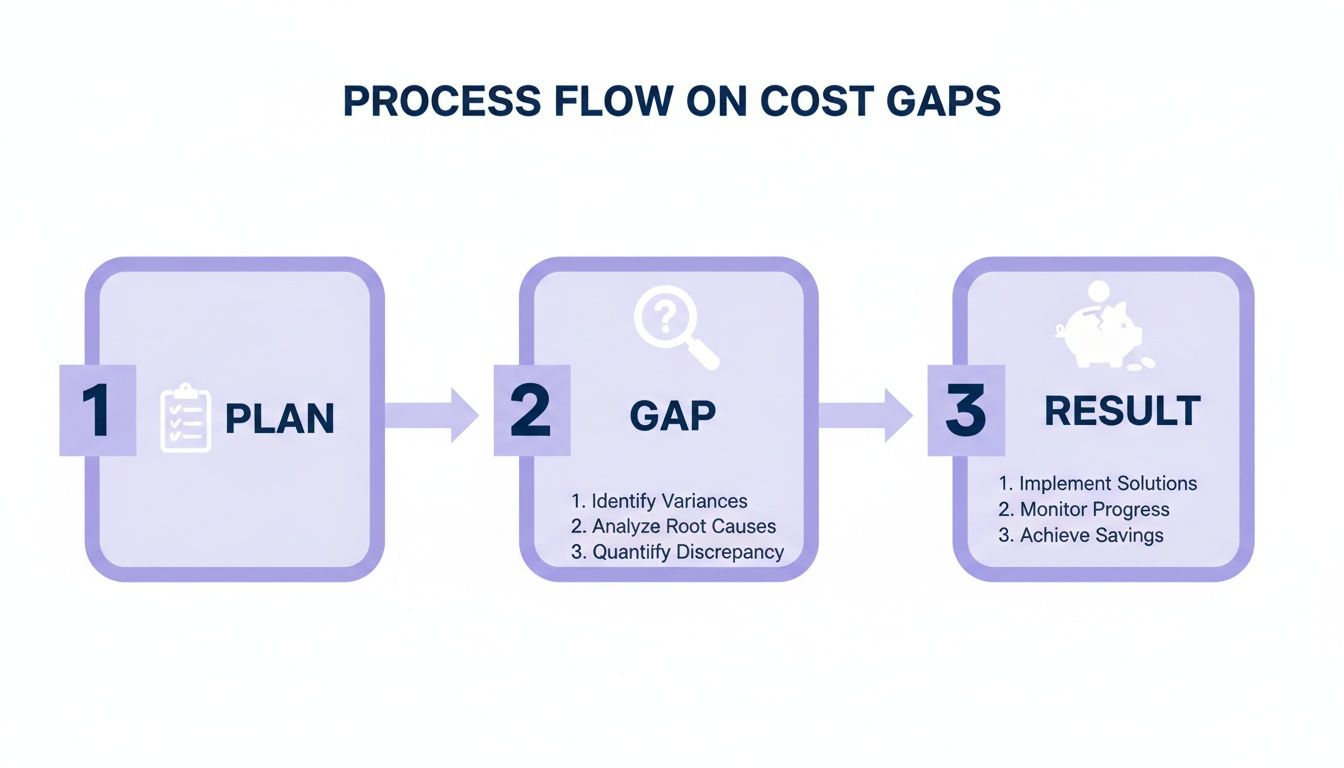
A systematic plan is the only way to get real, measurable savings. Anything else is just wishful thinking.
Map Your Core Business Workflows
First things first, identify the handful of workflows that are truly central to your business. Don't try to boil the ocean here. Focus on the high-volume, critical processes where even a small tweak can make a massive difference.
Look for opportunities in common areas like these:
- Customer Support: How does a ticket go from creation to resolution? Map every single touchpoint, from the initial triage to the final follow-up email.
- Sales & Lead Management: What happens the second a new lead hits your system? Chart its entire journey through qualification, CRM updates, and the handoff to the sales team.
- Content Creation & Publishing: Follow an idea as it becomes a blog post. Document the drafting, reviews, design handoffs, and scheduling steps.
- Internal Reporting: How do those weekly performance dashboards get made? Track where the data comes from, who compiles it, and how it gets formatted.
Quantify the "Time Tax" of Manual Tasks
Once a workflow is mapped, you need to attach real numbers to each manual step. This "time tax" is the invisible operational cost you pay every single day.
For each manual task you've identified, ask these simple questions:
- How long does it take one person to do this? Be brutally honest. Is it 5 minutes or 15?
- How many times is this done per day or week? Volume is a huge multiplier. A 2-minute task done 100 times a day is a far bigger problem than a 30-minute task done once a week.
- What's the error rate? How often does a simple mistake force someone else to spend time fixing it? Rework is a massive hidden cost.
Multiply the time per task by its frequency, and you’ll find the total hours burned by that one inefficiency. This turns a fuzzy problem like "our reporting is slow" into a concrete metric like "we spend 40 hours per month just copying and pasting data for reports."
Prioritize Based on Impact and Feasibility
With your data in hand, it's time to prioritize. You can't fix everything at once. Create a simple matrix to score each bottleneck you’ve found.
Weigh two main factors:
- Potential Impact: How much time and money would automating this save? High-volume, time-sucking tasks with high error rates should be at the top of your list.
- Implementation Feasibility: How hard would this actually be to automate? Connecting two apps with a tool like Make is highly feasible. A complex process needing custom code is much less so.
Your goal is to find the low-hanging fruit: the tasks that are high-impact and easy to implement. These quick wins deliver immediate savings and, just as importantly, build the momentum and buy-in you'll need for bigger projects down the road.
If you want to get a better handle on the numbers, check out our guide on how to measure your operational efficiency with clear metrics. This audit gives you a clear, actionable roadmap for reducing operational costs where it matters most.
Free weekly brief
Steal our production automations
The exact n8n flows, Claude Code setups, and prompts we ship for clients, broken down step by step. No spam, unsubscribe anytime.
Put AI and Automation to Work Slashing Your Expenses
You've done the hard work of auditing your processes and pinpointing the high-impact, low-effort bottlenecks. Now comes the fun part: deploying the right tools to actually fix them. This is where AI agents and workflow automation stop being buzzwords and start delivering real, tangible cost savings. You’re doing more than trimming the budget; you’re surgically removing the manual work that inflates it.
This means putting specialized AI agents on specific, repetitive tasks and using workflow automation platforms to connect all the dots in your tech stack. The goal is to build a seamless, automated ecosystem where information just flows, cutting down on wasted labor hours and the expensive mistakes that always creep in with manual data entry.

Give Repetitive Tasks to AI Agents
Think of AI agents as your digital workforce. They’re trained for very specific jobs, and they can work 24/7 without getting tired or making typos. By offloading this grunt work, you free up your actual team to focus on what humans do best: strategy, building customer relationships, and coming up with the next big idea.
Here are a few common scenarios where AI agents can deliver immediate savings:
- 24/7 Customer Support Triage: An AI agent can greet customers instantly, answer common questions by pulling from your knowledge base, and intelligently route the tricky issues to the right human. This crushes wait times and reduces the number of people you need on the front lines.
- Automated Data Analysis: Instead of a data analyst spending half their Monday pulling reports, an AI agent can monitor key metrics, flag anomalies, and have a summary report waiting in your inbox every morning.
- Smarter Lead Qualification: An agent can chat with new website leads, ask the right qualifying questions, and neatly update your CRM. This ensures your sales team only spends their valuable time on prospects who are actually ready to talk.
A huge part of this is using tools like Intelligent Document Processing (IDP). This tech lets AI automatically read, understand, and process information from invoices, contracts, and forms, turning mountains of paperwork into automated, error-free workflows.
Connect Your Entire Tech Stack with Workflow Automation
Workflow automation tools like Make or n8n are the glue that holds your entire automated operation together. They’re the central nervous system, letting you build complex, multi-step processes that link all your different apps without having to write a single line of code. This is how you truly tap into the power of AI automation for business.
Let's revisit that "new lead" process you identified in your audit. Manually, it probably involves five people and four different apps. It’s slow and leaky.
With a simple workflow automation, it becomes a single, touchless process:
- A new lead fills out a form on your website (say, Webflow).
- Make instantly grabs the data.
- The info is automatically sent to your CRM (like HubSpot), and a new contact is created.
- A personalized welcome email fires off from your email tool (like Mailchimp).
- A notification with all the lead's details pops up in the right sales rep's Slack channel.
That one automated workflow just eliminated dozens of manual clicks, saved hours of admin time every single week, and made sure a valuable lead never falls through the cracks again.
This is exactly why companies are investing heavily in these efficiencies. In fact, a company called VendingONE used software to optimize its operations so effectively that it cut its workforce needs by over 50%, reallocating those team members to higher-value roles instead of laying them off.
The real power of automation is more than in making one task faster; it's about creating a chain reaction of efficiency. When systems talk to each other automatically, you eliminate the delays, errors, and communication gaps that bloat your operational costs.
To give you a clearer picture, here are some of the highest-impact automation opportunities we see across different departments.
High Impact AI Automation Use Cases
This table breaks down common business headaches and shows how a targeted AI solution can directly reduce costs.
| Business Function | Common Problem | AI Automation Solution | Potential Cost Reduction |
|---|---|---|---|
| Finance | Manual invoice processing and accounts payable. | Use an IDP agent to extract data from invoices, match them to purchase orders, and enter them into the accounting system. | 40-60% reduction in manual data entry time and error correction. |
| HR | Time-consuming employee onboarding paperwork. | A workflow that auto-generates contracts, sends them for e-signature, and creates accounts in IT systems. | 50%+ reduction in administrative time per new hire. |
| Marketing | Generic, one-size-fits-all email campaigns. | An AI agent that analyzes customer data to segment audiences and triggers personalized email sequences based on behavior. | 15-25% increase in conversion rates and customer lifetime value. |
| Sales | Reps spending too much time on admin tasks. | Automate CRM data entry, schedule follow-ups, and generate sales reports, freeing up reps to sell. | 10-15% increase in active selling time per rep. |
| Operations | Inefficient inventory management and stockouts. | An AI agent that monitors sales data, predicts demand, and automatically generates purchase orders when stock is low. | 20-30% reduction in carrying costs and lost sales from stockouts. |
These are more than theoretical ideas; they are practical, proven ways to build a more efficient and resilient business.
By tackling your bottlenecks with the right combination of AI agents and workflow automation, you’re doing more than cutting costs. You're building a smarter, more scalable foundation for your entire company.
Build In-House AI Talent Without Bloating Headcount
Alright, deploying AI agents and automating workflows gives you an immediate efficiency boost. That’s the quick win. But the real, long-term game in cost control isn’t about one-off projects; it's about building a durable, in-house muscle for continuous improvement.
The goal is to weave AI expertise right into your team's DNA. This way, you’re constantly spotting and fixing inefficiencies on your own, without having to call in expensive consultants for every little tweak. And no, this doesn't mean you need to go on a hiring spree for a dozen AI specialists. Instead, you can get smart and targeted with strategies like AI team augmentation and AI-adopted engineer placements.

Accelerate Projects With AI Team Augmentation
One of the fastest ways to inject AI knowledge into your company is through AI team augmentation. Think of it as the perfect middle ground between hiring full-time staff and completely outsourcing a project. You bring in external AI experts to work shoulder-to-shoulder with your current teams on specific, high-priority initiatives.
It’s like adding a seasoned specialist to your squad for a critical mission. They bring deep expertise you don’t have yet, helping you crush development timelines and solve complex automation problems right away. This is the ideal move when you have a well-defined project with a clear deadline but lack the niche skills to nail it.
The upside is pretty clear:
- Immediate Impact: You get the benefit of their skills instantly, sidestepping the long recruitment and onboarding process. This is huge for jumping on automation opportunities before they spiral into bigger cost centers.
- Knowledge Transfer: This is the best part. As these experts work embedded with your people, their knowledge naturally rubs off. Your engineers learn by doing, seeing firsthand how to design, build, and maintain production-ready AI solutions.
This strategy gets your most important automation projects off the ground fast, ensuring they're built right from day one while making your own team smarter in the process.
Embed Long-Term Capability With AI-Adopted Engineer Placements
Team augmentation is fantastic for short sprints, but what about the marathon? For a truly self-sufficient AI capability, you need a more permanent solution. That's where AI-adopted engineer placements come into play. This is more than filling a seat; it's a strategic move to plant an expert who becomes a fully integrated part of your team.
This person becomes your internal champion for all things AI and automation. Their job isn’t just to build and maintain your core systems, but to actively mentor and train your existing engineers. They become the go-to resource, helping standardize tools and establish best practices across the entire organization.
This approach shifts AI from being a siloed, outsourced skill into a core competency of your engineering department. It’s an investment in sustainable, long-term efficiency that pays for itself many times over.
An AI-adopted engineer is the seed from which your internal AI talent grows. They can lead more ambitious projects, ensure your automation infrastructure is secure and scalable, and guide the team in adopting new AI-powered development tools. To get a feel for what these experts can build, check out the power of modern AI agents for business and imagine that capability living inside your own team.
Equip Your Current Developers With Targeted AI Workshops
Let’s be honest, the most scalable way to cut costs with technology is to equip the developers you already have. Your team is packed with smart problem-solvers; they just need the right tools and a little guidance to start seeing and seizing automation opportunities.
Forget dry, theoretical training. The best AI workshops are hands-on and focused on practical tools your developers can use the very next day to get more done. The idea is to make their daily work faster, easier, and more impactful.
Here are a few high-impact workshop ideas to get you started:
- AI Coding Assistants: Get your team trained up on tools like Cursor. These assistants can write boilerplate code, untangle complex bugs, and even help refactor legacy systems. This frees up your senior devs to focus on high-level architecture instead of routine tasks.
- Practical LLMs for Dev Teams: A workshop on using models like Claude for development tasks can be a massive win. Teams can learn to use it for generating unit tests, documenting code, or just brainstorming solutions to tough technical challenges.
- Collaborative Development Tools: A session on platforms like Weavy.ai can show teams how to bake communication and collaboration features directly into the applications they’re building. This cuts down on the constant context-switching between Slack, Jira, and email, which kills productivity.
By investing in your current team's skills, you're making them faster and turning them into an internal army of efficiency experts who are constantly looking for ways to improve the business.
Build The Business Case For Your AI Investment
Let’s be honest. An AI investment is more than another line item on a budget request; it's a strategic bet. Before your CTO or CFO signs off, they need to see a rock-solid business case, one that’s less about buzzwords and more about dollars and cents.
That means you have to move past vague promises of "efficiency" and build a concrete ROI model for every AI or automation project you pitch.
The foundation of any good business case is hard data. Remember that automation audit you did? Pull out those numbers. They're your best ammunition for getting this approved.
Start by quantifying the direct, undeniable savings:
- Reduced Manual Hours: Tally up the exact number of hours your team currently sinks into the tasks you want to automate. Multiply those hours by the fully-loaded hourly cost of the employees doing that work. That’s your first hard-dollar saving.
- Lower Error Rates: Put a price tag on human error. How many hours are wasted on rework? What’s the financial fallout from mistakes like bungled data entry or a missed sales follow-up? Automation all but eliminates these costs.
- Increased Output: Measure the potential productivity jump. If an automated system can process invoices 3X faster than a person, you've just gained higher throughput without adding a single person to the payroll.
Go Beyond Simple Cost-Cutting Metrics
A truly compelling business case doesn't stop at trimming expenses. The real magic happens when you frame AI as a tool for building a more capable, scalable business. You need to talk about top-line growth and strategic advantages, not bottom-line savings alone.
This is more than theory; it's happening right now. Look at how major corporations are evolving their Global Business Services (GBS) organizations into Global Capability Centers (GCCs). Their mission has shifted from pure cost arbitrage to boosting employee productivity and accelerating time-to-market for new products. It’s a clear signal that modern cost reduction is about gaining a competitive edge. You can read more on this strategic shift from PwC.
Frame your AI investment as a strategic enabler for growth, not a cost to be minimized. It's about letting your business do more, faster, and smarter, without proportionally increasing your operational overhead.
Think about the revenue-generating side of the equation:
- Faster Lead Response: When you automate lead qualification and routing, your sales reps are talking to hot prospects in minutes, not hours. That has a direct and measurable impact on conversion rates.
- Scaling Revenue Without Scaling Headcount: Show how AI lets you handle 2x or 5x the customer volume with your current team. This is how you finally break the linear connection between growth and hiring.
Frame The Investment As A Strategic Contribution
Finally, tie your ROI calculation directly to the company's biggest goals. Your pitch needs to land with every stakeholder, from the CFO obsessed with margins to the Head of Product focused on speed.
Show them exactly how AI underpins key strategic pillars:
- Shorter Time-to-Market: By automating everything from software testing to internal approval workflows, you help the entire company launch products and features ahead of the competition.
- Happier, More Productive People: Pitch AI as a tool that frees your team from the soul-crushing, repetitive parts of their jobs. This lets them focus on creative, high-value work, a massive win for both innovation and employee retention.
When you blend hard savings with clear strategic benefits, your proposal is no longer just a cost-cutting measure. It becomes an undeniable plan for building a smarter, more resilient, and more profitable business. That’s a decision any forward-thinking leader can get behind.
Common Questions About Cutting Costs with AI
When I talk with CTOs and founders about using AI to trim operational costs, a few key questions always come up. Here’s a look at the most common ones and how I typically answer them.
How Can We Get AI Expertise Without Hiring a Whole New Team?
This is a big one. Many leaders are rightfully cautious about bloating their headcount just to bring in AI skills. The smart move here is what’s called AI team augmentation.
Think of it as bringing in a specialist, like a plumber for a leaky pipe. You bring in external experts to work shoulder-to-shoulder with your current team on a specific, high-priority project. You get immediate access to top-tier expertise, solve your problem fast, and you don't have the long-term overhead of a full-time hire. It’s perfect for getting a critical project over the finish line while your team learns by doing.
What's the Best Way to Build Our Own AI Skills for the Long Haul?
For lasting change, you need to build that knowledge in-house. This is where AI-adopted engineer placements come in. It’s a bit different from augmentation. Instead of a temporary team, you embed a single seasoned AI expert directly into your engineering squad.
This person does two things: they build and maintain your core automation systems, but just as importantly, they mentor your developers. They turn AI from some mysterious, niche skill into a core competency for your entire team. This way, the knowledge sticks around, creating a self-sufficient group that’s always looking for the next inefficiency to crush.
Can We Actually Train Our Current Developers to Use AI?
Absolutely, and you should. One of the most powerful things you can do is give your current engineers the right tools and training. Practical, hands-on AI workshops can get them productive incredibly fast.
We’ve seen huge wins from this. For instance, a workshop focused on an AI coding assistant like Cursor can slash the time spent on routine coding. A session on using a large language model like Claude for complex development tasks or a collaborative tool like Weavy.ai can help your team build faster and more creatively. These small upskilling efforts pay dividends directly in lower operational costs.
If this sounds like the right fit, our AI automation agency page covers scope, process, and how an engagement starts.
Ready to build a leaner, more scalable operation? AY Automate designs and deploys custom AI agents and workflow automation that can cut your operational costs by up to 60%. [Schedule your free automation audit today.
For custom AI automation built specifically around your cost reduction priorities, see AY Automate custom automation.](https://www.ayautomate.com)
Continue Reading
AI Agents for Business in 2026: Real Use Cases, Cost, and How to Pick the Right One
Updated June 2026. "AI agents for business" went from buzzword to real category between 2024 and 2026.
How to Build an AI Chatbot That Drives 10X Growth
A practical guide on how to build an AI chatbot for your business. Learn to select LLMs, design conversations, and deploy agents that scale.
Unlocking Scale With Integration Software as a Service
Discover how Integration Software as a Service (iPaaS) slashes operational costs and scales your business. A complete guide for CTOs and founders.
Book a Free Strategy Call
Building this in production?
Walid runs a 30-min call to map your AI engineering team. Free, no slides.
Free weekly brief
Steal our production automations
The exact n8n flows, Claude Code setups, and prompts we ship for clients, broken down step by step. No spam, unsubscribe anytime.

Ex-IBM AI engineer and enterprise architect. Adel owns the technical architecture behind every automation and AI agent system AY Automate ships.