Book a Free Strategy Call
Skip the read: talk to Walid in 30 min.
Free strategy call. We map your AI engineering team, you keep the notes.
The Zero-Click Ledger: We Opened Our Own Search Console and Counted Every Impression
In the 28 days ending July 23, 2026, ayautomate.com showed up in Google search results 2,033,312 times and got clicked 13,293 times. That is a 0.65% click-through rate at an average ranking position of 9.1, meaning most of those impressions landed on page one. We were seen. We were mostly not clicked.
This is not a complaint post. It is a data release. We pulled our own Google Search Console panel, sc-domain:ayautomate.com, 768 ranking pages, and bucketed every impression and click by position band and by page. The numbers below are ours, dated, and sourced to that pull. Nothing here is a vendor estimate or an industry-average guess: it is one real site's search-visibility ledger, opened up.
The headline numbers
- 2,033,312 impressions across 768 ranking pages, 28 days
- 13,293 clicks, a 0.65% site-wide CTR
- Average position 9.1, meaning the median impression is a page-one result
- The single biggest page in the panel, claude-fable-5-pricing-explained, alone accounts for 318,998 of those impressions at a 0.21% CTR
Page-one visibility and a sub-1% click rate can both be true at once. That gap, not the ranking, is what this piece is about.
Related Reads
CTR by position band, not by page
Averaging CTR across the whole site hides where the gap actually lives. So we bucketed all 768 pages into five position bands and summed impressions and clicks inside each one.
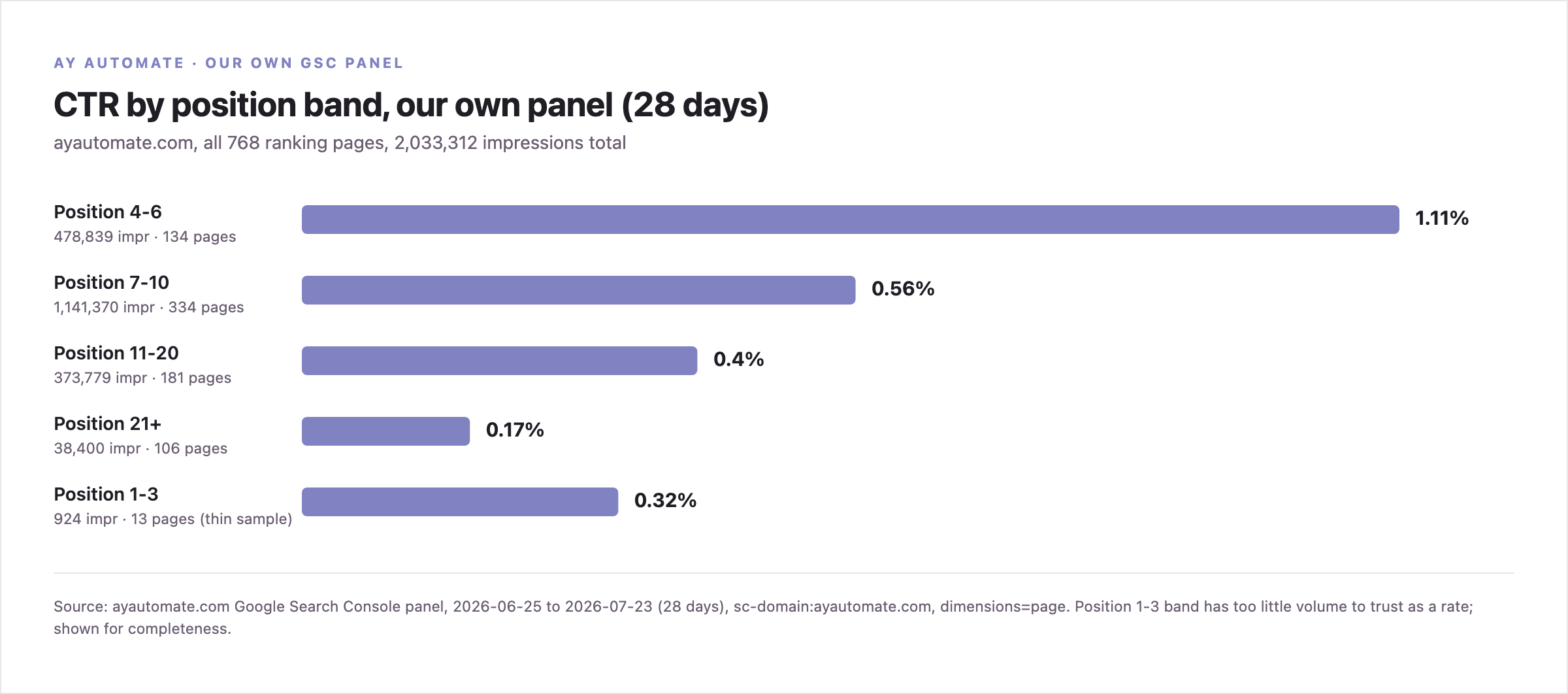
The position 4-6 band, 134 pages and 478,839 impressions, converts at 1.11%. Slide to position 7-10, the single largest band at 334 pages and 1,141,370 impressions, and CTR drops to 0.56%, roughly half. By position 21+, it is 0.17%. That slope is the expected shape: lower position, lower CTR. Nothing surprising yet.
What is worth pausing on is the size of band 7-10. It holds 56% of every impression this site earns in a month. A one-point CTR improvement inside that single band is worth more raw clicks than a rank jump on a page in any smaller band. That is the leverage most CTR conversations skip past in favor of chasing position 1.
Free weekly brief
Steal our production automations
The exact n8n flows, Claude Code setups, and prompts we ship for clients, broken down step by step. No spam, unsubscribe anytime.
Where the impressions land vs where the clicks land
Impression share and click share do not move together. Charting both by band makes the mismatch visible in one image.
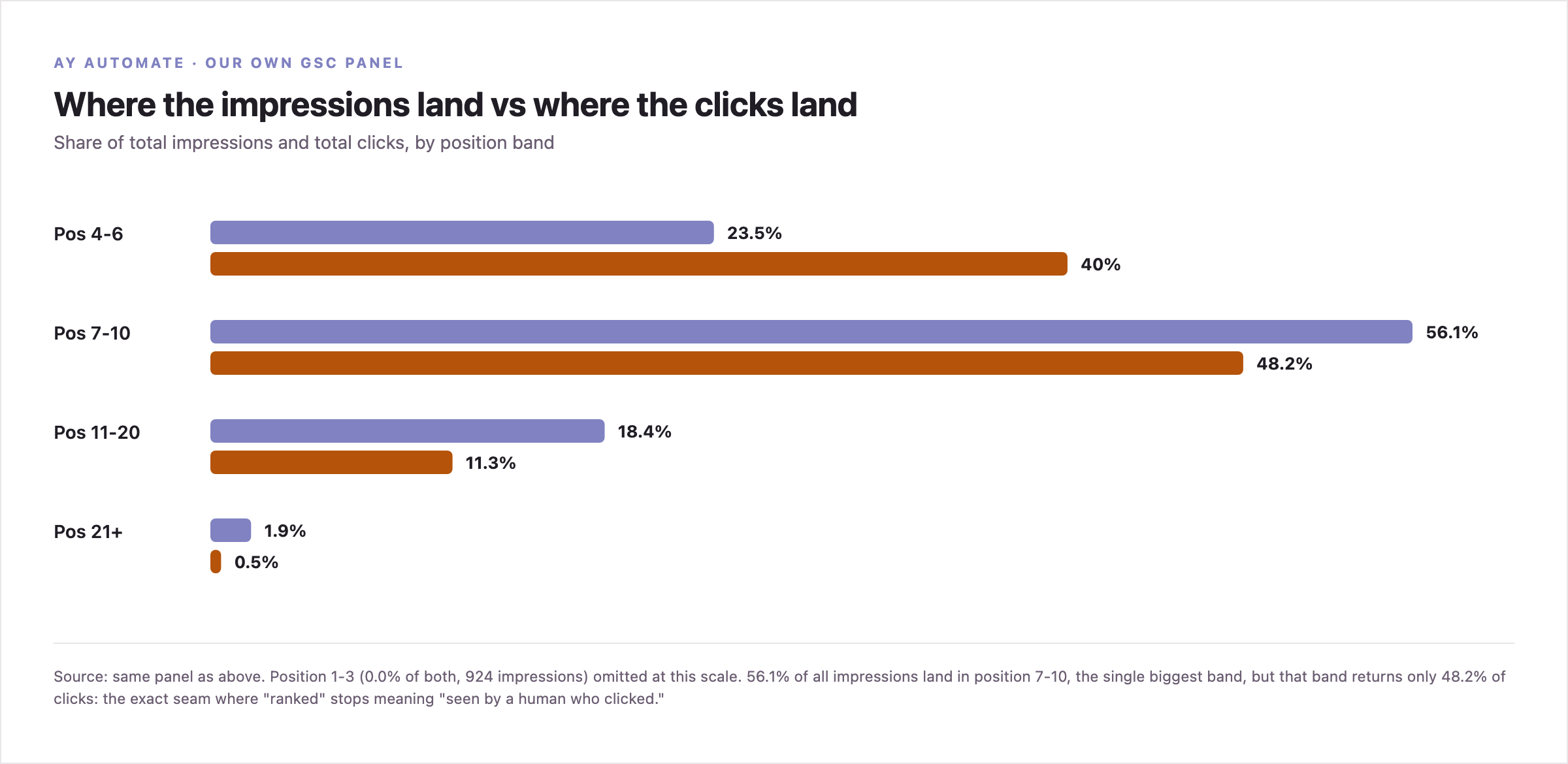
Position 4-6 holds 23.5% of our impressions but returns 40.0% of our clicks: it over-delivers. Position 7-10 holds 56.1% of impressions and returns 48.2% of clicks: it under-delivers, by volume, more than any other band, simply because it is so much bigger than the others. Position 11-20 and 21+ both under-deliver too, but at a fraction of the scale.
Read plainly: the single highest-leverage fix on this site is not a new page or a rank push. It is closing the gap inside position 7-10, where the majority of our own visibility already sits and where the majority of our own missed clicks are concentrated.
The part position does not explain
Position bands only tell half the story, because pages at nearly identical positions do not convert anywhere close to the same rate. We pulled six of our own page-one pages, all sitting within a tight position 6.1-9.1 band, and sorted them by CTR.
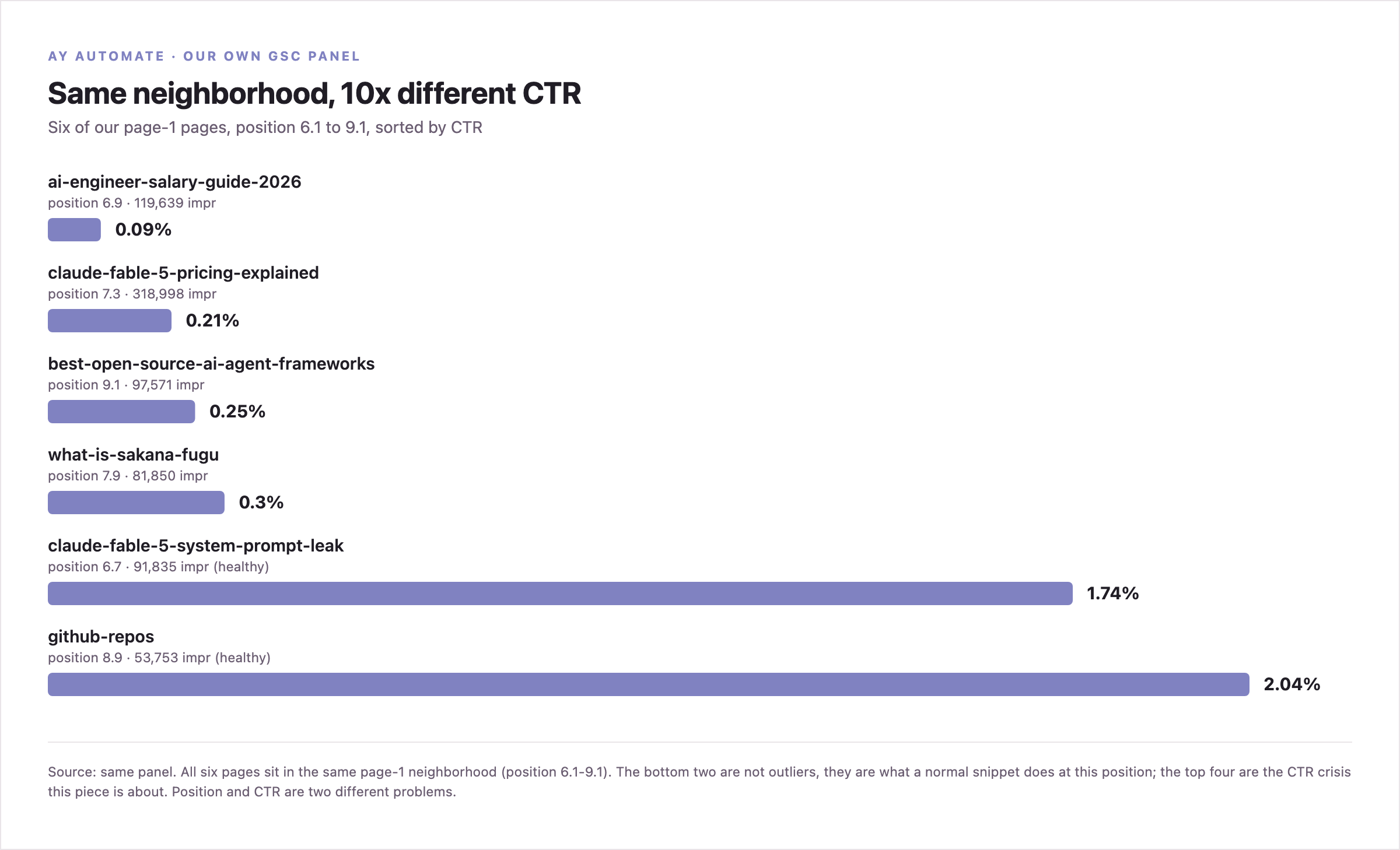
ai-engineer-salary-guide-2026 sits at position 6.9 with 119,639 impressions and a 0.09% CTR. claude-fable-5-system-prompt-leak, one position band over at 6.7, converts at 1.74%, nearly 20 times higher, on a similar volume of impressions. best-claude-code-github-repos sits further down the page at 8.9 and still converts at 2.04%, the best CTR in the set. Four of these six pages sit under 0.35% CTR at page-one positions; two sit above 1.7% at nearly the same positions. Same neighborhood, order-of-magnitude different outcome.
That spread is not a ranking problem. Every one of these pages already earned its position. It is a snippet problem: the title tag and meta description are the only ad space Google gives a result, and four of these six were not written to win the click once the searcher saw them next to nine other blue links. We know this because we went back and rewrote the four underperforming titles and descriptions, keyword-front, one honest hook each, no invented numbers, and left the two healthy pages untouched as the internal control. We will report the before/after CTR on this same panel once a full cycle of data exists, on this same page.
What we did not measure
Our panel tells us an impression happened and whether it turned into a click. It does not tell us what happened between those two events: whether an AI Overview, a featured snippet, or another result answered the query well enough that the click was never going to happen regardless of our title. Zero-click search, results that get seen and answered without a visit to any site, is a well-documented industry pattern; we are not the ones who discovered it. What we can say from our own data is narrower and more useful to us: within a single site's panel, at matched positions, CTR still varies by an order of magnitude, and title/description quality is a large, controllable piece of that variance regardless of how much of the rest is AI-answer attrition we cannot see from inside Search Console.
The takeaway
Rank is necessary and not sufficient. This site earns page-one visibility on 2 million impressions a month and converts under 1% of them into a visit. The biggest single lever is not new content, it is fixing the snippet on the pages that already sit in the highest-volume position band. We are running that fix on our own site first, in public, on this data.
We will refresh this panel monthly and update the numbers on this page rather than publish a new one, so the series stays comparable over time.
FAQ
What is zero-click search? Zero-click search describes a search result that answers the searcher's question directly on the results page, through a featured snippet, an AI-generated answer, or a knowledge panel, so the person never clicks through to any website. It is a documented, industry-wide pattern, not something specific to one site.
Why does click-through rate matter if a page already ranks on page one? Ranking determines whether a page is shown; CTR determines whether it is visited. A page at position 9 with a 2% CTR earns roughly ten times the traffic of a page at the same position with a 0.2% CTR, on the same impressions, at zero additional ranking cost. CTR is the cheapest lever available on a page that already ranks.
Where did the numbers in this article come from? Every figure traces to ayautomate.com's own Google Search Console property (sc-domain:ayautomate.com), pulled for the 28-day window ending July 23, 2026, across all 768 pages that earned at least one impression. No third-party panel, vendor estimate, or industry average appears in this piece.
Why does the position 7-10 band matter more than position 1-3 in this data? Because of volume, not rate. Position 7-10 holds 56.1% of this site's total impressions, by far the largest band, so even a modest CTR improvement there returns more raw clicks than the same improvement in a smaller band like position 1-3, which held only 924 impressions in this panel.
Does a higher-ranking page always get a higher CTR? Generally, yes, in aggregate; that is why CTR falls as position falls in the band chart above. But at the individual-page level, position explains only part of the variance. Two pages that rank within half a position band of each other, in our own data, showed a CTR difference of nearly 20 times, which we attribute mainly to snippet quality rather than rank.
Continue Reading
Google Is Testing Paying Sites for AI Answers: The AI Contribution Pilot Explained
Google is testing payments to websites whose content significantly shapes answers in Gemini, AI Overviews and AI Mode, with earnings shown in Search Console. Here is what the pilot is, what is confirmed, and what our own Generative AI report shows.
What Is llms.txt? Format, Real Adoption Data, and How to Write One
llms.txt is a proposed Markdown file at a site's root meant to give AI models a curated summary of its key pages. Publisher adoption is real and growing. Confirmed use by any major AI crawler is not, based on server-log data from Ahrefs and Semrush's own tests.
AEO and GEO for AI Search: A Practical Guide (2026)
What GEO (Generative Engine Optimization) actually changes about content structure, how it differs from traditional SEO, and a practical checklist to make a page citable by ChatGPT and Perplexity.
Book a Free Strategy Call
Building this in production?
Walid runs a 30-min call to map your AI engineering team. Free, no slides.
Free weekly brief
Steal our production automations
The exact n8n flows, Claude Code setups, and prompts we ship for clients, broken down step by step. No spam, unsubscribe anytime.

Walid founded AY Automate to help businesses ship AI workflows that actually move revenue. He leads strategy and oversees every client engagement end-to-end.
Full Bio →