Book a Free Strategy Call
Skip the read: talk to Walid in 30 min.
Free strategy call. We map your AI engineering team, you keep the notes.
Google is running a test where it pays some websites when their content shapes an AI answer. It is called the AI contribution pilot. It lives inside Search Console, it covers Gemini, AI Overviews and AI Mode, and only a limited group of publishers can see it so far.
The change matters because of what it says about the deal. Until now the arrangement has been that you write, Google might index you, and maybe you get a click. In this pilot, you write, the AI answers get better, and you get paid for your part.
The old deal and the new one
You write. Google might index you. Maybe you get a click.
You write. The AI answers get better. Google pays for your part.
Being cited still carries its own benefit, paid or not.
Our summary of the pilot as reported by Search Engine Land and Search Engine Journal.
What the AI contribution pilot is
Google's own help page describes it in one sentence: the pilot lets you earn money when your content contributes significantly to the creation of AI-generated responses shown to users in participating products.
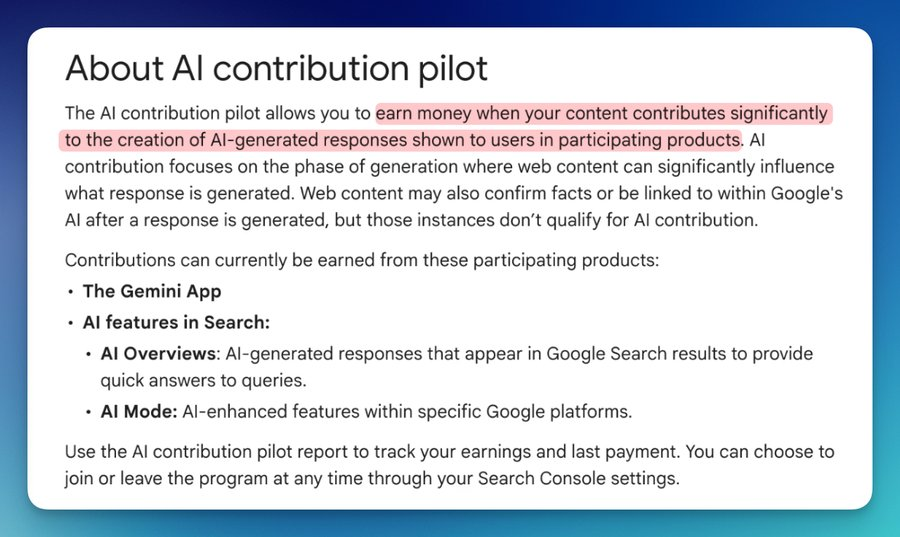
Three details on that page do most of the work:
- Where you can earn. The Gemini app, AI Overviews and AI Mode.
- What counts. Google says AI contribution is about the phase where web content can significantly influence what response gets generated. A page that only confirms a fact, or gets linked after the response exists, does not qualify.
- How you track it. A pilot report in Search Console shows your earnings and last payment, and you can join or leave at any time from Search Console settings.
What Google says qualifies, and what does not
Your content significantly shapes the AI response while it is being generated
Your page confirms a fact or is linked after the response is generated
Gemini app, AI Overviews, AI Mode
An AI contribution report in Search Console, with earnings and last payment
Source: Google Search Console help page for the AI contribution pilot, screenshot captured September 19, 2026.
Related Reads
What is confirmed and what is not
Reporting from Search Engine Journal and Search Engine Land says Google confirmed this is an early-stage pilot. At least dozens of publishers have been approached, though the total was not confirmed. It shows up as an opt-in panel in Search Console for a limited number of sites, and it was first spotted in April 2026.
Publishers in it see a monthly earnings figure in Search Console. They get little detail on how Google reached that number, and Playwire describes the payouts as real money and a black box. Some coverage describes early amounts as small next to ad revenue.
Google has reportedly run similar programs with some news publishers around the world, as negotiated deals. This pilot looks like an attempt to go beyond news and reach other kinds of sites with a standard program, closer to a creator rewards scheme than a licensing contract.
Free weekly brief
Steal our production automations
The exact n8n flows, Claude Code setups, and prompts we ship for clients, broken down step by step. No spam, unsubscribe anytime.
Why we care, and what we can show
We are not in the pilot as far as we can tell, and we have no payout to show you. Nothing in this post claims earnings.
What we can show is how much AI surfaces already draw on our content. Search Console's Generative AI features report (still labelled beta) counts impressions in AI features. Here is our main site and our SEO product site over the last three months.
Impressions in the Generative AI report, Search Console, last 3 months (June 17 to September 15, 2026)
Source: our own Search Console Generative AI features report (beta), screenshots captured September 19, 2026. Impressions, not earnings.
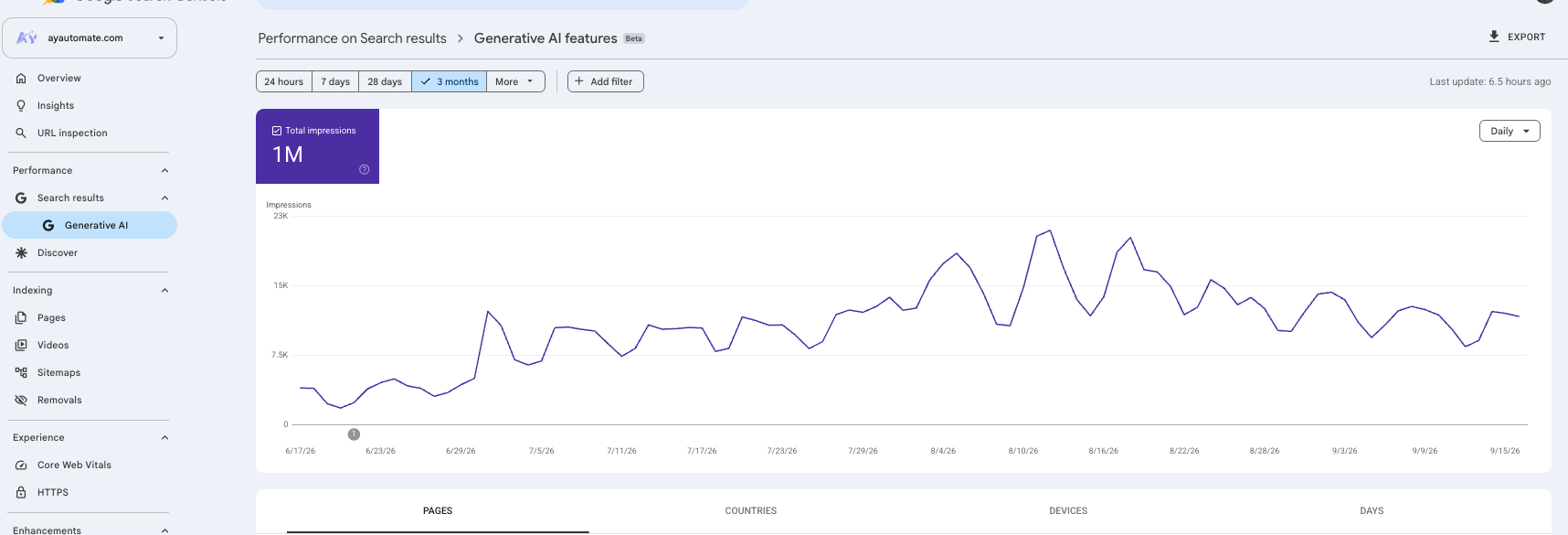
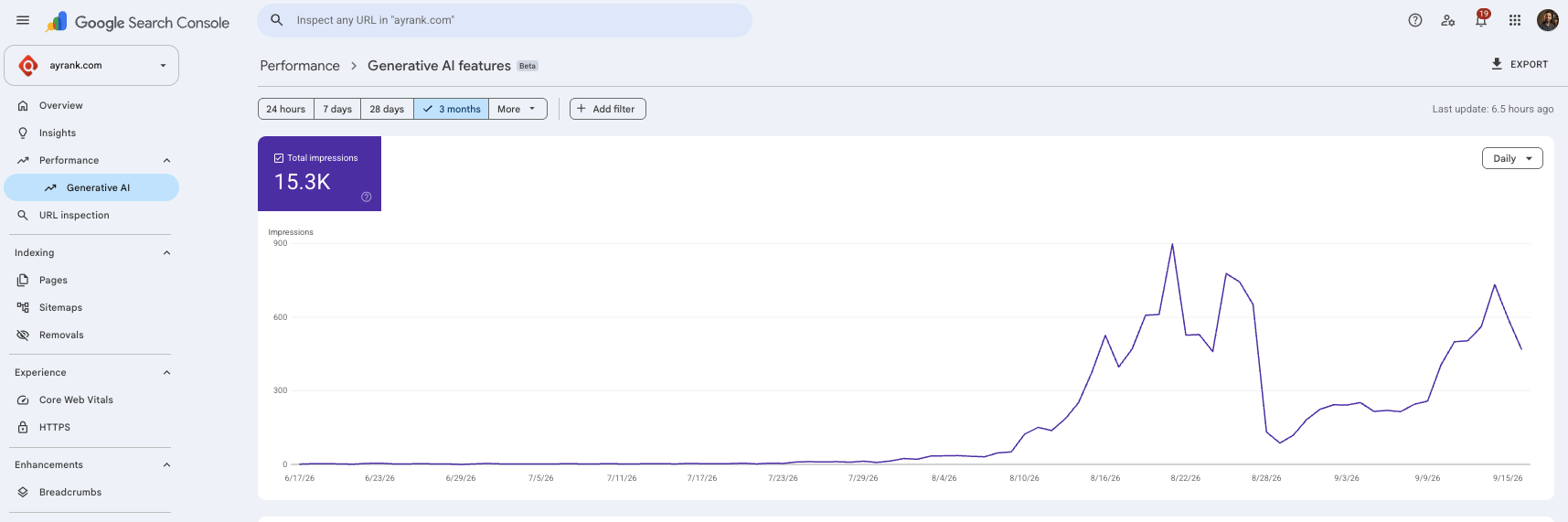
Two things stand out. The main site's daily figure climbed from about 4K to a peak near 23K. And ayrank.com went from near zero to about 900 daily AI impressions in roughly a month. Impressions are not contribution, and contribution is not earnings. The report tells you where AI features already show your pages. It does not tell you whether you would qualify.
What to do this week
- Check Search Console for an AI contribution panel. If it is there, you were invited. If not, you are like most sites right now.
- Open the Generative AI features report. Look at which pages get AI impressions. Those are the pages that already show up in AI features, which is a useful starting list.
- Write for the generation step, not the click. The pilot pays for content that shapes an answer as it is written. That favors original data, current facts and clear definitions over recycled summaries.
- Keep pages fresh and factual. Freshness is a reasonable bet, since the pilot is about content that shapes the answer while it is written. A stale page is a weak candidate.
- Do not restructure your whole site for a pilot. It is a test with unclear payouts. The work above also helps normal search and AI citations, so it pays off either way.
Our read
If Google scales this, sites would get paid for being useful inside an answer, and not only when someone clicks through. That is a real change in incentives for anyone who publishes.
It is also still a test. The payout method is opaque, the group is small and the amounts are reportedly modest. Treat it as a signal about direction, not a revenue line to plan around.
If you want help finding which of your pages AI features already lean on, and rewriting them to be worth citing, that is the work we do in our AI SEO and GEO services. The Search Console data you already have is the place to start.
Sources: Search Engine Roundtable, Search Engine Journal, Search Engine Land, Playwire, and Google's Search Console help page (screenshot above). Reports checked September 19, 2026.
Continue Reading
What Is llms.txt? Format, Real Adoption Data, and How to Write One
llms.txt is a proposed Markdown file at a site's root meant to give AI models a curated summary of its key pages. Publisher adoption is real and growing. Confirmed use by any major AI crawler is not, based on server-log data from Ahrefs and Semrush's own tests.
AEO and GEO for AI Search: A Practical Guide (2026)
What GEO (Generative Engine Optimization) actually changes about content structure, how it differs from traditional SEO, and a practical checklist to make a page citable by ChatGPT and Perplexity.
Bing's AI Performance Report: What 43.9K Citations Taught Us
Bing Webmaster Tools now shows how often Copilot cites your site. We read our own 43.9K-citation dashboard against Bing's own release notes and our real referrer data, and separated what we can attribute from what we can't.
Book a Free Strategy Call
Building this in production?
Walid runs a 30-min call to map your AI engineering team. Free, no slides.
Free weekly brief
Steal our production automations
The exact n8n flows, Claude Code setups, and prompts we ship for clients, broken down step by step. No spam, unsubscribe anytime.

Walid founded AY Automate to help businesses ship AI workflows that actually move revenue. He leads strategy and oversees every client engagement end-to-end.
Full Bio →