Book a Free Strategy Call
Skip the read: talk to Walid in 30 min.
Free strategy call. We map your AI engineering team, you keep the notes.
Bing just told us how often AI cites our site. For three months, the number sat near zero. Then it hockey-sticked to 43.9K citations, and we had to figure out how much of that was real.
In February 2026, Microsoft added a new report called AI Performance to Bing Webmaster Tools. It shows how often Microsoft Copilot and partner AI experiences cite your pages when answering a question, something no major search engine had exposed to site owners before. In June, Microsoft expanded it with citation share, intent labels, topic groupings, and period comparisons.
We watched our own numbers move through both changes. This is what the report actually measures, how to read it without fooling yourself, and what we can honestly attribute to our own work versus Bing's own measurement changes.
What is Bing's AI Performance report?
AI Performance is a BETA dashboard inside Bing Webmaster Tools that tracks how often your site's pages get pulled into answers generated by Microsoft Copilot and its partner AI experiences. Microsoft's own product managers, Krishna Madhavan, Meenaz Merchant, Fabrice Canel, and Saral Nigam, introduced it on February 10, 2026, framing it as "an early step toward Generative Engine Optimization (GEO) tooling" for publishers.
You will find it in Bing Webmaster Tools under Search Performance > AI Performance. Anyone with a verified site already has access; there is no waitlist.
The original release shipped three numbers:
- Total Citations: how many times your pages were used as sources in AI-generated answers over the selected period.
- Average Cited Pages: the daily average of unique pages from your site that showed up as sources.
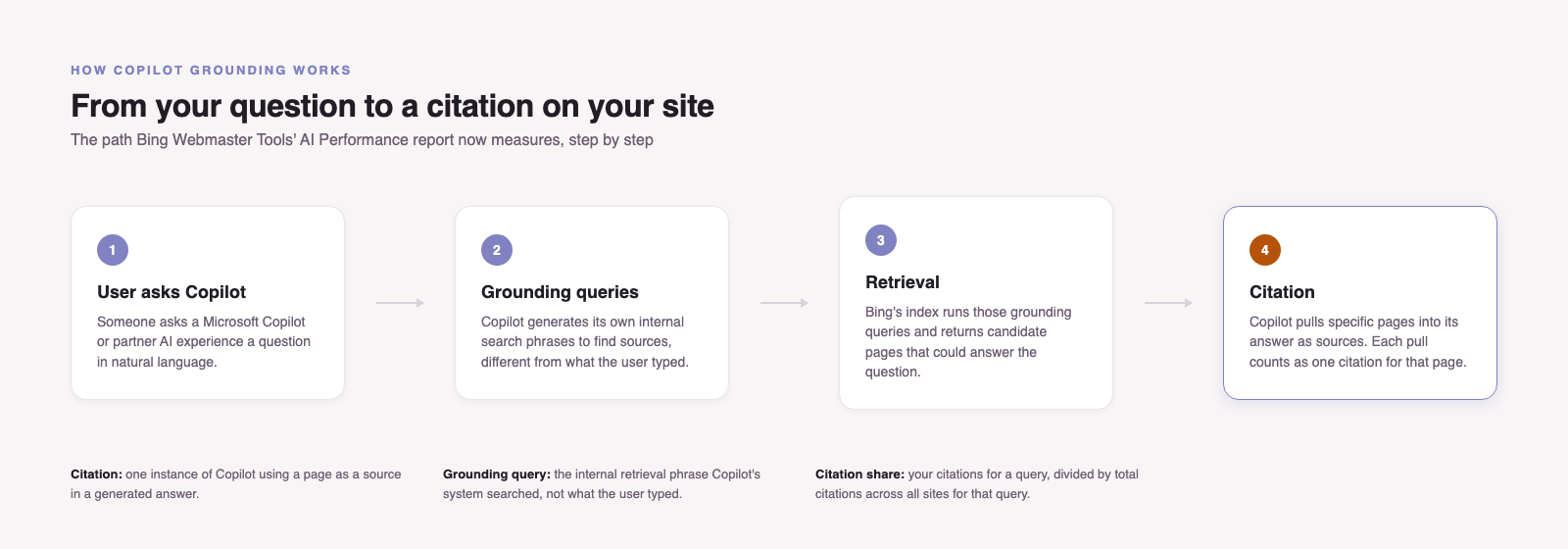
- Grounding Queries: a sample of the internal search phrases Copilot generated while retrieving content, not what the user actually typed.
That third metric confuses almost everyone the first time they see it. A grounding query is not a search query. It is the phrase Copilot's own retrieval system searched for internally to find a page worth citing. If someone asks Copilot "what's the difference between RPA and AI agents," Copilot might generate three or four grounding queries behind the scenes, each one a candidate search aimed at pulling in a source. Only some of those pulls turn into a citation in the final answer.
Related Reads
The June 16 expansion: citation share, intents, topics, compare
On June 16, 2026, Microsoft shipped four additions to the same report, again announced on the official Bing Webmaster blog:
| Feature | What it does |
|---|---|
| Citation Share | Your citations for a query, divided by total citations across all sites for that query, times 100. For example, if your site gets 3 of the 10 citations an answer drew on, your Citation Share for that query would be 30%. |
| Intents | Classifies each grounding query into a category: Informational, Commercial, Navigational, Learn and Solve, Research, Creation, Local, and more. |
| Topics | Clusters related grounding queries by theme, so you can see which subject areas earn you citations instead of reading one query at a time. |
| Compare | Overlays a prior period on the current one, so you can see whether citation activity is actually trending up. |
Microsoft is explicit that Citation Share is "designed as an observational metric, not a ranking system or a competitive scoreboard." It does not show you which competitors got the other 70%. It just tells you your own share of the pie for a given query.
One honesty check before you trust a sudden jump: at least one independent analysis (PinMeTo) found that some of the citation-count jumps sites saw in early June traced back to Microsoft backfilling historical citation data into the dashboard, not a real-time change in how often sites were cited. A Microsoft product manager described part of that move as "regular data backfilling with no anomalies." If your own chart shows a step change right around June 1 or June 16, check whether it lines up with the report's own release dates before you credit it entirely to your content work. We ran into exactly this ambiguity with our own numbers below, and we are not going to pretend we can fully untangle it.
Free weekly brief
Steal our production automations
The exact n8n flows, Claude Code setups, and prompts we ship for clients, broken down step by step. No spam, unsubscribe anytime.
Our own numbers: 43.9K citations, and what we can and cannot attribute
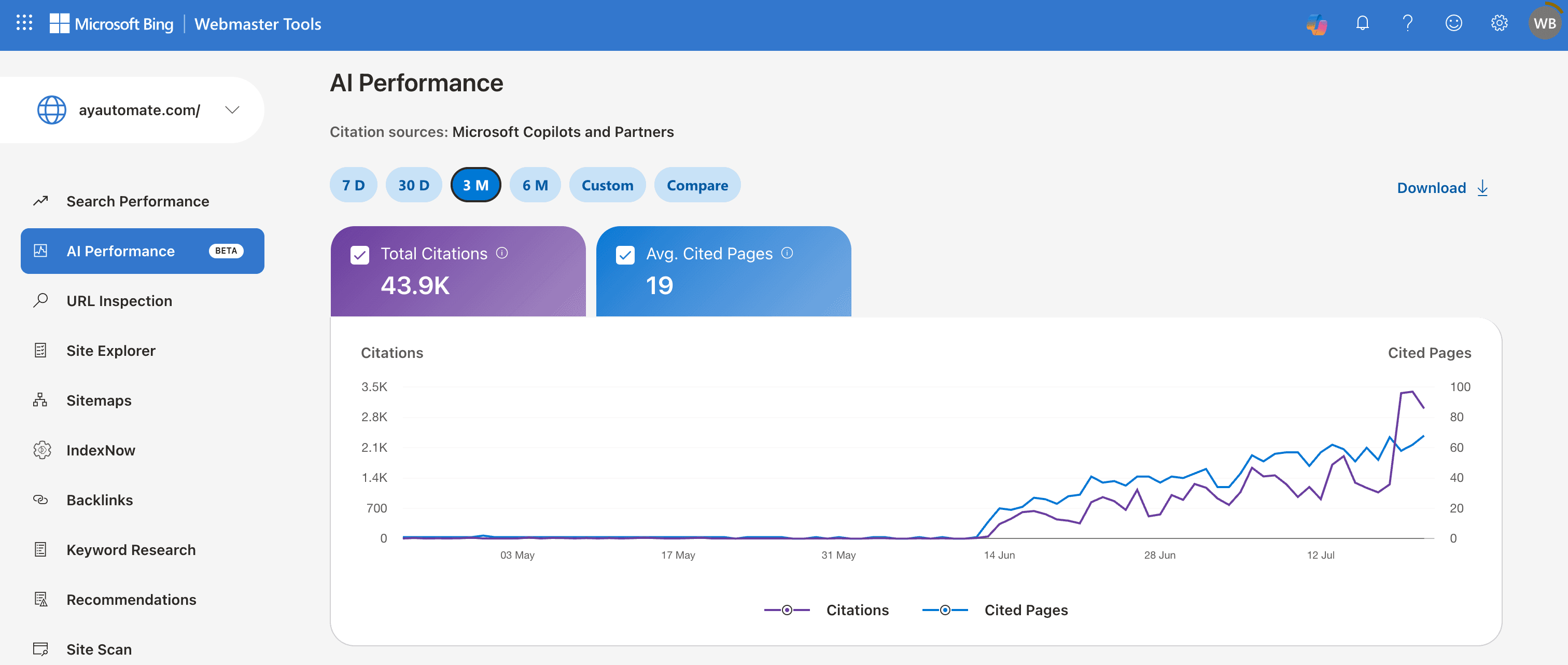
Here is our own AI Performance dashboard for ayautomate.com, three-month view, pulled directly from Bing Webmaster Tools:
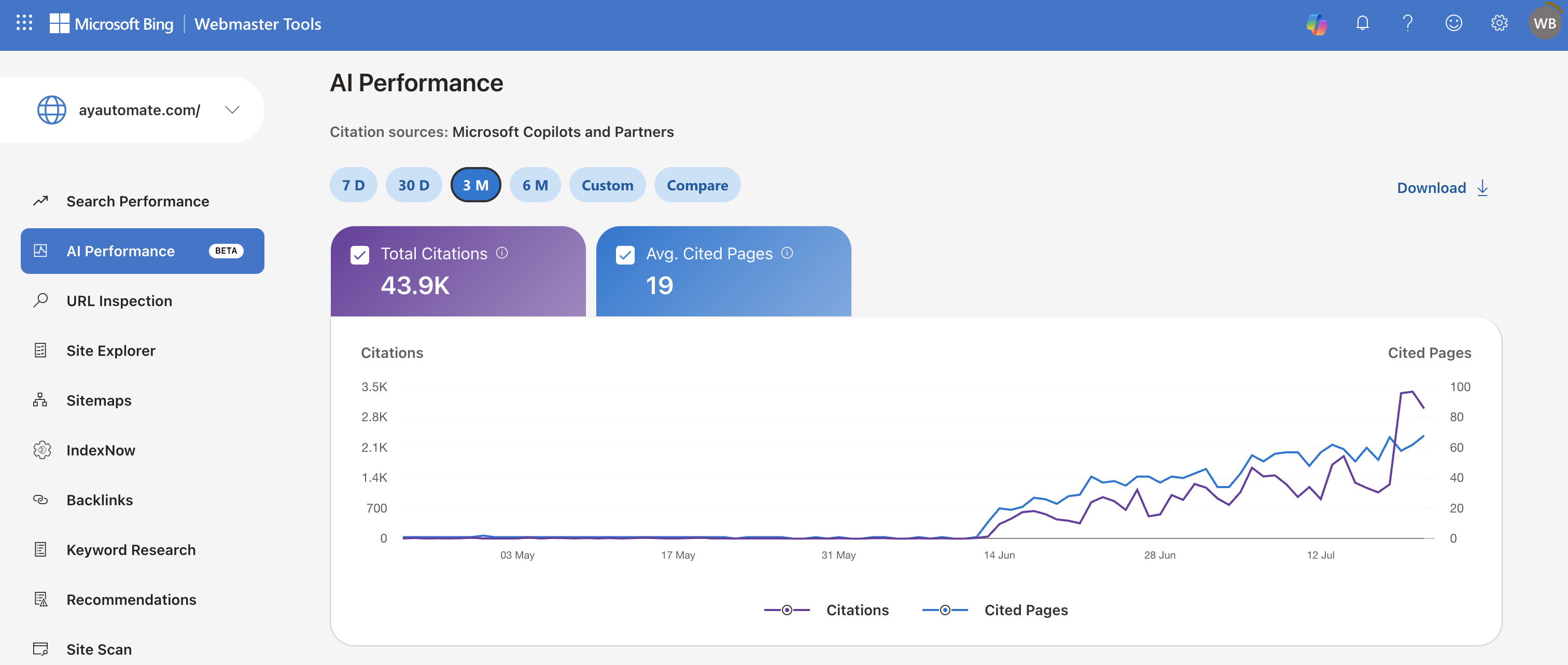
Total Citations: 43.9K over three months. Average Cited Pages: 19 per day. The chart tells the real story better than the summary numbers do: the line sits flat near zero from early May through roughly June 13, then climbs, first slowly, then steeply, to a peak near 3.5K citations a day and 60 to 100 cited pages a day by mid-July.
That inflection point lands within days of Bing's June 16 expansion. We are not going to claim a clean causal story here. Two things happened in the same window:
- Bing expanded what the AI Performance report measures and, per the independent reporting above, may have backfilled historical data into it around the same date.
- We were mid-push on content volume and structure: more published posts, cleaner heading hierarchy for featured-snippet extraction, and consistent IndexNow pings on every publish so Bing's crawler sees new and updated pages fast.
We cannot cleanly separate how much of the 43.9K comes from Bing counting more of what was already happening versus our content actually earning more citations in the same window. What we can say: our own referrer data, pulled directly from PostHog over the trailing 30 days, shows real AI-assistant traffic landing on the site, not just citations inside Bing's own dashboard: 703 visits from Brave Search, 565 from Bing, 463 from DuckDuckGo, and a combined 648 visits from AI assistants directly (Gemini 216, Claude.ai 210, ChatGPT 140, Perplexity 71, NotebookLM 11). None of that traffic depends on Bing's citation count being accurate. People are actually landing on the site from AI surfaces, which is the thing the citation number is trying to be a proxy for.
That is the differentiator we want in this piece: most coverage of this report treats a rising line as an unqualified win. We are telling you what we can actually attribute and what we cannot, because a number you cannot explain is not a number you can act on.
What actually moves your citation count
Based on what changed on our own site during this window, and on what Microsoft's own definitions imply about how grounding retrieval works, a few things are worth doing regardless of how much credit Bing's dashboard gives you for them:
Structure content so a retrieval system can lift one answer cleanly. Grounding queries are themselves generated to find a specific, extractable answer. A page with a direct answer in the first two sentences of a section, followed by supporting detail, gives Copilot's retrieval something to cite without having to synthesize across the whole page. This is the same practice behind getting cited by ChatGPT and Perplexity: answer-first structure, one claim per heading, and schema markup that tells a crawler what kind of content it is looking at.
Ping IndexNow on every publish and update. Bing (and Yandex, Seznam, Naver, and Yep, which all consume the same protocol) can index a new or changed page within minutes of an IndexNow ping instead of waiting for the next crawl cycle. If Copilot's retrieval step depends on Bing's own index having your page, and your page is not in that index yet, it cannot be cited no matter how well it is written.
Publish llms.txt. It is a low-effort signal that tells AI crawlers which pages on your site are meant to be read and cited, similar in spirit to a sitemap but aimed at language models instead of search crawlers.
Treat security and trust content as citation bait, not just readers. Our two most recent posts on AI agent security best practices and the best AI agent security tools are exactly the kind of specific, well-sourced, frequently-updated content that grounding retrieval favors: a direct question, a direct answer, real citations of our own.
Citations, grounding queries, and citation share: how to read them together
Total Citations tells you volume. Grounding Queries tell you what Copilot was actually looking for when it decided your page was worth pulling. Citation Share tells you how much of the available citation pool for a specific query you are actually winning, which matters more than the raw count once you have any citations at all: a page with 50 citations and a 10% share is losing to eight other sites; a page with 20 citations and a 60% share basically owns that query inside Copilot's answers.
Read them in that order: check total citations to see if you show up at all, check grounding queries to see what questions are pulling you in, then check citation share on your best queries to see whether you are winning them outright or splitting them with competitors.
What this means for you
- Check Search Performance > AI Performance in Bing Webmaster Tools this week, even if you have never looked at it before. It is free, already live on your account if the site is verified, and it is the first real visibility any major platform has given publishers into AI citation volume.
- Do not credit a sudden spike to your own work without checking the date against Bing's release notes first. The February 10 launch and the June 16 expansion both changed what and how the dashboard counts; a step change that lines up with either date deserves a second look before you write it into a case study.
- Use grounding queries and topics to find weak spots, too. If a topic cluster shows citations but at a low citation share, that is a page worth strengthening rather than one to leave alone.
- Keep IndexNow and llms.txt live if you have not already, since both directly affect whether Bing's index even has the page available to cite in the first place.
- Track your own referrer data alongside the citation count, the same way we did for our own Search Console impressions. Bing's dashboard tells you what Bing thinks it did. Your own analytics tell you whether people actually showed up.
FAQ
What is Bing's AI Performance report? It is a BETA report inside Bing Webmaster Tools, launched February 10, 2026, that shows how often Microsoft Copilot and partner AI experiences cite your site's pages when generating answers. You find it under Search Performance > AI Performance for any verified site.
What is the difference between a citation and a grounding query? A citation is Copilot actually using one of your pages as a source in a generated answer. A grounding query is the internal search phrase Copilot's retrieval system generated to find that source in the first place; it is not something a user typed.
What is citation share? Citation share is your citations for a specific query divided by the total citations across all sites for that same query, expressed as a percentage. Microsoft added it on June 16, 2026, and describes it as an observational metric rather than a competitive ranking.
Does the AI Performance report cover ChatGPT, Perplexity, or Google AI Overviews? No. It only covers Microsoft Copilot and Bing's own partner AI experiences. For visibility into ChatGPT and Perplexity citations specifically, see our guide on how to get cited by ChatGPT and Perplexity, linked earlier in this article.
Why did my citation count suddenly jump in June? It may be partly real and partly Bing's own reporting change. Microsoft expanded the report's feature set on June 16, and at least one independent analysis found that some of the citation increases sites saw around the same period traced back to backfilled historical data rather than new activity. Check whether your own jump lines up with that date before attributing it entirely to your content work.
Is a high citation count the same as real AI-referred traffic? Not necessarily. A citation means Copilot used your page as a source; it does not always mean the reader clicked through. Pair the citation count with your own referrer data (Brave, Bing, DuckDuckGo, and direct AI-assistant referrals in your analytics) to see how much of that citation activity is turning into actual visits.
What can I do to increase my citation count?
Structure content so a specific answer sits in the first two sentences of a section, keep your site's index fresh with IndexNow pings on every publish, publish an llms.txt file, and prioritize topics where your citation share is low but your citation volume already shows Copilot considers you a source.
Is Citation Share the same as a ranking? No. Microsoft describes it explicitly as an observational metric, not a ranking system or competitive scoreboard. It will not show you which other sites got the remaining citations for a query, only your own percentage of the total.
Sources: Introducing AI Performance in Bing Webmaster Tools (Public Preview), New AI Visibility Insights in Bing Webmaster Tools: Intents, Topics, Citation Share, Compare, Bing's AI citation surge was backfill, not new visibility, Bing Webmaster Tools AI Citation Share: A GEO Guide
Continue Reading
Google Is Testing Paying Sites for AI Answers: The AI Contribution Pilot Explained
Google is testing payments to websites whose content significantly shapes answers in Gemini, AI Overviews and AI Mode, with earnings shown in Search Console. Here is what the pilot is, what is confirmed, and what our own Generative AI report shows.
What Is llms.txt? Format, Real Adoption Data, and How to Write One
llms.txt is a proposed Markdown file at a site's root meant to give AI models a curated summary of its key pages. Publisher adoption is real and growing. Confirmed use by any major AI crawler is not, based on server-log data from Ahrefs and Semrush's own tests.
AEO and GEO for AI Search: A Practical Guide (2026)
What GEO (Generative Engine Optimization) actually changes about content structure, how it differs from traditional SEO, and a practical checklist to make a page citable by ChatGPT and Perplexity.
Book a Free Strategy Call
Building this in production?
Walid runs a 30-min call to map your AI engineering team. Free, no slides.
Free weekly brief
Steal our production automations
The exact n8n flows, Claude Code setups, and prompts we ship for clients, broken down step by step. No spam, unsubscribe anytime.

Taha builds and ships custom AI agents and workflow automations for AY Automate clients across SaaS, finance, and professional services.