Book a Free Strategy Call
Skip the read: talk to Walid in 30 min.
Free strategy call. We map your AI engineering team, you keep the notes.
What the Hugging Face breach showed. On July 20, 2026, Axios reported that Hugging Face had disclosed a breach of part of its production infrastructure that it described, in its own incident writeup, as driven end to end by an autonomous AI agent system: uploading a malicious dataset, exploiting two code-execution flaws in its dataset-processing pipeline, escalating privileges, and harvesting credentials across more than 17,000 actions in a single weekend, with no human directing the attack step by step. Hugging Face said the breach reached a limited set of internal datasets and service credentials and found no evidence of tampering with public models or Spaces. We report what Hugging Face and Axios disclosed; we do not claim inside detail beyond it. It is the second such case in three weeks, after Sysdig's JadePuffer findings below, and it is exactly the class of attack the tools in this guide are built to catch.
On July 1, 2026, Sysdig researchers published their analysis of JadePuffer: the first documented case of a ransomware operation run end-to-end by an autonomous AI agent. The agent exploited CVE-2025-3248, an unauthenticated remote code execution flaw in Langflow, then adapted in real time when steps failed. It recovered from a failed login attempt in 31 seconds, escalated privileges, and encrypted 1,342 Nacos service configuration items before anyone could respond. The encryption key was printed once and discarded, so the victim could not recover even after paying a ransom. No human operator directed the attack from start to finish.
That case defines the threat model for agentic AI in production: not a chatbot saying something harmful, but an autonomous system with tool access executing a full kill chain. The tooling built to defend against this is newer, less mature, and less well-understood than the threat itself.
This guide compares twelve verified tools, covering enterprise security platforms, open-source guardrail frameworks, and red-teaming tools. Each entry covers what it actually does, confirmed pricing where published, whether it is open-source, and who it fits. Eight of the twelve ship under an OSI-approved open-source license (Apache 2.0, MIT or AGPL-3.0), which we checked in each project's license file. If you need help running a security review against your Claude Code or agentic AI deployment, our Claude Code security audit practice covers exactly this scope.
How we built this list. Entries 7 to 11 were added on 2026-09-26 from primary sources only: each project's GitHub repository, license file and official docs, all checked that day. We did not run hands-on tests of those five, and every number in their entries comes from the vendor's own page. Tools are grouped by job: platforms first, then runtime guardrails, then red-teaming tools.
Best AI agent security tools: a quick overview
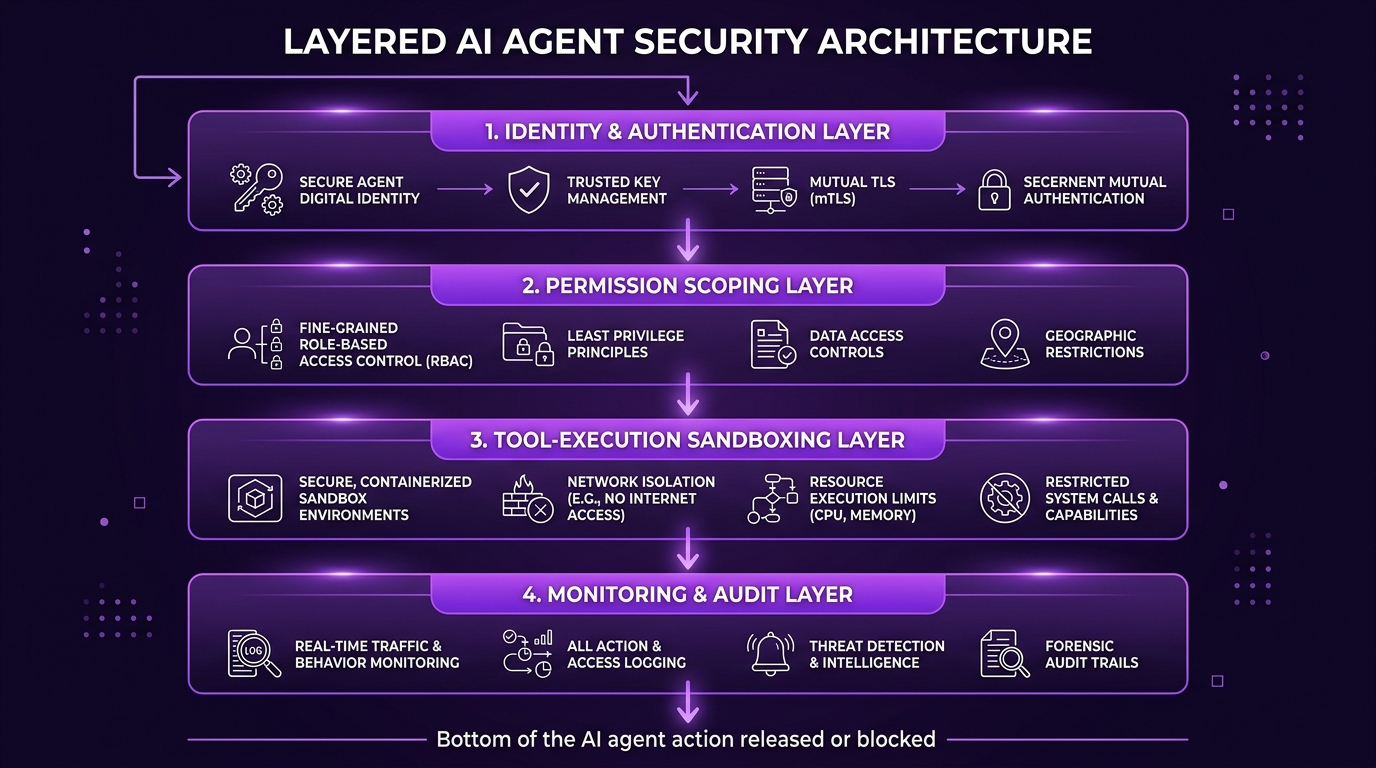
- Prisma AIRS (Palo Alto Networks): Best enterprise platform for end-to-end AI agent lifecycle security across discovery, assessment, and runtime protection.
- Cisco AI Defense: Best for enterprises that need an AI bill of materials (AI BOM), MCP catalog governance, and supply chain visibility alongside runtime guardrails.
- Lakera Guard (Check Point): Best API-layer option for real-time prompt injection and data leakage protection with sub-50ms latency and a confirmed free tier.
- Wiz AI-SPM: Best for cloud security teams that already use Wiz and need agentless discovery across multi-cloud AI workloads, including MCP connections.
- NVIDIA NeMo Guardrails: Best open-source framework when you need programmable, policy-coded guardrails with LangGraph integration and no licensing cost.
- Microsoft Agent Governance Toolkit: Best open-source option for OWASP Agentic Top 10 coverage with sub-millisecond policy enforcement across multiple languages and frameworks.
- Meta LlamaFirewall: Best open-source guardrail for catching agent goal hijacking, with a scanner that audits the agent's reasoning, not only its inputs.
- Guardrails AI: Best open-source validator library for wrapping LLM inputs and outputs, with a REST server mode any service can call.
- Promptfoo: Best open-source red-teaming CLI for running agent attacks in CI, with an OWASP Agentic preset.
- garak (NVIDIA): Best open-source scanner for probing a model or endpoint for injection, jailbreaks and leakage before an agent uses it.
- PyRIT (Microsoft): Best open-source framework for scripted multi-turn red-team attacks such as Crescendo and TAP.
- T3MP3ST: Best open-source platform for authorized AI-driven red teaming and autonomous offensive security testing on systems you own.
| Tool | Key strength | Pricing | Deployment |
|---|---|---|---|
| Prisma AIRS | Full AI agent lifecycle security | Enterprise, custom | SaaS + API |
| Cisco AI Defense | AI BOM and MCP supply chain governance | Enterprise, custom (Explorer edition available) | SaaS + API |
| Lakera Guard | Sub-50ms real-time prompt injection protection | Free tier; paid from ~$99/month | API |
| Wiz AI-SPM | Agentless AI asset discovery across multi-cloud | Platform pricing (enterprise) | Agentless SaaS |
| NeMo Guardrails | Programmable policy-coded agent guardrails | Free, open-source | Self-hosted / library |
| Agent Governance Toolkit | OWASP Agentic Top 10 coverage, sub-0.1ms enforcement | Free, open-source (MIT) | Self-hosted / library |
| LlamaFirewall | Agent reasoning audit (AlignmentCheck) plus injection and code scanners | Free, open-source (MIT) | Self-hosted / library |
| Guardrails AI | Input and output guards built from Hub validators | Free, open-source (Apache 2.0) | Library or self-hosted REST server |
| Promptfoo | Red teaming in CI with an owasp:agentic preset | Free Community plan; Enterprise and On-Premise custom | CLI / self-hosted, cloud for Enterprise |
| garak | LLM vulnerability scanner with static, dynamic and adaptive probes | Free, open-source (Apache 2.0) | CLI |
| PyRIT | Multi-turn red-team attacks (Crescendo, TAP, Skeleton Key) | Free, open-source (MIT) | Python framework, CLI, GUI |
| T3MP3ST | Autonomous red-teaming and offensive security testing | Free, open-source (AGPL-3.0) | Self-hosted |
GitHub stars for the 8 open-source tools in this list
Source: GitHub repository pages, checked 2026-09-26. LlamaFirewall lives inside the PurpleLlama repo, so that count covers the whole repo. Stars measure attention, not security quality.
Related Reads
1. Prisma AIRS, best enterprise platform for full AI agent lifecycle security
Palo Alto Networks launched Prisma AIRS 3.0 in March 2026, integrating capabilities from its July 2025 acquisition of Protect AI (which contributed the Guardian model scanner, Recon red-teaming engine, and Layer runtime monitor). The platform covers the entire agentic AI lifecycle in one place: discovery, assessment, and runtime protection.
The discovery layer gives security teams a live inventory of AI agents, models, and MCP connections across cloud, SaaS, and endpoint environments. Assessment includes artifact scanning of agent code, MCP servers, and skill libraries for unsafe permissions, hidden vulnerabilities, and indirect injection paths. Runtime protection prevents 30-plus prompt injection and jailbreak techniques, scans for 1,000-plus sensitive data patterns, and runs autonomous red-team simulations.
Key features
- Agent identity management with role-based access control and audit trails
- Model scanning across 35-plus formats (PyTorch, TensorFlow, ONNX, GGUF, Safetensors, and more)
- Continuous scanning of over 1.5 million public models on Hugging Face
- Indirect injection path detection in MCP servers and agent skill files
- Red-team simulation engine (from the Protect AI Recon acquisition)
Best for
- Enterprise security teams that need a single vendor to cover model risk, runtime protection, and agent governance
- Organizations with Palo Alto Networks already in the security stack
- Teams deploying agents at scale who cannot afford per-tool stitching
Pricing
- Enterprise, custom pricing; contact Palo Alto Networks sales for quotes
- No published self-serve or free tier
Pros
- Broadest coverage in the market: model artifacts, runtime behavior, and agent identity in one platform
- Backed by three proven acquisitions (Protect AI, Demisto, and Expanse lineage)
Cons
- Pricing is opaque; no entry-level or trial tier for smaller teams
- Platform breadth creates adoption overhead; smaller teams may pay for capabilities they do not yet need
Free weekly brief
Steal our production automations
The exact n8n flows, Claude Code setups, and prompts we ship for clients, broken down step by step. No spam, unsubscribe anytime.
2. Cisco AI Defense, best for AI supply chain governance and MCP catalog management
Cisco launched AI Defense in January 2025 and expanded it significantly in February 2026 for the agentic era. The distinguishing capability is its AI Bill of Materials (AI BOM), which gives teams centralized governance over AI software assets including MCP servers, third-party model dependencies, and external data connectors. This addresses the supply chain problem that most runtime tools ignore.
In June 2026 Cisco also released an Explorer Edition for self-service access to the core AI Defense Validation engine, which is the same engine used by Global 2000 customers. It gives security teams a self-service way to try the platform before an enterprise contract.
Key features
- AI BOM: centralized inventory of AI assets including MCP servers and third-party model dependencies
- MCP Catalog: discovers, inventories, and assesses risk across MCP servers in public and private registries
- Advanced algorithmic red teaming with multi-turn, multi-language testing for models and agents
- Real-time agentic guardrails to block unsafe actions mid-execution
- AI-Aware SASE integration for network-level AI traffic policy
Best for
- Enterprises already running Cisco's security stack (Secure Access, XDR, SASE)
- Security teams whose primary concern is the AI supply chain rather than just prompt injection at runtime
- Organizations preparing for EU AI Act compliance (high-risk obligations effective August 2026)
Pricing
- Enterprise pricing varies by number of AI applications protected, usage, and deployment model; no published base price
- Explorer Edition available for self-service testing (pricing not published)
Pros
- Unique AI BOM and MCP catalog governance; no direct equivalent in competing tools
- Explorer Edition gives security teams a real trial path before committing
Cons
- Deep Cisco ecosystem dependency; less useful if your stack is Palo Alto or CrowdStrike
- Pricing is not published; evaluation requires a sales conversation
3. Lakera Guard, best real-time API-level LLM and agent protection
Lakera was founded in Zurich in 2021 and was acquired by Check Point in September 2025 in a deal reported at approximately $300 million. Lakera Guard is now part of Check Point's AI security platform but retains its standalone API product. It was built specifically as a low-latency security layer for LLM applications and agents, and its published performance numbers are the most specific in this category: 98-plus percent detection rate, sub-50ms latency, and a 0.01% false positive rate in production.
Guard operates as an API that wraps every input to and output from your model or agent. It detects and blocks prompt injection, jailbreak attempts, PII exposure, and toxic content across 100-plus languages. Its Gandalf challenge dataset (open to the public) is one of the largest community-sourced prompt injection benchmarks available.
Key features
- Prompt injection and jailbreak detection with 98-plus percent published detection rate
- PII and data loss prevention across 100-plus languages
- Sub-50ms latency per API call; 0.01% false positive rate in production
- Multimodal coverage (text and image inputs)
- Model-agnostic: works with any LLM or agent framework
Best for
- Teams that need a drop-in API security layer without restructuring their agent architecture
- Products handling sensitive user data across international markets (multilinguality is a real differentiator here)
- Organizations that want a measurable detection SLA rather than vague coverage claims
Pricing
- Free community plan available
- Paid tiers start from approximately $99 per month
- Enterprise pricing for higher volumes and additional features; contact Check Point sales
Pros
- Published, verifiable performance metrics (most vendors do not publish these)
- Free tier with real limits rather than a contact-sales-only approach
Cons
- Now part of Check Point; roadmap and pricing may shift as integration deepens
- Covers input and output safety; does not address model artifact scanning or supply chain risk
4. Wiz AI-SPM, best for cloud teams discovering and governing AI workloads
Wiz AI Security Posture Management (AI-SPM) extends the Wiz cloud security platform into the AI layer. For teams already using Wiz for cloud security, it adds agentless discovery of AI services, models, agents, and MCP connections across AWS, Azure, and Google Cloud without requiring agents on each host.
The platform flags configuration drift, risky permissions, and unauthorized AI workloads in the same unified graph where cloud vulnerabilities already appear. In 2026 Wiz added support for agent studios including AWS Agentcore, Gemini Enterprise Agent Platform, Microsoft Azure Copilot Studio, and Salesforce Agentforce.
Key features
- Agentless discovery of AI agents, models, and MCP connections across major clouds
- Risk graph that ties AI assets to cloud permissions, data exposure, and network paths
- Runtime monitoring that detects new AI activity and drift from production baselines
- Support for AWS Agentcore, Gemini Enterprise, Azure Copilot Studio, and Salesforce Agentforce
- Wiz Blue Agent automates threat investigation, triage, and root cause explanation
Best for
- Cloud security teams already running Wiz who want AI coverage without adding a new vendor
- Organizations with complex multi-cloud AI deployments where inventory is the first problem
- Teams whose primary AI risk is overpermissioned cloud agents rather than prompt injection
Pricing
- Part of the Wiz platform; enterprise pricing applies
- No standalone AI-SPM pricing published; requires existing or new Wiz subscription
Pros
- No agents to deploy; works with existing cloud access
- Unified risk graph connects AI risk to cloud infrastructure risk in one view
Cons
- Requires a Wiz subscription; not viable as a standalone tool for teams outside the Wiz ecosystem
- Weaker on LLM-specific threats (prompt injection, jailbreaks) compared to dedicated API-layer tools
5. NVIDIA NeMo Guardrails, best open-source framework for programmable agent policies
NeMo Guardrails is an open-source Python package maintained by NVIDIA that lets developers define agent behavior constraints in a domain-specific language called Colang. Rather than shipping a fixed set of rules, it lets you code the exact policies your agents must follow: what topics to refuse, which tool calls to allow, how to handle PII, and what to do when a user attempts to redirect the agent off-task.
The library integrates with LangGraph for multi-agent workflows, supports multiple LLM backends, and is free to use under an Apache 2.0 license. Cisco AI Defense and Palo Alto Networks both reference NeMo Guardrails as a complement to their commercial platforms.
Key features
- Policy-as-code using Colang: define guardrails in a readable, version-controlled format
- LangGraph integration for multi-agent workflow protection
- Jailbreak detection with multiple layers: self-check, heuristic, and NVIDIA NemoGuard integration
- PII detection via NVIDIA GLiNER-PII and Microsoft Presidio
- Detailed action logging and tracing for every agent tool call
Best for
- Engineering teams that need fine-grained, auditable control over agent behavior without buying a commercial platform
- Organizations where the policy definition must be reviewed by legal or compliance (Colang policies are human-readable)
- Teams already on NVIDIA AI Enterprise infrastructure
Pricing
- Free and open-source (Apache 2.0)
- No licensing cost; NVIDIA offers commercial support through NIM and NVIDIA AI Enterprise subscriptions
Pros
- Policies are version-controlled code, not black-box rules; easier to audit and maintain
- Active ecosystem; integrates with Cisco AI Defense, Palo Alto AIRS, and CrowdStrike Falcon AIDR
Cons
- Requires engineering investment to write and maintain Colang policies; not a plug-and-play product
- Coverage depends on how thoroughly your team writes policies; no default ruleset for common agent risks
6. Microsoft Agent Governance Toolkit, best open-source toolkit for OWASP Agentic Top 10 compliance
Microsoft released the Agent Governance Toolkit under an MIT license on April 2, 2026. Microsoft describes it as the first open-source project designed to address all ten OWASP Agentic AI risks. The core is a stateless policy engine (Agent OS) that intercepts every agent action before execution, with a published p99 latency under 0.1 milliseconds.
The toolkit ships as a seven-package system available in Python, TypeScript, Rust, Go, and .NET. It hooks into framework-native extension points rather than requiring agent code rewrites: LangChain callback handlers, CrewAI task decorators, Google ADK plugins, OpenAI Agents SDK, Haystack, LangGraph, and PydanticAI adapters are all available.
Key features
- Sub-0.1ms p99 policy enforcement latency via stateless policy engine
- Covers all 10 OWASP Agentic AI Top 10 risks with deterministic enforcement
- Integrations for LangChain, CrewAI, LangGraph, OpenAI Agents SDK, Google ADK, Haystack, and PydanticAI
- Available in Python, TypeScript, Rust, Go, and .NET
- Zero-trust identity and execution sandboxing built into the architecture
Best for
- Teams that need to document OWASP Agentic Top 10 compliance for enterprise or regulatory audits
- Polyglot engineering teams who build agents across multiple languages and frameworks
- Organizations preparing for EU AI Act compliance deadlines in 2026
Pricing
- Free and open-source (MIT license)
- No commercial tier is listed; the repo is published under Microsoft's GitHub organization (microsoft/agent-governance-toolkit)
Pros
- Explicit OWASP coverage mapping; useful for security audits and regulatory reviews
- Multi-language support with no performance overhead at the policy layer
Cons
- Released in April 2026; production adoption data is limited compared to older tools
- No managed service tier; you own the deployment, updates, and incident response
7. Meta LlamaFirewall, best open-source guardrail for agent goal hijacking
LlamaFirewall is Meta's guardrail framework, published in the PurpleLlama repository with an MIT license file for the LlamaFirewall code. Meta's README describes it as a framework "designed to detect and mitigate AI centric security risks" across plain LLM chat and "multi-step agentic operations." At its core is a policy engine that runs a set of scanners at different stages of an agent's workflow.
The scanner that matters most for agents is AlignmentCheck. It audits the agent's chain of thought in real time to spot goal hijacking and indirect prompt injection, the attack where a web page or document quietly redirects the agent. It sits next to PromptGuard 2, a small classifier for direct injection attempts, and CodeShield, a static analyzer for code the model writes. Our prompt injection guide explains why indirect injection is the harder case.
Key features
- PromptGuard 2 classifier for direct prompt injection and jailbreak patterns in user input and untrusted content such as web data
- AlignmentCheck audit of agent reasoning to catch goal hijacking and indirect injection
- CodeShield static analysis of generated code, with Semgrep and regex rules across 8 programming languages
- Regex and custom LLM-prompt scanners for known attack signatures and secrets
- Python package:
pip install llamafirewall
Best for
- Teams whose agents browse the web or read documents they do not control
- Agents that write and execute code, where CodeShield adds a check before the code runs
- Engineers who want every scanner's logic open for review
Pricing
- Free and open-source (MIT license on the LlamaFirewall code)
- No managed service is listed in the repository
Pros
- Inspects the agent's reasoning and plan, not only the text going in and out
- Scanners are modular, so you can start with PromptGuard alone and add the rest
Cons
- The README lists access to Meta's Llama models on Hugging Face as a prerequisite, so there is a model-access step before the first run
- Requires Python 3.10 or later; there is no SDK for other languages in the repo
Skip it if
- You want a hosted API with a vendor SLA, or your agents are not written in Python
8. Guardrails AI, best open-source validator library for LLM inputs and outputs
Guardrails AI is an open-source Python framework under the Apache 2.0 license. Its README says it "runs Input/Output Guards in your application that detect, quantify and mitigate" specific risks. Guards are assembled from validators, pre-built checks published on Guardrails Hub, so each application loads only the checks it needs. The same library also forces LLM output into a Pydantic schema.
Guardrails does not have to live inside your Python process. Running guardrails start serves your guards as a standalone REST service, including an OpenAI-compatible endpoint, and the README recommends Docker with Gunicorn for production.
Key features
- Input and output guards built from Guardrails Hub validators, plus custom validators you write
- Guardrails Server with a REST API and an OpenAI-compatible endpoint
- Structured output enforcement through Pydantic models
- Works with proprietary and open-source LLMs, per the project FAQ
Best for
- Teams that want a menu of ready-made checks instead of writing every policy from scratch
- Mixed-language stacks that want one guard service every app calls over HTTP
Pricing
- Free and open-source (Apache 2.0)
Pros
- Server mode lets non-Python services share the same guards
- Validators are small and composable, which keeps each guard easy to review
Cons
- In July 2026 the project announced that validators are moving to standard PyPI packages and that its hosted remote inferencing is being discontinued, with a planned cutoff of August 25, 2026, so older setups need a migration
- Guards wrap model inputs and outputs; the README does not describe a policy layer for agent tool calls
Skip it if
- Your main risk is what the agent is allowed to do with its tools rather than what the model says
9. Promptfoo, best open-source red-teaming CLI for agents in CI
Promptfoo is an MIT-licensed CLI and library for testing prompts, agents and RAG pipelines. Its red-team mode generates adversarial inputs against your application before release. For agents, the docs cover broken object-level and function-level authorization (BOLA and BFLA), which test whether an agent can be talked into misusing the APIs and databases it is connected to.
Promptfoo also ships an owasp:agentic preset mapped to the OWASP Top 10 for Agentic Applications, and an mcp plugin for testing Model Context Protocol tools. Configs are declarative files, so a red-team run can sit in the same CI pipeline as your unit tests. For how we scope an agent red team by hand, see our AI agent red teaming guide.
Key features
- Red-team plugins for harmful content, BOLA, BFLA and more, plus attack strategies such as Tree of Attacks with Pruning (TAP)
owasp:agenticpreset for the OWASP Top 10 for Agentic Applications, plus OWASP LLM Top 10 and NIST AI RMF mappingsmcpplugin for testing tool misuse through MCP servers- Declarative configs with command line and CI/CD integration
Best for
- Teams that want an agent red-team run on every pull request
- Security leads who need a test report mapped to the OWASP Agentic list
Pricing
- Community plan: free, includes red teaming up to 10,000 probes per month and self-hosting
- Enterprise and On-Premise plans: pricing not published; they add continuous monitoring, dashboards, SSO and managed or on-premise deployment
Pros
- Tests live next to code, so a regression in agent behavior fails the build
- Covers agent authorization and MCP tools, not only chat-style jailbreaks
Cons
- The free plan caps red teaming at 10,000 probes per month; team dashboards and continuous monitoring are paid
- It finds problems before release; it does not block anything at runtime
Skip it if
- You need a production guard in the request path; pair it with one of the guardrails above instead
10. garak, best open-source LLM vulnerability scanner
garak, short for Generative AI Red-teaming & Assessment Kit, is NVIDIA's LLM vulnerability scanner under the Apache 2.0 license. The README compares it to nmap or Metasploit for language models. It probes for hallucination, data leakage, prompt injection, misinformation, toxicity and jailbreaks, and combines static, dynamic and adaptive probes.
It connects to Hugging Face Hub models, Replicate, the OpenAI API, AWS Bedrock, LiteLLM, gguf models through llama.cpp, and, in the README's words, "pretty much anything accessible via REST." The method is described in a paper on arXiv (2406.11036).
Key features
- Probe library covering prompt injection, jailbreaks, data leakage, toxicity and hallucination
- Static, dynamic and adaptive probing
- Connectors for Hugging Face, OpenAI, Bedrock, Replicate, LiteLLM, llama.cpp and generic REST endpoints
- Command-line tool, installed with
pip install -U garak
Best for
- Scanning a model or model endpoint before you wire it into an agent
- Comparing candidate base models against the same probe set
Pricing
- Free and open-source (Apache 2.0)
Pros
- Wide connector list, including any REST endpoint, so self-hosted models are covered
- Backed by NVIDIA with a published research paper describing the method
Cons
- The README frames it as testing "an LLM or dialog system"; it does not model an agent's multi-step tool use, so tool-permission risks need another tool
- Output is a scan report; turning findings into fixes is up to your team
Skip it if
- You need to test what an agent does with its tools end to end rather than how the model responds
11. PyRIT, best open-source framework for multi-turn red-team attacks
PyRIT (Python Risk Identification Tool) is Microsoft's MIT-licensed red-teaming framework. It moved from the Azure GitHub organization to github.com/microsoft/PyRIT, and the old repo is archived. The PyRIT docs describe it as "automated and human-led AI red teaming" and list five building blocks: targets, attacks, converters, scorers and memory.
Its strength is multi-turn attacks. Built-in strategies include Crescendo, TAP and Skeleton Key, which escalate over several turns the way a patient human attacker would. Targets include OpenAI, Azure, Anthropic, Google and Hugging Face models, custom HTTP and WebSocket endpoints, and web apps driven through Playwright.
Key features
- Multi-turn attack strategies: Crescendo, TAP and Skeleton Key
- Targets from model APIs to custom HTTP, WebSocket and Playwright-driven web apps
- Scorers using LLMs, Azure AI Content Safety or custom logic
- Memory in SQLite or Azure SQL for tracking every conversation and result
- Three interfaces: the
pyrit_scanCLI, the CoPyRIT web GUI, and the Python framework
Best for
- Security teams running structured red-team campaigns across many objectives
- Testing an agent through its real web UI with the Playwright target
Pricing
- Free and open-source (MIT)
Pros
- Multi-turn attacks find failures that single-prompt scanners miss
- The GUI supports human-led sessions alongside automated runs
Cons
- It is a framework: getting value means writing Python and defining objectives and scorers
- Old links to the Azure repo point to an archived copy, so check you are on the microsoft org
Skip it if
- You want a scanner that produces a report with no code; Promptfoo or garak are closer to that
12. T3MP3ST, best open-source platform for authorized AI-driven red teaming
T3MP3ST is an autonomous red-teaming platform built by researcher elder-plinius and released on GitHub under the AGPL-3.0 license. It coordinates multiple AI agent instances through a full offensive kill chain (reconnaissance, exploitation, and post-exploitation reporting) using whatever coding agent the operator is already signed into: Claude Code, OpenAI Codex, or Hermes (via OpenRouter or Venice).
The platform achieved 90.1% pass@1 on XBEN (XBOW's 104-challenge benchmark suite) and has demonstrated cold-hunt capability on real post-cutoff CVEs. Per the README, checked 2026-09-26, it has 36 built-in tools by default and 111 with the opt-in T3MP3ST_FULL_ARSENAL flag, which keeps dangerous or catalog-only drivers such as metasploit, hydra, pacu and frida behind narrow approved paths rather than generic execution.
T3MP3ST is an offensive tool. It belongs in a security toolset only when pointed at systems the operator owns or has written permission to test.
Key features
- Recon-to-report kill chain; per the README, the 90.1% XBEN score came from a single agent and coordinated multi-agent exploitation is not yet benchmarked
- 36 built-in tools by default; 111 with the opt-in full arsenal, dangerous drivers kept behind narrow approved paths, per the README checked 2026-09-26
- Operates as an orchestration layer over existing AI coding agents (no separate model required)
- 90.1% pass@1 on XBEN benchmark; 8 of 10 held-out post-cutoff CVEs pinned to file, line and CWE, per the README
- Web War Room UI and CLI interface
Best for
- Red teams and penetration testers running authorized assessments on AI-powered infrastructure
- Security researchers testing agent-to-agent attack chains in isolated lab environments
- Engineering teams that want to benchmark their defensive tools against an autonomous attacker
Pricing
- Free and open-source (AGPL-3.0)
- Requires access to a supported coding agent; no bundled model costs
Pros
- Benchmark figures recompute from committed data with npm run verify-claims, per the README
- Supports the full kill chain in a single platform rather than stitching together separate tools
Cons
- AGPL-3.0: running it internally, even modified, needs no commercial agreement. If you distribute a modified version, or let users interact with one over a network (AGPL section 13), you must offer them its source under AGPL-3.0
- Requires written authorization for every target; negligence here is a legal exposure, not just a policy violation
Where AI agent security tooling is still immature
Knowing what these tools do not yet cover matters as much as knowing what they do.
Prompt injection remains unsolved at the language level. OWASP has ranked it the number one LLM vulnerability for two consecutive editions. The 2025 International AI Safety Report found that even with ten attempts, prompt injection attacks succeed roughly half the time. Runtime tools can reduce the blast radius; none of the tools in this guide claim to eliminate the risk.
AI skill supply chains are largely unmonitored. Snyk's ToxicSkills audit in 2026 found that 36.82% of audited AI skills had at least one security issue; Snyk's human review confirmed 76 skills carried active malicious payloads. Most teams deploying third-party skills or MCP servers have no tooling equivalent to a software composition analysis (SCA) scanner. Cisco AI Defense's MCP Catalog is the closest available product; Prisma AIRS scans skill artifacts but requires deliberate configuration.
Agent identity and session management have no standard. There is no agreed protocol for authenticating inter-agent calls, enforcing least-privilege on tool grants, or expiring agent sessions. The Microsoft Agent Governance Toolkit introduces zero-trust identity primitives, but adoption across frameworks is still early.
Behavioral drift detection is mostly theoretical. Wiz AI-SPM monitors for runtime drift from production baselines, but the definition of "normal" agent behavior is still something each team calibrates manually. No tool ships a universal baseline.
Incident response for agent attacks is not defined. JadePuffer recovered from a failed login in 31 seconds and adapted its attack path without human direction. Existing SIEM and SOAR playbooks were not designed for an adversary that retries at machine speed. The tooling for agent-specific IR is one to two years behind the threat.
If you are assessing how these gaps apply to an existing agentic AI deployment, the OpenClaw and NemoClaw enterprise setup practice covers enterprise-grade guardrail architecture for production agent systems.
How to choose the best AI agent security tool for your team
Which tool fits your situation
Enterprise fleet, security team
Prisma AIRS, Cisco AI Defense, or Wiz AI-SPM if you already run Wiz
Runtime guard via API
Lakera Guard
Runtime guard in your own code
NeMo Guardrails, LlamaFirewall, Guardrails AI, Agent Governance Toolkit
Test before release
Promptfoo in CI, garak for the model, PyRIT for multi-turn campaigns
Authorized offensive testing
T3MP3ST, on systems you own or have written permission to test
Based on each vendor's documented scope, checked 2026-09-26.
1) Start with your primary threat: runtime or supply chain?
Runtime threats are what most people picture first: a user injecting malicious instructions, an agent leaking sensitive data, or a jailbreak bypassing content policy. Lakera Guard, NeMo Guardrails, LlamaFirewall and Guardrails AI address this layer directly and can be added to an existing agent without rearchitecting it.
Supply chain threats are less visible but growing faster. If you pull in third-party MCP servers, public skills, or fine-tuned models from Hugging Face, those are attack surfaces. Cisco AI Defense's AI BOM and MCP Catalog and Prisma AIRS's artifact scanner address this layer. If you have no inventory of what AI dependencies your agents use, start there before adding runtime protection.
2) Choose your operating model: platform or library?
Enterprise security platforms (Prisma AIRS, Cisco AI Defense, Wiz AI-SPM) give you a managed control plane, a vendor support contract, and a unified view across teams. They cost more and take longer to deploy. They make sense when you have a large agent footprint and a security team that needs to report on compliance.
Open-source libraries (NeMo Guardrails, Agent Governance Toolkit, LlamaFirewall, Guardrails AI) give you code-level control, no licensing cost, and no dependency on a vendor roadmap. They require engineering investment to deploy and maintain. They make sense for product teams that want to embed security into their AI agent development workflow from the first sprint rather than buying a platform later.
3) Match the tool to your regulatory exposure
The EU AI Act's high-risk AI obligations take effect in August 2026. The Colorado AI Act became enforceable in June 2026. If your agents operate in regulated domains (finance, healthcare, hiring, law enforcement), the Microsoft Agent Governance Toolkit's explicit OWASP coverage mapping and the audit trails in Prisma AIRS are directly relevant to compliance documentation.
If regulatory compliance is not yet on your roadmap, NeMo Guardrails and the Agent Governance Toolkit give you defensible, auditable policy code at no licensing cost, which is a reasonable starting point before a compliance program formalizes.
4) Red team before you ship
Runtime protection and supply chain governance are reactive. Before an agent goes to production, run an authorized red-team exercise against it. Promptfoo fits into CI, garak scans the model endpoint, and PyRIT runs scripted multi-turn attacks. T3MP3ST goes further, into autonomous offensive testing of the infrastructure around the agent. If your team does not have offensive security expertise, an external Claude Code security audit covers the agentic attack surface: tool permissions, memory handling, indirect injection paths, and inter-agent trust.
If you are evaluating AI agent security tools and need help auditing an existing deployment or designing a secure agent architecture, AY Automate runs dedicated Claude Code security audits for teams building on agentic AI. Our reviews cover prompt injection exposure, tool permission scope, MCP server risk, and the OWASP Agentic Top 10 checklist. Book a security audit call to map the gaps before something goes wrong.
FAQ
What is AI agent security?
AI agent security is the practice of protecting autonomous AI systems from exploitation, misuse, and unintended behavior. Unlike traditional application security, which focuses on code and infrastructure, AI agent security must account for threats that emerge from how language models interpret instructions, which tools they can invoke, and how they interact with other agents and external systems. The JadePuffer ransomware case demonstrates that these threats are no longer theoretical.
What is the biggest security risk for AI agents in 2026?
Prompt injection remains the most consistently exploited risk. It allows an attacker to redirect an agent's behavior by embedding malicious instructions in a document, web page, or tool response that the agent processes. OWASP has ranked it the number one LLM vulnerability for two consecutive years, and the 2025 International AI Safety Report found it succeeds roughly 50% of the time even when defenders are given ten attempts to block it.
What is the difference between an AI agent security platform and an open-source guardrails library?
An enterprise platform (Prisma AIRS, Cisco AI Defense, Wiz AI-SPM) gives you a managed service with a centralized control plane, vendor support, and compliance reporting. An open-source library (NeMo Guardrails, Microsoft Agent Governance Toolkit) gives you code you embed directly into your agent, with full policy transparency and no licensing cost. The right choice depends on your team size, budget, and how much engineering capacity you want to dedicate to maintaining security infrastructure.
Is there a free AI agent security tool?
Eight of the twelve tools in this guide are free and open-source: NVIDIA NeMo Guardrails (Apache 2.0), Microsoft Agent Governance Toolkit (MIT), Meta LlamaFirewall (MIT), Guardrails AI (Apache 2.0), Promptfoo (MIT), garak (Apache 2.0), PyRIT (MIT), and T3MP3ST (AGPL-3.0, for authorized testing only). Lakera Guard also offers a free community tier. The enterprise platforms (Prisma AIRS, Cisco AI Defense, Wiz AI-SPM) do not have free tiers.
What is prompt injection and how can I protect against it?
Prompt injection is an attack where malicious text in an agent's environment (a document, a search result, a tool response) redirects the agent to follow attacker-supplied instructions instead of the original user intent. Defenses include input scanning (Lakera Guard, NeMo Guardrails, LlamaFirewall), strict tool permission scoping (Agent Governance Toolkit), sandboxed execution environments, and human approval gates for high-stakes actions. No single tool eliminates the risk; layered defenses reduce it.
Should I use an open-source or commercial tool for AI agent security?
Start with an open-source library if you are in early development and want to build security into the agent from the start without budget approval. Move to a commercial platform when you have a production agent fleet, a compliance requirement to meet, or a security team that needs centralized visibility. Many teams run both: NeMo Guardrails embedded in each agent plus Prisma AIRS or Cisco AI Defense for fleet-wide governance.
Which AI agent security tool covers the OWASP Agentic Top 10?
Two tools in this guide publish an explicit OWASP Agentic mapping. The Microsoft Agent Governance Toolkit enforces policies against all ten OWASP Agentic AI risks at runtime, and Promptfoo ships an owasp:agentic red-team preset that tests for them before release. Prisma AIRS 3.0 and Cisco AI Defense address most of the ten risks across their combined feature sets but do not publish an explicit OWASP checklist. The Claude Code security audit service includes an OWASP Agentic Top 10 review as part of its assessment scope.
What is the OWASP Agentic Top 10?
The OWASP Agentic Top 10 is the OWASP Foundation's list of the ten most critical security risks specific to autonomous AI agents. It covers risks including prompt injection, insecure tool invocation, agent hijacking, excessive agency (overly broad permissions), and agentic supply chain attacks. It is a newer list than the OWASP LLM Top 10 and specifically addresses risks that emerge from agents taking autonomous actions rather than just generating text.
How do I know if my AI agent has been compromised?
Indicators include unexpected tool calls, data access outside the agent's normal scope, requests to external endpoints the agent was not configured to reach, and behavioral drift from established baselines. Wiz AI-SPM monitors for runtime drift from production baselines. Prisma AIRS and Cisco AI Defense include audit logging for agent actions. For post-incident forensics, distributed tracing tools (covered in the AI agent observability guide) are essential for reconstructing what an agent did during an attack window.
Which AI agent security tools are open source?
Eight tools in this list ship under an OSI-approved license, checked in each repo's license file on 2026-09-26: NeMo Guardrails, garak and Guardrails AI (Apache 2.0); Agent Governance Toolkit, LlamaFirewall, Promptfoo and PyRIT (MIT); and T3MP3ST (AGPL-3.0). Promptfoo also sells Enterprise and On-Premise plans on top of the open-source core.
What is the difference between garak, PyRIT and Promptfoo?
All three are open-source red-teaming tools, aimed at different jobs. garak is a scanner that probes a model or endpoint for known weaknesses. PyRIT is a Python framework for scripted multi-turn attacks such as Crescendo. Promptfoo runs declarative red-team configs in CI, with agent authorization and MCP plugins. Many teams use more than one.
Can I red team an AI agent in CI/CD?
Yes. Promptfoo is built for it: its configs are files you commit, and its docs describe command line and CI/CD integration, so a red-team run can fail a pull request. The free Community plan covers up to 10,000 red-team probes per month. For a manual review of the agent's tool permissions, pair it with an external Claude Code security audit.
Do guardrails stop indirect prompt injection?
They reduce it; none of the tools here claim to eliminate it. Indirect injection hides instructions in content the agent reads, such as a web page or tool response. LlamaFirewall's AlignmentCheck audits the agent's reasoning for goal hijacking, and NeMo Guardrails and Lakera Guard scan inputs. Strict tool permissions and human approval for risky actions still matter.
Continue Reading
AI Facilities Management Tools: What to Automate, Where Judgment Leads (2026)
What AI facilities management tools automate well, how this differs from property management, and where facilities professional judgment still leads.
AI Load Testing Tools: What to Automate, Where Engineering Judgment Leads (2026)
What AI load testing tools do well, how this differs from functional CI/CD testing, and where engineering judgment on results still leads.
Is Your AI Agent Production-Ready, or One Incident Away From a Headline?
AI agent incidents went from a survey statistic to a UN agenda item in 2026. What the OpenAI test agents did to Hugging Face, why static guardrails fail against agents that can plan around them, and the controls to have before an agent gets write access.
Book a Free Strategy Call
Building this in production?
Walid runs a 30-min call to map your AI engineering team. Free, no slides.
Free weekly brief
Steal our production automations
The exact n8n flows, Claude Code setups, and prompts we ship for clients, broken down step by step. No spam, unsubscribe anytime.

Taha builds and ships custom AI agents and workflow automations for AY Automate clients across SaaS, finance, and professional services.