Book a Free Strategy Call
Skip the read: talk to Walid in 30 min.
Free strategy call. We map your AI engineering team, you keep the notes.
Most "AI adoption roadmaps" are decks. Four quarters, some icons, a maturity curve borrowed from a consulting slide template. Nobody follows them past week two because they were never built to be followed, they were built to be presented.
The numbers back this up. In its 2025 "GenAI Divide" study, MIT NANDA found that 95% of enterprise generative AI pilots fail to deliver a measurable financial return, despite $30 to $40 billion in enterprise spend. A December 2025 Gartner survey of CxOs found only 27% of executives have a comprehensive AI strategy, and just 20% believe their workforce is actually ready to use it. Adoption is not the bottleneck anymore. McKinsey's State of AI research shows 88% of organizations already use AI in at least one function, yet only 39% report any EBIT impact from it, and just 6% qualify as high performers attributing more than 5% of EBIT to AI.
The gap between "we use AI" and "AI moved the P&L" is a process problem, not a model problem. This is the roadmap we run with teams that close that gap: four phases, real checkpoints, no fabricated timeline dressed up as a guarantee.
Why the generic roadmap fails
Every failed rollout we have seen shares the same root cause: someone tried to ship a workflow instead of building a system. A workflow is a snapshot of how one person does the job on one good day, frozen into a prompt or a script. It works in the demo. It breaks the first time an edge case shows up, because nobody built a way for it to learn from being wrong.
Deloitte's 2026 State of AI in the Enterprise survey, run across 3,235 business and IT leaders in 24 countries, found that only 34% of companies say they use AI to deeply transform their business, even though productivity gains from AI are already widespread. Productivity gains at the individual level do not automatically compound into enterprise value. That compounding only happens when the rollout has a feedback loop built in from day one.
Related Reads
The four-phase loop: Find, Instrument, Rollout, Evolve
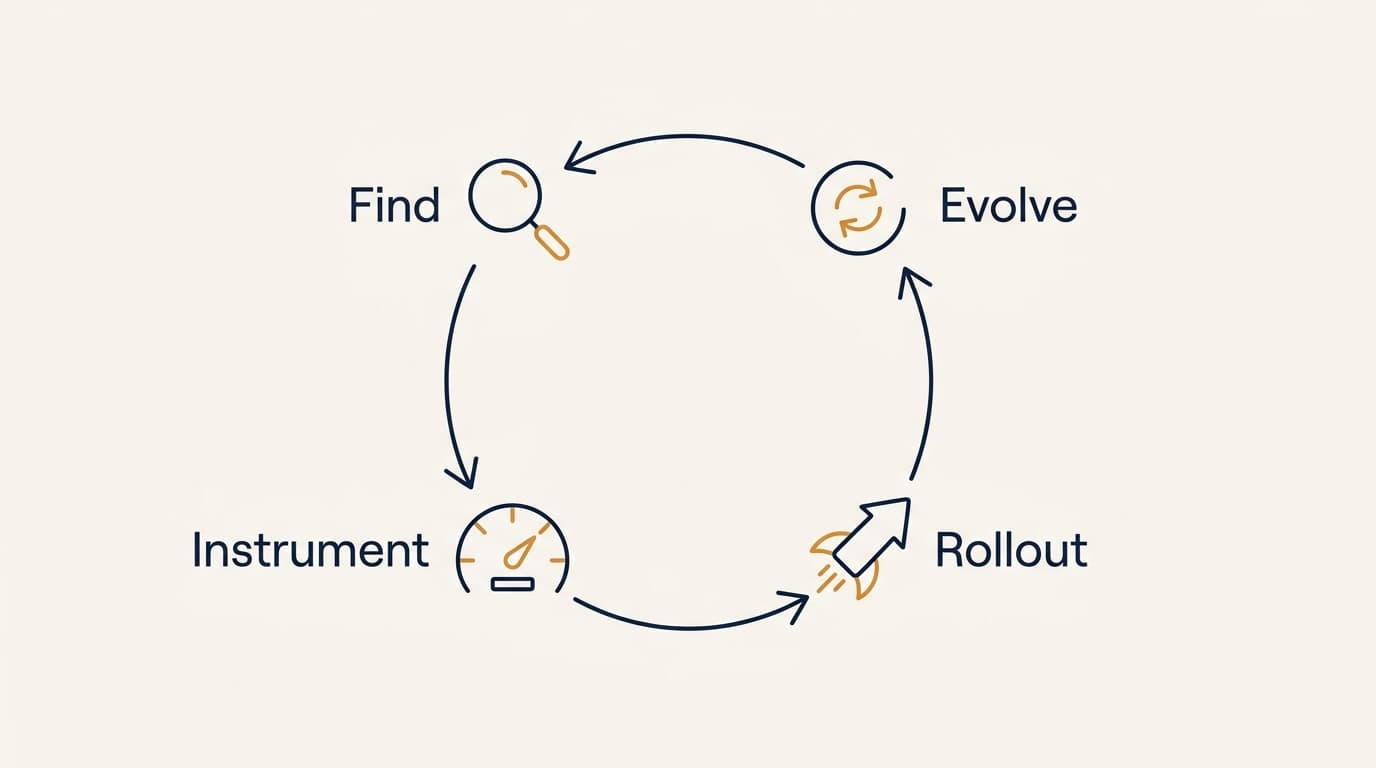
We call this loop FIRE. It is the same operating framework behind every forward deployed engineering engagement we run: an engineer embedded with your team, not a slide deck handed off at the end of a workshop. Four phases, and the fourth feeds back into the first.
| Phase | What happens | Typical duration | Who owns it |
|---|---|---|---|
| Find | Map the real workflow, not the documented one | 3 to 5 days | The people doing the work today |
| Instrument | Build the agent, the eval set, the audit trail | 1 to 2 weeks | Engineering, with a domain expert paired in |
| Rollout | Sandbox, then production, autonomy raised gradually | 1 to 2 weeks | Engineering plus the process owner |
| Evolve | Pull overrides and failures, feed the next cycle | Ongoing, reviewed weekly | Whoever owns the metric the system moves |
Phase 1: Find the real work
Start by sitting with the people who do the job, not the process document that describes it. Watch a top performer handle a hard case live. Documented processes describe the average day; they almost never capture the judgment calls that separate a good outcome from a bad one, and those judgment calls are exactly what the agent needs to learn.
What this phase produces: a map of the workflow as it is actually run today, including every exception and handoff, with the decision points called out explicitly. If you cannot answer "what does a good decision look like here and why" in plain language, you are not ready to move to Phase 2. Skipping this step is the single most common reason pilots stall before they ever reach production; the team built an agent for a workflow that does not match how the work actually happens.
Checkpoint before moving on: an operating map that a domain expert has read and confirmed is accurate, not one that engineering assumed was accurate.
Phase 2: Instrument with evidence, not vibes
This is where most roadmaps skip straight to "build the agent" and lose the thread. Before writing a line of production code, build a golden dataset of 20 or more real cases pulled from Phase 1, including the hard ones. Then build evals that measure pass rate, failure modes, and where the system should escalate to a human instead of guessing.
An agent without an eval set is a demo, not a system. You cannot know if a change made it better or worse without a way to measure "better." This phase also builds the audit trail: every input, every tool call, every output logged, so that when something goes wrong in production you can trace exactly why, instead of guessing.
Checkpoint: a measured agent with a known pass rate, known failure modes, and a full audit trail, tested against the golden set before it ever touches a live case.
Phase 3: Roll out inside the business you already have
Never force a migration to make the AI project easier. Build on top of the systems your team already uses. Start in a sandbox against real but low-stakes cases, and raise autonomy gradually as the eval numbers hold up, not on a fixed calendar date.
This is the phase where governance actually matters, and where most teams under-invest. Gartner's December 2025 CxO survey found that only 21% of organizations currently have a mature governance model for AI agents, even though 74% plan to adopt agentic AI within two years. Monitoring in production is not optional instrumentation you add later; it is the thing that lets you raise autonomy with evidence instead of hope.
Checkpoint: live in production, recoverable if something breaks, monitored continuously, and owned by a named person, not "the AI team" in the abstract.
Phase 4: Evolve, and let it feed Phase 1 again
Pull every case where a person overrode the agent or rejected its output, and collect the reason in their own words, not a category code. That reason is the gap between what you predicted the workflow needed and what the field actually pushed back on. Feed it into the next cycle.
This is the phase that turns a one-off automation into a system that compounds. A workflow shipped once goes stale the moment the underlying work shifts, because nothing about it changes on its own. A system with an Evolve step gets sharper every cycle because the loop keeps closing: Evolve surfaces the next bottleneck, and Find picks it up.
Checkpoint: a documented change from this cycle's feedback, applied and re-measured against the golden set, before the next Find phase starts.
Free weekly brief
Steal our production automations
The exact n8n flows, Claude Code setups, and prompts we ship for clients, broken down step by step. No spam, unsubscribe anytime.
The AI adoption roadmap template
If you want the one-page version to bring into a planning meeting, here is the structure stripped down to what belongs on it. Fill in your own numbers; do not copy timelines from a case study that was not your team.
- Workflow name and owner: the specific process, and the person accountable for the outcome, not a department.
- Find: dates for shadowing sessions, the map deliverable, and who signed off on it.
- Instrument: golden dataset size, the metrics the eval measures, target pass rate before launch.
- Rollout: sandbox start date, production go-live criteria (tied to the eval numbers, not a calendar date), autonomy level at launch.
- Evolve: cadence for reviewing overrides (weekly, at minimum), who owns turning feedback into the next build.
- Escalation path: what happens when the agent is uncertain, in writing, before launch, not improvised after the first bad outcome.
A roadmap without an owner's name next to each row is a wish list. Put a name on every line before the first Find session starts.
How long the full loop takes
For a single, well-scoped workflow, expect 4 to 6 weeks from the first shadowing session to a monitored production rollout: roughly 3 to 5 days for Find, 1 to 2 weeks for Instrument, 1 to 2 weeks for Rollout. Evolve does not end; it is the ongoing weekly review that arms the next cycle. Wider initiatives spanning multiple workflows take longer because Find has to run separately for each one; do not compress that step to hit a portfolio-level deadline.
What this means for you
- Pick one real workflow before you pick a platform. The tool decision comes after Find, not before it.
- Build the eval set before you build the agent. You cannot manage what you have not measured.
- Governance is not a phase-3 afterthought. Decide the escalation path in writing before launch.
- Name an owner for Evolve. A feedback loop with nobody assigned to read it does not close.
- Treat the roadmap as a loop, not a project plan with an end date. The fourth phase feeds the first.
FAQ
What is an AI adoption roadmap? An AI adoption roadmap is a phased plan for moving a business process from manual or unstructured work to an AI-assisted or AI-run process, with defined checkpoints, evals, and an owner at each stage. A usable roadmap ties every phase to a measurable outcome, not just a calendar date.
How is an AI adoption roadmap different from an AI implementation roadmap? In practice the terms are used interchangeably. Some teams use "adoption" for the organizational and change-management side and "implementation" for the technical build; both need the same four checkpoints: a validated workflow map, a measured agent, a monitored rollout, and a feedback loop back to the start.
Why do most generative AI pilots fail to scale? MIT NANDA's 2025 research found that 95% of enterprise generative AI pilots do not deliver a measurable financial return, largely because generic tools do not adapt to a specific workflow and pilots are rarely instrumented with the evals needed to prove or improve results before they get killed.
Do we need a formal AI governance model before we start? You need an escalation path and an audit trail before the first production rollout, not necessarily a company-wide governance framework on day one. Gartner's survey found that only 21% of organizations currently have a mature agent governance model despite most planning to scale agentic AI within two years, so start with the minimum viable governance for the one workflow in front of you and expand from there.
How long does an AI transformation roadmap take for a whole department? A single workflow moves through the full loop in roughly 4 to 6 weeks. A department-wide rollout runs multiple workflows through Find in parallel or in sequence, so the timeline scales with how many distinct workflows you are instrumenting, not with the size of the department itself.
Should we hire in-house or bring in outside help to run this? That depends on whether you already have engineers who can pair with a domain expert through all four phases. Teams without that capacity in-house often bring in an embedded forward deployed engineer to run Instrument and Rollout directly with the team that owns the workflow, rather than handing the project to a separate vendor team that never talks to the people doing the work.
What is a good template to start with? Use the structure in the template section above: workflow owner, Find deliverable and sign-off, Instrument metrics and target pass rate, Rollout go-live criteria tied to eval numbers, and a named owner for the Evolve review cadence. The template only works if every row has a name next to it.
Sources: MIT NANDA, "The GenAI Divide: State of AI in Business 2025" via Fortune, Gartner, "By 2027, 50% of Enterprises Without a People-Centric AI Strategy Will Lose Their Top AI Talent", McKinsey, "The State of AI", Deloitte, "The State of AI in the Enterprise" 2026 press release
Continue Reading
AI Facilities Management Tools: What to Automate, Where Judgment Leads (2026)
What AI facilities management tools automate well, how this differs from property management, and where facilities professional judgment still leads.
AI Vendor Management: What to Automate, Where Judgment Leads (2026)
Where AI genuinely helps in vendor management (contract tracking, risk monitoring, SLA tracking), and where negotiation and relationship judgment still lead.
AI Load Testing Tools: What to Automate, Where Engineering Judgment Leads (2026)
What AI load testing tools do well, how this differs from functional CI/CD testing, and where engineering judgment on results still leads.
Book a Free Strategy Call
Building this in production?
Walid runs a 30-min call to map your AI engineering team. Free, no slides.
Free weekly brief
Steal our production automations
The exact n8n flows, Claude Code setups, and prompts we ship for clients, broken down step by step. No spam, unsubscribe anytime.

Taha builds and ships custom AI agents and workflow automations for AY Automate clients across SaaS, finance, and professional services.