
Book a Free Strategy Call
Skip the read: talk to Walid in 30 min.
Free strategy call. We map your AI engineering team, you keep the notes.
The AI agent distrust tax is the time and money you spend checking and fixing agent work because you don't yet trust it to run alone. G2 named it in its 2026 AI Agents Report, published October 14, 2026: 31% of B2B software buyers say employees spend six or more hours a week supervising agents, and 45% say oversight and corrections eat more than a quarter of the productivity gains they expected.
Two other October studies point the same way. A VentureBeat survey found that 61% of teams with pre-deployment evals still had a customer-facing failure from something that passed those evals. An IBM study of 3,221 European and Middle Eastern executives found that 80% had an AI incident reach the board or C-suite in the past year.
So the question buyers ask has changed. It used to be "will our agent pilot ever ship?" Now it is "the agent is live, so why are we still paying people to watch it?" This article puts the three studies side by side, says who each one surveyed, and shows what cuts the oversight bill without taking the human out of the decisions that need one.
Quick answer: The AI agent distrust tax is G2's term for "the ongoing cost of running agents you don't fully trust." In G2's survey of more than 1,000 B2B software buyers, 66% have agents in limited or scaled production, 31% say staff spend 6+ hours a week overseeing them, 45% say oversight eats more than a quarter of expected gains, and 46% report higher-than-expected operating costs. You cut it by tying evals to real outcomes, checking live output automatically, and writing down which actions need a human, so reviewers only see the cases that matter.
TL;DR
- Agents are in production now. 66% of organizations in G2's survey have agents in limited or scaled production; IBM, asking a different question of larger EMEA companies, found 35% running agentic AI in production.
- Supervision is the new cost. 31% say employees spend 6+ hours a week overseeing agents, and 46% say operating costs came in higher than expected (G2).
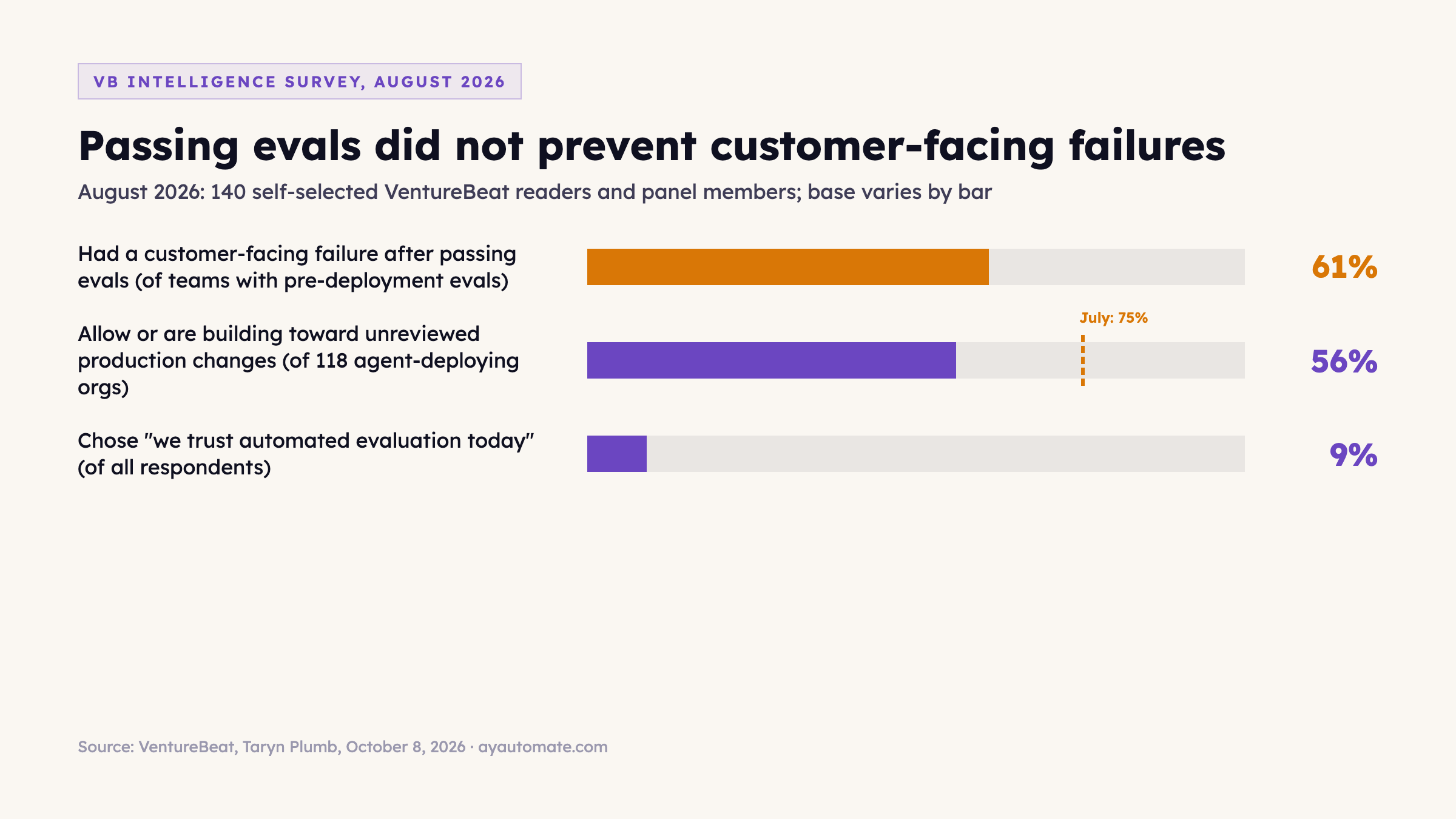
- Passing evals is not enough. 61% of VentureBeat's respondents with pre-deployment evals had a customer-facing failure that slipped past them in the last 12 months.
- Fewer agent-deploying teams allow, or plan to allow, unreviewed production changes: 75% in July, 56% in August (VentureBeat, small self-selected sample).
- Incidents reach the top. 80% of IBM's executives had an AI incident escalate to the board or C-suite in the past year, and only 37% say their governance is built to scale with agents.
- The fix is targeted review. Outcome-based evals, inline checks on live traffic and written escalation thresholds move human time away from every output and onto the risky ones.
What is the AI agent distrust tax?
G2 coined the term in its 2026 AI Agents Report, "Crossing the Agentic Chasm." In the announcement post, Chief Innovation Officer Tim Sanders describes a trust gap that "didn't disappear in production, but moved inside the workflow and became the Distrust Tax: the ongoing cost of running agents you don't fully trust."
In practice the tax shows up in three places. The first is review time: people read agent output before it goes anywhere, fix mistakes and approve actions, which G2 calls "bot-sitting." The second is rework, because an error that gets past review costs more once a customer has seen it. The third is the monitoring, eval platforms, governance committees and approval queues that weren't in the original business case.
None of this is waste in itself. Some review is the right call for high-risk actions. The tax becomes a problem when teams review everything at the same depth because nothing tells them which outputs are safe, so the oversight bill grows with every agent they add.
Free weekly brief
Steal our production automations
The exact n8n flows, Claude Code setups, and prompts we ship for clients, broken down step by step. No spam, unsubscribe anytime.
Who ran the three October 2026 studies, and how much weight can they carry?
All three are surveys, and two were run or commissioned by companies that sell into this market. Read them as signals that agree with each other, not as census data.
| Study | Published | Who answered | Sample | What to keep in mind |
|---|---|---|---|---|
| G2, 2026 AI Agents Report | October 14, 2026 | B2B software buyers, plus G2 review data | More than 1,000 | G2 sells software reviews and buyer intent data; the press page doesn't give fieldwork dates or countries |
| VB Intelligence (VentureBeat), "Agentic Reliability and Evaluations" survey | October 8, 2026 | VentureBeat readers and panel members | 140 in August, 108 in July | Self-selected, small, and July and August are different groups; VentureBeat flags which changes are statistically significant |
| IBM study run by Censuswide | October 14, 2026 (London dateline October 15) | Executives, including C-level, at companies with 1,000+ employees | 3,221 across the UK, France, Germany, Italy, Spain, the Netherlands, Saudi Arabia and the UAE | Fieldwork September 14 to 24, 2026; commissioned by IBM, which sells AI governance products |
The G2 sample is the broadest view of buyers. The VentureBeat sample is the smallest, but it is the only one that asks about evals in detail. The IBM sample is the largest and the most senior, but it covers EMEA only.
How much time do teams spend supervising AI agents?
According to G2, 31% of B2B buyers say employees spend six or more hours each week overseeing agent work.
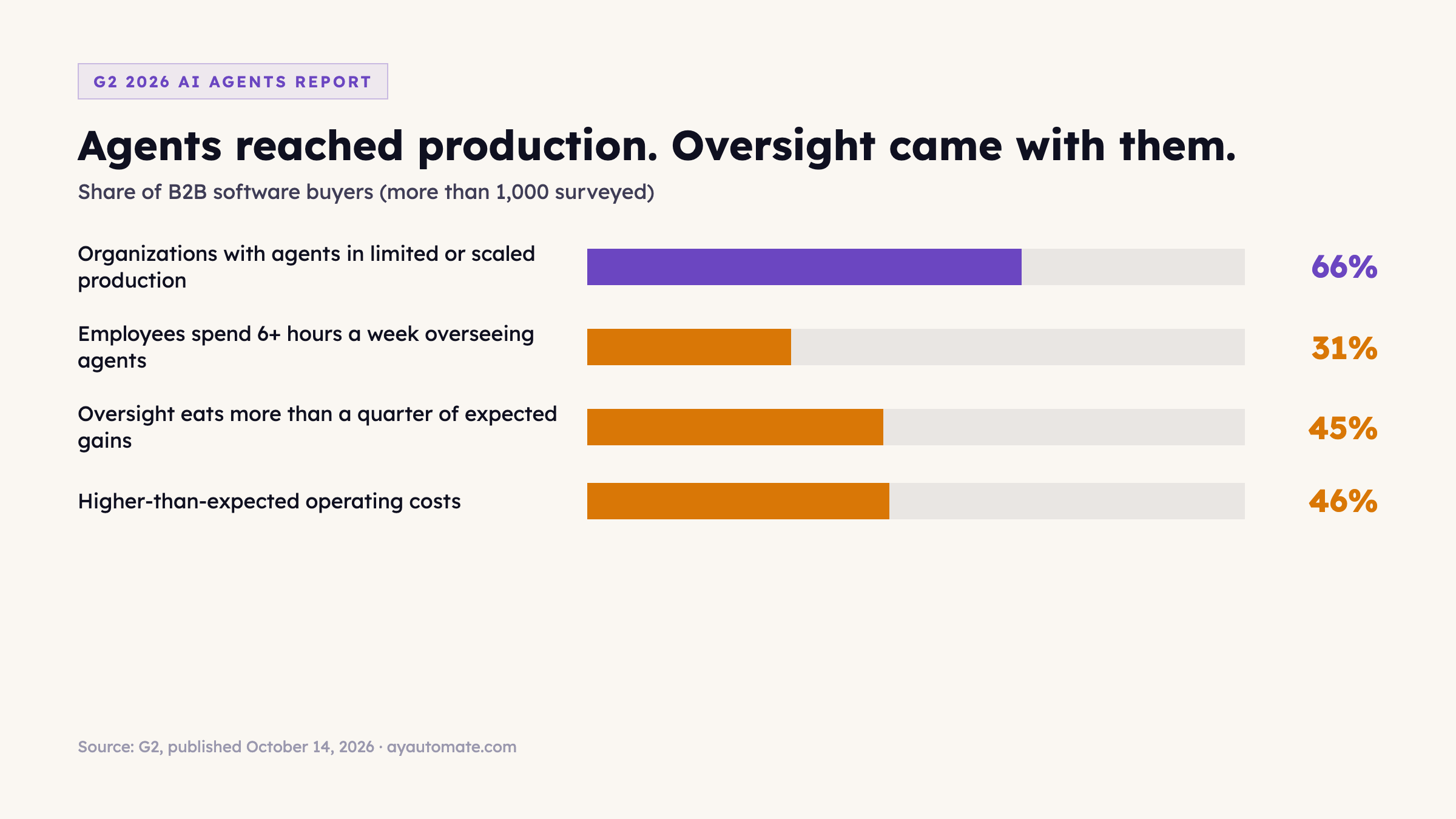
The rest of the G2 numbers explain where that time goes and why it matters:
- 45% say time spent overseeing and correcting agent mistakes consumes more than a quarter of the productivity gains they expected.
- 46% report higher-than-expected operating costs.
- 52% require human quality review before an agent goes to production, and 77% re-evaluate agent performance at least monthly.
- 38% of organizations with agents in production run more than 100 agents, and almost half (47%) still use informal or decentralized management models.
That last pair is where the tax can compound. G2 doesn't say how much the two groups overlap, but the logic is simple: a team with five agents can review everything by hand, and a team with 100 agents and no clear owner can't. Either review becomes a bottleneck or it quietly stops happening.
G2 also reports the upside: among teams running agents in mature workflows, four in five see cycle-time gains of at least 11%. Where workflows are mature, the gains are measurable. The distrust tax decides how much of the payoff you keep.
What does six hours a week cost?
G2 doesn't put a dollar figure on it, and it doesn't say whether those six hours are per person or per team. So here is a scenario to run with your own numbers. If one person spends six hours a week on oversight, that's 276 hours a year across 46 working weeks. At a fully loaded cost of $75 an hour, that's about $20,700 a year. If every member of a 10-person team did the same, it would be roughly $207,000.
Those inputs are an example, not a finding. Swap in your team size, hours and rate. The point is that the oversight line belongs in the business case next to licence and build costs, and it's easy to leave out.
Why do AI agents fail in production after passing evals?
VentureBeat's August survey asked teams with pre-deployment evals whether something that passed internal testing later failed in front of a customer. 61% said yes, at least once in the past 12 months, and 22% said it happened more than once. (The July figure was 53%. VentureBeat notes that change was not statistically significant.)
When asked what most reduces their trust in automated evaluation, respondents named:
| Reason | Share (August) |
|---|---|
| Misalignment with real-world outcomes | 27% |
| Lack of explainability | 24% |
| Evaluation bias or inconsistency | 16% |
| Data leakage or privacy concerns | 13% |
| Tooling immaturity | 12% |
| "We trust automated evaluation today" | 9% |
The top answer is the useful one. Many eval suites check whether an output looks right rather than whether it produced the right result for the customer. An agent can pass a rubric for tone and format and still refund the wrong order. Our guide to AI agent evals covers how to build test sets from real cases instead of synthetic ones.
Are teams handing agents more autonomy or less?
Less, at least in this sample. Among organizations that deploy agents, the share that allow some production changes based on automated evaluations alone, or are engineering to allow it within a year, fell from 75% in July to 56% in August. Excluding non-deployers, the share expecting to keep human review "for the foreseeable future" went from 20% to 42%, a change VentureBeat reports as statistically significant.
VentureBeat is careful to say the data doesn't show why caution rose. It also points out that both months are separate, self-selected groups of its readers. Treat the direction as a signal, not the exact size.
What happens when an AI incident reaches the board?
IBM's study adds the governance view. 80% of executives say an AI-related incident reached their board or C-suite in the past year, and 40% of those organizations changed their AI governance policy or framework in response.
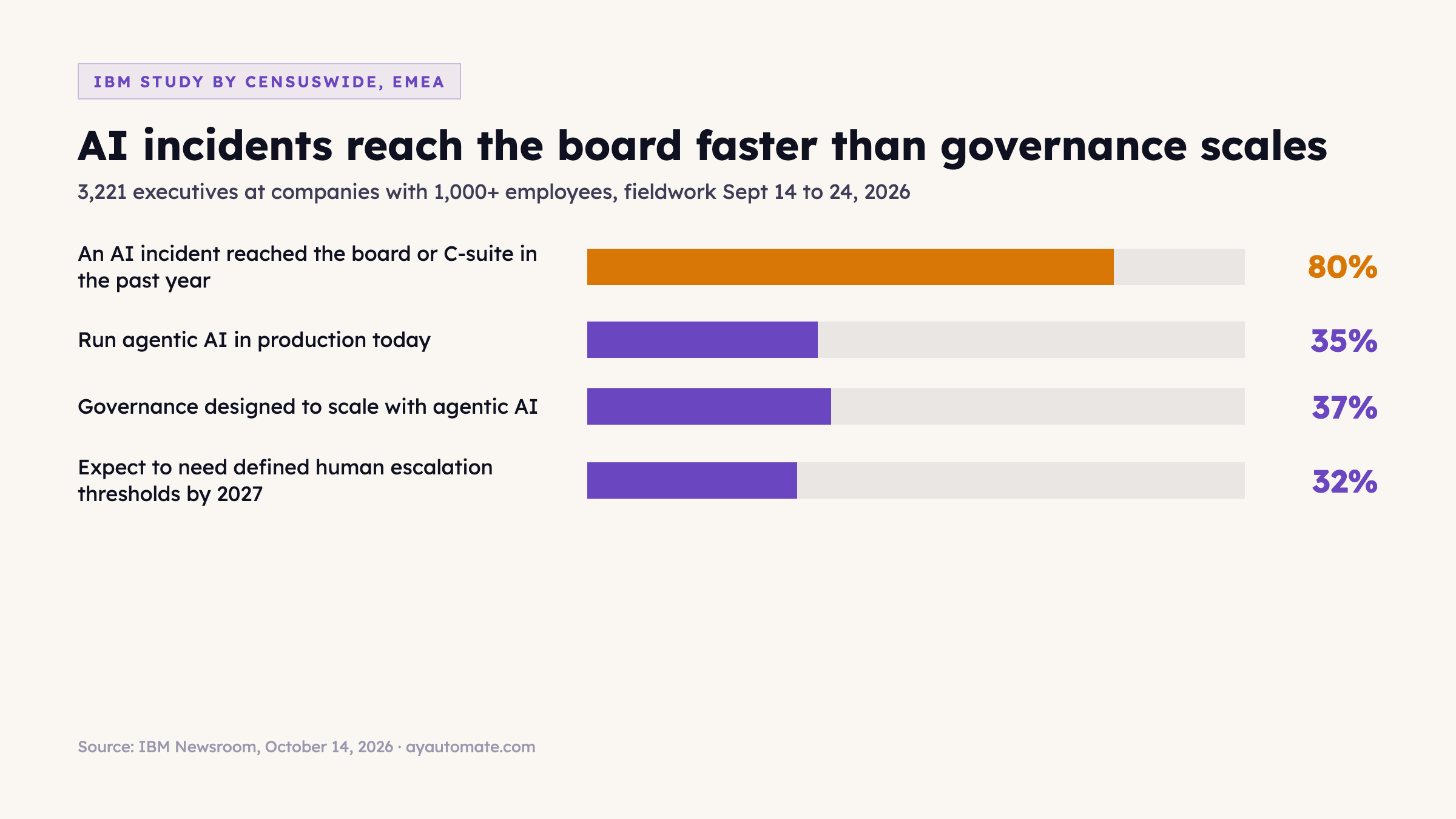
Only 35% run agentic AI in production today, yet 75% expect agents to have some autonomy over decisions by 2027, and only 37% say their governance is designed to scale with agentic AI. When deployment moves faster than governance, 56% keep deploying within agreed risk limits and 33% wait.
The most telling part of the IBM data is what executives say they will need to manage autonomous agents by 2027:
| Capability | Share who expect to need it |
|---|---|
| Vendor liability frameworks for agent failures | 33% |
| Defined human escalation thresholds | 32% |
| Real-time monitoring and audit trails | 30% |
| Ability to halt agent activity enterprise-wide immediately | 29% |
Three of those four are things an engineering team can build now. Liability is a contract question. Escalation rules, monitoring and a kill switch are design decisions. If you've read our breakdown of 2026 AI agent incidents in production, the same lesson shows up there: approvals and the off switch have to live in systems the agent can't reach or rewrite.
How do the three studies fit together?
Read together, they tell one story with three angles:
| Question | G2 | VentureBeat | IBM |
|---|---|---|---|
| Are agents in production? | 66% limited or scaled | 118 of 140 deploy autonomous agents | 35% run agentic AI in production |
| What does it cost? | 31% spend 6+ hrs/week on oversight; 46% higher operating costs | 30% expect human review workflows to get the most reliability-investment growth next year | 80% had an incident reach the board |
| Why the caution? | 52% require human review before production | 61% had a failure that passed evals | 37% have governance built to scale with agents |
| What do they want? | Better management of large agent fleets | Evals that match real outcomes | Escalation thresholds, monitoring, a kill switch |
For buyers who already have agents live, the problem has shifted from getting to production to the cost of running agents safely. That cost lands on whoever reviews the output, and it grows with every agent you add.
How do you reduce the AI agent oversight cost?
You don't fix the distrust tax by removing humans. You fix it by sending human attention only where it changes the outcome. These six steps follow directly from what the studies found.
1. Measure oversight as a cost line
Track hours spent reviewing, correcting and approving agent work per agent, per week. If you don't measure it, it won't show up in the ROI review, and G2's 45% figure suggests it is often big enough to change the answer.
2. Build evals from real outcomes
VentureBeat's top trust problem is evals that don't match real-world outcomes. Pull test cases from production logs and customer tickets, and score whether the agent got the business result right (the correct refund, the right record updated), not only whether the text reads well.
3. Check live output automatically
Only 29% of VentureBeat's agent-deploying respondents use inline quality assertions on live traffic as their primary monitoring method; 36% rely on trace logging and 8% on ad-hoc review. Logs tell you what happened after the fact. Inline checks (schema validation, policy rules, a second model scoring risky outputs) stop a bad action before it lands.
4. Write down your escalation thresholds
32% of IBM's executives expect to need defined human escalation thresholds by 2027. Put it in writing now: which actions an agent can take alone, which need approval, and what confidence or dollar level triggers a handoff. Our guide to human-in-the-loop AI automation shows how to set approval points without turning every output into a ticket.
5. Tier your agents by risk
Review depth should match blast radius. A draft email reply and a production database change shouldn't get the same review. At 100+ agents (38% of G2's respondents with agents in production run that many), reading every output by hand stops being realistic. Sample the low-risk work and gate the high-risk work.
6. Build the off switch first
29% of IBM's executives want the ability to halt agent activity enterprise-wide. That's cheaper to build before launch than after an incident. Stopping an agent should mean revoking its credentials and network access, not asking it to stop. Scoped credentials, a switch per agent that pulls them, and a tested rollback path cover most teams.
Want a second pair of eyes on an agent that's already live? Our AI agent development engagements start with a free architecture audit. For agents already in production, it looks at the same things this article covers: whether your evals reflect real outcomes, what checks run on live traffic, where humans approve actions, and how you'd stop the agent if something goes wrong.
Is it still worth deploying AI agents?
For teams with mature agent workflows, the evidence says yes. G2's data shows real gains (four in five mature-workflow teams see cycle-time improvements of at least 11%), and nearly half of organizations with completed pilots say most pilots reached full production. The distrust tax doesn't mean agents don't pay. It means the payoff shrinks when supervision stays manual and unmeasured.
The teams that keep the gains will treat trust as something they build with evidence: evals that match outcomes, monitoring that catches problems in real time, and written rules for when a human steps in. If you'd rather have that work done inside your team, a forward deployed engineer can build it next to the people who run the agents. If the agents already exist and you need them watched and fixed as your systems change, that's what automation maintenance and support covers.
FAQ
What is the AI agent distrust tax?
The AI agent distrust tax is the ongoing cost of running AI agents you don't fully trust, mostly the people who review and correct their work. G2 coined the term in its 2026 AI Agents Report (October 14, 2026), where 31% of B2B buyers said staff spend six or more hours a week overseeing agents.
How much time do teams spend supervising AI agents?
In G2's survey of more than 1,000 B2B software buyers, 31% said employees spend six or more hours a week overseeing agent work, and 45% said oversight and corrections consume more than a quarter of expected productivity gains. If one person spends six hours a week on it, that's about 276 hours a year over 46 working weeks.
Why do AI agents fail in production when they passed testing?
Mostly because the tests don't reflect real outcomes. In VentureBeat's August 2026 survey, 61% of teams with pre-deployment evals had at least one customer-facing failure from something that passed them, and the most cited reason for distrusting automated evaluation was misalignment with real-world outcomes (27%).
What is human in the loop for AI agents?
Human in the loop means a person reviews or approves certain agent actions before they take effect. It works best when it's targeted: low-risk actions run on their own, and high-risk ones (payments, customer-facing messages, production changes) stop for approval.
How do you reduce the cost of AI agent oversight?
Reduce it by reviewing only what needs a human. Build evals from real production cases, add automated checks on live output, write down escalation thresholds, tier agents by risk, and track oversight hours as a cost. IBM's 2026 EMEA study found 32% of executives expect to need defined human escalation thresholds by 2027.
Are companies trusting AI agents more or less in 2026?
Less, for unreviewed changes. VentureBeat found the share of agent-deploying teams that allow or are building toward production changes without human review fell from 75% in July to 56% in August 2026. The sample is small and self-selected, so treat it as a direction rather than a precise market figure.
What is the ROI of AI agents in 2026?
It depends on how much of the gain oversight eats. G2 reports that four in five teams with mature agent workflows see cycle-time gains of at least 11%, but 46% report higher-than-expected operating costs. Count review hours, incident costs and tooling alongside build and licence costs when you calculate ROI. If you want help scoping that, our AI agent development team starts with a free architecture audit.
Sources: G2, "New G2 Research: AI Agents Have Moved From Pilot to Production. Now Comes the Distrust Tax" (October 14, 2026), VentureBeat / VB Intelligence, Taryn Plumb, "The share of enterprises trusting AI agents to make production changes on their own has fallen from 75% to 56%" (October 8, 2026), IBM Newsroom, "IBM Study: Eight in Ten EMEA Enterprises Escalate AI Incidents to Board or C-Suite as AI Agents Test Governance" (October 14, 2026)
Book a Free Strategy Call
Building this in production?
Walid runs a 30-min call to map your AI engineering team. Free, no slides.
Free weekly brief
Steal our production automations
The exact n8n flows, Claude Code setups, and prompts we ship for clients, broken down step by step. No spam, unsubscribe anytime.

Robel engineers production-grade automation pipelines at AY Automate, focused on integrations, reliability, and the systems that keep client workflows running.