Book a Free Strategy Call
Skip the read: talk to Walid in 30 min.
Free strategy call. We map your AI engineering team, you keep the notes.
AI agent governance becomes necessary when an agent can call tools, change records, send messages or make decisions without someone approving every step. The practical answer is to define its authority, restrict its access, record its actions and assign an owner before it reaches production. AI agent governance is the set of policies, technical controls and oversight processes used to manage what an AI agent may do and how its actions are reviewed.
This guide compares four kinds of options rather than ranking named products. No set of at least three named options could be assessed consistently from public information, so declaring a winner would imply evidence that is not available. For most B2B, SaaS and ecommerce teams, the starting point is a governance framework paired with controls in the systems the agent can access.
The short answer
Start with the agent's authority and risk, not a software category. A framework defines the rules, native controls enforce boundaries inside an existing environment, a governance platform gives teams shared oversight, and a custom control layer handles requirements that cross tools or business processes.
- Governance framework, best for setting policy: Define ownership, allowed actions, approval points, evidence and incident handling before buying another system.
- Native ecosystem controls, best for teams concentrated in one environment: Use the identity, access and security controls available around the systems where agents run.
- AI agent governance platform, best for oversight across many agents: Look for a shared inventory, policy management, monitoring and review process.
- Custom governance layer, best for unusual workflows: Add application checks, approval gates and logs around agents that cross several business systems.
| Option type | What it does | Best for | Pricing basis |
|---|---|---|---|
| Governance framework | Defines authority, ownership, controls, reviews and incident processes | Teams establishing a common policy | Not published |
| Native ecosystem controls | Applies identity, access and security controls within an existing environment | Teams whose agents and data sit mainly in one ecosystem | Not published |
| AI agent governance platform | Centralizes oversight across agents, policies and operating teams | Organizations managing many agents or environments | Not published |
| Custom governance layer | Adds workflow specific permissions, approvals, validation and action records | Agents that cross tools or carry out company specific processes | Project scope or internal engineering cost |
How we ranked these
We did not rank vendors because there are not enough confirmed, comparable product entries to support a fair list. Instead, we ordered the option types by the sequence most teams should assess them: policy first, existing controls second, shared platform needs third and custom engineering when standard controls do not fit.
The assessment criteria are practical. They cover authority, identity, access, action records, approvals, monitoring, incident response, lifecycle ownership and fit with your current systems. These areas let you compare very different approaches without treating a policy document and a technical platform as equivalent products.
Use these questions as your evaluation rule:
- Can you identify every agent, its owner and its business purpose?
- Can you restrict which tools, records and actions each agent may access?
- Can you require human approval for selected actions?
- Can you reconstruct what the agent did after an error or incident?
- Can you pause or remove an agent without disrupting unrelated workflows?
- Can the control follow the agent across development, testing and production?
- Can business, security and compliance owners review the same evidence?
- Does the approach fit the systems where actions actually happen?
This guide does not rank options by market share, customer count, analyst position or claimed return on investment. It also does not assume that the option with the longest feature list is the right one. A smaller set of enforced controls can be more useful than a broad policy that nobody can test.
AY Automate is the publisher of this guide and provides custom agent and automation engineering. We have not placed our service first or presented it as a ranked product.
Free weekly brief
Steal our production automations
The exact n8n flows, Claude Code setups, and prompts we ship for clients, broken down step by step. No spam, unsubscribe anytime.
What should you look for in AI agent governance?
A useful governance approach connects written rules to controls that can stop, permit or record an action. Look for clear ownership, identity and access boundaries, approval conditions, action evidence, ongoing review and a defined response when an agent behaves outside its intended scope.
Named ownership and purpose
Every deployed agent should have a business purpose and an accountable owner. The owner decides whether the agent is still needed, whether its permissions remain suitable and who responds when its behavior changes. Avoid ownership labels such as "the AI team" when no named role has authority to pause the system.
Record the agent's inputs, available tools, expected outputs and affected systems. This inventory does not need to begin as a large platform. A controlled register can work while the number of agents remains manageable, provided someone keeps it current.
Authority and access boundaries
An agent should receive only the permissions needed for its assigned work. Separate reading information from changing it, and separate reversible actions from actions that create financial, legal or customer consequences. The ability to draft a refund response is different from the ability to issue the refund.
Check whether permissions belong to the agent itself or are borrowed from a user account. Shared credentials make ownership and investigation harder. Also check what happens when the agent delegates work, calls an external tool or sends data to another system.
Approval based on consequence
Human approval is most useful when it is tied to a specific condition. You might require review before an agent sends an external message, changes a sensitive record or acts above an internal threshold. Requiring approval for every step can remove much of the value of an agent, while approving nothing can grant more authority than the process can tolerate.
Define what the reviewer sees. A useful approval request includes the proposed action, relevant context and the systems that will change. The reviewer also needs a clear way to reject or modify the action.
Action records and evidence
Logs should help you reconstruct a business action, not merely confirm that a model produced a response. Capture the agent identity, time, relevant input, tool called, permission used, result and approval where applicable. Apply your own retention and access rules to that evidence.
Test the record with a realistic question: if an agent changed a customer account incorrectly, could you determine how the change occurred and which control allowed it? If the answer depends on several disconnected logs, decide who is responsible for joining them during an incident.
Monitoring and incident response
Monitoring should focus on meaningful departures from the agent's intended behavior. Examples include repeated failed actions, unexpected tool use, attempts to access restricted data or an unusual rise in consequential operations. Alerts need an owner and a response path, or they become background noise.
Your response plan should cover pausing the agent, limiting access, preserving evidence, correcting affected records and deciding when the agent may return. Test that path before production. A shutdown control that nobody can locate is not an effective control.
What are the main kinds of AI agent governance options?
The main options are a written governance framework, controls native to your technology environment, a dedicated governance platform and a custom control layer. They can work together. The choice depends on how many agents you operate, where they run and how much authority they receive.
Building an AI Agent Governance Framework: 5 Essential PillarsWatch "Building an AI Agent Governance Framework: 5 Essential Pillars" on YouTube
Governance framework
A governance framework defines the common rules that teams follow. It should describe ownership, risk assessment, access, approvals, testing, monitoring, evidence, incident handling and retirement. It is usually the right first move because software cannot decide your acceptable business risk for you.
Microsoft's Cloud Adoption Framework describes agent governance and security as requiring coordinated decisions across multiple areas of an organization. Palo Alto Networks defines agentic AI governance around the structured management of delegated authority in systems that can carry out actions for an organization.
Best for:
- Teams that do not yet have one policy for agent ownership and authority
- Organizations that need several departments to make consistent decisions
Strengths:
- Creates one decision model for different agent technologies
- Clarifies ownership before implementation
- Can map existing security and risk processes to agent activity
Limits:
- A document cannot enforce permissions by itself
- Broad principles can leave delivery teams unsure what to implement
- It requires maintenance as agents and workflows change
Who should skip it: Nobody operating agents with access to business systems should skip policy entirely. A small team can keep the framework short and focused on the actions its agents can take.
The video below shows IBM Technology's approach to building an AI agent governance framework around five pillars.
Native ecosystem controls
Native controls use the identity, permission, security and monitoring features around the environment where an agent operates. This approach can reduce the number of new systems your team must administer. It works best when agent identities, data and target applications remain inside a well defined environment.
Microsoft publishes guidance for governing and securing AI agents across an organization in its Cloud Adoption Framework. Microsoft also publishes an open source Agent Governance Toolkit for runtime security. Evaluate any ecosystem approach against your actual architecture rather than assuming that one vendor boundary contains every agent action.
Best for:
- Teams already concentrated in one cloud or business application environment
- Agents whose tools and data stay inside that environment
Strengths:
- Builds on identity and access systems your team may already operate
- Keeps policy enforcement close to the applications and data
- Can reduce duplicate administration
Limits:
- Coverage may weaken when an agent crosses into another ecosystem
- Native logs may describe technical events without enough business context
- Features and terms can differ between services
Who should skip it: Teams with agents spread across unrelated environments should not rely on one ecosystem's controls as their entire governance model.
AI agent governance platform
A dedicated AI agent governance platform aims to provide shared oversight across agents, teams and technical environments. The useful test is whether it can connect an agent inventory to enforceable policies, evidence and operational response. A dashboard alone does not control an agent's authority.
Ask how the platform discovers agents, identifies owners and connects to the tools agents call. Then test whether it records consequential actions in a form that security, compliance and business teams can review. Pricing, supported integrations and exact platform capabilities need to be checked directly with each vendor before selection.
Best for:
- Organizations managing agents across several teams or environments
- Teams that need a common review and reporting process
Strengths:
- Can give owners one place to review inventory and policy status
- May reduce manual evidence collection across separate systems
- Can support a shared operating process across departments
Limits:
- Connector coverage may not match every internal system
- Central visibility does not guarantee enforcement at the point of action
- A platform adds another system that needs access controls and ownership
Who should skip it: A team with few agents and a simple environment may not need a separate platform yet. Start with an inventory, clear policy and controls in the systems already in use.
Custom governance layer
A custom governance layer places checks around the agent's actual workflow. It can validate inputs, restrict tool calls, request approval, record actions and stop execution when a policy condition is not met. This is useful when an agent crosses applications or applies company specific business logic that standard controls do not express.
AY Automate builds and maintains AI automations, workflows and agents using clients' existing business tools, with production testing on real data. Our AI automation agency work can include workflow audits, API integration and ongoing maintenance, while AI agent development focuses on agents that carry out multi step work.
Best for:
- Workflows with company specific permissions and approval conditions
- Agents that act across several applications or APIs
Strengths:
- Places controls close to the business action
- Can express rules that a general platform does not support
- Can connect governance evidence to the surrounding workflow
Limits:
- Requires engineering, testing and maintenance
- Poorly designed custom controls can create their own security gaps
- It should not replace organization wide policy and ownership
Who should skip it: Teams whose needs are fully met by existing access, approval and logging controls should avoid unnecessary custom software. Teams still exploring agent use cases can first compare no code AI agent builders, but should check how each option handles permissions and action records.
How should you choose an AI agent governance approach?
Choose according to the authority you delegate, the systems an agent can affect and the evidence your organization needs. Begin with a framework, reuse native controls where they cover the workflow, add a platform when shared oversight becomes difficult and build custom controls only where a real gap remains.
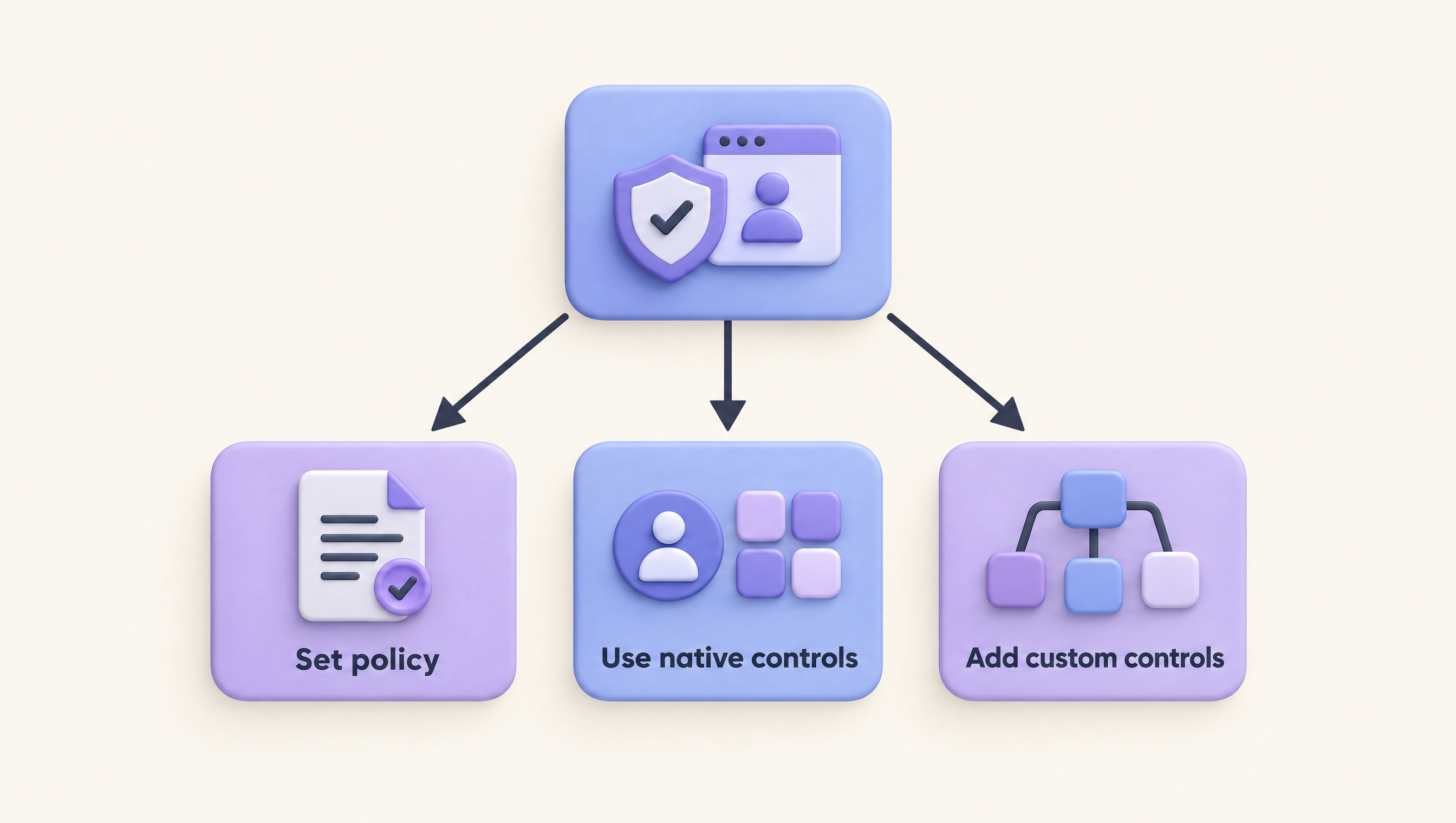
Choose a governance framework when ownership is unclear
Start with the framework if teams cannot answer who owns each agent, which actions require approval or who can stop it. Keep the first version operational. Name roles, define authority levels and specify the evidence required before production.
Do not wait for a large policy project. Apply the framework to one real agent and follow an action from request through execution and review. That exercise exposes vague rules faster than debating labels in isolation.
Choose native controls when agents stay in one environment
Use native controls when identity, data, agent runtime and target systems sit mainly within one managed environment. Confirm coverage at the action level. An environment may authenticate the agent while leaving an external API call outside its main policy boundary.
Review the exit points. These include web access, external tools, delegated agents and user supplied credentials. If important actions leave the environment, pair native controls with another layer rather than treating the ecosystem boundary as complete.
Choose a governance platform when oversight is fragmented
Consider a platform when separate teams maintain different inventories, evidence cannot be compared and reviewers lack one view of agent status. Run a proof of fit with your real environments. Test discovery, policy enforcement, action evidence, alert ownership and agent removal.
Do not select based only on a feature checklist. Ask the vendor to demonstrate how its controls respond to a prohibited action and what evidence remains afterward. Record any systems or agent types it cannot cover.
Choose custom controls when the workflow carries the risk
Use custom controls when policy depends on transaction context, customer state, application specific permissions or a sequence of actions across tools. Define the rule outside the agent's prompt where possible. A prompt can guide behavior, but a separate control can block an action.
If you need help mapping permissions and approval points into a working process, our embedded engineering model places an engineer within your team to learn the workflow and build against the existing stack. You can also review categories of AI agent builders before deciding where governance checks should sit.
Before committing, run one scenario in which the agent acts correctly and another in which it attempts a prohibited action. Your chosen approach should make the correct action possible, stop or escalate the prohibited one and leave enough evidence for review.
FAQ
What is agent governance in AI?
Agent governance in AI is the set of policies, technical controls and oversight processes that manage an agent's authority and actions. It covers who owns the agent, which systems it may access, what it may do, when approval is required and how its activity is recorded and reviewed.
What are the six pillars of AI governance?
There is no universal set of six pillars that applies to every AI governance program. For an actionable AI agent governance framework, assess ownership, authority and access, testing, monitoring and evidence, human oversight, and incident response. Your organization can group these controls differently as long as responsibilities and enforcement remain clear.
Is ChatGPT an agent or LLM?
ChatGPT is a conversational application built around language models, while an agent is a system that can pursue a task and take actions through tools or connected systems. A ChatGPT based setup may operate as part of an agent when it is given tools, instructions, state and permission to act. The governance requirement depends on what the complete system can do, not only on the model name.
What should an AI agent governance framework include?
An AI agent governance framework should include an agent inventory, named ownership, permitted purposes, access boundaries, approval rules, testing, monitoring, action records, incident response and retirement. It should also state who may grant new permissions and how changes move into production.
What do AI agent governance tools do?
AI agent governance tools help teams inventory agents, apply or track policies, monitor activity and retain evidence for review. Some controls may come from identity, cloud or application systems rather than a dedicated product. Check whether a tool can enforce a decision where the agent acts, rather than only reporting activity later.
When do you need an AI agent governance platform?
You may need an AI agent governance platform when agents span several teams or environments and shared oversight has become hard to maintain. Before buying one, test its agent discovery, integration coverage, policy enforcement, evidence quality, alert routing and removal process with your actual systems.
How does Microsoft approach AI agent governance?
Microsoft addresses AI agent governance through organizational guidance and technical tooling. Its Cloud Adoption Framework covers responsible AI policies, agent governance, security and environment preparation, while Microsoft also publishes an open source Agent Governance Toolkit for runtime security. Teams still need to check whether those controls cover actions outside their Microsoft environment.
Where can I find an AI agent governance PDF or field guide?
The Institute for AI Policy and Strategy publishes "AI Agent Governance: A Field Guide" on its website. You can also use the Microsoft Cloud Adoption Framework and the Dataiku governance guide as web based planning references. Check each publication's scope and date before adopting its structure as internal policy.
If your agent crosses tools or needs company specific approval rules, discuss the workflow with AY Automate through our AI automation agency page.
Sources
Sources: Microsoft Cloud Adoption Framework, Microsoft Agent Governance Toolkit, Palo Alto Networks agentic AI governance guide, Dataiku AI agent governance guide, Institute for AI Policy and Strategy field guide, AY Automate.
Last checked: October 27, 2026.
Book a Free Strategy Call
Building this in production?
Walid runs a 30-min call to map your AI engineering team. Free, no slides.
Free weekly brief
Steal our production automations
The exact n8n flows, Claude Code setups, and prompts we ship for clients, broken down step by step. No spam, unsubscribe anytime.

Robel engineers production-grade automation pipelines at AY Automate, focused on integrations, reliability, and the systems that keep client workflows running.