Book a Free Strategy Call
Skip the read: talk to Walid in 30 min.
Free strategy call. We map your AI engineering team, you keep the notes.
AI-powered workflow automation connects your business tools so that rule-based handoffs happen automatically and AI agents handle decision steps that used to require human judgment. The result is faster throughput, fewer manual errors, and staff freed from repetitive task queues.
This is how you build a smarter, more resilient business that operates around the clock.
What Is AI-Powered Workflow Automation?
Imagine your company is a symphony orchestra. Each musician has a specific role, but it's the conductor who weaves their individual parts together to create something incredible. In this analogy, AI-powered workflow automation is your conductor.
This is a fundamental shift from the old way of doing things. We're moving beyond just automating simple, repetitive tasks and into orchestrating entire end-to-end processes with intelligence and adaptability.
This approach hits right at the core challenge for founders and operations leaders: how to scale without breaking the bank. Instead of just hiring more people to handle a growing workload, you can deploy intelligent systems to manage complex operations on their own.
And this isn't some far-off concept; it's happening right now. The global workflow automation market, valued at USD 26.01 billion in 2026, is set to explode to USD 40.77 billion by 2031. That's a 9.41% compound annual growth rate, fueled by a massive global shift away from manual work and toward AI-driven efficiency.
Manual vs. AI-Powered Workflows at a Glance
To really grasp the difference, it helps to see a side-by-side comparison. The table below breaks down the fundamental shift from traditional, human-led processes to the intelligent, automated systems we're talking about.
| Aspect | Manual Workflow | AI-Powered Workflow |
|---|---|---|
| Decision-Making | Relies on human judgment; prone to inconsistency. | Data-driven decisions made by AI agents in real time. |
| Scalability | Limited by headcount; expensive to scale. | Highly scalable; handles massive volume without added staff. |
| Adaptability | Rigid and slow to change. | Learns and adapts to new data and changing conditions. |
| Operating Hours | Limited to the 9-to-5 workday. | Runs 24/7/365 without breaks or fatigue. |
| Error Rate | Prone to human error and oversight. | Near-zero error rate for repetitive tasks. |
| Focus | Task completion. | Process optimization and end-to-end orchestration. |
It's a completely different way of thinking about how work gets done. You're more than plugging leaks; you're building a smarter, self-sufficient ship.
The Strategic Shift from Automation to Orchestration
Let's be clear: traditional automation and AI-powered workflow automation are not the same thing.
Old-school automation is great for isolated, rule-based tasks. Think of a simple script that sends a standardized email whenever a form is filled out. It's useful, but limited. AI-powered workflow automation, on the other hand, connects multiple systems and makes decisions along the way.
It’s the difference between that simple email script and an intelligent system that can:
- Enrich a new lead with data from multiple sources.
- Score their potential based on your ideal customer profile.
- Assign them to the right salesperson in the right territory.
- Schedule a follow-up task in the CRM, all automatically.
This is possible by bringing a few key elements together:
- AI Agents: These are your digital specialists, trained to perform intelligent functions like analyzing customer support tickets or categorizing sales leads.
- Smart Integrations: Think of these as secure data pipelines that let all your essential tools (from your CRM to your accounting software) talk to each other.
- Orchestration Platforms: This is the central hub, like n8n, that directs the flow of data and tasks between your AI agents and all your other apps.
By combining these components, you can create a resilient, efficient operation that doesn't just execute tasks but also learns and adapts over time. This is how you build a foundation for 10x growth without the 10x increase in operational headaches.
Beyond Efficiency: A New Workforce Paradigm
The real magic happens when you see how this technology reshapes your team. It's not about replacing talented people; it’s about augmenting their abilities so they can focus on what they do best.
This is the competitive edge leading companies are chasing. For a deeper dive, our guide on what workflow automation is and how it works is a great place to start.
Here are a few ways this new paradigm takes shape:
- AI Team Augmentation: You can pair your human experts with AI agents that handle the grunt work of data analysis, reporting, and administrative tasks. Your team gets superpowers.
- AI-Adopted Engineer Placements: We can embed specialized engineers who are already fluent in AI tools directly into your team, helping you build and automate faster than you ever thought possible.
- Targeted AI Workshops: We can upskill your existing teams with modern tools like Cursor for AI-assisted coding or advanced prompting techniques for LLMs like Claude, ensuring everyone can contribute to your automated future.
Understanding The Core Components
To really get what makes AI-powered workflow automation tick, you have to look under the hood. This is more than one piece of software; it's a powerful engine built on four key parts that work together. When they're all in sync, you get a smooth, self-managing system that makes your whole operation more efficient.
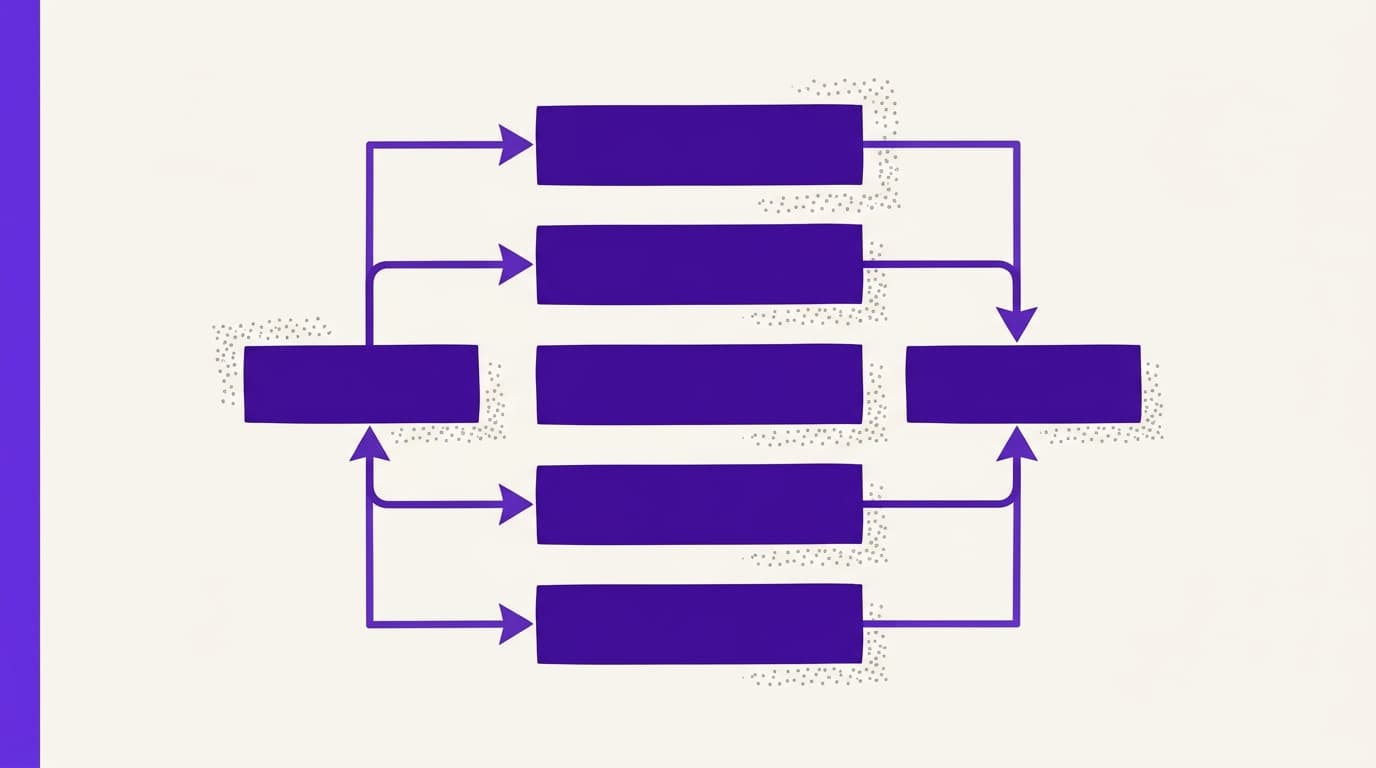
This map shows how AI Agents, Integrations, and Orchestration all fit together, with AI Automation running the show.
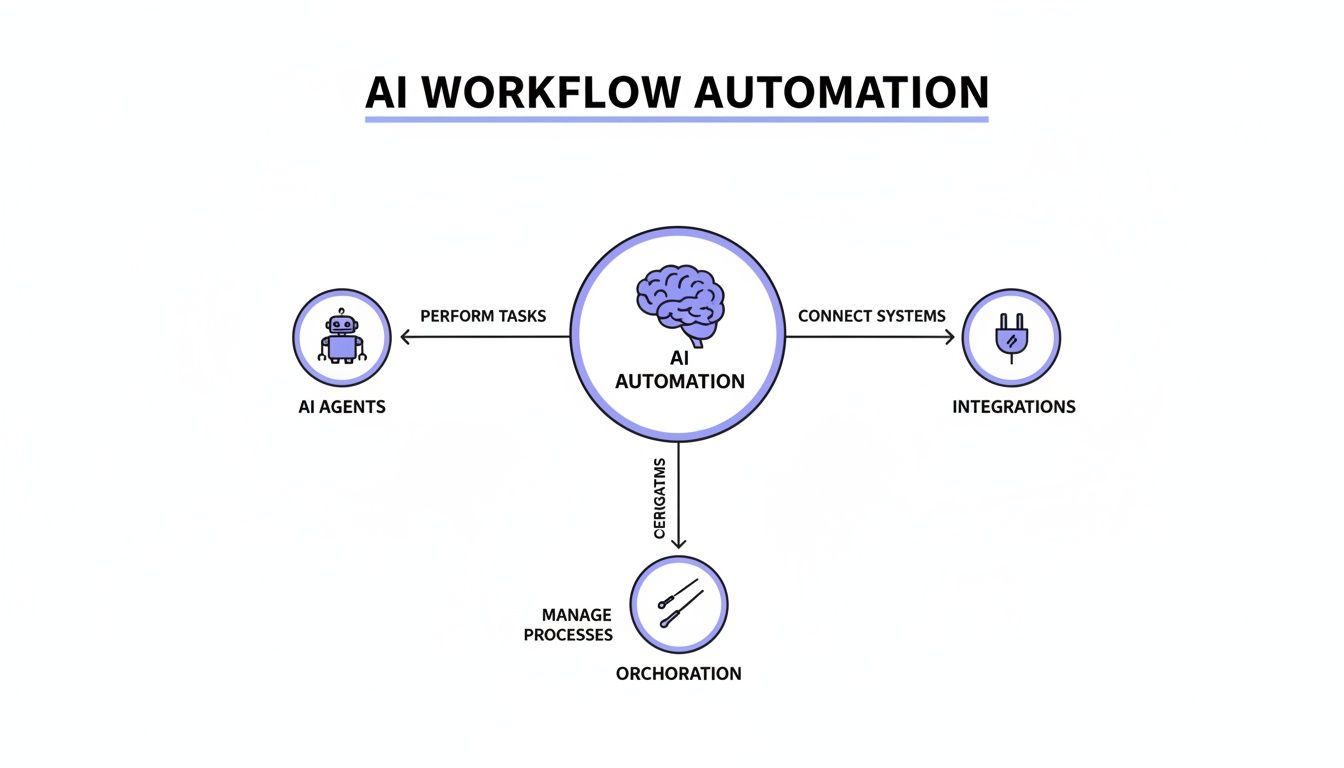
As you can see, a central AI Automation hub is the brain of the operation. It coordinates all the specialized agents and connects different systems to get complex jobs done. This is how you build an intelligent, scalable backbone for your business.
Custom AI Agents: Your Digital Workforce
Think of Custom AI Agents as your new, specialized digital employees. These are more than your average chatbots. We're talking about sophisticated programs trained to handle specific, intelligent tasks that would normally take a person's focus and reasoning.
For example, you could have an AI agent that sifts through incoming support tickets, figures out the customer's sentiment and how urgent the issue is, and then routes it to the right person, all without a single click from your team. Another agent could be a financial specialist, trained to scan invoices for errors or flag transactions that look like fraud.
A huge part of this is analyzing unstructured data, turning messy info from emails or PDFs into something you can actually use. Best of all, these agents work 24/7, crushing high-volume tasks with incredible accuracy.
Orchestration Platforms: The Central Nervous System
If AI agents are your digital employees, then the orchestration platform is the central nervous system telling them what to do. Tools like n8n or Make are the command centers for your entire automated setup. They give you a visual canvas to design, build, and manage how work flows between your apps and AI agents.
This is where the "workflow" part of the name really comes to life. The orchestration platform tells the system what needs to happen, in what order, and when.
An orchestration platform is the conductor of your automation symphony. It makes sure every piece (from your CRM to your custom AI agents) plays its part at the perfect time to create a harmonious and efficient process.
Without this, your automations would just be a chaotic mess of disconnected tasks. Orchestration turns them into a cohesive, manageable, and scalable operation.
Secure Integrations: The Communication Lines
Your business probably runs on a whole stack of software: a CRM for sales, an ERP for operations, and a dozen other tools for marketing, finance, and HR. Secure integrations are the digital bridges that let all these different systems talk to each other safely and reliably.
These are more than flimsy connections. They are secure data pipelines, ensuring information flows where it needs to go without putting you at risk. For an automated lead qualification process to work, for instance, your website form has to securely send data to an enrichment tool, which then has to update your CRM. All of this has to happen without exposing sensitive customer info.
Building these solid communication lines is non-negotiable for a trustworthy automation foundation. As you get more advanced, exploring concepts like Hyperautomation shows just how deep these integrations can go to transform a company.
Continuous Monitoring: The Quality Control Manager
Even the most perfectly designed automation needs someone watching over it. Continuous monitoring is your dedicated quality control manager, keeping a constant eye on your automated workflows to make sure everything is running like it should. It tracks performance, logs every action, and flags any errors or bottlenecks the second they pop up.
This is not a "set it and forget it" kind of deal. It’s a living system, and monitoring gives you the data you need to keep making it better. By looking at the performance numbers, you can spot opportunities to make your workflows even faster, more reliable, and more cost-effective over time.
Related Reads
How AI Transforms Your Workforce
Bringing AI-powered workflow automation into your company does a lot more than just make things run faster. It fundamentally changes what your team is capable of.
The common fear is that AI is here to replace people. The reality? It’s here to amplify them. This isn't about subtracting jobs; it's about adding intelligent, digital partners to handle the repetitive, data-heavy lifting. This frees up your team to focus on what humans do best: strategy, creative problem-solving, and building relationships.
When you start weaving AI into your daily operations, you're more than tweaking a few tasks; you're upgrading your company's entire operational DNA.
AI Team Augmentation
Imagine giving your best people a tireless digital assistant, custom-built to handle the most tedious parts of their job. That's AI team augmentation in a nutshell.
These AI agents are designed to take over the grunt work. Think sifting through thousands of data points, cranking out routine reports, or keeping an eye on systems for any odd behavior.
For instance, a marketing analyst who used to lose hours every week pulling performance metrics can now just hand that job to an AI agent. The agent gathers data from all the right places, spots the trends, and has a clean summary report waiting for them every morning.
Suddenly, that analyst is free to spend their day actually thinking about the data, brainstorming new campaigns, and making the creative calls that drive real growth. Their value to the company hasn't just been preserved; it's been multiplied.
AI-Adopted Engineer Placements
If you want to hit the ground running with automation, one of the fastest ways is to bring in an expert who already speaks the language of AI. This is where AI-adopted engineer placements come in. We’re talking about embedding a specialized AI engineer directly into your team.
These are more than coders; they're architects of efficiency. They bring immediate, hands-on experience with the latest automation tools and AI models, so they can start building, deploying, and fine-tuning workflows from day one. Your learning curve gets slashed.
By placing an AI-savvy engineer on your team, you bypass months of trial and error. You get an immediate catalyst for innovation who can identify automation opportunities you might have missed and build stable solutions that scale.
This is all about injecting expertise right where you need it most. It ensures your projects are built on a solid foundation of best practices, security, and scalability, ultimately speeding up your development and getting you a return on your investment much faster.
Targeted AI Workshops and Upskilling
A tool is only as good as the person using it. That’s why targeted AI workshops are so critical. Upskilling your team isn’t just a nice-to-have perk; it's a strategic move to ensure everyone can contribute to, and benefit from, your automation efforts.
These workshops aren't about abstract theories. They're hands-on sessions focused on the specific tools your teams are using every single day. This kind of practical training gets everyone on the same page, leading to more consistent, high-quality work. To dig deeper into how this impacts team results, you can explore our guide on improving team productivity.
Great training programs are tailored to the role:
- For Your Devs: Workshops on an AI-first code editor like Cursor can help engineers write, debug, and refactor code at an incredible pace. Training on how to properly prompt models like Claude ensures they can generate standardized, top-quality code for any task.
- For Collaboration: A workshop on a platform like Weavy.ai can show teams how to embed AI-powered communication right into the apps they already use, cutting down on context switching and keeping projects on track.
- For Everyone: Foundational training in advanced prompt engineering pays off fast. It teaches employees how to have a productive conversation with AI, turning them from passive users into active collaborators who can pull precise, valuable insights from these powerful models.
By focusing on these three areas (augmentation, placements, and upskilling), you’re more than preparing your workforce for the future. You’re building it.
Free weekly brief
Steal our production automations
The exact n8n flows, Claude Code setups, and prompts we ship for clients, broken down step by step. No spam, unsubscribe anytime.
Practical Automation Use Cases for Every Department
If you're shortlisting outside help for any of these use cases, our side-by-side agency comparison is a faster starting point than another sales call.
The real magic of AI-powered workflow automation happens when you see it solve real-world problems for your teams. This isn't about some isolated tech fix; it's about weaving a smarter operational fabric that connects everyone, from the marketers chasing leads to the engineers shipping code. The goal is to get rid of the friction that slows everyone down.
And make no mistake, this is more than just a passing trend. The AI-powered business process automation market is booming, jumping from USD 9.8 billion in 2020 to a predicted USD 19.6 billion by 2026. This explosive growth shows that business leaders are serious about cutting costs and boosting efficiency. For a look at how this is being applied today, you can find some great business process automation examples that show the sheer breadth of what’s possible.
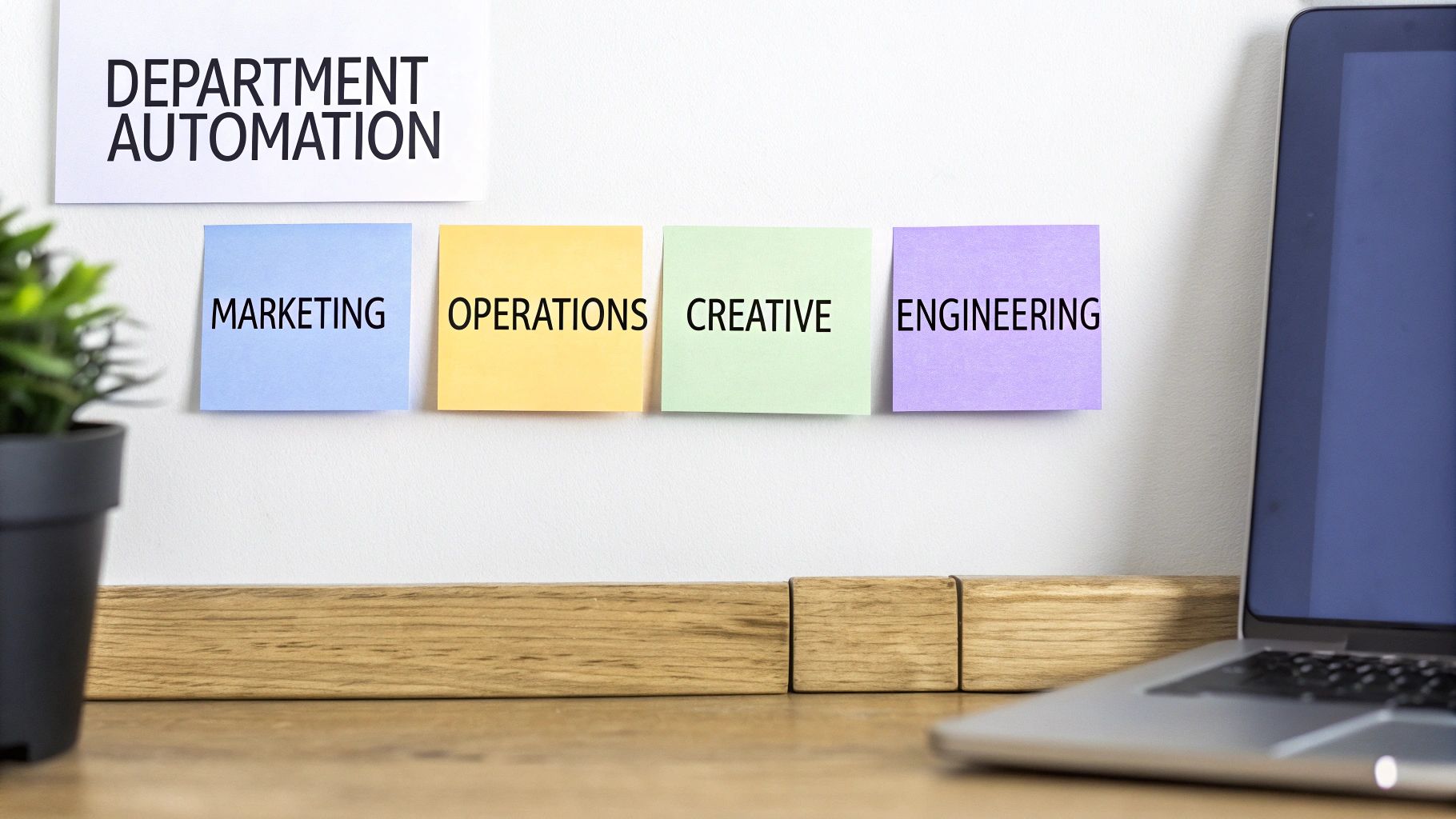
So, let's get into the specifics and see what this looks like department by department.
Turbocharging Your Marketing and Sales Engine
For marketing and sales, speed and personalization are the name of the game. AI automation is a total force multiplier here, taking over the soul-crushing data tasks that clog up the pipeline.
A new lead lands on your website. Before a human can even blink, an automated workflow is already in motion.
- Lead Enrichment: An AI agent instantly gets to work, pulling public data to flesh out a detailed profile: company size, industry, role, you name it.
- Intelligent Routing: The system digests this info and routes the lead to the perfect salesperson based on their territory, expertise, or even current workload.
- Personalized Outreach: Another agent drafts a custom email that references the lead’s industry and interests, then schedules it to send at the optimal time.
This all happens in seconds. Your sales team is now talking to the hottest leads right when they’re most interested, which means shorter sales cycles and way better conversion rates.
Streamlining Operations and Finance
In the world of ops and finance, it's all about accuracy and efficiency. Manual data entry and invoice processing are more than slow; they’re a breeding ground for human error. AI-powered workflow automation brings a new level of precision to the table.
Take your accounts payable process. Instead of someone manually keying in every invoice, an AI agent can:
- Extract and Categorize Data: Automatically scan incoming invoices, pull out key details like vendor and payment amounts, and categorize the expense. It doesn't matter what format the invoice is in.
- Flag Discrepancies: Instantly cross-reference the invoice against purchase orders and flag anything that looks off (like a duplicate payment) for a human to review.
- Sync with Accounting Software: Once everything checks out, the system updates your books and queues the payment. The workflow is completely touchless.
This frees up your finance pros to stop being data entry clerks and start focusing on high-value strategic planning.
Empowering Your Engineering and Development Teams
Even highly technical teams like engineering get a massive boost. The secret is automating the routine checks and balances that bog down development, letting engineers focus on what they do best: building amazing products. This is where AI team augmentation truly shines.
By embedding AI agents and specialized engineers directly into the workflow, you can hit the accelerator on development. Here’s how:
- Automated Code Review: AI agents trained on your team’s coding standards can do the first pass on code reviews, catching style issues or common mistakes before a human reviewer even lays eyes on it.
- Intelligent Bug Triage: A new bug report comes in. An AI system can analyze it, figure out how severe it is, and assign it to the right developer with all the relevant logs attached.
- CI/CD Pipeline Checks: Automation can handle all the routine security and stability checks in your deployment pipelines without anyone having to babysit the process.
When it comes to engineering, having the right AI tools is non-negotiable. Targeted AI workshops on platforms like Cursor, an AI-first code editor, can help standardize excellence. Getting the whole team trained on models like Claude and other collaborative tools ensures they can all write better, more consistent code, faster. That’s how you build a truly innovative engineering culture.
A Simple Roadmap for Your Automation Journey
If your team doesn't have the bandwidth to run this roadmap alone, an AI automation agency can take it from audit to production.
Getting started with AI-powered workflow automation isn’t some giant, intimidating leap into the dark. Think of it more like a series of deliberate, smart steps that build on one another. A solid roadmap takes the guesswork out of the equation, making sure every automation you build adds real value from day one and helps create a scalable, efficient foundation for your business. This is how you get from a cool idea to measurable impact.
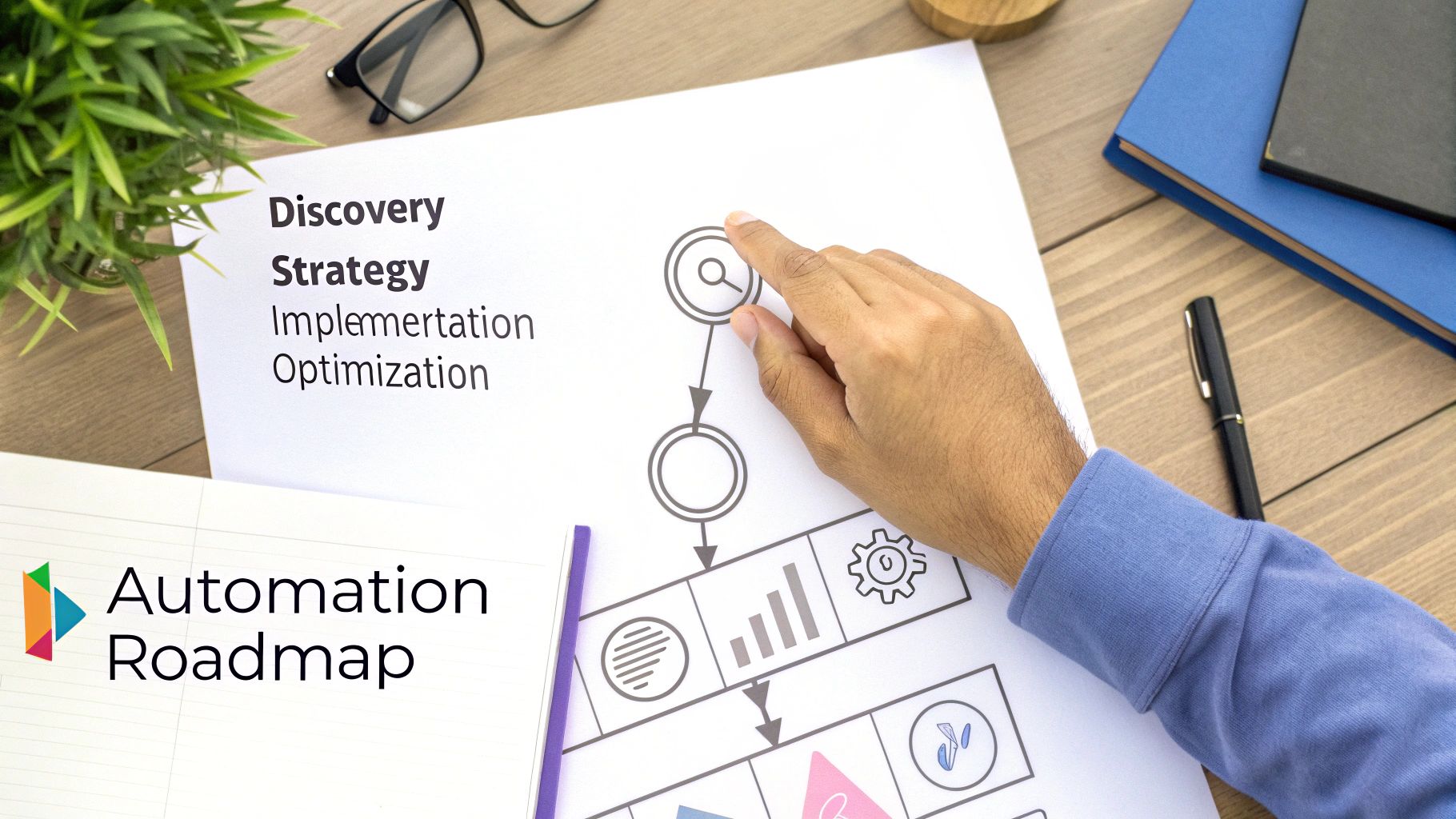
The whole approach is methodical. By following a clear, four-step process, you can systematically upgrade how you operate, build momentum with some early victories, and foster a culture of constant improvement that grows right alongside your company's ambitions.
Step 1: Discovery and Quick Wins
First things first, you have to know where to start. We kick things off by identifying the processes that are just begging to be automated. The goal here is to find the "quick wins": those tasks that are high-impact but don't require a massive effort to automate. These are usually the repetitive, soul-crushing activities that eat up hours but don't need much creative brainpower.
An automation audit is the perfect tool for this. We'll map out your current workflows, from how marketing handles new leads to the way finance closes the books, and score each one on its automation potential and business impact. What you get is a clear, data-backed priority list.
By nailing these quick wins first, you generate immediate momentum. Your team sees the benefits right away, which gets them excited and on board for the bigger changes to come.
Step 2: Strategy and Solution Design
Okay, so we know what to automate. Now we need to figure out how. This is the strategy phase, where we architect the solution and pick the right tools for the job. This isn't a one-size-fits-all deal; the best solution is completely dependent on your specific needs, your current tech stack, and where you want to be in the future.
The toolkit could include a few different things:
- No-Code/Low-Code Platforms: Tools like n8n or Make are fantastic for connecting different apps and building out complex workflows using a visual, drag-and-drop interface.
- Custom Code: When you have a really specialized task or need a super-deep integration, custom-coded solutions give you the ultimate flexibility and control.
- Advanced LLMs: We might bring in powerful models like GPT-4 or Claude to handle jobs that need to understand human language, like summarizing customer feedback or drafting personalized outreach emails.
The result of this stage is a detailed blueprint. This plan maps out every component, every integration point, and every security measure, making sure the final product is tough, secure, and perfectly aligned with what your business needs to achieve.
Step 3: Implementation and Deployment
This is where the rubber meets the road and the plan becomes a reality. The implementation phase is all about the hands-on building, testing, and secure rollout of your new automated workflows. Our engineers get to work configuring the orchestration platform, writing any custom code needed, and tweaking the AI agents until they perform their jobs flawlessly.
We are absolutely relentless about testing. Before anything goes live, we throw every imaginable scenario at the workflow to catch and squash any potential bugs.
Security is front and center during deployment. We make sure every integration is locked down, all your data is handled with care, and the right access controls are in place. This guarantees your new system is more than efficient; it's also a fortress for your sensitive business information.
Step 4: Optimization and Scaling
Launching the automation isn't the finish line; it’s just the start of a continuous loop of improvement. In the optimization phase, we keep a close eye on how your new workflows are performing. We track the numbers that matter (like time saved, costs cut, and errors eliminated) to measure your return on investment (ROI).
This data-first approach lets us spot bottlenecks and find new ways to make the process even slicker. Often, the insights from one successful automation point directly to the next high-value process to tackle. This creates a powerful cycle of improvement, where each new workflow builds on the success of the last, progressively transforming your entire operation from the ground up.
Why You Need an AI Transformation Partner
Diving into AI-powered workflow automation on your own can feel like trying to navigate a dense jungle without a map. The potential upside is massive, but so are the risks. It's easy to get lost in costly missteps, from security blindspots and integration nightmares to big projects that just never deliver a return.
Bringing on a specialized AI transformation partner isn’t just another expense; it's an investment in getting it right the first time. Think of it as hiring a seasoned guide who knows the terrain. They bring the strategic oversight of an architect and the certified, hands-on skills across platforms like n8n and Make, plus the deep knowledge of language models like Claude. This partnership is your shortcut past the common DIY traps like scope creep and technical debt, pointing you on a direct path to real, measurable results.
Accelerate Your Transformation with Specialized Talent
One of the biggest wins of partnering up is getting immediate access to a deep bench of specialists. Forget the long, expensive slog of hiring. You can instantly bring in the exact skills you need to put your AI initiatives on the fast track, building up your internal team's capabilities along the way.
This talent injection can look a couple of different ways:
- AI Team Augmentation: We can pair your existing teams with AI specialists. They'll get to work designing and building custom agents to take over all that repetitive analysis and reporting, freeing up your people to focus on the big-picture strategic work they were hired for.
- AI-Adopted Engineer Placements: You can also embed engineers who are already fluent in AI tools directly into your development teams. This immediately compresses development cycles and bakes best practices into your workflow from day one.
The whole idea is to go beyond just implementing a piece of tech. It's about building a durable, in-house capability for ongoing innovation.
Upskill Your Team with Targeted AI Workshops
Great technology is only half the story. Your team's ability to actually use it is what brings out its real power. A good partner provides structured, hands-on training that’s tailored to the specific tools that will make the biggest difference in your day-to-day operations.
The goal is to build a culture of AI fluency, where every single person feels able to contribute to and benefit from automation. This is how you move from just using AI tools to truly thinking with them.
These workshops are all about practical, hands-on skill building. For instance, your engineering teams could join a workshop on AI-first code editors like Cursor or learn advanced prompting techniques for models like Claude, helping them ship standardized, high-quality code faster. Or, your product teams might join a session on a platform like Weavy.ai to learn how to embed AI-powered communication right into the apps they're already building.
This kind of targeted upskilling ensures your investment pays dividends for years to come by creating a smarter, more capable workforce that's ready for whatever comes next.
If this sounds like the right fit, our workflow automation agency page covers scope, process, and how an engagement starts.
Frequently Asked Questions
What’s the Difference Between AI Team Augmentation and AI Adopted Engineer Placements?
Think of these as two ways to get expert AI help, fast. Each one is designed to plug directly into your team and start delivering value right away, but they solve slightly different problems.
With AI team augmentation, we pair our AI specialists with your in-house experts. It’s a partnership. We work alongside your team to build custom AI agents that take over the tedious, repetitive work (like data analysis and reporting), freeing up your people to focus on strategy and growth.
AI adopted engineer placements are for when you need to go a step further. We embed a dedicated, AI-savvy engineer directly into your development team. This completely sidesteps the steep learning curve, letting you build sophisticated automation projects with expert guidance from day one. It’s the fastest way to compress development timelines and bake best practices into your process.
What Is the Real Goal of AI Workshops?
It’s all about upskilling your team with practical, hands-on knowledge. Amazing technology is useless if your people don't know how to wield it. Our workshops are designed to build that capability right inside your organization.
These aren't dry, theoretical lectures. We focus on training your team with the exact tools that will make the biggest difference in their day-to-day work. This way, everyone from marketing to development can actively contribute to your automation initiatives and see the benefits firsthand.
The goal is to create a culture of AI fluency. You want your team to shift from being passive users of technology to active creators who can spot opportunities and drive innovation themselves. It's about building a sustainable, in-house engine for efficiency and growth.
What Kind of AI Workshops Do You Offer?
We run targeted, role-specific workshops that give your teams the most relevant skills for their jobs. The focus is always on practical application so you see an immediate jump in productivity.
Our workshop lineup includes:
- For Development Teams: We get your engineers hands-on with AI-first code editors like Cursor. They'll learn how to write, debug, and refactor code at a speed that just wasn't possible before.
- For Advanced Coding: This training dives into using Large Language Models like Claude to generate clean, standardized code and tackle incredibly complex programming challenges.
- For Better Collaboration: We show your teams how to integrate platforms like Weavy.ai. It embeds AI-powered communication and workflow tools directly into the apps you already use, cutting down on friction and speeding up projects.
For related resources: best workflow automation platforms compares the tools that power AI-native automation stacks; how to automate business processes end-to-end is a step-by-step guide for implementation; and workflow automation for small business applies these principles to smaller teams and tighter budgets.
Ready to build a more efficient, scalable operation? AY Automate designs and deploys custom AI agents and intelligent workflows that cut costs and amplify your team's impact. Schedule your free automation audit to identify your biggest opportunities today at https://www.ayautomate.com.
Continue Reading
What Is Hyperautomation in 2026? (Definition, Stack, and the Honest ROI)
Hyperautomation in 2026: RPA combined with AI agents. What frontier models changed, where it delivers ROI, and when plain automation is the right answer.
AI Agents for Business in 2026: Real Use Cases, Cost, and How to Pick the Right One
Updated June 2026. "AI agents for business" went from buzzword to real category between 2024 and 2026.
Custom AI Agent Development in 2026: The Honest Buyer's Guide
Updated June 2026. Two years ago, "AI agent development" meant a chatbot with extra steps.
Book a Free Strategy Call
Building this in production?
Walid runs a 30-min call to map your AI engineering team. Free, no slides.
Free weekly brief
Steal our production automations
The exact n8n flows, Claude Code setups, and prompts we ship for clients, broken down step by step. No spam, unsubscribe anytime.

Robel engineers production-grade automation pipelines at AY Automate, focused on integrations, reliability, and the systems that keep client workflows running.