Book a Free Strategy Call
Skip the read: talk to Walid in 30 min.
Free strategy call. We map your AI engineering team, you keep the notes.
Updated September 5, 2026. Next refresh: October 5, 2026.
Quick answer: The best AI automation agency for most businesses is AY Automate for end-to-end strategy, build, and maintenance. For enterprise RPA at scale, UiPath and Automation Anywhere are the market leaders. For AI-native growth marketing, RZLT is the specialist. The right choice depends on whether you need a partner (the agency handles strategy through maintenance) or a platform (you build with vendor tooling your team manages).
Disclosure: AY Automate publishes this list, and we rank ourselves first. We show our full ranking criteria below, disclose what we could and could not verify for every agency including our own, and list honest reasons to skip us if we are not the right fit. Judge our entry by the same evidence bar we hold every other agency to.
The best AI automation agencies in 2026 are AY Automate for full-service strategy, build, and maintenance under one roof; RZLT for AI-native growth marketing; Kanerika for data analytics paired with automation; Ema AI for no-code AI employee deployment; Sana Labs for knowledge and learning agents; and UiPath or Automation Anywhere if what you actually want is an enterprise RPA platform rather than a partner.
The decision that matters most is partner vs platform. Agencies build and run your automation stack for a project fee. Platforms hand you tooling with licensing that starts around $25/month for entry tiers and climbs into custom enterprise quotes once you need real throughput, and you still need internal engineers to build with it. Picking the wrong side of that line costs months of budget and half-built integrations.
This guide compares the 9 best AI automation agencies for enterprise teams in 2026. We cover what each agency specializes in, how they price their services, and which type of organization gets the most value from each partner.
Ready to hire, or still comparing? This guide is built for research: it ranks and compares the top AI automation agencies so you can shortlist with real evidence before you talk to anyone. If you already know you want to hire an AI automation agency and you are ready to scope a project, skip ahead to our AI automation agency page for pricing structure, process, and how an engagement starts with AY Automate.
How we ranked these agencies
We evaluated agencies on four criteria: (1) Production focus: do they build automation that survives real data, volume, and failure, or stop at the demo? (2) Stack breadth: do they cover workflow orchestration (n8n, custom code) through AI agents and RAG pipelines? (3) Pricing transparency: have they published real numbers or given honest signals? (4) Delivery languages: do they serve non-English-speaking teams? AY Automate is listed first because it is ours and we meet all four criteria; every other agency was evaluated by the same rubric regardless of our interest.
What we checked directly: each agency's own pricing and services pages, and each agency's public review profiles. Clutch pages for AY Automate, RZLT, Kanerika, LowCode Agency, and LeewayHertz were re-verified live on September 1, 2026. G2 pages for UiPath, Automation Anywhere, and Sana Learn blocked automated access on this pass, so those figures are carried over from our last successful pull (July 20, 2026) rather than restamped without a fresh check. What we could not verify: private client references, win rates, or delivery timelines that aren't published anywhere public. Where a rating or price wasn't publicly confirmable, we say so instead of guessing. On September 5, 2026 we re-confirmed all 9 listed sites are still live and operating (AY Automate, RZLT, Kanerika, Ema AI, Sana Labs, UiPath, Automation Anywhere, LowCode Agency, and LeewayHertz); no pricing or review figures were re-pulled on this pass.
Best AI automation agencies: a brief overview
If you need a full-service AI automation partner:- Start with AY Automate for end-to-end strategy, build, and maintenance under one roof
- Consider Kanerika if your priority is data analytics alongside automation
- Go with RZLT for data-driven campaigns at scale across B2B, Fintech, and Web3
- Go with Ema AI for no-code AI employee deployment across departments
- Choose Sana Labs if knowledge management and learning automation are equally important
- Consider LowCode Agency for smaller automation projects paired with custom app builds
- Consider LeewayHertz for regulated-industry AI strategy and engineering at enterprise scale
- Start with UiPath for the broadest ecosystem and agentic testing
- Choose Automation Anywhere for cloud-first RPA with strong document processing
| Agency | Best for | Pricing signal | Public reviews | Stack |
|---|---|---|---|---|
| AY Automate | Full-service AI automation: strategy, build, QA, and maintenance | Custom project-based; fractional CAIO retainer available | 5.0/5 on Clutch (3 reviews) | Workflow automation, AI agents, RAG pipelines, SaaS MVPs |
| RZLT | AI-native marketing with custom agentic workflows and 200M+ impressions | Custom engagement-based; retainer models available | 5.0/5 on Clutch (10 reviews) | GTM strategy, demand generation, ABM, performance marketing |
| Kanerika | Data analytics + AI/ML consulting with proprietary AI products | Custom engagement-based; mid-market rates | 5.0/5 on Clutch (18 reviews) | Data analytics, RPA, AI/ML, migration services |
| Ema AI | No-code AI employee platform with pre-built persona templates | Custom enterprise pricing | No independently verified public rating found | AI agents, customer support, compliance, HR automation |
| Sana Labs | AI-native learning + agent platform (acquired by Workday) | Published from ~$13/user/month at last check (learning, 300-user minimum, now an interactive calculator); free tier for agents | 4.8/5 on G2 (106 reviews) | Knowledge management, learning, workflow agents |
| UiPath | Largest RPA ecosystem with agentic AI and process mining | From $25/month (Basic); Standard and Enterprise custom-quoted | 4.6/5 on G2 (7,768 reviews) | RPA, agentic automation, document processing, testing |
| Automation Anywhere | Cloud-native RPA with strong document processing (IQ Bot) | No public pricing; custom quotes only | 4.5/5 on G2 (5,705 reviews) | RPA, AI agents, intelligent document processing |
| LowCode Agency | Budget-conscious automation paired with custom app builds (Bubble, FlutterFlow, n8n, Make) | $50-99/hr; projects typically start under $10,000 | 4.9/5 on Clutch (34 reviews) | n8n, Make, Zapier, Bubble, FlutterFlow, Webflow, Airtable |
| LeewayHertz | Enterprise AI consulting and engineering for regulated industries | $50-99/hr; typical project $50,000-$199,999 per Clutch | 4.7/5 on Clutch (9 reviews) | AI strategy, generative AI, blockchain integration, enterprise automation |
1. AY Automate, best overall AI automation agency for enterprise teams
AY Automate is a full-service AI automation agency that covers the entire lifecycle: strategy consulting, custom development, quality assurance, deployment, and ongoing maintenance. Unlike platform vendors that hand you a tool and leave, AY Automate builds and operates your automation stack. Want to hire an AI automation agency? See the AI automation agency page for scope, pricing structure, and how an engagement starts.The agency specializes in custom workflow automation using n8n, AI agent development for autonomous business processes, and RAG pipeline architecture for connecting LLMs to private enterprise data. Their fractional CAIO (Chief AI Officer) model gives enterprises executive-level AI strategy without the full-time C-suite hire.
Why we rank AY Automate #1Not on adjectives, on checkable evidence:
- Named client work with verified numbers: a legal and compliance automation build that saved a client an estimated €10,000 in fines by catching filing errors before they became penalties, a marketing operations build that automated 95% of a client's recurring campaign tasks, and a customer support automation that moved a client to 24/7 first-response coverage. These are the same case studies published on our service page, not new numbers invented for this list.
- An engineer-placement model most agencies on this list do not offer: a 2 to 4 week placement window and a 90-day replacement guarantee for teams that need embedded capacity instead of a single project.
- Multilingual delivery (English, French, Arabic), which matters for the non-English-speaking teams we score every agency on in our ranking criteria above.
What we will not claim: broad press coverage or a large public review count. Our Clutch profile now carries 3 verified reviews at 5.0/5 as of September 2026, up from 0 at our last check, disclosed in the Public reviews line below with the same evidence bar we hold every other agency to.
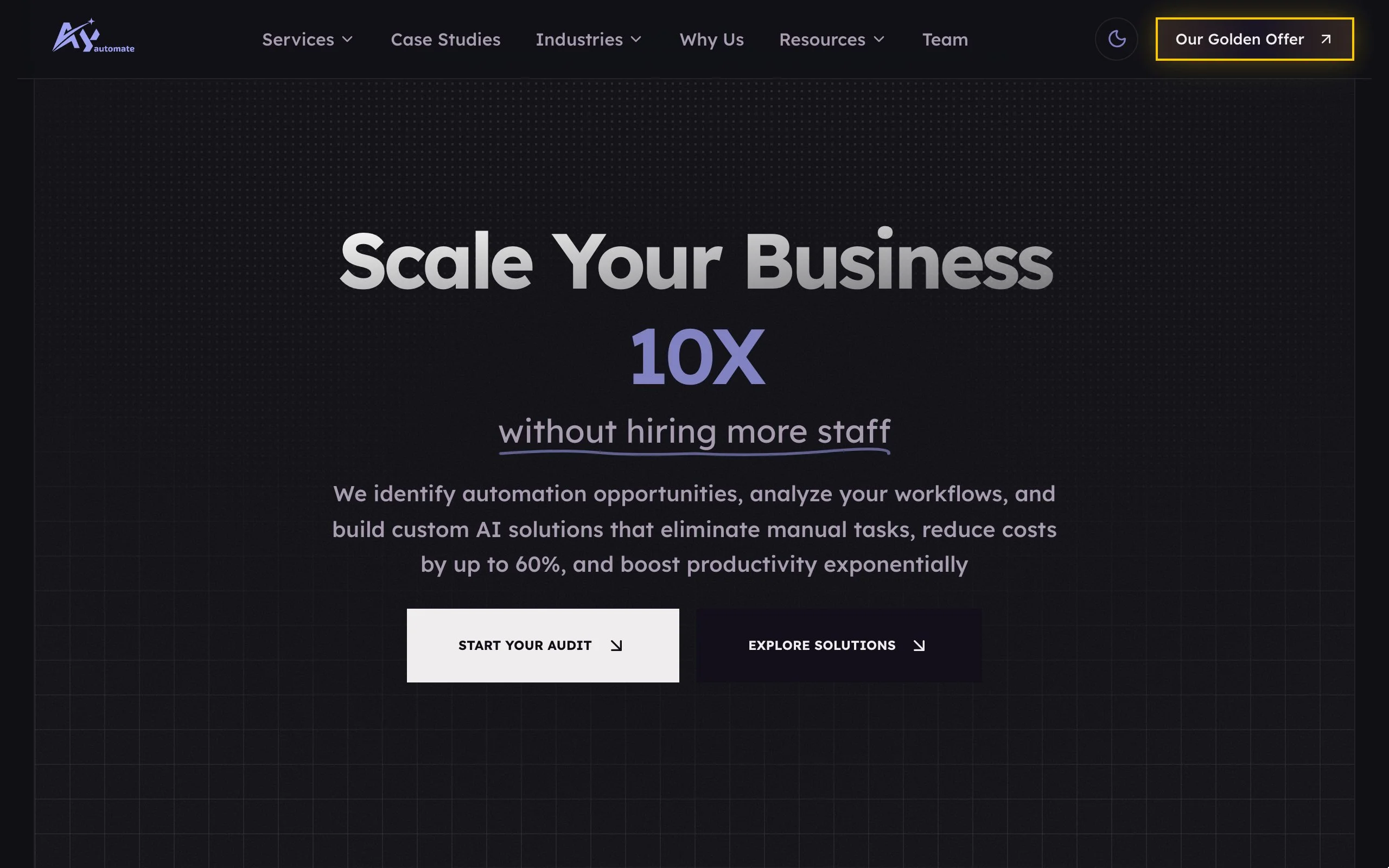
- End-to-end service: strategy, build, QA, deployment, and 24/7 maintenance
- Deep n8n expertise for complex workflow orchestration across APIs, webhooks, and custom code
- RAG pipeline architecture using Pinecone, Weaviate, and Supabase vector databases
- 30-day SaaS MVP delivery for rapid product validation
- Fractional CAIO offering for AI transformation leadership
- Multilingual support across English, French, and Arabic
- Enterprise operations teams that need a single partner to handle strategy through maintenance
- CTOs and founders evaluating AI transformation who want executive guidance (fractional CAIO) plus hands-on engineering
- Organizations in logistics, e-commerce, real estate, legal-tech, and fintech
- Custom project-based pricing tailored to scope and complexity
- Fractional CAIO retainer model available for ongoing strategic oversight
- AI staff augmentation with 2-4 week engineer placement and 90-day replacement guarantee
Public reviews: AY Automate's Clutch profile shows 5.0/5 across 3 verified reviews as of September 2026, up from 0 reviews at our last check. Ask us directly for client references if you want more than three data points to judge by.
Pros- Single partner covers strategy, development, QA, and ongoing support, so you avoid juggling multiple vendors
- n8n and RAG pipeline depth means complex integrations ship faster than with generalist agencies
- Fractional CAIO model provides C-suite AI leadership at a fraction of a full-time hire
- Not the cheapest option for simple, one-off automations
- No self-serve platform for teams that prefer DIY tooling
2. RZLT, best for AI-native growth marketing and demand generation
RZLT is an AI-native marketing firm that has worked with 100+ leading B2B, AI, Fintech, and Web3 startups and enterprises, including Telegram, Workato, and NEAR. They combine sentiment analysis, market research, and competitive intelligence with custom agentic workflows built in-house to run data-driven campaigns at scale.With 200M+ impressions generated and $40M+ in revenue driven for clients, RZLT brings a rare mix of marketing strategy and AI-powered execution. Their team of 10 growth leads, 7 marketing managers, and 20+ specialists has executed 50+ campaigns reaching 20M+ users globally. Their approach is powered by custom agentic workflows that automate campaign optimization, audience targeting, and competitive intelligence gathering.
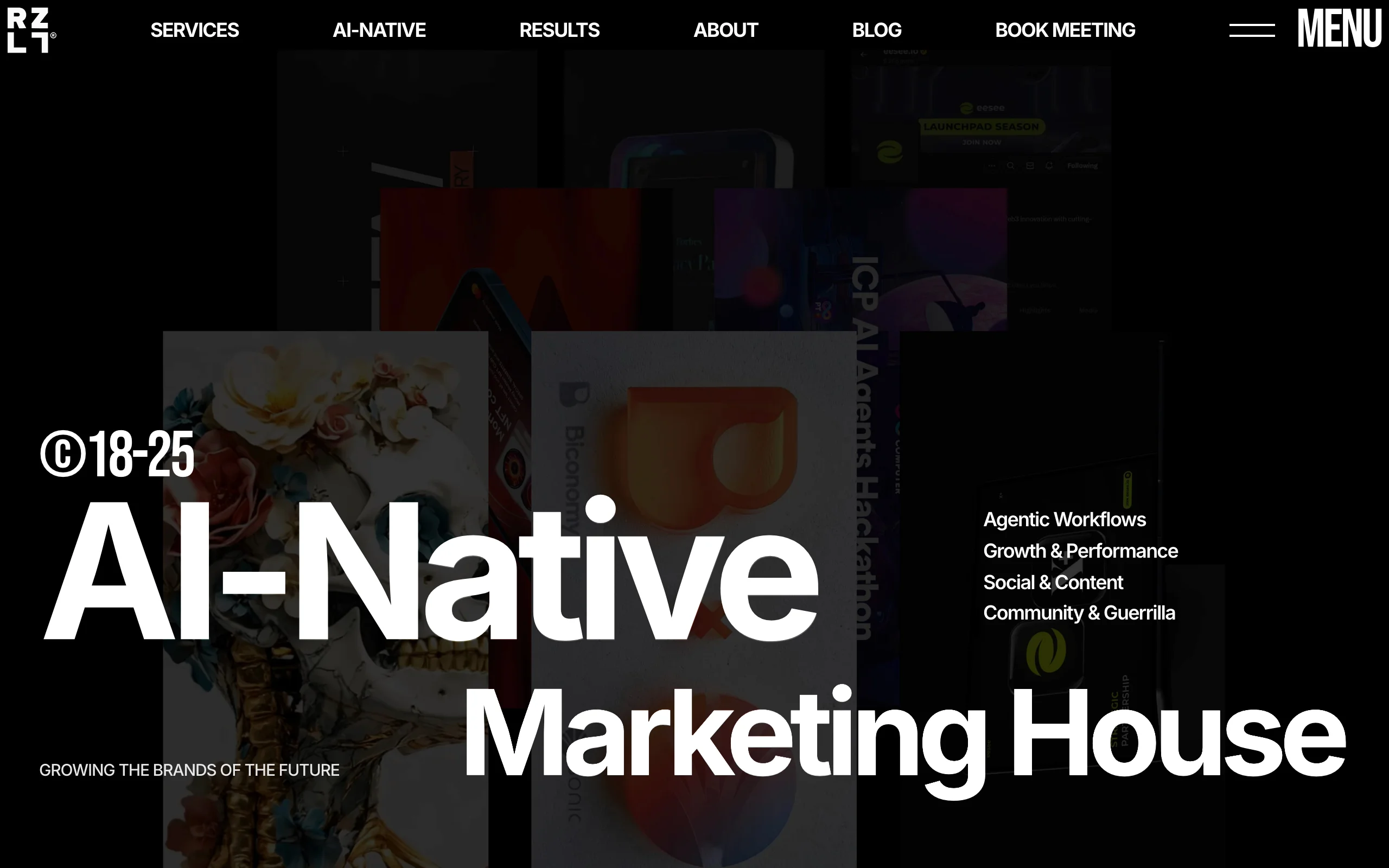
- AI-integrated go-to-market strategy with custom agentic workflows built in-house
- Full-funnel demand generation combining ABM, performance marketing, and content marketing
- Sentiment analysis and competitive intelligence for ICP-targeted campaigns
- Guerrilla marketing tactics for high-impact brand awareness in crowded markets
- Deep B2B, Fintech, and Web3 vertical expertise with 100+ client track record
- B2B startups and scaleups that need AI-powered marketing execution rather than strategy decks
- AI, Fintech, and Web3 companies looking for a growth partner that understands their buyer persona
- Teams that want data-driven campaign automation with human strategic oversight
- Custom engagement-based pricing tailored to campaign scope and duration
- Retainer models available for ongoing growth partnerships
- No public pricing tiers; requires consultation
Public reviews: 5.0/5 on Clutch across 10 verified reviews, with clients citing responsiveness and direct C-level involvement.
Pros- Proven track record: 200M+ impressions and $40M+ revenue generated across 100+ clients
- Custom agentic workflows mean campaigns are optimized by AI instead of human intuition alone
- Strong B2B and Web3 vertical expertise that generalist marketing agencies lack
- Primarily a marketing and growth agency, not a workflow automation or RPA provider
- No public pricing makes it harder to budget before initial consultation
3. Kanerika, best for data analytics paired with AI automation
Kanerika is a global consulting firm that combines AI/ML implementation with data analytics, governance, and RPA. Their strength is helping enterprises that need both data infrastructure and automation built in parallel. If your automation bottleneck is messy data rather than workflow logic, Kanerika addresses both sides.
They also offer proprietary AI products: Karl (a data insights AI agent), DokGPT (document intelligence), and FLIP (a low-code DataOps platform). This gives clients pre-built tools to complement custom consulting work.
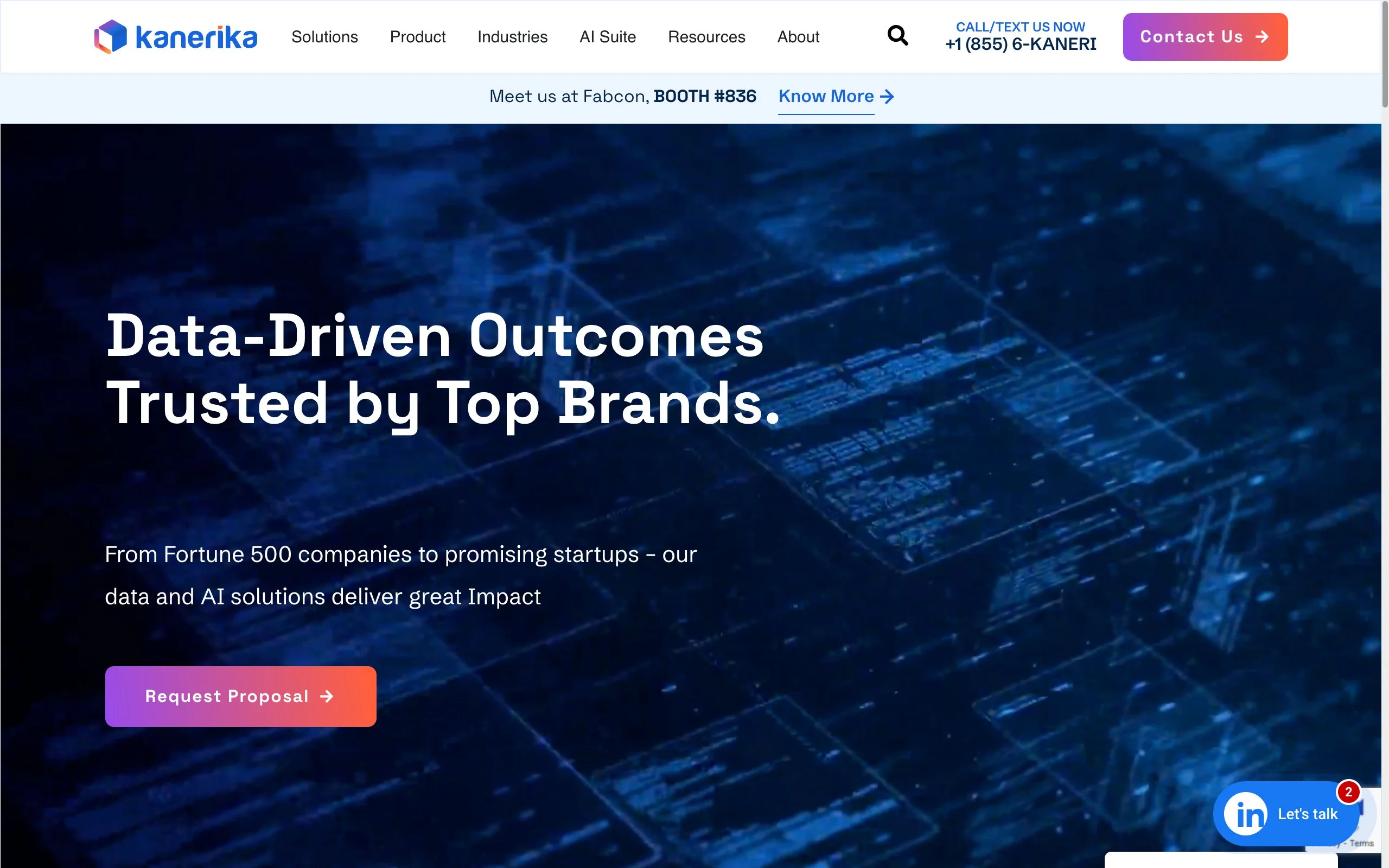
- AI/ML and generative AI implementation tailored to business challenges
- Data analytics, business intelligence, and visualization services
- Proprietary AI products (Karl, DokGPT, FLIP) for accelerated deployment
- Migration services for platform transitions (Microsoft Fabric, Databricks)
- Data governance and compliance frameworks
- Enterprises with fragmented data infrastructure that need analytics and automation built together
- Organizations planning cloud data platform migrations alongside AI initiatives
- Teams in banking, healthcare, and manufacturing where data governance is non-negotiable
- Custom engagement-based pricing
- Mid-market rates competitive with other global consulting firms
- Project-based and retainer models available
Public reviews: 5.0/5 on Clutch across 18 verified reviews (also 5.0/5 on G2 across 37 reviews), with reported outcomes like a 90% reduction in reporting time on cited engagements.
Pros- Dual expertise in data analytics and AI automation covers both sides of the data-to-action pipeline
- Proprietary AI products (Karl, DokGPT) accelerate time-to-value for common use cases
- Strong data governance capabilities for regulated industries
- Broader consulting scope means less deep specialization in pure workflow automation compared to automation-first agencies
- Proprietary tools may create vendor lock-in for some implementations
4. Ema AI, best for no-code AI employee deployment
Ema AI takes a different approach to enterprise automation: instead of building workflows, you deploy "AI employees." Their Generative Workflow Engine (GWE) powers pre-built persona templates that handle customer support, compliance analysis, HR tasks, and more. You pick a template, fine-tune it through a guided conversation, and deploy.
Founded in 2023 by former Coinbase CPO Surojit Chatterjee and backed by $61M in funding from Accel, Section 32, and KPMG, Ema targets enterprises that want to add AI capacity without writing code or managing complex integrations.
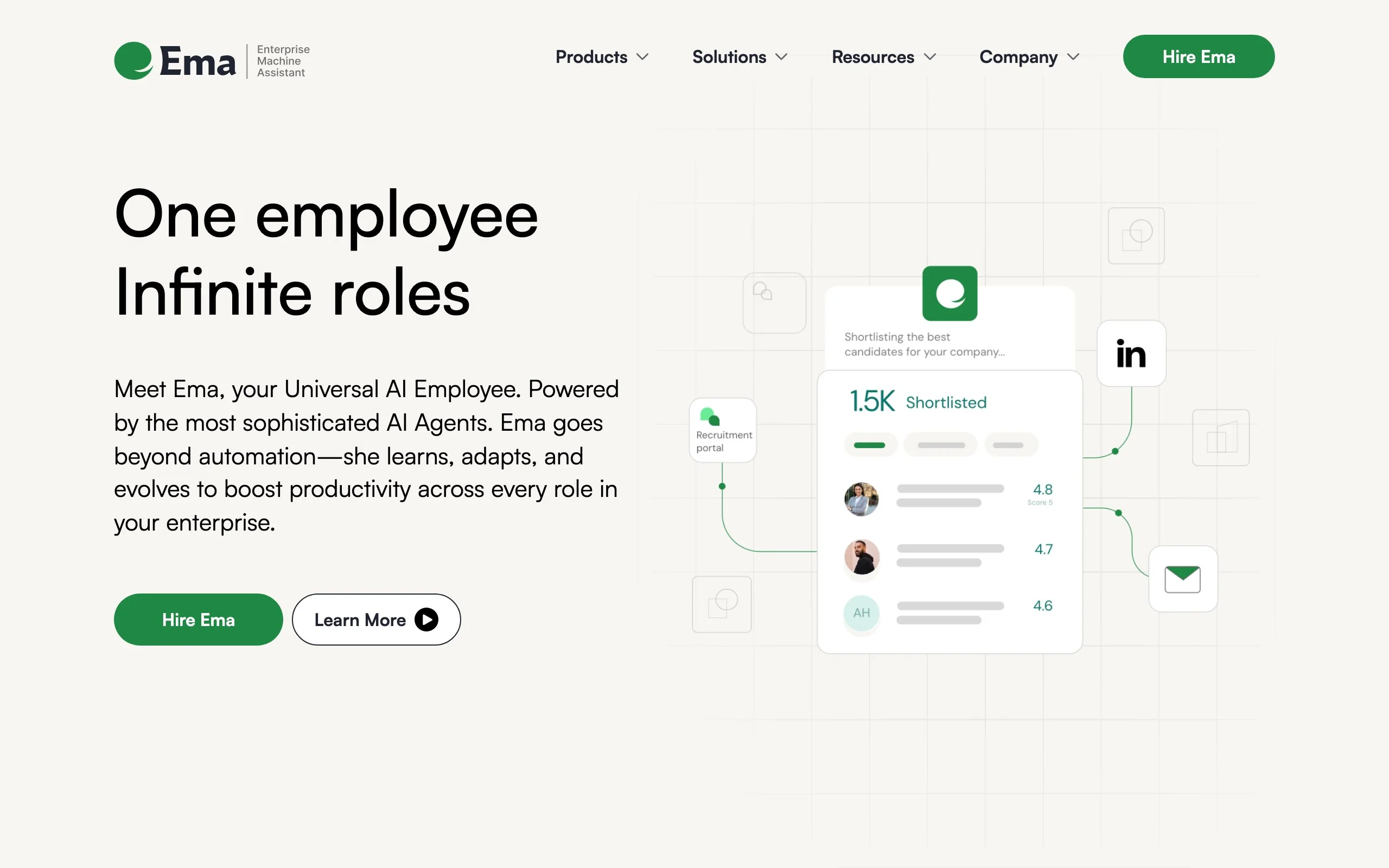
- Pre-built AI employee templates for customer support, compliance, HR, and data analysis
- Proprietary Generative Workflow Engine (GWE) for reasoning over structured and unstructured data
- No-code AI Employee Builder with guided setup flow
- On-premise deployment option for enterprise security requirements
- Multi-department coverage from a single platform
- Mid-to-large enterprises that want to deploy AI agents without writing code
- Compliance-heavy industries (fintech, legal, healthcare, insurance) that need AI reasoning over documents
- Teams that prefer an "AI employee" framing over traditional workflow automation
- Custom enterprise pricing based on business scale and deployment needs
- No public pricing tiers; requires sales engagement
- Tailored subscription plans with on-premise options available
Public reviews: we could not find an independently verified public rating for Ema AI on Clutch or G2 as of July 2026. If a rating shows up later, we will add it here, not before.
Pros- No-code deployment means non-technical teams can configure and launch AI agents
- Persona-based templates get you running faster than building from scratch
- On-premise option addresses data sovereignty concerns for regulated enterprises
- Relatively new company (founded 2023) with a smaller track record than established RPA players
- Custom pricing with no public tiers makes it hard to budget before a sales call
- Less suitable for teams that need deep, custom workflow logic beyond pre-built templates
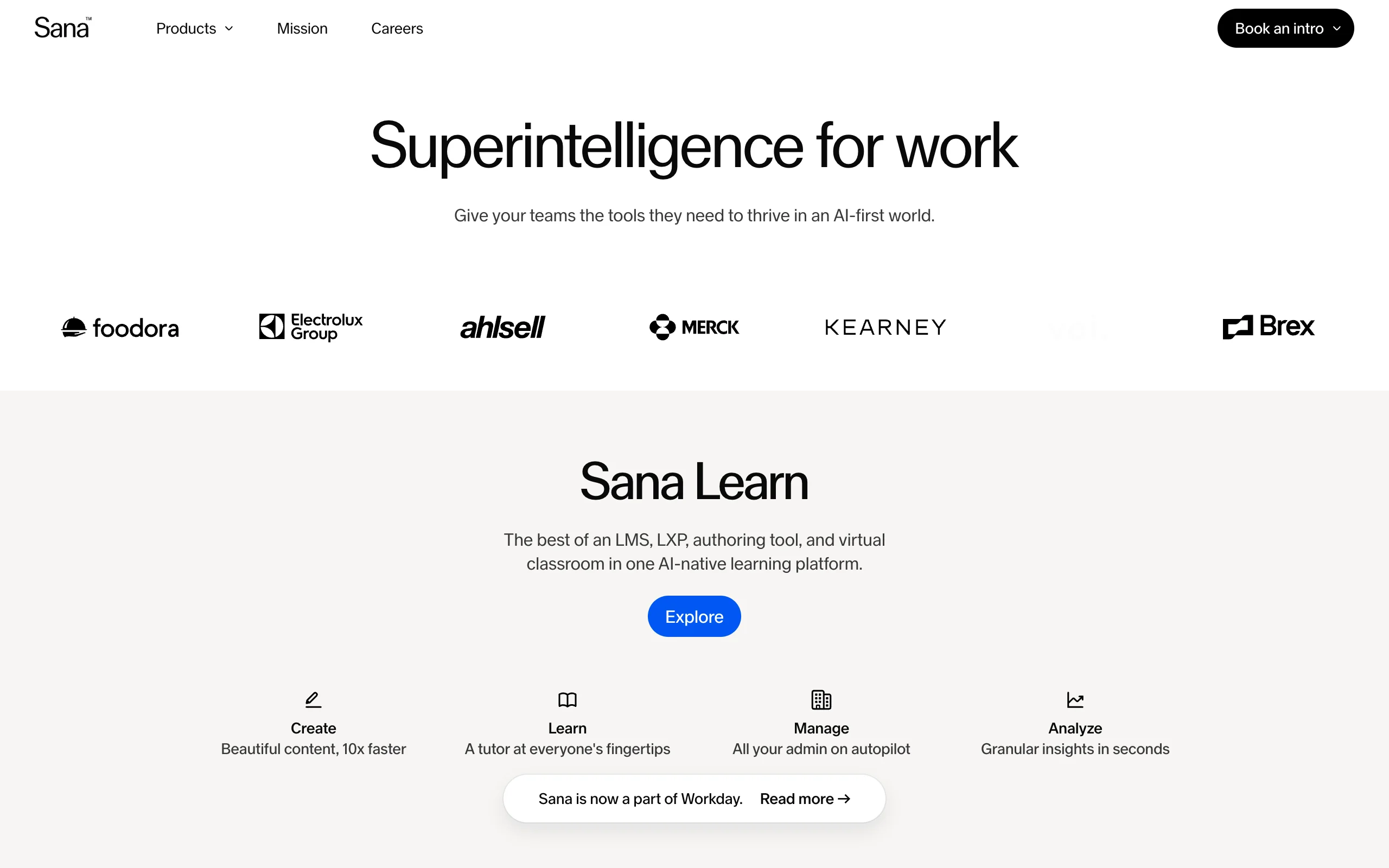
5. Sana Labs, best for knowledge management and AI learning agents
Sana Labs sits at the intersection of enterprise learning and AI automation. Their platform combines an AI-native learning management system (Sana Learn) with a no-code agent builder (Sana Agents) that connects to 100+ applications. Acquired by Workday for approximately $1.1 billion in late 2025, Sana now operates within the Workday ecosystem.
This makes Sana a strong pick for enterprises already using Workday, or those where knowledge management and employee training are core automation priorities alongside operational workflows.
- AI-native learning management with personalized tutoring and course generation
- No-code agent builder connected to 100+ enterprise applications
- Unified company knowledge base that powers both learning and automation
- Deep Workday integration following the 2025 acquisition
- Reported outcomes: up to 95% time savings finding product info, 90% productivity gains
- Enterprises already in the Workday ecosystem looking to add AI learning and agent capabilities
- HR and L&D teams that need learning automation paired with workflow agents
- Organizations in manufacturing, legal, healthcare, and consumer electronics
- Sana Learn's published entry pricing was $13/user/month (Core plan), 300-license minimum, at our last check; Sana's pricing page is now an interactive calculator with no static figure, so confirm current tiers directly with Sana
- Sana Agents has a free tier; scalable paid plans for enterprise use
- Enterprise pricing is custom with minimum seat commitments
Public reviews: 4.8/5 on G2 across 106 verified reviews for Sana Learn.
Pros- Unique combination of learning management and workflow automation in one platform
- Workday acquisition provides deep enterprise HR and finance integration
- Free tier on Sana Agents lowers the barrier to testing before committing
- Workday acquisition may limit independence and integration with non-Workday ecosystems
- 300-license minimum on learning plans prices out smaller teams
- Stronger on knowledge/learning automation than on complex multi-system workflow orchestration
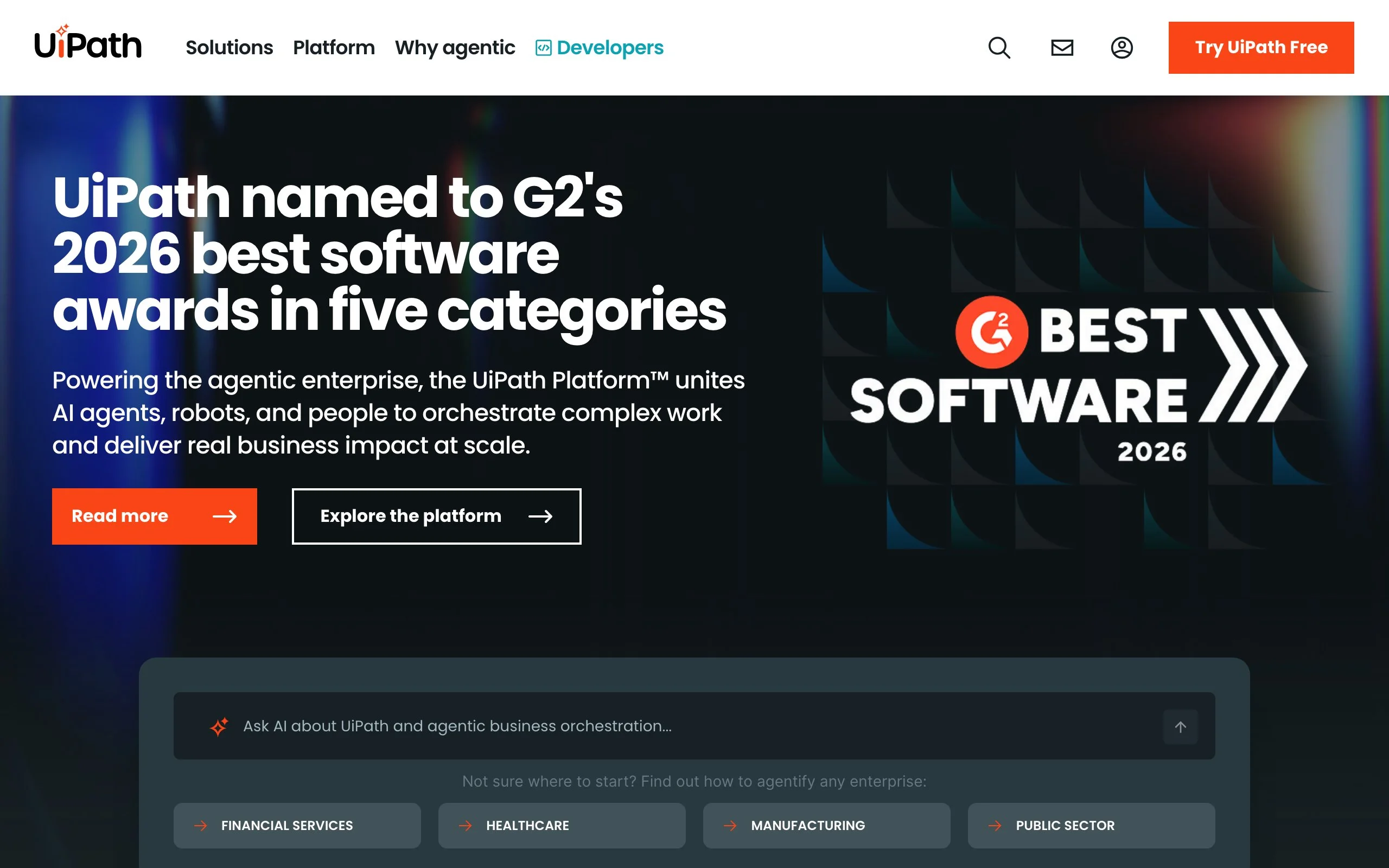
6. UiPath, best enterprise RPA platform with agentic AI
UiPath is the market leader in robotic process automation, with the broadest ecosystem of tools for building, deploying, and managing software robots. Their platform now extends into agentic AI with Agent Builder, process mining, intelligent document processing, and agentic testing. UiPath is publicly traded and serves thousands of enterprise clients globally.
If your automation needs center on scaling RPA across hundreds of processes with AI layered on top, UiPath has the most mature tooling. Their Maestro orchestration engine coordinates robots, AI agents, and human workers through BPMN-based processes.
- Industry-leading RPA platform with attended and unattended bot deployment
- Agentic AI capabilities via Agent Builder and Maestro orchestration
- Process mining and task mining for identifying automation opportunities
- Intelligent document processing (IDP) for classifying and extracting data at scale
- UiPath Test Cloud powers its agentic testing; UiPath was named a Leader in Gartner's Magic Quadrant for AI-Augmented Software Testing Tools (6 October 2025)
- Large enterprises managing hundreds of automated processes that need a proven, scalable RPA platform
- IT teams with dedicated automation CoEs (Centers of Excellence) that can manage the platform internally
- Organizations in banking, insurance, healthcare, and manufacturing with high-volume repetitive processes
- Basic plan starts at $25/month on UiPath's own pricing page
- Standard tier is custom-quoted through sales; third-party aggregators cite around $420/month, but that figure is not confirmed on UiPath's own site, so treat it as a rough signal
- Enterprise plans with full orchestration and AI capabilities are custom-priced
- Free Community Edition available for individual developers and small teams
Public reviews: 4.6/5 on G2 across 7,768 verified reviews, the largest review base of any agency or platform in this list.
Pros- Largest RPA ecosystem with the deepest partner and integration network
- Process mining helps you discover automation opportunities before building, reducing wasted effort
- Publicly traded with long-term stability and enterprise support infrastructure
- Primarily a platform, not an agency; you need internal teams (or a partner) to build and maintain automations
- Licensing costs scale quickly when deploying hundreds of bots across an enterprise
- Steeper learning curve for teams without dedicated RPA developers
7. Automation Anywhere, best cloud-native RPA with AI document processing
Automation Anywhere is a cloud-first RPA platform that has pivoted heavily toward "Agentic Process Automation." Their Automation 360 platform combines traditional RPA bots with AI agents and IQ Bot (their intelligent document processing engine). Automation Anywhere was named a Leader in the 2026 Gartner Magic Quadrant for Robotic Process Automation for the eighth consecutive year (report published 24 June 2026), and they serve major enterprises like Volkswagen, Mastercard, and Dell.
Their cloud-native architecture and drag-and-drop interface make them more accessible than UiPath for teams that want faster setup without heavy on-premise infrastructure.
- Cloud-native Automation 360 platform with microservices architecture
- IQ Bot for intelligent document processing of unstructured data (invoices, forms, contracts)
- Bot Store with 1,200+ prebuilt bots and digital workers
- Process discovery for automated identification of automation opportunities
- Advanced analytics (Bot Insights) for ROI tracking
- Enterprises that prioritize cloud-first architecture over on-premise RPA deployment
- Finance and accounting teams processing high volumes of invoices, purchase orders, and compliance documents
- Organizations that want prebuilt bots from a marketplace to accelerate deployment
- Automation Anywhere does not publish pricing; every paid tier requires a sales quote
- Third-party purchase data puts small deployments (5-10 bots) around $50,000-150,000/year, scaling into the hundreds of thousands for mid-market and enterprise rollouts
- Free Community Edition and trial available
Public reviews: 4.5/5 on G2 across 5,705 verified reviews.
Pros- Cloud-native architecture scales horizontally without heavy on-premise infrastructure
- IQ Bot excels at document-heavy automation (invoices, forms, compliance docs)
- 1,200+ prebuilt bots in the Bot Store reduce development time for common processes
- Like UiPath, it is a platform, not an agency; you still need internal automation engineers or a consulting partner
- Bot pricing adds up quickly when scaling across multiple departments
8. LowCode Agency, best for budget-conscious automation and app builds
LowCode Agency builds automation systems alongside full custom apps, using a broader toolkit than pure workflow platforms: n8n and Make for automation, Bubble, FlutterFlow, and Webflow for the app layer, plus Airtable and Zapier for lighter integrations. That combination suits teams that need an internal tool or MVP built at the same time as the automation around it, not just the automation itself.
Their published pricing signals put them at the accessible end of this list: an average hourly rate of $50 to $99 and project minimums that often land under $10,000, a meaningfully lower entry point than the enterprise consulting firms in this comparison.
Key features- Combined automation and app-development delivery in one engagement
- Broad toolkit: n8n, Make, Zapier, Bubble, FlutterFlow, Webflow, Airtable
- Lower typical project minimums than enterprise-focused agencies on this list
- Teams that need a custom internal tool, mobile app, or MVP built together with the automation that runs it
- Smaller projects where an enterprise consulting minimum would be overkill
- Average hourly rate of $50-99/hr
- Minimum project size around $10,000, with many smaller projects landing under that
- No structured pricing tiers published for larger, enterprise-scale engagements
Public reviews: 4.9/5 on Clutch across 34 verified reviews, with clients citing on-time delivery and responsive communication.
Pros- Lower typical minimum project size makes them accessible for smaller automation builds
- Combines app development and automation in one engagement instead of requiring two vendors
- 34 Clutch reviews give more independent signal than several other agencies on this list
- Broader app-plus-automation focus means less specialization in pure enterprise workflow orchestration than automation-first agencies
- No structured pricing tiers for larger engagements, so budgeting a big enterprise rollout upfront is harder
9. LeewayHertz, best for enterprise AI consulting in regulated industries
LeewayHertz is an AI consulting and development company (part of the Hackett Group) with 15+ years of engineering experience, covering strategy, use-case discovery, solution architecture, integration, and deployment. Gartner named LeewayHertz a representative vendor in its 2024 Hype Cycle for Generative AI, and the firm has been ranked among the top AI consulting firms by industry press.
Their work spans supply chain, finance, and retail, with an emphasis on regulated-industry engagements where strategic AI advisory needs to precede engineering execution. Teams that already have a defined use case and need deep engineering, rather than initial scoping, are the closest fit.
Key features- Full-lifecycle AI consulting: strategy, architecture, integration, and deployment
- Gartner-recognized (2024 Hype Cycle for Generative AI representative vendor)
- Enterprise engineering depth across supply chain, finance, and retail verticals
- Enterprises in regulated industries that need analyst-recognized AI strategy credibility alongside engineering
- Teams with a defined use case that need deep execution rather than exploratory scoping
- Hourly rate signal of $50-99/hr
- Typical project cost on Clutch is $50,000-$199,999; larger multi-model enterprise engagements can run higher but we could not verify a specific upper bound beyond that, so we are not stating one
- Published minimum engagement size around $10,000 for smaller scopes
Public reviews: 4.7/5 on Clutch across 9 verified reviews.
Pros- Analyst recognition (Gartner Hype Cycle) provides third-party credibility beyond client testimonials
- Deep bench across regulated, high-compliance verticals
- Full-lifecycle coverage from AI strategy through deployment
- Smaller public review count (9 on Clutch) than several other agencies on this list
- Better suited to buyers who already have a defined use case than teams needing exploratory strategic guidance from scratch
- Typical engagement cost ($50,000-$199,999 per Clutch) prices out smaller teams and single-workflow projects
Red flags when evaluating an AI automation agency
None of these disqualify an agency by themselves, but each one has cost a client real time or money in cases we've seen. Worth raising directly in a first call.
- The agency demos against a curated sample dataset and won't run the same demo against one of your actual, messy records. Ask them to try it on a live file before you sign anything.
- A case study cites a percentage improvement with no named metric definition. "40% faster" of what, measured how, against what baseline? If they can't answer in one sentence, treat the number as decorative.
- A fixed-price quote names no one responsible for maintenance after handoff. Something has to own the workflow when it breaks at 2am on a Friday. If that person isn't named in the contract, it's you by default.
- "AI-powered" language covering what turns out to be a basic Zapier or Make chain with no reasoning step. Ask directly which model is doing the reasoning and where it sits in the pipeline.
- No willingness to show a past client's actual working automation, even redacted. A dashboard screenshot is not the same as watching a workflow run.
- Pricing that only appears after a discovery call, with no ballpark offered up front, not even a wide one. Vague pricing usually means the agency is pricing the client, not the project.
- A sales contact who can't answer a basic question about error handling or retries without looping in someone else. If the person selling the project doesn't understand how failures get caught, that's a preview of support quality.
- References that are all logos, no names. A logo wall proves nothing on its own; ask for one call with an actual point of contact.
How to choose the best AI automation agency
1) Do you need a partner or a platform?
This is the first decision. Agencies like AY Automate, Kanerika, and RZLT act as partners: they assess your needs, build custom solutions, and manage ongoing operations. Platforms like UiPath and Automation Anywhere give you the tools, but you need internal teams to build and maintain automations.
- If you have a dedicated automation CoE with RPA developers: a platform (UiPath, Automation Anywhere) gives you maximum control
- If you want someone to handle strategy through maintenance: an agency (AY Automate, Kanerika) delivers faster with less internal overhead
- If you need AI-powered marketing and demand generation: RZLT combines agentic workflows with growth strategy
2) How complex are your automation needs?
Simple, repeatable processes (invoice processing, data entry) work well with RPA platforms and their prebuilt bots. But multi-system workflows that involve AI reasoning, custom API integrations, and private data access require deeper engineering.
- For standard RPA across high-volume processes: UiPath or Automation Anywhere
- For custom AI agents with RAG pipelines and complex integrations: AY Automate or Ema AI
- For AI-native marketing automation and growth campaigns: RZLT
3) What is your budget and timeline?
Enterprise RPA platforms require licensing fees plus internal staffing. UiPath publishes a $25/month Basic tier but moves to custom quotes above that; Automation Anywhere does not publish pricing at all. Agencies charge project fees but handle the build. Factor in total cost of ownership rather than sticker price.
- Budget-conscious teams exploring AI: Sana's free agent tier for initial testing, or LowCode Agency for smaller projects with lower minimums
- Mid-market teams needing fast delivery: AY Automate's 30-day MVP model
- Large enterprises scaling existing RPA: UiPath or Automation Anywhere with enterprise licensing
- Growth-stage startups needing pipeline: RZLT's campaign retainer model
4) Do you need ongoing support or a one-time build?
Some agencies build and hand off. Others provide continuous maintenance, monitoring, and optimization. If your automations are business-critical (revenue operations, customer support, compliance), ongoing support is not optional.
- For build-and-maintain partnerships: AY Automate offers 24/7 automation maintenance
- For ongoing growth marketing retainers: RZLT's team embeds with your marketing operations
- For self-managed with vendor support: UiPath and Automation Anywhere enterprise support tiers
5) What to ask before you sign
- Who owns this workflow after handoff? A good answer names a role or a team, not "our support inbox."
- What happens when the automation fails at 2am? A good answer describes real alerting and an escalation path, not "we'll fix it Monday."
- Can I see this running on my own data before I commit? A good answer is yes, even in a limited pilot. A flat no is worth pushing on twice.
- What's the realistic timeline, including the parts that usually slip? A good answer names dependencies on your team, not just theirs.
- What does "AI-powered" mean in this specific build? A good answer names the model and where it sits in the pipeline, not a slogan.
- What's the total cost if this needs to scale 5x? A good answer gives a real number or a real range, not "let's cross that bridge later."
- Who on your team has built something like this before? A good answer names a person and a project, not "broad experience."
Which agency fits your case
- Choose AY Automate if you want one partner to own strategy, build, QA, and 24/7 maintenance, and you don't have the internal bandwidth to run a platform yourself.
- Choose RZLT if your bottleneck is AI-powered marketing execution, not workflow automation. They are not an RPA or agent-development shop.
- Choose Kanerika if messy or fragmented data infrastructure is slowing your automation down more than workflow logic is.
- Choose Ema AI if you want a no-code way to stand up AI agents fast and can live without a published rating or public pricing to benchmark against.
- Choose Sana Labs if you are already inside the Workday ecosystem and learning/knowledge automation matters as much as workflow automation.
- Choose UiPath or Automation Anywhere if you already have an internal automation team (a CoE) and want to own the platform instead of paying an agency to run it for you.
- Choose LowCode Agency if you need a smaller automation build paired with a custom app or MVP, and a lower project minimum matters more than enterprise scale.
- Choose LeewayHertz if you are in a regulated industry and want analyst-recognized AI strategy credibility alongside the engineering.
- Skip AY Automate if: you already have in-house RPA developers and just need software licensing, not a build partner. That's UiPath or Automation Anywhere's territory. Or if your problem is purely AI-native marketing execution with no workflow or agent component, RZLT is the better fit. We would rather send you to the right agency than force a fit that doesn't work.
If you want more background before you decide: what workflow automation actually involves, how automation fits into a broader business strategy, what it costs to hire AI engineers directly instead, and what enterprise-scale automation actually requires.
FAQ
What is an AI automation agency?
An AI automation agency is a service provider that helps businesses design, build, and maintain AI-powered automation systems. Unlike software platforms that give you tools to build yourself, agencies handle the strategy, development, and ongoing operations. They typically specialize in workflow automation, AI agent development, and integrating AI into existing business processes.
What is the difference between an AI automation agency and an RPA platform?
An RPA platform (like UiPath or Automation Anywhere) provides software tools for building and managing bots. You need internal developers or a consulting partner to use them. An AI automation agency (like AY Automate or Kanerika) acts as your development team: they assess your needs, build custom solutions, and often maintain them post-launch. Agencies are better for teams without in-house automation expertise.
How much does it cost to hire an AI automation agency?
Costs vary widely based on scope. Full-service agencies like AY Automate use project-based pricing scaled to complexity. Growth marketing agencies like RZLT typically work on retainer models tied to campaign scope. Enterprise RPA platform licensing starts around $25/month for entry tiers (UiPath's published Basic plan) and moves to custom quotes for anything beyond that, plus implementation costs. For most mid-market companies, expect $10,000-50,000 for a focused automation project, with enterprise engagements ranging higher.
Can AI automation agencies work with my existing tech stack?
Yes. Most agencies specialize in integration. AY Automate, for example, uses n8n to orchestrate workflows across APIs, webhooks, and custom code, connecting your CRM, ERP, communication tools, and databases. The key question is whether the agency has experience with your specific platforms (Salesforce, HubSpot, SAP, etc.) and can handle custom API work.
Should I use a platform or hire an agency for AI automation?
It depends on your internal capabilities. If you have a dedicated automation team with RPA developers, a platform like UiPath gives you full control. If you need someone to handle everything from strategy through deployment and maintenance, an agency like AY Automate reduces time-to-value and internal hiring pressure. Many enterprises use both: a platform for standardized processes and an agency for complex, custom integrations.
What industries benefit most from AI automation agencies?
Banking and finance, healthcare, logistics, e-commerce, manufacturing, insurance, and legal are the most active adopters. These industries have high volumes of repetitive processes, strict compliance requirements, and complex multi-system workflows that benefit from AI-powered automation. If your team processes more than 1,000 documents, tickets, or transactions per month, automation typically delivers measurable ROI within 90 days.
How long does it take to implement AI automation?
Timeline depends on complexity. Simple RPA bots can be deployed in 1-2 weeks. Custom AI agents with RAG pipelines and multi-system integrations typically take 4-8 weeks. Full enterprise automation programs (process discovery, pilot, scale) can span 3-6 months. Some agencies, like AY Automate, offer 30-day MVP delivery for rapid validation before scaling.
What should I look for when evaluating AI automation agencies?
Focus on four things: (1) relevant industry experience and case studies, (2) technical depth in the specific AI capabilities you need (RPA, AI agents, RAG, workflow orchestration), (3) post-deployment support and maintenance, and (4) clear pricing structure with no hidden costs. Ask for references from clients in your industry and request a pilot project before committing to a large engagement.
What are the top AI automation agencies for B2B teams in 2026?
The top AI automation agencies for B2B teams in 2026, sometimes searched simply as the best AI agencies for automation work, are AY Automate for full-service strategy, build, and maintenance; RZLT for AI-native growth marketing; Kanerika for data analytics paired with automation; and Ema AI or Sana Labs for no-code AI agent and knowledge deployment. A b2b ai automation agency earns a spot on this list through production-grade delivery and transparent pricing, not marketing spend, the same evidence bar we hold every entry to. Enterprise RPA platforms like UiPath and Automation Anywhere belong here too, but as software you build with rather than a partner that builds for you.
For teams comparing workflow automation platforms before choosing an agency, see the best AI workflow automation tools 2026 guide.
If you are weighing dedicated software instead of an agency engagement, our best workflow automation platforms and best AI sales automation tools roundups cover the standalone tool options.Are AI automation agencies and AI automation companies the same thing?
Yes, in practice: "AI automation company" and "AI automation agency" describe the same kind of business, a team you hire to build and maintain AI-driven automation instead of doing it in-house. Searchers use both terms interchangeably, so the ranking above answers both questions the same way. If a distinction matters to you: "agency" more often implies an ongoing service relationship (retainer, maintenance), while "company" can also describe a software vendor. The rankings on this page are all service providers that build custom automation, not off-the-shelf software vendors, whichever term you use to search for them. And if your real goal is in-house capability rather than an ongoing retainer, AI engineer placement is the middle path: a vetted AI engineer embedded directly in your team.
Continue Reading
Slack AI Agent Integration: What to Scope Before You Install One (2026)
What a Slack-integrated AI agent actually does well, the permission and access questions to answer first, and the two failure modes this integration tends to produce.
AI Invoice Automation: What It Catches and Where Humans Still Matter (2026)
What AI invoice automation actually does (extraction, three-way matching, anomaly detection), where a human still needs to be involved, and how to evaluate a system.
Human-in-the-Loop AI Automation: Where to Put the Checkpoint (2026)
The main human-in-the-loop models (pre-execution approval, post-execution review, confidence-based routing, exception-only escalation) and how to decide where the checkpoint belongs.
Book a Free Strategy Call
Building this in production?
Walid runs a 30-min call to map your AI engineering team. Free, no slides.
Free weekly brief
Steal our production automations
The exact n8n flows, Claude Code setups, and prompts we ship for clients, broken down step by step. No spam, unsubscribe anytime.

Robel engineers production-grade automation pipelines at AY Automate, focused on integrations, reliability, and the systems that keep client workflows running.