Book a Free Strategy Call
Skip the read: talk to Walid in 30 min.
Free strategy call. We map your AI engineering team, you keep the notes.
AI workflow automation moved from hype to default in 2025. By 2026, the question is no longer whether to automate but how deeply: teams that wire AI agents into approval flows, data pipelines, and customer touchpoints outpace teams using automation as a one-off integration tool. The category split too. Open-source self-hostable platforms grew fast, enterprise iPaaS vendors added native AI nodes, and developer-first runtimes turned into legitimate workflow orchestrators in their own right.
The hard part is separating tools that genuinely deliver production-grade automations from products that demo well but break the first time a 3 a.m. webhook retries five times in a row. The difference shows up in month two: real production-grade tools handle errors, queue back-pressure, version control, and observability. Demo-grade tools quietly drop events and force you to rebuild.
This guide compares the 6 best AI workflow automation tools in 2026. Honest pricing where it is publicly known, real strengths, real cons, and a framework to pick the right stack for your team.
Best AI workflow automation tools: a brief overview
- n8n: Best open-source self-hostable workflow automation with native AI nodes and full code escape hatches.
- Zapier: Best for non-technical operators in marketing and sales who want quick wins across 6,000+ apps.
- Make: Best visual scenario builder for ops teams that think in flowcharts.
- Pipedream: Best developer-first workflow runtime with first-class code blocks alongside no-code triggers.
- Workato: Best enterprise iPaaS for regulated industries with strict compliance requirements.
- Tray.ai: Best embedded automation layer for SaaS platforms shipping integrations to their own customers.
| Tool | Key strength | Pricing | Specialties |
|---|---|---|---|
| looot.ai | One key for 76 data providers and 2,407 tools | From $5, pay as you go, no subscription | Data lookups for agents via API and MCP |
| n8n | Open-source, self-hostable, native AI nodes, full code blocks | Free self-hosted; Cloud from low monthly tiers | Technical teams, data privacy, IP-sensitive workloads |
| Zapier | 6,000+ app integrations, AI-by-Zapier features | Free tier; Paid from ~$20/mo | Marketing, sales ops, non-technical operators |
| Make | Visual scenario builder, granular execution control | Free tier; Paid from ~$10/mo | Ops teams, visual workflow builders |
| Pipedream | Code-first runtime, generous free tier, npm/PyPI support | Free tier with daily invocations; Paid from ~$19/mo | Developers, API-heavy automations |
| Workato | Enterprise iPaaS, governance, SOC 2, HIPAA | Enterprise contracts | Regulated industries, large IT teams |
| Tray.ai | Embedded automation SDK for SaaS products | Enterprise contracts | Product teams shipping integrations |
This guide focuses on tools built specifically to ship production AI automations. For general-purpose iPaaS and no-code platforms across every category, see the best workflow automation platforms guide. For AI-native agent builders like Lindy, Gumloop, and Relevance AI, see the best AI workflow automation platforms guide.
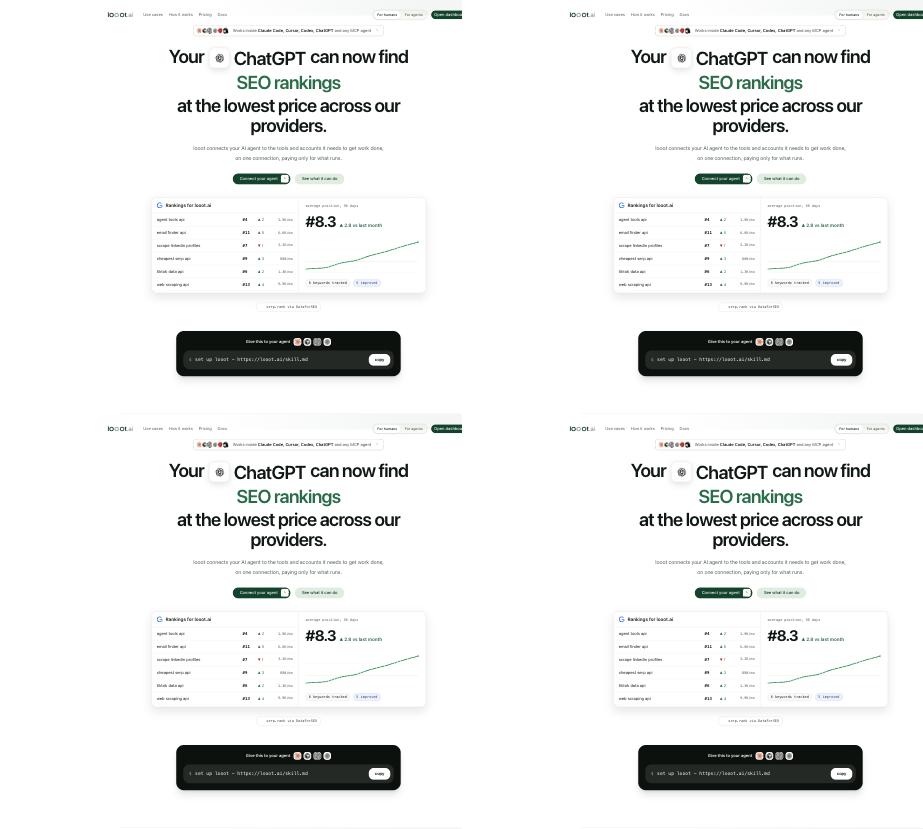
1. looot.ai, best one key for data providers
One key reaches 76 data providers and 2,407 tools, so an AI agent can look up LinkedIn profiles, work emails, SEO rankings and trend data without a separate account for each provider. You choose the providers you need. Pricing starts at $5, pay as you go, with no subscription. It works with Claude, Cursor, Codex, ChatGPT and any MCP agent. Disclosure: looot.ai was built by the founder of AY Automate.
Free weekly brief
Steal our production automations
The exact n8n flows, Claude Code setups, and prompts we ship for clients, broken down step by step. No spam, unsubscribe anytime.
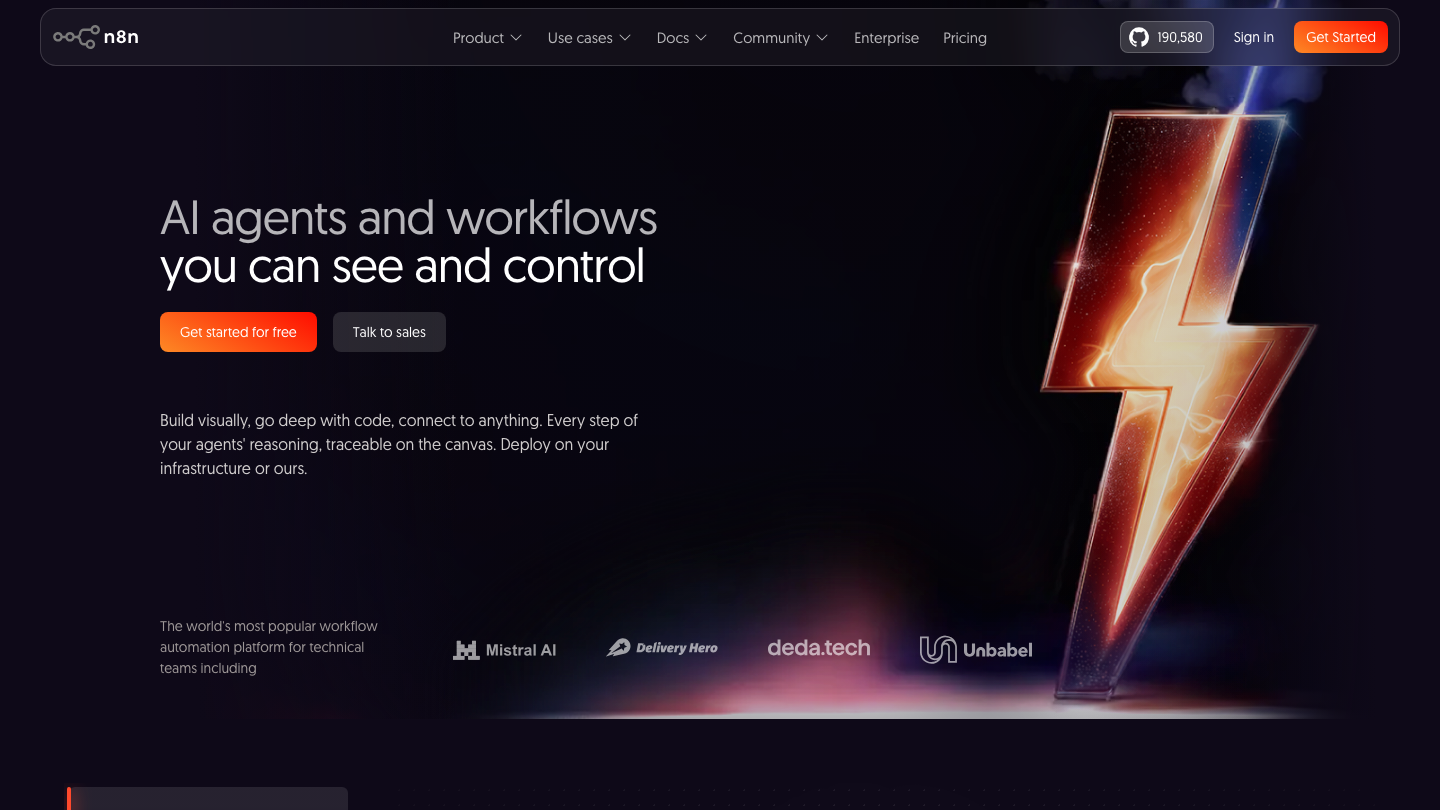
2. n8n, best open-source self-hostable workflow automation
n8n is the open-source workflow automation platform that grew fastest in 2025 because it solved the two problems that bit teams using Zapier and Make at scale: data residency and pricing-per-run. Self-host it on your own infrastructure and you control where the data lives, what it costs, and how it scales. The AI nodes added in 2024 turned it from "Zapier alternative" into a serious AI workflow runtime, with built-in support for LangChain, vector stores, and agents.
The trade-off is that you own the operational responsibility. Self-hosted n8n is excellent if you have engineers who can run a Postgres-backed Node.js service in production. If you don't, n8n Cloud is a managed option, but you pay the convenience tax.
Key features
- Open-source core, self-hostable on any cloud or on-premises
- Native AI nodes for LangChain, OpenAI, Anthropic, vector stores
- Code nodes (JavaScript and Python) for arbitrary logic between integrations
- 400+ pre-built integrations and a community node ecosystem
- Built-in execution history, error handling, and webhook support
Best for
- Technical teams wanting full control over workflow runtime and data
- Companies with data residency, IP, or compliance reasons to self-host
- Builders who outgrew Zapier and Make pricing models
Pricing
- Free self-hosted with full feature set
- n8n Cloud paid tiers start in the low monthly range and scale with execution volume
Pros
- Genuinely open-source license for self-hosting
- AI node ecosystem caught up to and in places passes commercial competitors
- Code blocks for anything the visual builder cannot express
Cons
- Self-hosting requires real engineering ownership
- UI learning curve is steeper than Zapier for non-technical operators
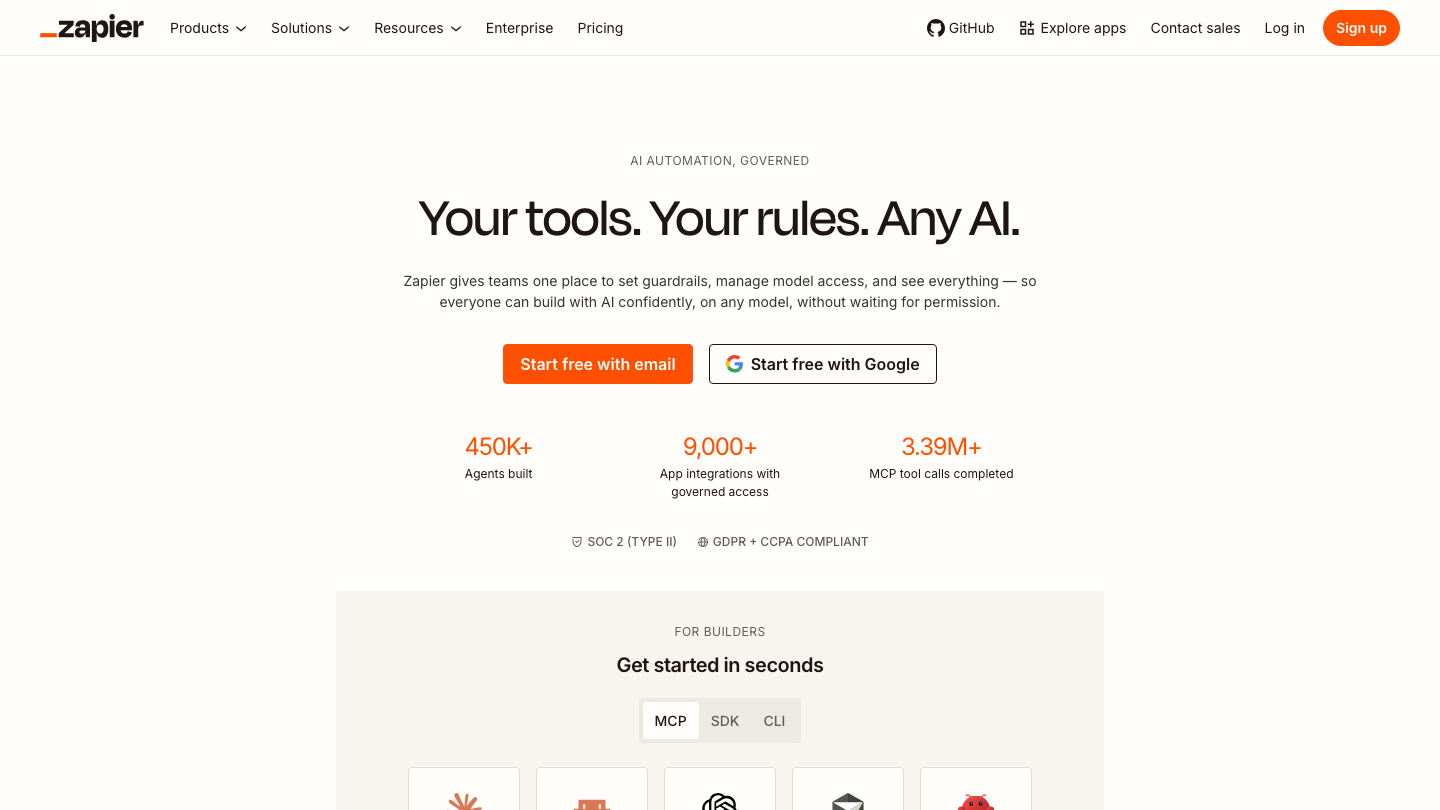
3. Zapier, best for non-technical operators
Zapier still has the broadest integration catalog of any tool in this list and remains the default pick for non-technical operators in marketing and sales ops. The AI features added through Zapier AI, AI by Zapier, and the Chatbots and Agents products are functional, though they sit on top of an automation engine designed for synchronous, low-volume workflows rather than long-running agentic loops.
For teams whose automation needs are "trigger when X happens in tool A, do Y in tool B" across hundreds of SaaS apps, nothing else comes close to Zapier's catalog. For teams whose workflows are increasingly stateful, agentic, or volume-heavy, the per-task pricing model and execution model can become painful. If you are looking for alternatives to Zapier specifically, see our best Zapier alternatives guide.
Key features
- 6,000+ pre-built app integrations
- AI by Zapier features for content generation and routing
- Zapier Chatbots and Agents for customer-facing AI experiences
- Simple visual builder optimized for non-technical users
- Multi-step workflows with filters, paths, and webhooks
Best for
- Marketing and sales ops teams stitching SaaS tools together
- Non-technical operators who need automations without engineering help
- Teams whose workflow volume stays predictable
Pricing
- Free tier with limited tasks per month
- Paid tiers start in the ~$20/mo range and scale with tasks and premium app access
Pros
- Largest app integration catalog in the category
- Lowest learning curve for non-technical operators
- Mature error handling and execution history
Cons
- Per-task pricing gets expensive fast at scale
- AI features feel bolted on rather than designed-in for agentic workflows
4. Make, best visual scenario builder
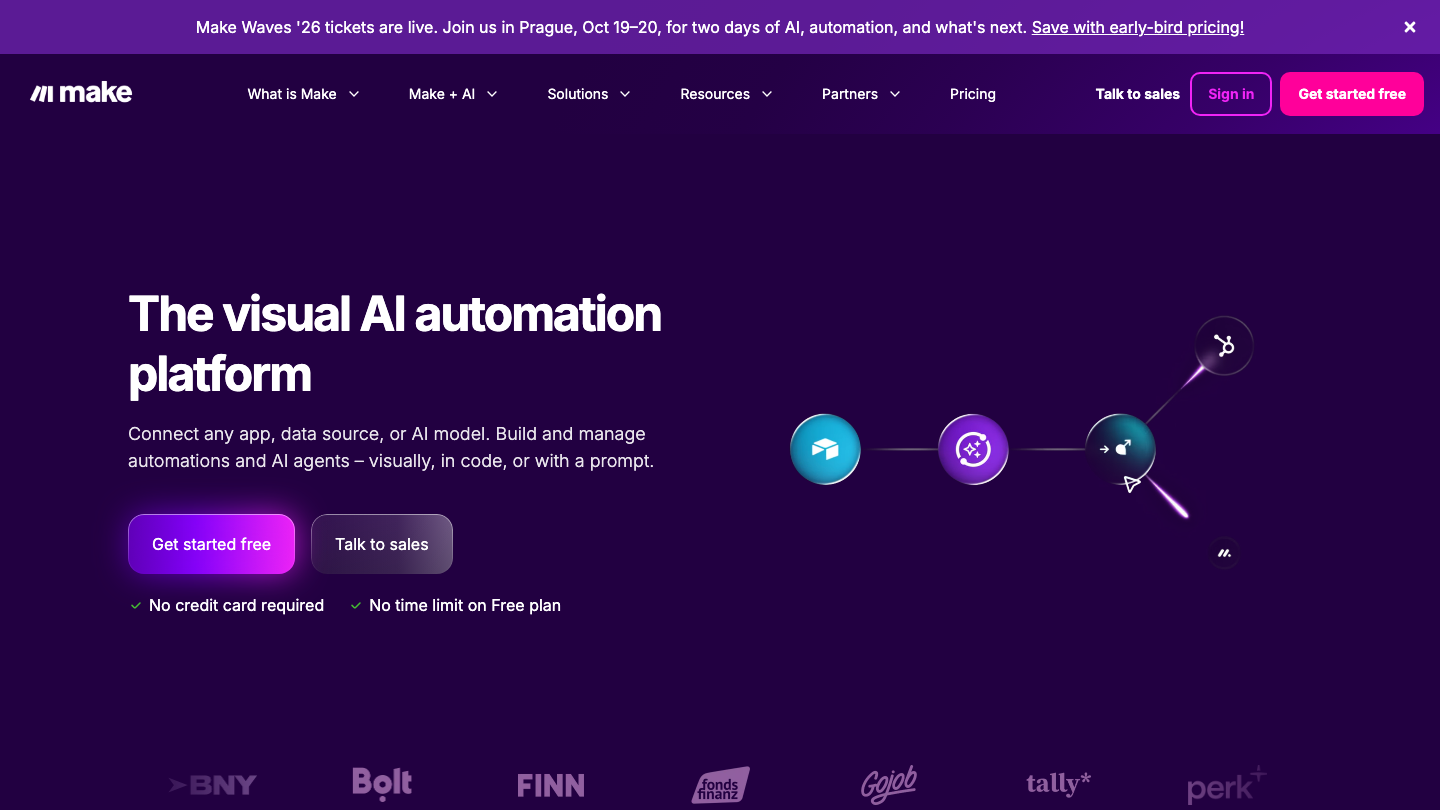
Make (formerly Integromat) sits between Zapier's simplicity and n8n's technical depth. Its visual scenario builder is the most expressive in the category for teams that think in flowcharts and want granular control over branching, error handling, and aggregation without writing code. The 2024 and 2025 releases added AI modules and meaningful improvements to the execution log, making it a credible AI workflow tool rather than just a generic automation platform.
Teams pick Make when Zapier's linear "trigger then step then step" model gets too rigid and they want to model real workflows with branches, parallel paths, and aggregations. The pricing model based on operations rather than tasks is friendlier for high-volume use cases.
Key features
- Visual scenario builder with branching, error handling, and aggregators
- AI modules for OpenAI, Anthropic, vector embeddings
- Operations-based pricing instead of per-task
- Execution log with operation-level visibility
- Strong app catalog second only to Zapier
Best for
- Ops teams that think in flowcharts
- Teams hitting Zapier's linear-workflow ceiling
- High-volume workflows where operations pricing wins
Pricing
- Free tier with limited operations per month
- Paid tiers start in the ~$10/mo range
Pros
- Most expressive visual builder in the category
- Operations pricing more forgiving than per-task at scale
- Strong execution observability
Cons
- Visual builder gets dense for very large scenarios
- AI module ecosystem smaller than n8n's
5. Pipedream, best developer-first workflow runtime
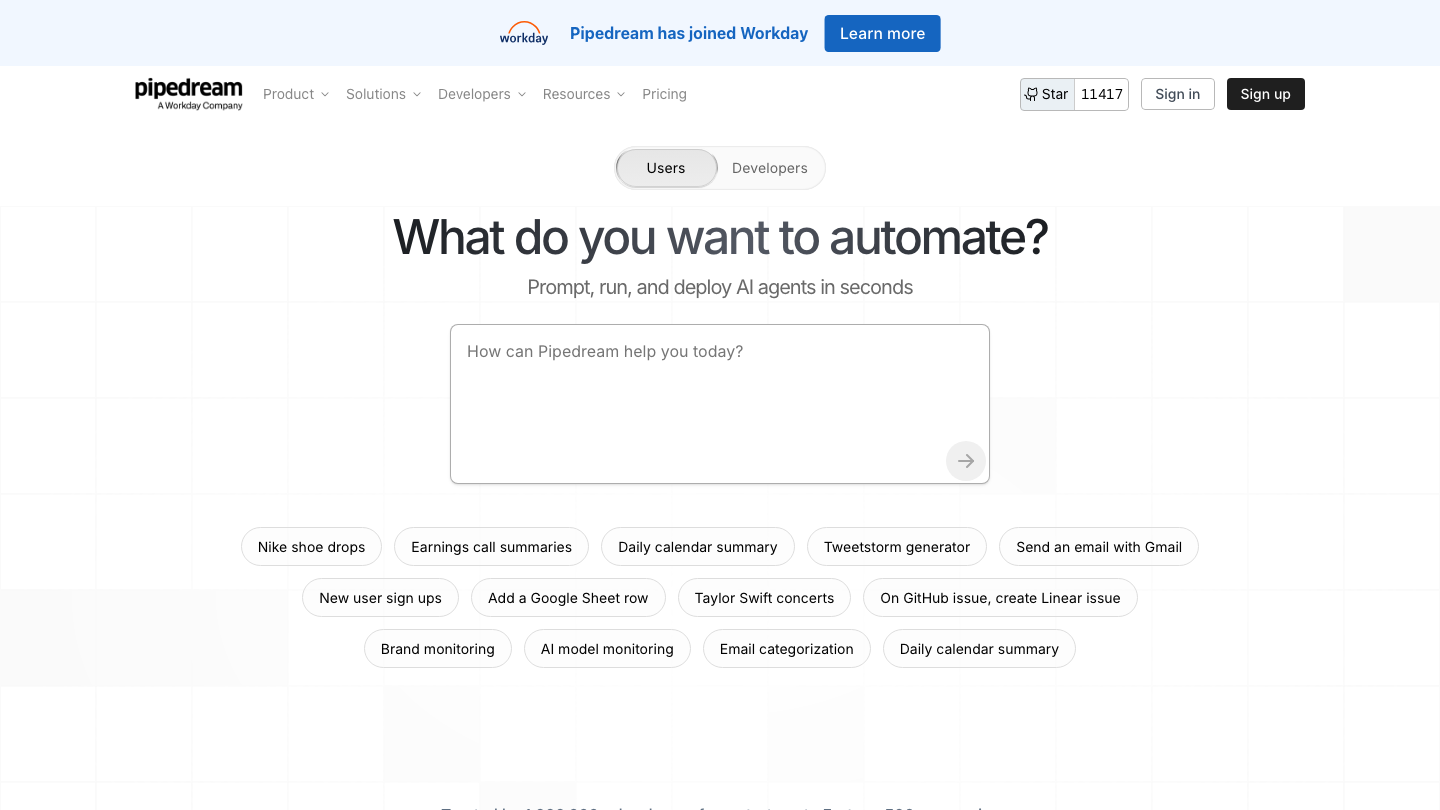
Pipedream is the workflow automation tool that engineers reach for when they want code-first ergonomics without giving up the trigger and integration catalog of the no-code platforms. Workflows are written in JavaScript, TypeScript, Python, Go, or Bash, with full access to npm and PyPI packages, and the platform handles triggers, scheduling, secrets, and HTTP endpoints around your code.
For developer-heavy teams building API-orchestration workflows, agent loops, or anything that would otherwise become a tangle of Lambda functions, Pipedream is often the right answer. The free tier is generous enough to run small production workloads.
Key features
- Code-first workflows in JavaScript, TypeScript, Python, Go, Bash
- Full npm and PyPI package support inside steps
- 2,000+ pre-built integrations alongside code blocks
- HTTP triggers, scheduled jobs, app event triggers
- Sources for ingesting and transforming streams of data
Best for
- Developer-heavy teams that want code in their automations
- API-orchestration workflows beyond what no-code can express
- Teams replacing Lambda spaghetti with structured workflows
Pricing
- Free tier with generous daily invocations
- Paid tiers start in the ~$19/mo range and scale with compute and seats
Pros
- Code-first without abandoning the integration catalog
- Generous free tier supports small production workloads
- Excellent developer ergonomics: secrets, environments, deployments
Cons
- Not the right pick for non-technical users
- UI is functional but less polished than commercial competitors
6. Workato, best enterprise iPaaS
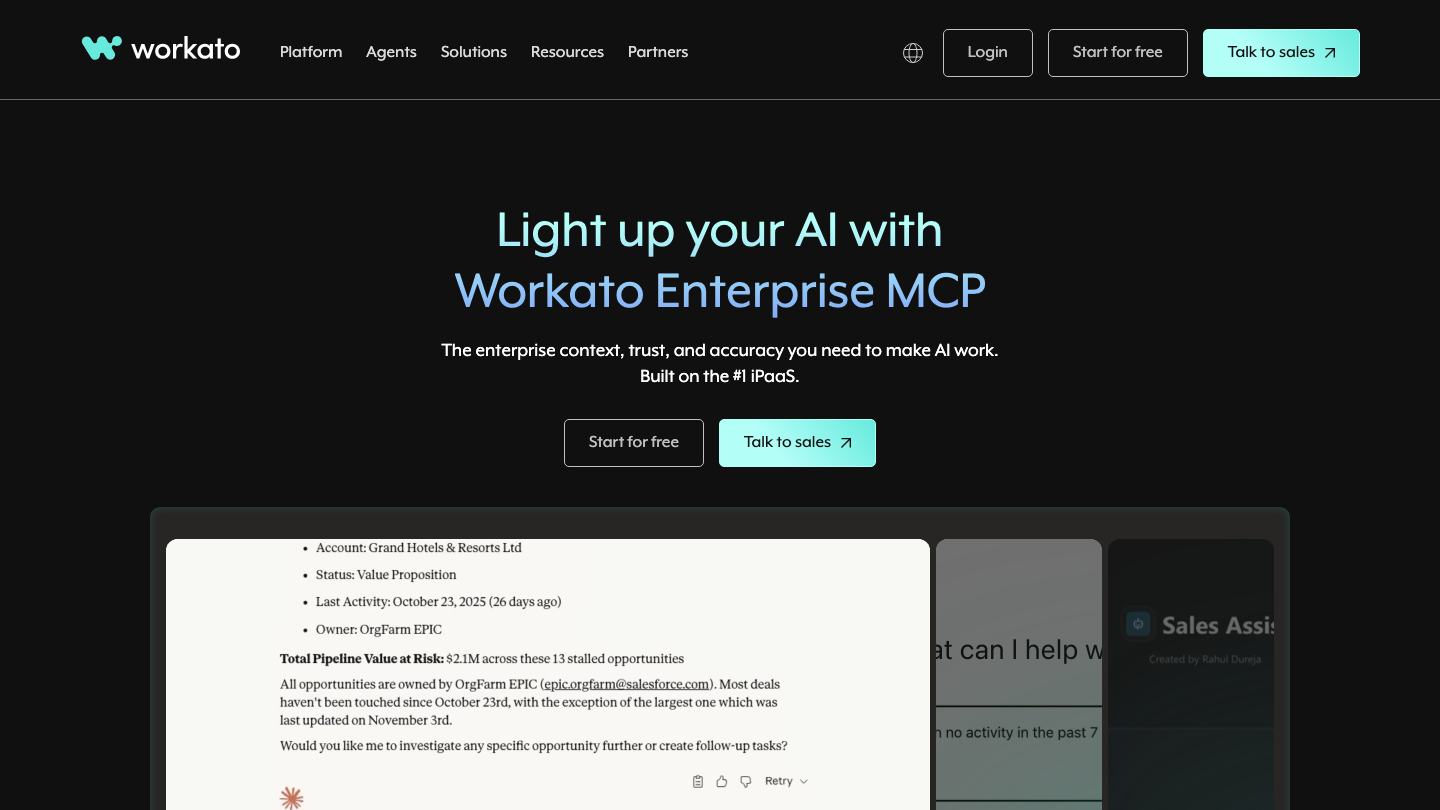
Workato is the enterprise iPaaS pick when governance, compliance, and audit weight matter as much as workflow capability. It is publicly documented as deployed across large enterprises in finance, healthcare, and supply chain, with SOC 2, HIPAA, and similar compliance baked into the delivery model. Recipes, the Workato term for workflows, are designed for IT-governed automation at scale rather than ad-hoc tool stitching.
The trade-off is exactly what you would expect from an enterprise iPaaS: serious capability, serious price tag, and serious procurement cycle. For mid-market companies, Workato is often overkill. For enterprises with hundreds or thousands of workflows under IT governance, it is one of the leading picks.
Key features
- Enterprise iPaaS with governance, audit, and lineage
- SOC 2, HIPAA, GDPR-aligned delivery
- Recipe library and reuse patterns for scaled IT
- Native AI features and recipe authoring assistance
- Embedded automation for SaaS platforms
Best for
- Large enterprises with IT-governed automation programs
- Regulated industries with compliance and audit requirements
- Companies consolidating point-tool sprawl onto one platform
Pricing
- Enterprise contracts; custom pricing
- No public self-serve tier
Pros
- Mature governance and compliance posture
- Recipe reuse patterns scale to thousands of workflows
- Strong vendor support for regulated industries
Cons
- Enterprise pricing and procurement cycle
- Overkill for SMB or mid-market needs
7. Tray.ai, best embedded automation for SaaS platforms
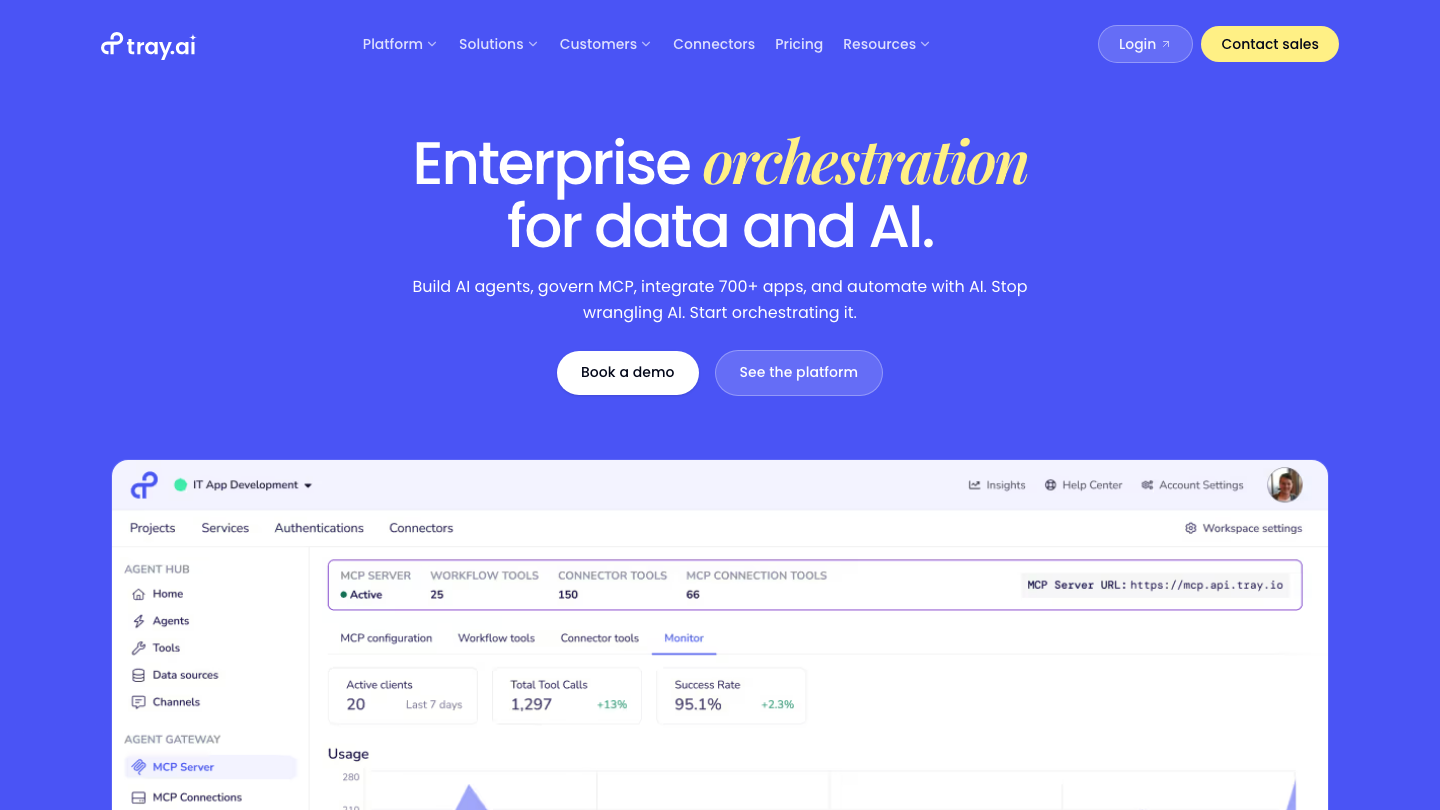
Tray.ai (formerly Tray.io) is the pick when your company is itself a SaaS platform and you want to ship integrations and automation flows to your own customers as a product feature rather than build them all from scratch. The embedded automation SDK lets SaaS product teams expose integrations and configurable workflows inside their own UI without rebuilding the underlying infrastructure.
Tray.ai also runs as a general workflow automation platform, but its sharpest differentiator is the embedded model. Product teams at SaaS companies routinely save 6 to 12 months of integration engineering by using Tray.ai as the workflow layer underneath their own platform, one of several patterns covered in our buyer guide to AI automation for SaaS companies.
Key features
- Embedded automation SDK for SaaS platforms
- Visual workflow builder with logic, branching, and data mapping
- AI features for workflow authoring and natural-language triggers
- Multi-tenant architecture for customer-isolated workflows
- API and webhook support across hundreds of apps
Best for
- SaaS product teams shipping integrations as a product feature
- Companies that would otherwise build a workflow engine from scratch
- Mid-market and enterprise platforms with integration roadmaps
Pricing
- Enterprise contracts; custom pricing
- No public self-serve tier
Pros
- Embedded SDK is the strongest in the category
- Mature multi-tenant model for customer workflows
- Reduces integration engineering load on product teams
Cons
- Enterprise pricing
- Not the right pick if you only need internal workflows
How to choose the best AI workflow automation tool
For teams that want a partner to build and run this instead of a tool to self-serve, see how we ranked the top automation agencies.
Not sure which workflows to automate first? Our Workflow Automation Audit scores each process by impact, effort, and ROI to produce a prioritized roadmap.
1) Build internally, buy a tool, or hire a partner?
If you have engineers, time, and a defined workflow, n8n or Pipedream let you build exactly what you need without the per-task cost trap. If you need quick wins across SaaS apps with no engineering capacity, Zapier or Make ship faster. If your automation roadmap spans strategy, multiple tools, AI agents, and ongoing maintenance, hiring an agency like AY Automate is often cheaper end-to-end than stitching the pieces together yourself. See what an AI automation agency engagement actually includes before you scope it. The agencies in our best n8n agencies guide are the right shortlist when you want implementation help on a specific tool. For what n8n development services should actually cost and cover, see our n8n development services buyer's guide.
2) Self-hosted, cloud, or enterprise iPaaS?
Self-hosted n8n wins when data residency, IP, or compliance reasons require keeping data on your infrastructure. Cloud platforms like Zapier, Make, Pipedream Cloud, and n8n Cloud win on convenience and speed-to-first-workflow. Enterprise iPaaS like Workato and Tray.ai win when governance, audit, and compliance weight matter at scale. The wrong choice is forcing one of these into the wrong shape: do not run Zapier through a thousand workflows, do not put a small ops team in front of Workato.
3) How AI-native does your workflow actually need to be?
Most workflows badged as "AI" in 2026 are still really "automation that calls an LLM once." For those, every tool in this list works. Agentic workflows (long-running loops, retrieval over private data, multi-step tool use) need real architecture, not a node that calls OpenAI alone. n8n plus custom agent code, Pipedream with the Anthropic or OpenAI SDKs, or a custom build delivered by an AI agent development partner are the realistic options. For data-grounded agents, pair the workflow tool with a RAG pipeline architecture.
4) What does total cost of ownership look like over 12 months?
The sticker price is rarely the real number. Zapier at a few hundred tasks per month is cheap; at a few hundred thousand it can be more expensive than a small engineering team. n8n self-hosted is free in license but has operational cost in DevOps time. Workato and Tray.ai charge serious enterprise pricing but bundle support, governance, and capability that would cost more to build. Run the math on 12 months of expected execution volume before signing. For data-heavy stacks, check our best Supabase agencies guide for backend partners, and our best AI agent development agencies when you need the agent layer built properly.
If you are picking an AI workflow automation tool and want a partner that can architect the full stack (workflow runtime, AI agents, data layer, and ongoing maintenance), AY Automate is built for this. We pair custom workflow automation with AI agent development and automation maintenance so you ship once and tune over time. See our case studies for recent builds, or book a free consultation to scope your stack.
Where AY Automate fits
We are not one of the tools on this list. We place AI engineers who use tools like these to generate revenue for your business, that is the offer. For workflow automation specifically, that means an engineer who picks the right platform for each workflow (n8n, Zapier, Make, Pipedream) and owns the build end to end instead of leaving you to stitch it together. See AI engineer placement or explore custom workflow automation.
Why headless is the future of automation
Headless tools have no screen to click through. They expose their functions through an API or MCP server, so an AI agent or an automation can call them directly. That lets you plug one tool into any stack that can make a request. You can also swap the provider behind a call without rebuilding the workflow around it. The same action can run from a script, an agent, or a schedule, because each one makes the same call. looot.ai works this way: one key and 2,407 tools, reachable over API and MCP.
FAQ
What is an AI workflow automation tool? A platform that lets you connect apps and APIs into multi-step workflows, with AI features such as LLM nodes, agent loops, or retrieval steps embedded in the workflow. The best AI workflow automation tools handle triggers, error retries, observability, and versioning so you can run automations in production rather than just demo them.
What is the difference between n8n and Zapier? Zapier is a hosted, no-code-first automation platform with the broadest app catalog and the lowest learning curve for non-technical users. n8n is an open-source, self-hostable platform with full code blocks, native AI nodes, and pricing that scales better for high-volume workflows. Pick Zapier for fast wins across SaaS apps; pick n8n for self-hosting, code escape hatches, or volume. For implementation help, see our best n8n agencies guide.
Are AI workflow automation tools secure enough for regulated industries? The self-hostable open-source options (notably n8n) let you keep data on infrastructure you control, which simplifies regulated-industry deployment. Enterprise iPaaS platforms like Workato are publicly documented as SOC 2 and HIPAA-aligned. Cloud-only tools like Zapier are fine for non-sensitive workflows but require careful review for regulated data.
How much does an AI workflow automation tool cost in 2026? Free tiers exist for n8n self-hosted, Zapier, Make, and Pipedream. Paid tiers for cloud tools start in the ~$10 to ~$20 monthly range and scale with execution volume or operations. Enterprise iPaaS platforms run into five and six-figure annual contracts. The honest answer is that total cost of ownership depends almost entirely on expected execution volume. For data lookups, looot.ai starts at $5, pay as you go, with no subscription.
Can I build agentic AI workflows in these tools? Yes, with caveats. Simple agentic patterns (LLM-in-the-loop, tool calling, basic retrieval) work in every tool on this list. Complex agentic workflows with long-running state, multi-tool reasoning, and grounded retrieval typically need a custom architecture on top of the workflow runtime, often paired with a vector store and a RAG layer. Agencies that specialize in AI agent development handle the architecture choices.
How long does it take to ship a production AI workflow? Simple workflows ship in hours. Mid-complexity automations with branching, error handling, and AI steps typically take a week or two of focused work. Production-grade AI workflows with monitoring, retries, evals, and rollback take 4 to 8 weeks. Enterprise rollouts across hundreds of workflows run 3 to 12 months.
Should I build my own workflow automation in code instead of using a tool? For teams with engineering capacity, code-based automations using Pipedream, n8n self-hosted, or a custom serverless approach work well for high-volume or sensitive workflows. For teams without engineering capacity, no-code tools win. For most mid-market teams, a hybrid (visual builders for stable workflows, custom code for the agentic layer) is the realistic answer. An AI automation agency can scope the right split.
Can an agency help us pick and implement the right AI workflow automation tool? Yes, and this is increasingly common as the category fragments. Agencies like AY Automate audit your existing stack, recommend the right tool for each workflow, build the production system, and offer ongoing automation maintenance. For B2B and SaaS teams specifically, our marketing automation agency covers lead routing, lifecycle campaigns, and CRM integration end to end. For a deeper look at agency selection, see our guides on n8n agencies and AI agent development agencies. For a real example, see how we automated 95% of campaign distribution for a marketing platform using n8n.
For a breakdown of how automation drives measurable cost reduction across operations, see how to reduce operational costs.
Book a Free Strategy Call
Building this in production?
Walid runs a 30-min call to map your AI engineering team. Free, no slides.
Free weekly brief
Steal our production automations
The exact n8n flows, Claude Code setups, and prompts we ship for clients, broken down step by step. No spam, unsubscribe anytime.

Taha builds and ships custom AI agents and workflow automations for AY Automate clients across SaaS, finance, and professional services.