
Book a Free Strategy Call
Skip the read: talk to Walid in 30 min.
Free strategy call. We map your AI engineering team, you keep the notes.
Choosing the best AI for ecommerce starts with the task, not the brand name. AI for ecommerce means software that uses models to create, classify, retrieve or act on information for an online store. For most teams, the right starting point is the AI already built into a core commerce platform, provided it can access the right catalog and order data.
No named ranking is included because comparable product features, prices and test results were not confirmed. Instead, this guide compares four kinds of options by task fit, data access, integration effort, human oversight and pricing basis. That gives you a practical shortlist without pretending one product can handle every ecommerce workflow.
The short answer
The right option depends on whether you need help inside one platform, broad knowledge work, customer interaction or a workflow that crosses systems. Start with one narrow process and define what a person must review before you compare tools.
- Built-in commerce AI: Best for teams that want help inside their existing store or marketing platform.
- General AI assistants: Best for research, drafts, analysis and internal productivity.
- Customer-facing AI agents: Best for support or product discovery grounded in approved store information.
- Custom AI automation: Best for bulk product data mapping and multi-step work across several systems.
| Option type | What it does | Best for | Pricing basis |
|---|---|---|---|
| Built-in commerce AI | Adds AI functions within an existing commerce tool | Low-friction adoption | Not published |
| General AI assistant | Creates and analyzes text or other supplied material | Research and internal work | Not published |
| Customer-facing AI agent | Answers shoppers or helps them find products | Support and product discovery | Not published |
| Custom AI automation | Connects models, rules, APIs and business tools | Cross-system operations | Project scope and maintenance needs |
How should you compare AI tools for ecommerce?
Compare options by task fit, access to current business data, integration effort, review controls and ongoing ownership. A polished answer is not useful if the tool cannot read the correct product, inventory, order or policy information. We do not rank options by popularity, vendor claims or an unsupported feature count.
Use a small test set based on your real work. For a support system, include policy exceptions and incomplete questions. For product mapping, include missing fields, conflicting categories and unusual variants.
Check these points before committing:
- Which systems can the option read from and write to?
- Can you restrict its actions and require approval?
- Can your team inspect errors and retry failed work?
- Who updates prompts, mappings and connections when the business changes?
- Does the pricing basis match your expected usage?
AY Automate provides custom automation, so we have a commercial relationship with that option type. We do not place it first by default.
What should you look for in built-in commerce AI?
Built-in commerce AI is the practical first choice when the work stays inside one platform. It can reduce setup because the feature is part of a tool your team already uses. Its value still depends on what data it can access, which actions it can take and whether its output fits your review process.
Best for
- Store teams that want a contained starting point
- Work that does not need several external systems
Strengths
- Fewer connections to design and maintain
- Familiar access controls and interface
Limits
- It may only work with data held in that platform
- Moving the process elsewhere may require rebuilding it
Skip this type if the workflow must coordinate several tools or apply detailed business rules across them.
Free weekly brief
Steal our production automations
The exact n8n flows, Claude Code setups, and prompts we ship for clients, broken down step by step. No spam, unsubscribe anytime.
When does a general AI assistant make sense?
A general AI assistant fits work where a person supplies context, reviews the result and remains responsible for the decision. Common uses include early research, draft content, document analysis and internal questions. It should not become an unattended source of truth for stock, orders, returns or product claims unless it is connected to current approved data.
The AI Stack I’d Use To Run an Ecommerce BrandWatch "The AI Stack I’d Use To Run an Ecommerce Brand" on YouTube
Best for
- Research and first drafts
- Tasks with active human review
Strengths
- Covers varied knowledge-work tasks
- Easy to test before building an integration
Limits
- It may lack current store information
- Staff can receive inconsistent results when context changes
Skip this type for unattended operational work that must update records or follow fixed rules.
The video below shows how Davie Fogarty Mentors would assemble an AI stack for an ecommerce brand.
When should you use a customer-facing AI agent?
A customer-facing AI agent suits support and product discovery when it can retrieve approved catalog, policy and order information. Its scope should be explicit. It also needs a clear route to a person when the request involves an exception, missing data or a decision the system should not make.
Best for
- Repeated customer questions
- Guided product discovery based on store data
Strengths
- Can handle questions outside staffed support periods
- Can ground responses in an approved knowledge base
Limits
- Weak source data produces weak answers
- Policy exceptions still need human judgment
Skip this type if policies are undocumented or product information is too inconsistent to retrieve safely. A private retrieval pipeline can ground answers in company information, which is one service offered by our AI automation agency.
When is custom AI automation the better fit?
Custom AI automation is the better fit when work crosses systems, follows company-specific rules or needs actions beyond generating text. AY Automate builds workflows and agents with n8n, Claude Code and clients' existing tools, tests them on real data and maintains them after launch. That makes this route relevant to product mapping, handoffs and multi-step internal operations.
Best for
- Bulk product data mapping with review rules
- Processes that connect several business tools
Strengths
- Can reflect company-specific logic
- Can replace manual handoffs through APIs and workflow engineering
Limits
- Requires design, testing and maintenance
- It cannot repair unclear ownership or poor source data by itself
Skip this route if a built-in feature already handles the full process. Technical teams comparing implementation approaches can also review our best Claude Code workflows and GitHub Copilot vs Claude Code guide.
How do you choose the right option?
Choose the smallest option that can complete the task with the required data, controls and human review. Built-in tools reduce connection work, general assistants suit supervised knowledge work, customer agents address shopper conversations, and custom automation handles processes that cross systems.
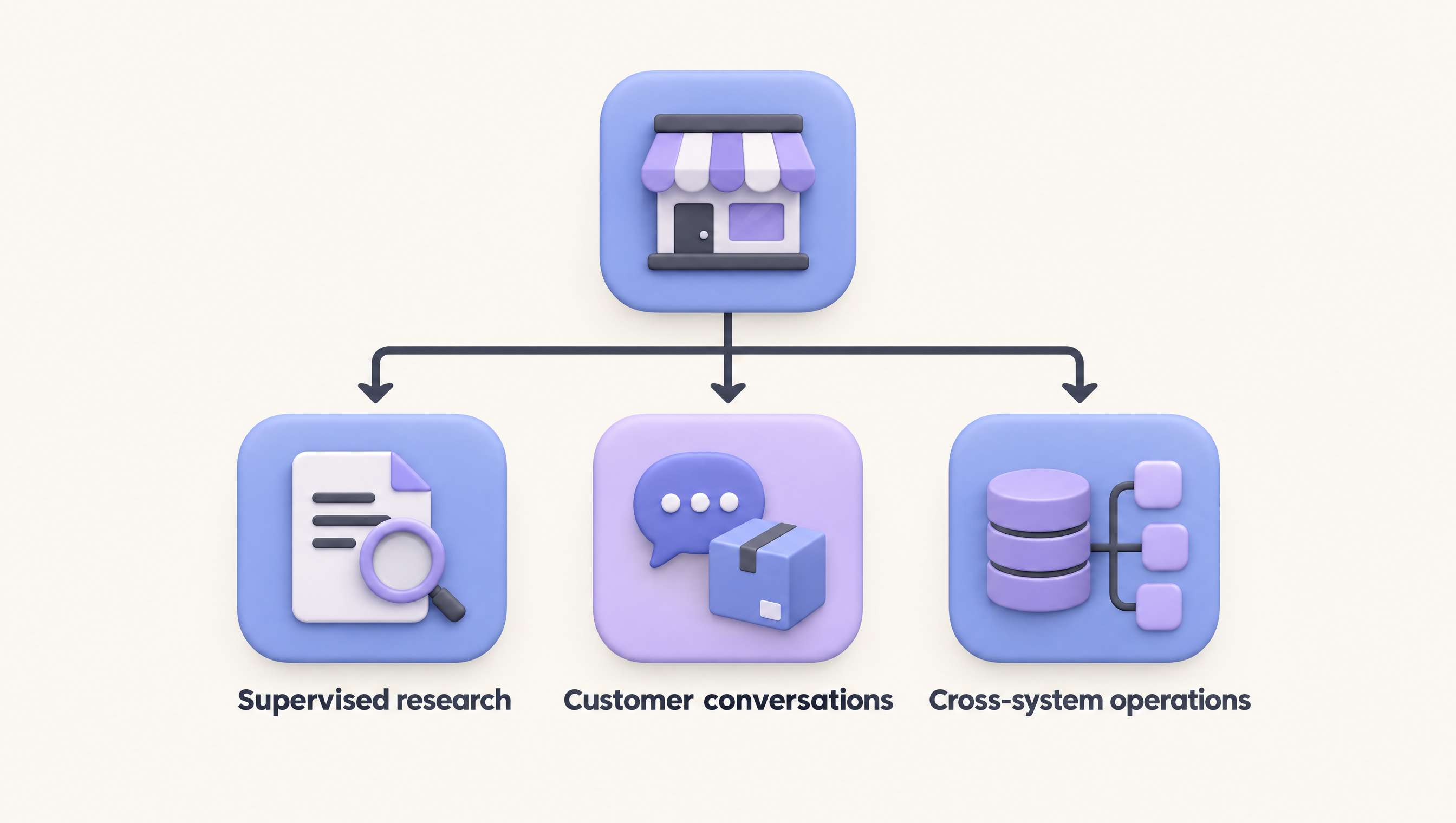
Choose built-in AI for work contained in one platform
Start here when the input, action and result all remain in your main commerce or marketing system. Confirm that the feature can access the records you need and that a person can review sensitive output.
Choose a general assistant for supervised research
Use a general assistant when your team will provide context and check each result. For shopping research, check whether you need one retailer's catalog or comparisons across stores before choosing a tool.
Choose an agent for repeated customer conversations
Use an agent when questions repeat and approved answers exist. Define escalation rules before launch, then test the agent against policy exceptions and incomplete customer requests.
Choose custom automation for cross-system operations
Use custom automation when a process reads from one system, applies business rules and writes to another. For implementation help, talk with our AI automation agency. Developers can also compare Claude Code CLI tools before selecting a build setup.
FAQ
Which AI is best for shopping research?
Amazon Rufus is a strong option for groceries and household research within Amazon, based on a cited test where it scored 89.1 in that category. Its advantage there came from access to one store's catalog, delivery times and Subscribe and Save prices. If you need comparisons across retailers, choose a research tool that can examine several stores rather than one catalog.
What is the 30% rule in AI?
The 30% rule is an informal guideline that keeps roughly 30% of the work with people for oversight, judgment and creative decisions while AI handles roughly 70% of repetitive, data-heavy tasks. It is not a regulation, ISO standard or legal requirement. Treat it as a planning prompt, not a required allocation.
What are the 7 main types of e-commerce business models?
The seven commonly listed models are B2C, B2B, C2C, C2B, B2G, C2G and D2C. Your model affects the AI choice because product data, sales cycles, permissions and customer questions differ across these relationships.
What are the 5 applications of AI?
Five relevant ecommerce applications are customer service, chatbots, business operations, image enhancement and social media work. These are selected from a broader published list of AI application areas. Choose a separate process and success check for each application rather than buying one tool for an undefined goal.
What are the 5 things AI can't do?
AI should not independently own creativity and innovation, system architecture, timing-sensitive process design, empathy-led user experience, or security and ethical responsibility. It can assist with parts of these areas, but people must own the judgment and consequences.
what ai ecommerce automation tools are available for 24/7 support and productivity?
The main option types are built-in commerce AI, general assistants, customer-facing agents and custom automation. Customer agents fit repeated support questions, while custom workflows can handle approved business logic across connected tools outside staffed hours. Human escalation and monitoring still matter.
is it best ai ecommerce automation for bulk product data mapping?
Custom AI automation is usually the most suitable option type for bulk product data mapping when categories, attributes and exceptions follow company-specific rules. Test it on real product records, require review for uncertain matches and keep a record of mapping failures.
Sources
Sources: AY Automate, AY Automate AI automation agency, shopping research result, 30% rule result, ecommerce business models result, AI applications result, AI limits result.
Last checked: 2026-11-14
Book a Free Strategy Call
Building this in production?
Walid runs a 30-min call to map your AI engineering team. Free, no slides.
Free 30-minute call
Want us to look at your setup?
Leave your name and email. You get the calendar right after.

Taha builds and ships custom AI agents and workflow automations for AY Automate clients across SaaS, finance, and professional services.