Book a Free Strategy Call
Skip the read: talk to Walid in 30 min.
Free strategy call. We map your AI engineering team, you keep the notes.
Claude agent teams can divide a large task among separate AI sessions, but the right setup depends on how much control, isolation and recovery your work requires. For most software teams, the sensible starting point is a supported native setup with a lead agent, clear task ownership and human review. Custom or OpenCode based orchestration becomes more useful when you need different models, tools or coordination rules.
A Claude agent team is a group of AI coding sessions that coordinate work across shared tasks. This guide compares three kinds of setup rather than ranking named products. No confirmed set of comparable products, features and prices was available, so a numbered ranking would suggest certainty that the evidence does not support.
The short answer
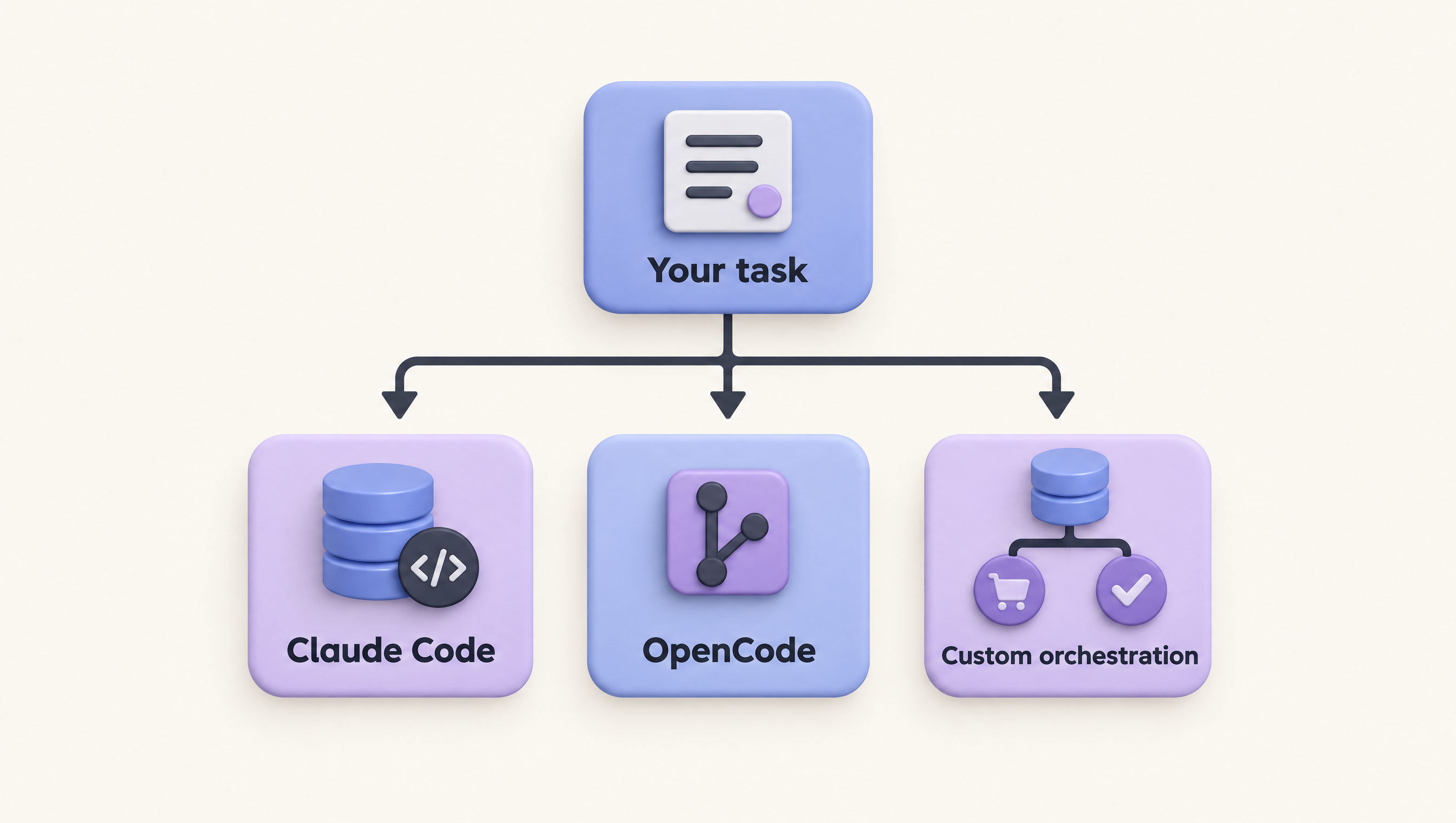
Choose the least complex setup that can divide your work safely. Native Claude Code teams suit teams that want a direct path within Claude Code. Community OpenCode implementations suit technical users who want to inspect or change the coordination layer. Custom orchestration suits businesses connecting agents to wider operational workflows.
- Native Claude Code agent teams: Best for software teams already working in Claude Code and willing to supervise experimental team workflows.
- Community OpenCode agent teams: Best for developers who want an inspectable implementation and can maintain community code.
- Custom agent orchestration: Best for B2B, SaaS and ecommerce teams connecting agents to business systems, approvals and private knowledge.
| Option | What it does | Best for | Pricing basis |
|---|---|---|---|
| Native Claude Code agent teams | Coordinates multiple Claude Code sessions around shared project work | Teams already using Claude Code | Not published |
| Community OpenCode agent teams | Adds team coordination patterns to an OpenCode based environment | Developers who can inspect and maintain the implementation | Not published |
| Custom agent orchestration | Connects agents, workflow tools, APIs, business rules and human approvals | Operational work that extends beyond coding | Project scope and operating requirements |
How should you assess Claude agent teams?
We assess these approaches by task fit, coordination model, context isolation, recovery, permissions, observability and maintenance burden. We do not rank them by popularity, search position or unverified performance claims. The right choice is the one whose operating model matches your work and your team's capacity to supervise it.
How to Build Claude Agent Teams Better Than 99% of PeopleWatch "How to Build Claude Agent Teams Better Than 99% of People" on YouTube
This is a guide to choosing, not a product ranking. AY Automate provides custom automation and agent development, so we have a commercial relationship with the custom approach described below. We do not place it first by default.
Use these checks before adopting any setup:
- Task separation: Can you give each agent a clear area of responsibility?
- Coordination: Is there a lead session, direct agent messaging or an external controller?
- Shared state: Where are tasks, decisions and outputs recorded?
- Failure recovery: What happens when a session stops or returns unusable work?
- Permissions: Can each agent access only the files, tools and data it needs?
- Review: Who approves changes before they reach customers or production systems?
- Cost visibility: Can you inspect model use, retries and duplicated work?
- Maintenance: Who updates prompts, integrations and recovery rules when the workflow changes?
A useful evaluation starts with one bounded workflow. Give every role an explicit input, output and stopping condition. Then test incomplete work, conflicting changes, unavailable tools and bad assumptions rather than assessing only the happy path.
The video below shows one practitioner's approach to building Claude agent teams and can help you see how delegation choices affect the setup: How to Build Claude Agent Teams Better Than 99% of People by Nate Herk of Nate Herk | AI Automation.
Free weekly brief
Steal our production automations
The exact n8n flows, Claude Code setups, and prompts we ship for clients, broken down step by step. No spam, unsubscribe anytime.
What are the main kinds of Claude agent team setup?
There are three practical categories to compare: native Claude Code teams, community OpenCode implementations and custom orchestration. They solve related coordination problems but create different responsibilities. Native support reduces setup work, community code offers more inspectability, and custom systems can connect agents to business processes outside a coding environment.
Native Claude Code agent teams
Native Claude Code agent teams coordinate multiple Claude Code sessions around the same project. One session can act as the lead while other sessions take distinct tasks. This approach fits work that can be separated by component, investigation or review area. Anthropic's documentation describes agent teams as teams of Claude Code sessions, while the interface and supported behavior should be checked before each implementation because the available workflow may change.
Best for
- Engineering teams already using Claude Code for repository work
- Projects with tasks that can proceed independently before review
Strengths
- Keeps the team workflow within the Claude Code environment
- Supports separate session context for distinct responsibilities
- Gives the lead session a defined coordination role
Limits
- Parallel sessions can duplicate effort if task boundaries are weak
- More sessions create more output for a person to inspect
- A team setup does not replace tests, access controls or code review
Who should skip it
Skip this approach when the task is small, tightly sequential or difficult to divide. A single session or a focused subagent may be easier to control. You should also avoid it when nobody owns final review or when agents would receive broader repository access than the task requires.
For related command line options, see our guide to the best Claude Code CLI tools.
Community OpenCode agent teams
Community OpenCode agent teams adapt team coordination patterns to an OpenCode environment. One documented implementation discusses agent communication, spawning, state management, crash behavior and testing. A separate GitHub plugin describes workflows for parallel code review, debugging and coordinated feature development. These are useful reference points, but a community implementation should not be treated as official support without checking its owner and repository.
Best for
- Developers who want to read and change the orchestration code
- Teams prepared to test, secure and maintain a community project
Strengths
- Makes coordination logic available for technical inspection
- Can expose design choices around messaging, state and agent creation
- Offers a starting point for teams studying alternative orchestration patterns
Limits
- Repository ownership, update policy and compatibility may vary
- Your team may become responsible for fixes and security review
- Similar project names do not prove that implementations share features
Who should skip it
Skip a community implementation if you need vendor support, a fixed compatibility commitment or an approved enterprise procurement path. It is also a poor fit when your team cannot inspect dependencies, permissions and failure behavior before agents touch a real repository.
When searching for "OpenCode agent teams GitHub," verify the repository owner, licence, recent changes, installation steps and issue history. Distinguish an official project repository from a plugin, fork or example. Read the code path that creates agents and stores team state rather than relying on the repository description alone.
Custom agent orchestration
Custom orchestration places agent coordination inside a wider workflow built around your systems and rules. It can combine agents with APIs, workflow tools, private retrieval, approval steps and operational records. AY Automate builds n8n workflows and autonomous agents connected to existing business tools, and it tests systems on real data before maintaining them after launch. This option offers more control, but it also creates an ongoing engineering responsibility.
Best for
- SaaS or ecommerce operations that cross several business systems
- Teams that need approvals, private knowledge or tailored access rules
Strengths
- Can reflect your actual handoffs, permissions and business logic
- Supports API integration between agents and existing systems
- Can include private retrieval pipelines that ground answers in company information
Limits
- Requires design, testing, monitoring and maintenance
- Scope can grow when the underlying business process is unclear
- Custom work is usually excessive for a simple coding task
Who should skip it
Skip custom orchestration when a supported product already handles the full workflow with acceptable controls. You should also pause if the process has no stable owner, clear source of truth or review policy. Automation will expose those gaps rather than solve them by itself.
AY Automate's AI agent development service is relevant when agents must execute multi step work across company systems. For broader workflow audits and ongoing maintenance, review our AI automation agency approach.
How do you choose the right setup?
Start with the work rather than the number of agents you want. Choose native Claude Code teams for bounded repository work, inspectable OpenCode implementations for experimentation, and custom orchestration for workflows that cross business systems. Move to a more complex setup only when the simpler option cannot meet a specific requirement.
Choose native Claude Code teams for bounded software work
Use the native route when the work stays inside a codebase and can be divided cleanly. Examples include separate investigations, independent components or review areas. Define ownership so that two sessions do not edit the same area without a merge plan.
Start with a lead session and a small number of distinct assignments. Require each session to report assumptions, changed files, tests and unresolved questions. A person should review the combined result before it moves into a protected branch or release process.
Choose OpenCode agent teams when inspectability matters
An OpenCode implementation may suit you when the coordination mechanism itself is part of what you want to study or change. Inspect how it starts agents, routes messages, persists state and handles interrupted work. Confirm what happens when an agent returns late, fails silently or edits overlapping files.
Do not choose from a repository name alone. Check whether the project is a plugin, fork, demonstration or maintained package. Run it in an isolated test repository before granting access to internal code or credentials.
Choose custom orchestration for cross system work
Use custom orchestration when the process includes customer records, support tools, inventory, billing, internal knowledge or approval queues. In this case, the hard problem is usually not agent conversation. It is controlling data access, recording decisions and handling exceptions across systems.
Map the workflow before choosing models. Mark each system of record, permitted action and required approval. If your team wants an engineer to learn the workflow and build within the existing stack, AY Automate also offers embedded engineering.
Choose one agent or a subagent for smaller tasks
Do not build a team when one agent can complete the task with a clear prompt and adequate context. A subagent can be enough for a contained investigation or specialist check that returns a result to the main session. Fewer moving parts make review, cost tracing and failure diagnosis easier.
A simple test is to ask whether the assignments can progress independently. If every task waits for the previous task's output, parallel agents add coordination work without creating useful parallel progress.
If you need help mapping an operational workflow, define the current steps, systems, owners and approval points before discussing implementation. We can then assess whether a single agent, a team or ordinary workflow automation is the smallest suitable design.
FAQ
What is a Claude agent teams list?
A Claude agent teams list usually means a list of team configurations, tools or implementations for coordinating multiple Claude sessions. No stable product list is presented here because comparable named options, current features and prices could not be confirmed. The useful categories are native Claude Code teams, community OpenCode implementations and custom orchestration.
What are the best Claude agent teams?
The best Claude agent teams are those matched to a clearly divided task, controlled permissions and a defined review process. Native Claude Code teams fit bounded coding work, OpenCode implementations fit technical experimentation, and custom orchestration fits work that crosses business systems.
What is the difference between a Claude agent team and a subagent?
A Claude agent team coordinates separate sessions that can hold distinct responsibilities, while a subagent is better treated as a contained worker returning a result to a main session. Choose a team when roles need ongoing coordination. Choose a subagent when one delegated task has a clear return point.
How do OpenCode agent teams work?
OpenCode agent teams depend on the implementation, but the coordination layer generally needs to create agents, route work, exchange messages and track state. Before adopting one, inspect how it handles permissions, overlapping edits, interrupted sessions and recovery.
How should I assess an OpenCode agent teams GitHub repository?
Check the repository owner, licence, maintenance activity, installation process, dependencies and issue history. Then inspect how it creates agents, stores state, limits tool access and recovers from failures. A familiar project name does not establish official ownership or support.
What is Claude agent teams pricing?
Claude agent teams pricing is not published as a comparable standalone figure in the material used for this guide. Your operating cost may depend on the underlying service, model use, number of sessions, retries and any engineering needed to run the workflow. Confirm current terms with the relevant provider before adoption.
What is a simple Claude agent teams example?
A simple example is a lead session assigning separate repository investigations to different teammates, then reviewing their findings before any combined change is accepted. Give each teammate a distinct area, expected output and stopping condition. Avoid assigning several agents to the same files without a conflict plan.
Are Claude Code experimental agent teams ready for production work?
Treat any feature described as experimental as requiring extra validation before production use. Test permissions, failure recovery, output review and cost visibility with noncritical work first. Keep a human approval step for changes that affect customers, money, security or production data.
If your use case crosses tools, data and approval steps, AY Automate can assess it as an agent team workflow and identify the smallest practical setup.
Sources
- Anthropic Claude Code documentation: Orchestrate teams of Claude Code sessions
- GitHub: Agent teams plugin README
- AY Automate
- AY Automate AI automation agency
- Nate Herk: How to Build Claude Agent Teams Better Than 99% of People
Last checked: 2026-10-28
Book a Free Strategy Call
Building this in production?
Walid runs a 30-min call to map your AI engineering team. Free, no slides.
Free weekly brief
Steal our production automations
The exact n8n flows, Claude Code setups, and prompts we ship for clients, broken down step by step. No spam, unsubscribe anytime.

Ex-IBM AI engineer and enterprise architect. Adel owns the technical architecture behind every automation and AI agent system AY Automate ships.