
Next.js
The React framework that powers the modern web
- Best for
- Full-stack React applications of any scale
- Pricing
- Free and open-source (MIT)
- Stack layer
- Frontend Stack
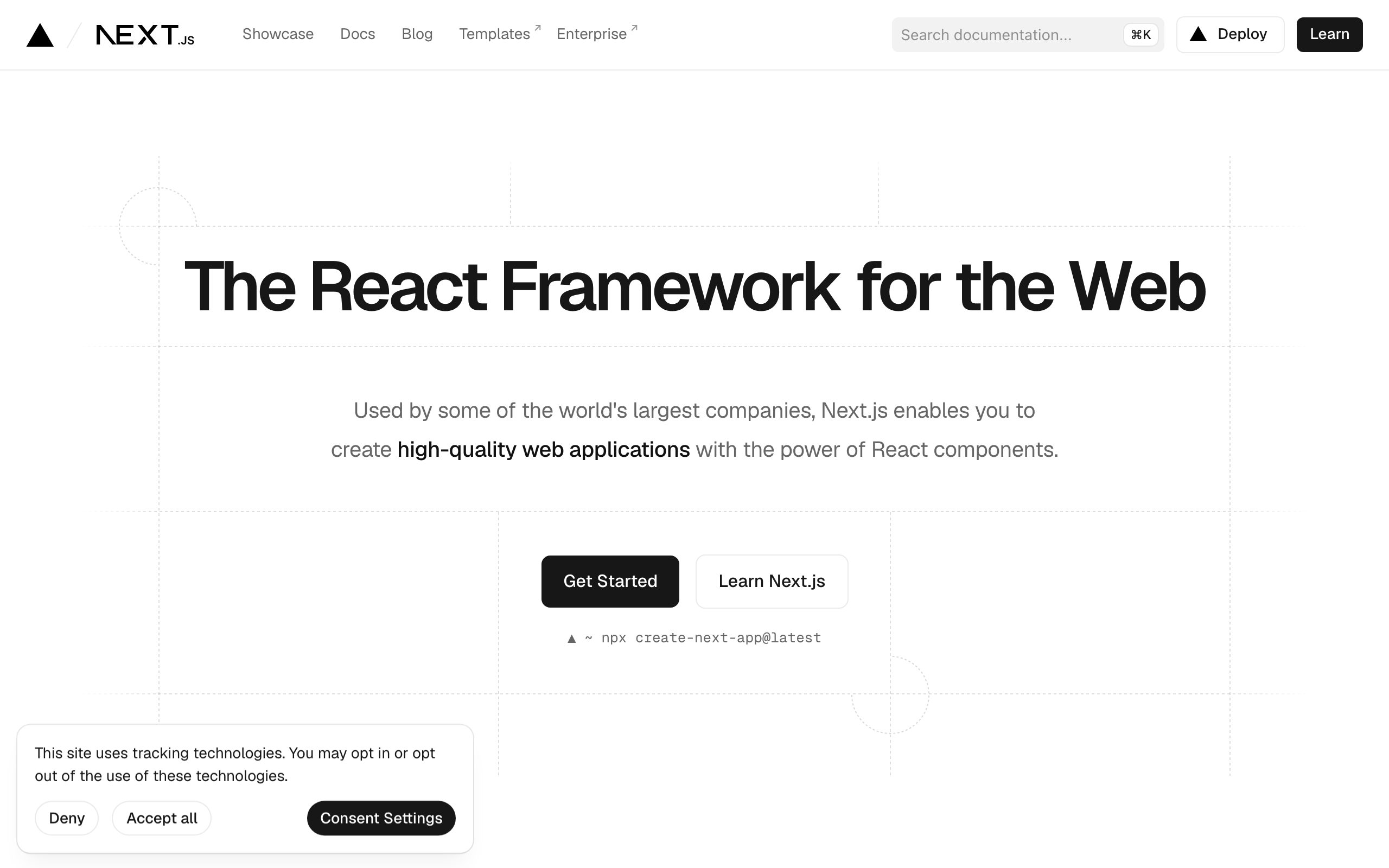
Live preview of nextjs.org
Overview
Next.js has become synonymous with production React development. It provides the architecture decisions that React intentionally leaves open - routing, data fetching, rendering strategies, and deployment - letting teams focus on building product rather than configuring infrastructure.
The App Router, built on React Server Components, represents the current state of the art in web application architecture. Server Components reduce client JavaScript, streaming enables instant page loads, and the layout system eliminates redundant re-renders during navigation. For data-heavy applications, the performance improvements are substantial.
Vercel's deployment platform is optimized for Next.js, but the framework deploys anywhere - Node.js servers, Docker containers, or edge runtimes. This flexibility means you are never locked into a single hosting provider, even as you benefit from tight integration when using Vercel.
Key Features
App Router
File-based routing with layouts, loading states, and error boundaries
Server Components
Render components on the server for smaller bundles and faster loads
API Routes
Build backend APIs alongside your frontend in the same project
Static & Dynamic
Mix static generation and server rendering per-page
Streaming
Progressive page rendering with Suspense boundaries
Image Optimization
Automatic image resizing, format conversion, and lazy loading
Why We Recommend Next.js
Next.js is our default framework for client projects. The App Router architecture, combined with Vercel's deployment platform, gives us the best combination of developer productivity and production performance available today.
How We Use Next.js
We treat Next.js as the default chassis for every client web app. Pages and APIs live in the same repo, Server Components fetch from Prisma or Supabase directly, and we lean on Server Actions for mutations so we ship fewer client bundles.
Our standard project skeleton: TypeScript strict, App Router with route groups for marketing vs. dashboard, Tailwind v4 + shadcn for the UI, and TanStack React Query only on screens that truly need client-side caching. Middleware handles auth gating in front of /admin and member-only routes.
For data, we stay in Server Components by default and reach for client islands ("use client") only when the UI is interactive enough to justify hydration. Forms run through Server Actions wrapped with Zod validation. Long-running work gets pushed to Trigger.dev or Inngest so the request thread stays under 10s.
When to Use Next.js
- You want a single full-stack codebase that ships a marketing site, a dashboard, and an API without juggling three repos.
- You need first-class SEO on dynamic pages (case studies, blog, programmatic landing pages) without a separate static-site build step.
- You are deploying to Vercel and want zero-config previews on every PR.
- You want React Server Components, streaming, and partial prerendering in production today.
- You are migrating away from a SPA + separate backend setup and want to consolidate the stack.
Advantages
- Hire-ability: by far the largest React talent pool, so handoff and team growth are easy.
- Server Components cut client JavaScript dramatically without rewriting your component model.
- File-based routing + layouts make the app structure self-documenting.
- Built-in image, font, and script optimization gets you a 90+ Lighthouse score with no extra work.
- Tight Vercel integration: preview URLs, analytics, OG image generation, edge runtime - all wired up.
- Escape hatches everywhere: static export, Node runtime, Docker, or edge - you are not locked in.
Reference Projects
Real projects where AY Automate ships Next.js into production.
ayautomate.com (this site)
Marketing site, admin dashboard, AI content generation, newsletter platform, blog, case studies - all in one Next.js 15 App Router project running on Vercel.
View projectAY Hire - engineer placement funnel
Multi-step intake + matching dashboard built as nested layouts with Server Actions for every form step.
AY Rank
GEO/AI-search analytics dashboard built on the App Router with streaming Server Components for real-time rank reports.