Book a Free Strategy Call
Skip the read: talk to Walid in 30 min.
Free strategy call. We map your AI engineering team, you keep the notes.
Most companies run an AI pilot before they run an AI readiness assessment, and that order is exactly backwards. The pilot tells you whether a model can do the task in a demo. It tells you nothing about whether your data, your process, and your governance can support that task running unattended in production, which is the part that actually decides whether the project survives past quarter one.
The data on this gap is stark. Gartner predicts that through 2026, organizations will abandon 60% of AI projects unsupported by AI ready data, and a Gartner survey of 248 data management leaders found that 63% of organizations either do not have, or are not sure they have, the right data management practices in place to support AI. A separate Gartner survey of 353 data, analytics, and AI leaders run between November and December 2025 found that only 39% of technology leaders are confident their current AI investments will have a positive impact on financial performance, and that organizations reporting successful AI initiatives invest up to four times more, as a share of revenue, in foundational areas like data quality, governance, AI ready people, and change management than organizations with poor results. The pattern across every one of these surveys is the same: the gap between AI ambition and AI outcome is a readiness gap, not a model gap.
This is a scorecard, not a gate. Score honestly, and a low result is a punch list, not a reason to cancel the project.
The five dimensions that actually predict outcomes
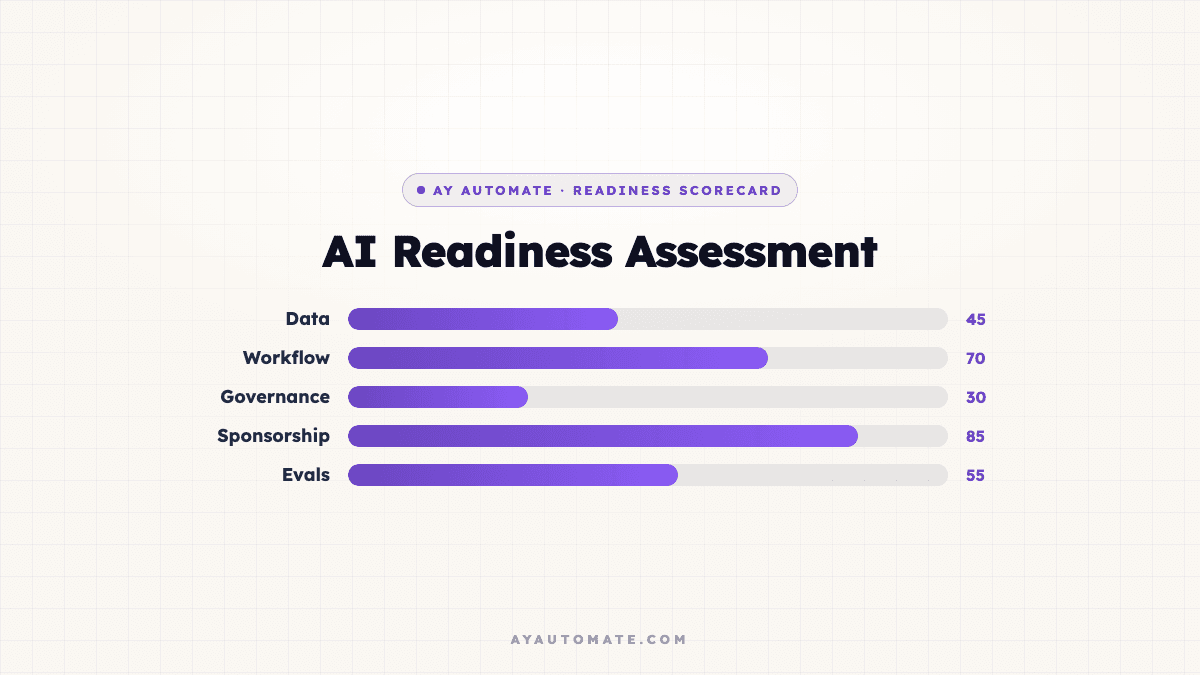
We assess five dimensions before recommending anything gets built. Each one maps to a specific failure mode we have watched kill a pilot.
| Dimension | What it actually checks | Common failure if skipped |
|---|---|---|
| Data | Is the data the agent needs actually accessible, current, and trustworthy, not just present somewhere in a warehouse | Agent gives confidently wrong answers because the source data was stale or split across systems that disagree |
| Workflow definition | Can someone describe, in plain language, what a correct decision looks like at each step, including the edge cases | Team builds an agent for the documented process, which is not the same as the process a top performer actually runs |
| Governance and escalation path | Is there a written rule for what the agent does when it is uncertain, and who it escalates to | Agent guesses instead of stopping, and nobody notices until a customer or auditor does |
| Executive sponsorship | Does one named person, not a department, own the outcome and have authority to change the process around the tool | Project stalls in committee the first time the AI recommendation conflicts with how someone has always done the job |
| Eval infrastructure | Is there a golden dataset and a way to measure pass rate before anything touches production | Nobody can tell whether a change made the system better or worse, so improvement is guesswork |
Score each dimension 1 to 10 based on the honest answer to its check, not the aspirational one. A rollout with a 3 on governance is not disqualified. It is a rollout that needs a written escalation path built before Rollout, not after something breaks in front of a customer.
Related Reads
Why "we already piloted this" does not mean you are ready
MIT NANDA's 2025 GenAI Divide study found that 95% of enterprise generative AI pilots fail to deliver a measurable financial return, despite $30 to $40 billion in enterprise spend on GenAI initiatives. That number gets read as "AI does not work yet." The more accurate read, based on the dimensions above, is that most pilots are scoped to prove the model can do the task, not to prove the organization is ready to run it unattended, so the pilot succeeds and the rollout still fails.
A December 2025 Gartner survey of CxOs found that only 27% of executives have a comprehensive AI strategy, and just 20% believe their workforce is actually ready to use it. That is a readiness gap showing up at the strategy layer, not the tooling layer. McKinsey's State of AI research shows 88% of organizations already use AI in at least one function, yet only 39% report any measurable EBIT impact from it. Usage and readiness are different measurements, and most reporting conflates them.
This is also where a readiness assessment and a broader AI transformation initiative connect. A readiness score tells you whether the specific workflow in front of you is safe to automate right now. A transformation strategy tells you which workflows to tackle in what order across the business. Skipping straight to the second without ever running the first is how a company ends up with an ambitious roadmap and a stalled first project.
Free weekly brief
Steal our production automations
The exact n8n flows, Claude Code setups, and prompts we ship for clients, broken down step by step. No spam, unsubscribe anytime.
What a low score on governance actually means
Governance is the dimension we see scored lowest most often, and it is also the one teams are most tempted to defer. That is a mistake specifically because governance failures are the ones that surface publicly, in front of a customer or a regulator, instead of quietly in an internal dashboard.
If your organization scores low here, the fix is not a company-wide AI governance program launched before the first pilot ships. It is a written answer to one question for the specific workflow in front of you: what does this agent do when it is uncertain, and who does it hand off to. Our AI governance framework walks through how to build that escalation path, the audit trail behind it, and how to grow it from a single workflow's rule into a company-wide framework once you have more than one system running in production.
What this means for you
- Run the assessment before the pilot, not after it stalls. A scorecard done in an afternoon catches the gap a failed rollout takes months to reveal.
- Treat data as the dimension most likely to sink you. Gartner's research points here for a reason: it is the least visible failure mode until an agent is already live and wrong.
- Name an executive owner before you name a vendor or a tool. Committees do not survive the first disagreement between the AI's recommendation and how the team has always worked.
- Write the escalation path down before launch. "The agent will figure it out" is not a governance answer, and it is the answer that shows up in postmortems.
- A low score is a sequencing problem, not a stop sign. Fix the lowest-scoring dimension first, then reassess before scaling the next workflow.
- Don't run the scorecard alone if you don't have to. A fractional AI lead can own the assessment and the governance work that follows it instead of it falling on whoever volunteered.
FAQ
What is an AI readiness assessment? An AI readiness assessment is a structured scorecard, typically covering data, workflow definition, governance, executive sponsorship, and evaluation infrastructure, used to check whether an organization can safely run an AI initiative in production before it invests in building one. It is diagnostic, not a pass or fail gate.
How is a readiness assessment different from an AI governance framework? A readiness assessment measures whether you are ready to start; a governance framework is what you build once you are running to keep the system safe, auditable, and accountable at scale. Most teams need a basic version of both before their first production rollout, and our AI governance framework guide covers how to build the second once the assessment tells you where you stand.
What score is considered "ready"? There is no universal passing score, because the dimensions are not equally weighted for every workflow. A customer-facing agent needs a much higher governance score than an internal reporting tool does. Use the assessment to find your lowest-scoring dimension for the specific workflow in question, and fix that one first.
Why do so many AI pilots fail if the technology works in the demo? Because a demo tests whether the model can complete the task once, with a curated input. Production tests whether the organization has the data, the escalation path, and the ownership in place to run that task unattended, at volume, including the cases nobody thought to demo. MIT NANDA's research found 95% of generative AI pilots fail to deliver measurable financial return for exactly this reason.
Is data really the biggest readiness gap? Across the Gartner surveys cited above, yes: 63% of data leaders say they lack confidence in their AI data practices, and Gartner projects 60% of AI projects will be abandoned through 2026 specifically because the underlying data was not AI ready. Most other readiness gaps are visible in a planning meeting. Data gaps are usually invisible until the agent is already live and quietly wrong.
Do we need outside help to run this assessment, or can we do it ourselves? A team with a strong internal owner and honest visibility into its own data and process can run a first-pass version of this scorecard alone in an afternoon. Where teams usually need outside help is turning a low score into a fix, particularly on the governance and eval dimensions, since those require building infrastructure most internal teams have not built before.
How does this connect to a broader AI transformation effort? The assessment scores one workflow. A digital transformation initiative sequences many workflows across the business. Run the assessment on the first workflow before committing to the sequence for the rest, so the transformation roadmap is built on evidence from a real rollout instead of an assumption.
Sources: Gartner, "Lack of AI-Ready Data Puts AI Projects at Risk", Gartner, "Organizations with Successful AI Initiatives Invest Up to Four Times More in Data and Analytics Foundations", MIT NANDA, "The GenAI Divide: State of AI in Business 2025" via Fortune, Gartner, "By 2027, 50% of Enterprises Without a People-Centric AI Strategy Will Lose Their Top AI Talent", McKinsey, "The State of AI"
Continue Reading
AI Facilities Management Tools: What to Automate, Where Judgment Leads (2026)
What AI facilities management tools automate well, how this differs from property management, and where facilities professional judgment still leads.
AI Vendor Management: What to Automate, Where Judgment Leads (2026)
Where AI genuinely helps in vendor management (contract tracking, risk monitoring, SLA tracking), and where negotiation and relationship judgment still lead.
AI Load Testing Tools: What to Automate, Where Engineering Judgment Leads (2026)
What AI load testing tools do well, how this differs from functional CI/CD testing, and where engineering judgment on results still leads.
Book a Free Strategy Call
Building this in production?
Walid runs a 30-min call to map your AI engineering team. Free, no slides.
Free weekly brief
Steal our production automations
The exact n8n flows, Claude Code setups, and prompts we ship for clients, broken down step by step. No spam, unsubscribe anytime.

Taha builds and ships custom AI agents and workflow automations for AY Automate clients across SaaS, finance, and professional services.