Book a Free Strategy Call
Skip the read: talk to Walid in 30 min.
Free strategy call. We map your AI engineering team, you keep the notes.
Enterprise automation means replacing manual, multi-step business processes with software that runs them continuously: invoice processing, employee onboarding, data reconciliation, compliance reporting. This is about getting past the idea of just buying software and starting to see automation as a core, dynamic part of your business that fundamentally changes how you grow.
Beyond Software: How Automation Redefines Growth
True enterprise automation isn't a single tool; it's an entire ecosystem built for scale. Think of it less like an app you install and more like a fundamental shift in how your organization operates. You're essentially building a digital workforce that runs 24/7, executing repeatable tasks consistently and freeing up your actual team to focus on high-value, strategic work.
A huge part of this shift is understanding the right way to approach automating repetitive tasks efficiently to build a solid foundation. This modern approach leaves simple, rule-based actions behind. Instead, you're weaving an intelligent, interconnected operational fabric for your entire business.
Building Your Digital Workforce
The real magic of today's automation solutions happens when you blend human expertise with artificial intelligence. This was never about replacing your team. It's about augmenting what they can do, helping them achieve outcomes that were previously out of reach. The goal is to build a sustainable, in-house AI capability that drives value for years to come.
Here are a few ways to make that happen:
- AI Team Augmentation: Instead of outsourcing, strategically embed skilled AI engineers directly into your projects. This model makes adoption less risky, gets projects delivered faster, and ensures critical knowledge is transferred directly to your team, creating lasting expertise.
- AI-Adopted Engineer Placements: Bring specialized talent on board who are already experts in the latest automation tools and methodologies. This lets you tap into advanced skills immediately, skipping the steep learning curve.
- Targeted AI Workshops: Give your existing teams the power to build through hands-on training. Workshops focused on powerful tools like Cursor, Claude & code for dev teams, and Weavy.ai equip your developers with the practical skills they need to build, manage, and innovate with automation.
When you put people and process first, automation stops being just a tech add-on and becomes a powerful engine for cultural change. It fosters a mindset of continuous improvement and innovation across the company.
Ultimately, enterprise automation redefines growth by building a more resilient, efficient, and scalable organization from the ground up. It gives founders, CTOs, and operations leaders a way to break the old rule of adding headcount in direct proportion to output.
Instead, you build an intelligent system where custom AI agents act as your digital employees, automated workflows serve as the central nervous system, and all your integrated systems work in perfect harmony to drive productivity and open up brand-new opportunities for expansion.
Related Reads
The Building Blocks Of A Modern Automation Stack
To build enterprise automation that actually scales, you have to understand the core components working together under the hood. Think of it like a high-performance engine; every part has a specific job, and they all need to run in perfect harmony. For any technical leader, getting a grip on these layers is the first step toward designing a system that delivers real results.
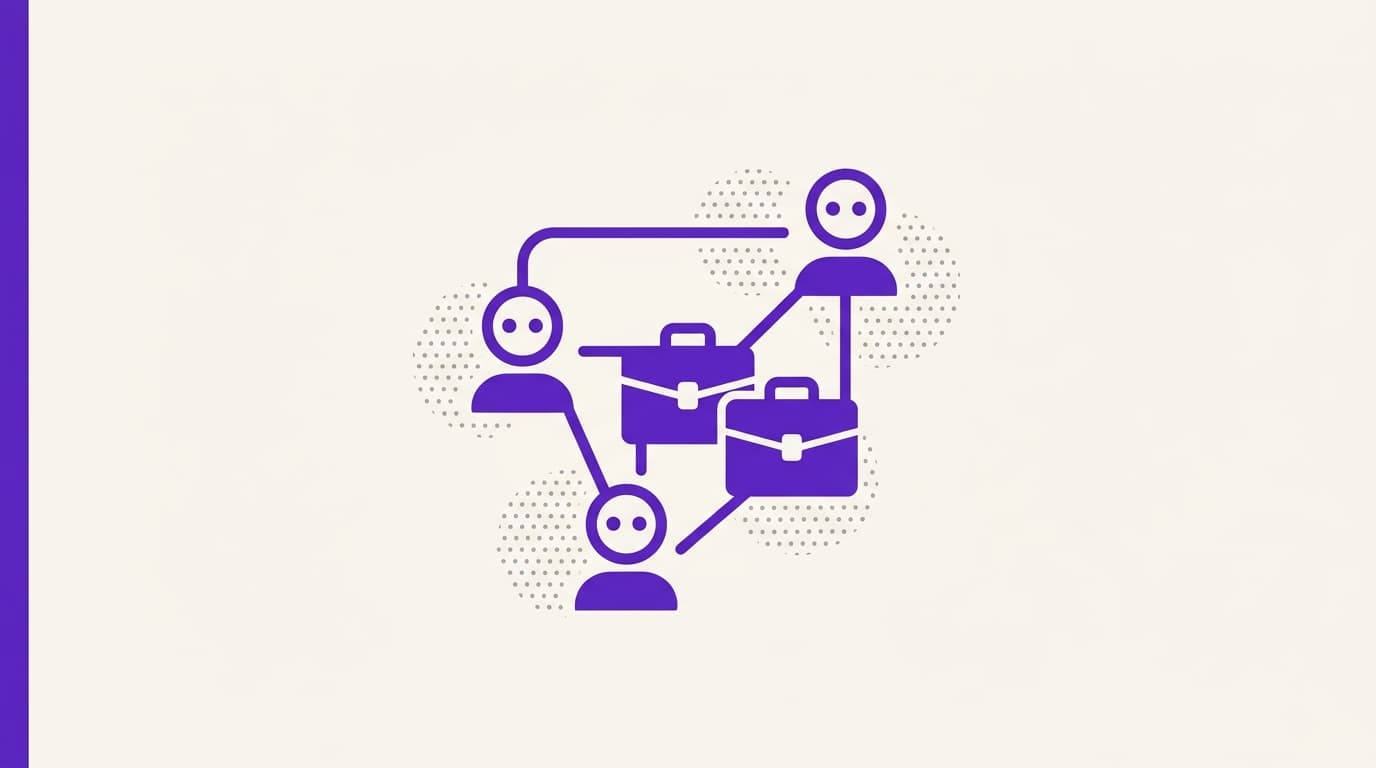
This concept map shows how automation acts as the central hub, connecting intelligent agents, organized workflows, and all your existing systems.
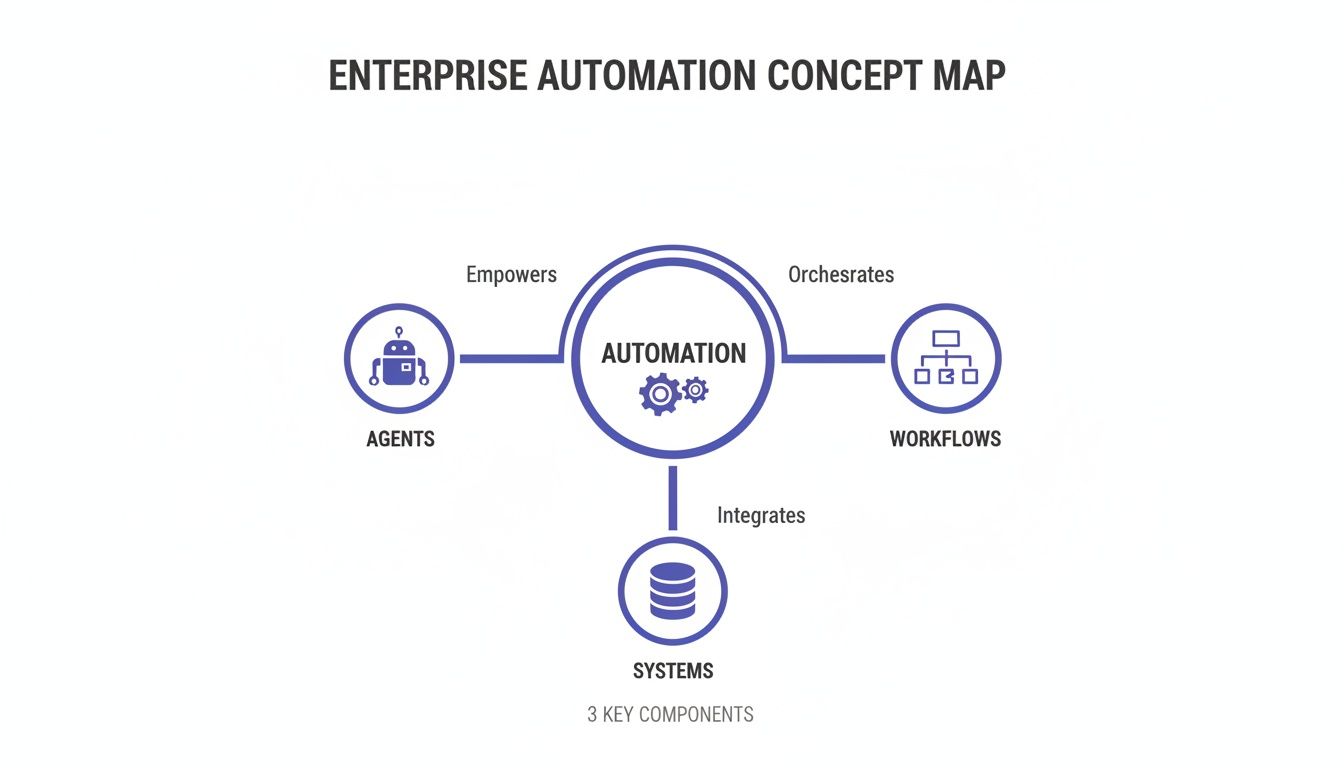
What this really shows is that true automation is more than one piece of software. It’s a dynamic interplay between different technologies. The real magic happens when agents, workflows, and your existing tools work together to deliver massive efficiency.
To make sense of it all, let's break down the essential technologies you'll find in a modern enterprise stack. Each plays a distinct role, and knowing when to use which is key to building something that works.
Comparing Core Automation Technologies
| Component | Primary Function | Best For | AY Automate Expertise |
|---|---|---|---|
| AI Agents | Autonomously perform complex tasks and make decisions by interacting with digital systems. | Handling dynamic, unpredictable tasks like outbound sales calls, customer support, or data analysis. | We build and deploy custom agents using platforms like Vapi.ai and Bland.ai for voice and task automation. |
| Workflow Automation | Connects different apps and services to automate a sequence of predefined tasks. | Automating linear, rule-based processes like lead nurturing, data entry, or employee onboarding. | Our team are experts in platforms like Make.com and Zapier for creating stable, integrated workflows. |
| Self-Hosted LLMs | Provides secure, private access to large language models within your own infrastructure. | Companies with strict data privacy needs or those requiring highly customized models for proprietary tasks. | We specialize in deploying and fine-tuning open-source models like Llama 3 and Mixtral for maximum security and control. |
| Integrations & APIs | The "glue" that allows all your different systems (CRM, ERP, etc.) to communicate. | Connecting your entire tech stack to ensure data flows smoothly and automation can access any system. | We design and build custom API connections to ensure your automation stack talks to every tool you use. |
As the table shows, a truly powerful system isn't about choosing one tool over another. It's about orchestrating them. An AI agent might handle a customer call, then trigger a workflow in Make.com to update your CRM, all while querying a self-hosted LLM for secure data analysis. That’s enterprise automation.
Empowering Your Teams With AI Expertise
Here’s the thing most people miss: the most critical building block isn't technology. It's the people who run it. An automation stack is only as powerful as the team behind the keyboard. This is why smart companies focus on building in-house capability from day one.
Instead of just outsourcing the work, the modern approach is about embedding expertise directly into your organization.
- AI Team Augmentation: We place expert AI engineers directly into your existing teams. This doesn't just speed up projects; it ensures vital skills get transferred to your staff, creating a sustainable, internal center of excellence.
- AI-Adopted Engineer Placements: Need an immediate skill injection? We can bring in engineers who are already masters of the automation field. They hit the ground running, solve complex problems, and lead your teams by example.
This human-first approach takes the risk out of AI adoption and builds a culture of innovation that sticks around long after the initial project is done.
True automation capability isn't bought; it's built. By investing in your people through augmentation and specialized training, you create a resilient, self-sufficient engine for continuous improvement.
Accelerating Adoption With Hands-On Training
To get the most out of your investment, your developers need to be fluent in the tools that power your automation. Generic training just doesn’t cut it. You need targeted, practical workshops that solve the specific challenges your engineers face every single day.
This focus on practical skills is exploding. The intelligent process automation market is projected to hit USD 17.88 billion in 2026 and jump to USD 37.54 billion by 2031. While big enterprises still lead, smaller businesses are catching up fast, with adoption growing at a 21.6% CAGR. You can dive deeper into the intelligent process automation market trends in the full report.
Expert-led AI workshops are designed to bridge the gap between having a tool and mastering it.
- Workshops for Developer Tools: Training focused on tools like Cursor and Claude & code for dev teams helps engineering teams write, debug, and ship code faster and more consistently.
- Workshops for Collaboration Platforms: Sessions on platforms like Weavy.ai show teams how to build powerful in-app collaboration features, automating communication right inside your own products.
When you equip your teams with these skills, you move beyond just automating simple tasks. You help them become architects of efficiency, capable of finding new opportunities and building the enterprise automation solutions that will drive your business forward.
Free weekly brief
Steal our production automations
The exact n8n flows, Claude Code setups, and prompts we ship for clients, broken down step by step. No spam, unsubscribe anytime.
How Automation Delivers Real, Tangible ROI
Not every provider delivers the same ROI. The agencies we ranked for enterprise automation work shows how the pricing and scope actually compare.
Throwing powerful technology at a problem is easy. Seeing a clear, measurable return on that investment? That’s a different game entirely.
The true value of enterprise automation solutions isn’t buried in technical spec sheets; it’s found in tangible business outcomes. It’s about bridging the gap between sophisticated tools and your bottom line, turning operational costs into strategic advantages.
This section isn't about theory. It’s the business case you need to champion automation, backed by real numbers. We’ll dig into how these solutions drive radical cost reductions, boost team productivity without the burnout, and deliver near-perfect accuracy by taking human error out of the equation.
The market is already voting with its wallet. The global business process automation market was valued at USD 9 billion in 2019 and is on track to hit USD 19.4 billion by 2026. This is more than a trend; it's a global shift. Organizations everywhere are aggressively adopting automation to get lean and efficient.
For any company looking to scale, this is the critical insight: you can achieve massive growth without a proportional spike in headcount by integrating custom AI agents and workflows.
Driving Down Costs While Scaling Up
One of the first and most immediate impacts of strategic automation is a dramatic drop in operational costs. When you automate the repetitive, time-sucking tasks, you free up your team’s most valuable resource: their time.
But this is about more than just saving money on salaries. It's about redirecting your smartest people toward innovation, strategy, and growth, the things that actually move the needle.
Look at where the savings really come from:
- Reduced Labor Costs: Automating tasks like data entry, invoice processing, or tier-1 customer support can slash related operational expenses by up to 60%, especially once paired with the right document automation software.
- Minimized Error-Related Expenses: A simple typo can be surprisingly expensive, leading to rework, unhappy customers, and compliance headaches. Automation performs tasks with near-perfect accuracy, making those costs disappear.
- 24/7 Operational Capability: Your automated systems don't need breaks or overtime pay. They work around the clock, ensuring continuous productivity and giving your customers faster turnaround times.
Amplifying Team Productivity and Expertise
Let's be clear: effective automation isn’t about replacing your team. It’s about supercharging them.
By taking the manual, soul-crushing work off their plates, you free your people to focus on high-value activities that demand creativity and critical thinking. This is where building in-house capability becomes a major advantage for long-term ROI.
Automation transforms your team's focus from 'doing the work' to 'improving the work.' It shifts their mindset from task execution to strategic optimization, which is the true engine of sustainable growth.
Of course, any automation initiative worth its salt needs a way to track results. That's why effective AI automation ROI tracking is non-negotiable: it provides the clear metrics to prove what's working. But measurement alone isn't enough; you have to pair it with an investment in your people.
To really maximize the return, forward-thinking companies are building internal expertise. Here’s how:
- AI Team Augmentation: We embed our expert AI engineers directly into your projects. This doesn't just speed up development; it facilitates a massive knowledge transfer. Your team learns by doing, building a sustainable center of excellence from the inside out.
- AI-Adopted Engineer Placements: Need an immediate boost? We can place specialized engineers who are already masters of the automation field onto your team. This de-risks complex projects and sets a high bar for your internal crew.
- Hands-On AI Workshops: We run targeted training on the essential developer tools: think Cursor, Claude for coding, and collaborative platforms like Weavy.ai. This ensures your teams are more than users of automation, but builders of it.
When you combine powerful technology with a skilled and confident workforce, you create a virtuous cycle of continuous improvement. This approach ensures your investment in enterprise automation pays dividends today and for years to come.
Building In-House AI Capability With Team Augmentation
If team augmentation isn't the right shape for your project, our AI automation agency team can scope and own the build directly.
Real enterprise automation isn't about replacing your team; it’s about making them unstoppable. The tools and tech are just one piece of the puzzle. The true, lasting advantage comes from building a skilled, confident workforce that can own your automation strategy from the inside out. This is where the goal shifts from quick fixes to creating a long-term, in-house AI capability.
Instead of getting stuck in a cycle of dependency on external consultants, the smarter approach is to embed that expertise directly into your organization. This strategy makes AI adoption far less risky, gets projects delivered faster, and, most importantly, lights a fire of innovation that fuels continuous growth. You're more than buying a solution; you're building a powerful internal engine for change.
Why Team Augmentation Beats Traditional Outsourcing
The old way of outsourcing often creates knowledge silos. An external team comes in, builds a solution, hands over the keys, and walks away. Your team is left trying to manage a complex system they didn't create, which leads to total dependency and a painfully slow response time when business needs inevitably change. AI team augmentation completely flips that model on its head.
When you embed expert AI engineers directly into your projects, you create a dynamic, hands-on learning environment. Your team works shoulder-to-shoulder with specialists, absorbing best practices, advanced techniques, and deep product knowledge simply by collaborating. This ensures that when a contract ends, the critical expertise doesn't walk out the door with it.
The goal of AI team augmentation is to make your own team the experts. It's a strategic investment in self-sufficiency, ensuring your organization not only adopts automation but masters it for the long run.
This approach creates a powerful flywheel. Your first few projects get done faster and with way less risk, all while your team’s skills grow exponentially. Over time, your company becomes less reliant on outside help and far more capable of spotting and executing new automation opportunities all on its own. For a deeper look into what these teams can build, check out our guide on custom AI agent development.
Strategic Placements For Immediate Impact
Sometimes you just need a specific skill set, right now. Whether you're tackling a monster of a project or trying to accelerate a high-priority initiative, strategic placements of AI-adopted engineers can be a real accelerator.
This goes beyond plugging a temporary hole. It's about bringing in a seasoned pro who has already mastered the modern automation stack.
- Accelerated Project Timelines: An AI-adopted engineer hits the ground running, applying proven methods to solve tough problems from day one.
- Mentorship and Leadership: These experts double as mentors, raising the skill level of your entire team by showing them how advanced problem-solving works in the real world.
- De-risking Innovation: Bringing in proven talent massively reduces the risk that comes with adopting new tech or taking on ambitious automation goals.
Empowering Your Developers With Hands-On AI Workshops
To build a truly AI-savvy organization, you need a consistent skill set across your development teams. To get the most out of your investment, your engineers need to be fluent in the tools that power modern automation and code generation.
Generic online courses often miss the mark because they're all theory and no practice. Targeted, hands-on AI workshops are designed to bridge that gap by focusing on the specific tools your developers will actually use every day.
Popular Workshops for Dev Teams:
- Cursor Workshops: Teach engineers how to use the AI-first code editor to write, debug, and refactor code with incredible speed and accuracy.
- Claude & Code for Dev Teams: Focus on using advanced language models like Claude for complex coding tasks, API integration, and generating high-quality documentation.
- Weavy.ai Workshops: Provide practical training on integrating powerful in-app collaboration features, automating communication, and boosting user engagement directly within your products.
By investing in these three pillars (team augmentation, strategic placements, and targeted workshops), you create a complete system for building a sustainable, in-house AI machine. This human-first approach ensures your automation solutions deliver value today and for years to come.
Accelerating Adoption With Hands-On AI Workshops
So, you've invested in a powerful enterprise automation solution. That's the first step. But the hard truth is that the best tools on the planet are worthless if your teams don't know how to use them effectively. This is where so many initiatives fall flat.
Hands-on, expert-led AI workshops are the bridge between buying powerful software and actually seeing a return on that investment.
These aren't your typical, theory-heavy training sessions. We're talking about practical, immersive experiences designed to get your teams on the same page, standardize how they use these new tools, and build a truly AI-proficient workforce. When specialists like our ex-IBM architects run these sessions, they close the knowledge gaps that inevitably slow down adoption.
The demand for this kind of advanced automation is exploding. Take turingbots, for example: these are sophisticated AI agents that can mimic human decision-making. The market for enterprise automation powered by them hit USD 1,382.5 million in 2024. Projections show it rocketing to USD 7,479.2 million by 2030, fueled by an incredible 32.3% CAGR.
This is more than a trend; it's a fundamental shift for any business that wants to boost productivity without just hiring more people. You can read the full research on the turingbots market to see just how big this wave is.
Empowering Developers With Practical Skills
For your developers, the right training is more than nice to have. It can slash the time they spend on coding, debugging, and deploying. Generic YouTube tutorials can't hold a candle to targeted workshops focused on the specific tools your engineers live in every day.
The goal is to give them skills they can immediately apply. We focus on the tools defining modern development:
- Workshops on Cursor: We train engineers to master this AI-first code editor. They learn to write, analyze, and refactor massive codebases faster than they ever thought possible.
- Claude & Code for Dev Teams: These sessions dive deep into using advanced models like Claude for complex coding challenges, from spinning up boilerplate to hunting down tricky bugs and even writing documentation.
- Training on Weavy.ai: We provide hands-on guidance for platforms like Weavy.ai, showing teams how to build powerful in-app collaboration features that automate communication right inside your own products.
Equipping your team with hands-on skills is the most direct path to maximizing your technology investment. It transforms them from passive users into active builders and innovators who can drive your automation strategy forward.
Standardizing Best Practices Across Teams
As an organization grows, consistency becomes one of its biggest headaches. Without a shared playbook, different teams end up using the same tools in completely different, often inefficient, ways. This creates technical debt, confusion, and even security risks.
Expert-led workshops fix this by establishing a single, unified set of best practices for everyone.
This alignment is absolutely critical for scaling your enterprise automation solutions. When every developer speaks the same language, collaboration gets smoother, code quality goes up, and the entire operation becomes more stable.
You end up with a cohesive, high-performing team that can build and maintain complex automation systems with confidence. If this sounds like what you're missing, check out our AI workshops designed for technical teams. We move beyond theory and focus on application, helping your people use automation and truly master it.
Your Four-Step Roadmap to Implementing Automation
Great technology is only one piece of the puzzle. To make enterprise automation actually work, you need a clear, structured plan. Without a proven roadmap, it’s all too easy for projects to lose steam, burning through resources and never quite delivering on the promise. We use a structured approach to take the guesswork out of the entire process, from initial idea to full-scale execution.
This isn’t just about getting from point A to point B. It’s about building a system that’s set up for scalable success from day one.
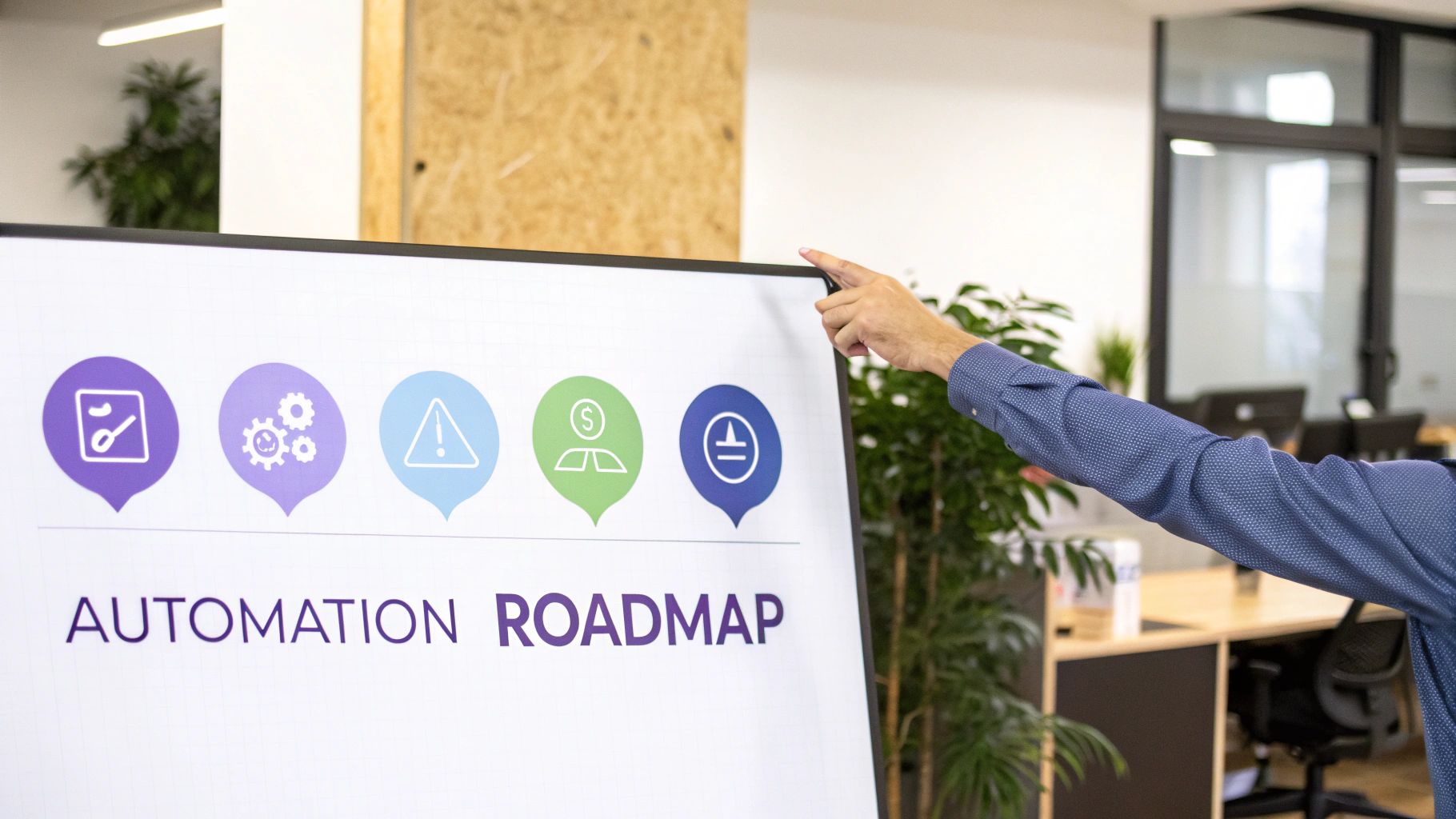
Our four-step framework is designed to deliver real results at every stage, turning your biggest goals into day-to-day reality. It’s a pragmatic approach that balances quick wins with long-term vision, building momentum while laying the groundwork for true enterprise-wide change.
Step 1: Discovery and Audit
It all starts with a close look at how your business runs today. We sit down with your team to find the most impactful opportunities for automation: those repetitive tasks, manual workflows, and operational bottlenecks that quietly eat up time and money.
This is more than a technical audit; it's a strategic hunt for the spots where automation can deliver the biggest, fastest ROI.
Step 2: Strategy and Design
Once we’ve pinpointed the high-value opportunities, it's time to build the blueprint. We map out a custom automation strategy and technical roadmap that aligns perfectly with your goals.
This is where we decide on the right mix of AI agents, workflow platforms, and integrations to create a cohesive system that slots right into your existing tech stack. This phase is all about designing a solution that is powerful and secure and ready to grow with you. To get a better sense of this, check out our guide on how to implement AI in business.
Step 3: Implementation and QA
This is where the plan springs to life. Our senior engineers, who bring an average of 8+ years of experience to the table, get to work building and deploying the solution. We live by rigorous quality assurance (QA) protocols, meticulously testing every single component. The goal is simple: a rock-solid, production-grade system that's ready for the real world.
A successful implementation is defined by reliability. Your automation must perform flawlessly 24/7, which is why meticulous testing and QA are non-negotiable parts of our process.
We handle the rollout to ensure there's minimal disruption to your daily operations. This focus on quality means the solution works exactly as intended from the moment it goes live, delivering immediate value to your team.
Step 4: Optimization and Scaling
Launching the system isn’t the finish line; it’s the starting gun. After deployment, we’re constantly monitoring performance, analyzing the results, and looking for new ways to make things even better.
This iterative process ensures your automation solutions don't just keep up with your business; they evolve with it, delivering more and more value over time. As you grow, we’ll help you scale the system to tackle new challenges and jump on emerging opportunities, creating a powerful cycle of ever-increasing efficiency and innovation.
Got Questions About Enterprise Automation? We've Got Answers.
Jumping into any new technology brings up questions. For the CTOs, founders, and operations leaders we talk to, the big ones always circle back to security, the impact on their team, and how to actually measure the results. So, let's get right to it. Here are some straight answers to the most common questions we hear.
How Does Automation Affect My Existing Team?
Let's clear the air on a common myth: this isn't about replacing people. It's about making your best people even better. Good automation takes over the grinding, repetitive tasks that drain energy and time, freeing up your team to focus on what humans do best: strategy, creative problem-solving, and building the next big thing for your business.
Our whole philosophy is built around making your team stronger and more self-sufficient. We do this in a couple of ways:
- AI Team Augmentation: We don't just build and hand over a solution. Our expert engineers work alongside your team, directly on your projects. This side-by-side collaboration means knowledge gets transferred naturally, upskilling your people in the process.
- AI-Adopted Engineer Placements: Need to fast-track a critical project? We can place one of our specialized engineers directly on your team to provide dedicated firepower and hands-on mentorship.
The end goal is simple: free up your team. When automation handles the grunt work, jobs become more engaging, and your people can make a much bigger impact. That’s a win for productivity and morale.
What Is The Role Of AI Workshops?
While embedding our engineers builds deep, long-term expertise, AI workshops are all about getting your entire development team up to speed, fast. These aren't boring, theoretical lectures. They're hands-on training sessions focused on getting everyone fluent with the tools they'll be using every day.
Think of it this way: a workshop ensures every single one of your developers uses a tool like Cursor for coding or Claude for complex analysis with the same best practices. That kind of consistency is absolutely critical if you want to build automation that can scale without breaking.
Workshops on platforms like Weavy.ai can also show your team how to weave powerful collaborative features right into the products you already offer. You’re more than making your internal processes more efficient; you’re turning your own software into an engine for your customers’ efficiency, too.
How Will Automation Integrate With My Current Systems?
A smart automation strategy has to work with what you've already got. The last thing you need is a solution that demands you rip and replace your entire tech stack. We design our solutions to plug right into your current environment, whether that’s a modern CRM, a decades-old legacy ERP, or a suite of custom-built internal apps.
Our specialty is building production-grade integrations and custom APIs that create a secure, reliable bridge between all your systems. Data flows where it needs to, when it needs to. This approach cuts down on disruption, lowers the risk, and means you start seeing a return on your investment way faster.
Ready to build a more efficient, scalable organization? AY Automate offers a complimentary automation audit to identify high-impact opportunities in your business. Book your free consultation today and discover how our custom enterprise automation solutions can help you scale 10X without increasing headcount.
Continue Reading
AI Agents for Business in 2026: Real Use Cases, Cost, and How to Pick the Right One
Updated June 2026. "AI agents for business" went from buzzword to real category between 2024 and 2026.
What Is Hyperautomation in 2026? (Definition, Stack, and the Honest ROI)
Hyperautomation in 2026: RPA combined with AI agents. What frontier models changed, where it delivers ROI, and when plain automation is the right answer.
Custom AI Agent Development in 2026: The Honest Buyer's Guide
Updated June 2026. Two years ago, "AI agent development" meant a chatbot with extra steps.
Book a Free Strategy Call
Building this in production?
Walid runs a 30-min call to map your AI engineering team. Free, no slides.
Free weekly brief
Steal our production automations
The exact n8n flows, Claude Code setups, and prompts we ship for clients, broken down step by step. No spam, unsubscribe anytime.

Walid founded AY Automate to help businesses ship AI workflows that actually move revenue. He leads strategy and oversees every client engagement end-to-end.
Full Bio →