Book a Free Strategy Call
Skip the read: talk to Walid in 30 min.
Free strategy call. We map your AI engineering team, you keep the notes.
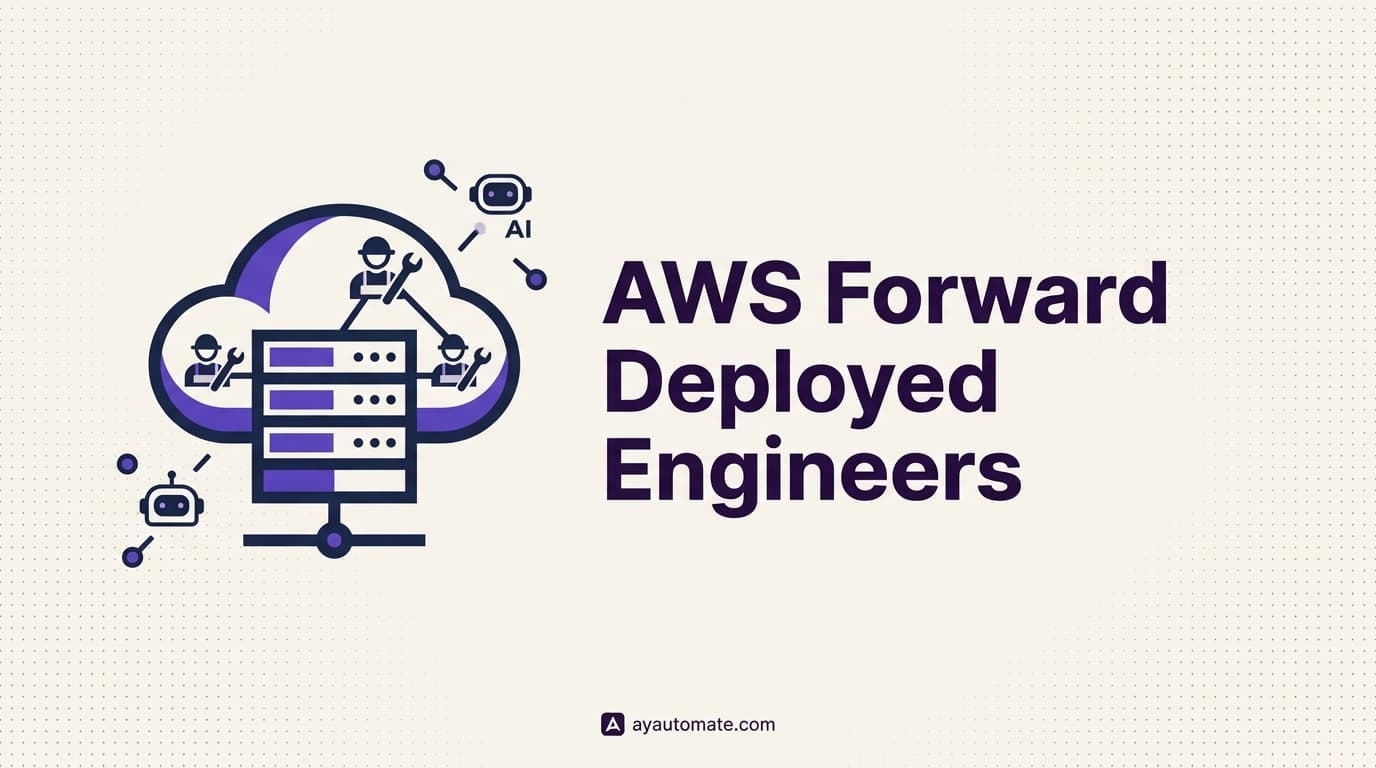
AWS just put a number on a trend that started at Palantir. On June 30, 2026, Amazon Web Services announced it is committing $1 billion to a new AWS Forward Deployed Engineering unit: pods of AI engineers embedded directly inside customer teams to build and ship production AI systems, not advise on them from the outside.
It is the biggest single bet yet on a hiring model that used to be a Palantir specialty. Here is exactly what AWS announced, what a forward deployed engineer actually is, why every major AI vendor is now copying the model, and what it means if you are the one deciding whether to hire one.
TL;DR
- AWS is investing $1 billion in a new AWS Forward Deployed Engineering (FDE) organization, announced June 30, 2026 (CNBC, AWS/About Amazon).
- The unit works in pods of five to six engineers running 45-day sprints inside a customer's own environment, per CIO Dive.
- Named early adopters include the Allen Institute, Cox Automotive, the NBA, the NFL, Ricoh, and Southwest Airlines.
- AWS is the third major AI lab or cloud provider to formalize this model in 2026, after OpenAI's Tomoro-based deployment arm and Anthropic's applied AI push; Google Cloud and an Accenture-Microsoft partnership have made similar moves.
- The model itself is not new. Palantir embedded roughly 120 forward deployed engineers inside JPMorgan starting in 2009. What is new is a hyperscaler putting a billion-dollar number on it.
Related Reads
What AWS actually announced
AWS Forward Deployed Engineering is a dedicated organization that AWS says it is seeding with "thousands" of engineers, funded by a $1 billion commitment (CNBC). Teams work in pods of five to six people, embedded inside a customer's own environment for roughly 45-day sprints, building agentic AI systems on the customer's actual stack rather than shipping a generic product (CIO Dive).
Francessca Vasquez, AWS's VP of Frontier AI Engineering and Services, framed the shift this way: "Customers have moved past exploring what AI can do; they want to make it core to how they operate" (About Amazon). On the model itself, she called it "the next evolution of where customers are looking to drive even more value through agents" (CIO Dive).
The stated design goals are compressing deployment timelines from months to days, working agentic-AI-first, and leaving customers self-sufficient once the embed ends, rather than dependent on AWS staff to keep the system running (About Amazon).
Early named customers include the Allen Institute, Cox Automotive, the NBA, the NFL, Ricoh, and Southwest Airlines. The NFL's chief information officer, Gary Brantley, credited the engagement with shipping fan-facing products fast: "Together, we created new fan-facing products like NFL Fantasy AI and NFL IQ that allow fans to interact with NFL data like never before" (About Amazon; CIO Dive).
Free weekly brief
Steal our production automations
The exact n8n flows, Claude Code setups, and prompts we ship for clients, broken down step by step. No spam, unsubscribe anytime.
What a forward deployed engineer actually is
A forward deployed engineer (FDE) is a role that writes and ships production code while embedded inside the client's team, rather than delivering a recommendation from the outside. The term traces back to Palantir, which embedded roughly 120 forward deployed engineers at JPMorgan starting in 2009 (Wikipedia).
Since then, the model has spread well beyond Palantir. OpenAI built its own FDE practice, growing the team from 2 to 39 people in a single year, targeting problems the team describes as worth "tens of millions to low billions" and deliberately kept small rather than staffed like a consulting bench, per a ZenML LLMOps case study on the team's approach. OpenAI later launched a majority-owned deployment arm through its acquisition of Tomoro, with adopters including HP, Intuit, Oracle, State Farm, and Uber (relayed via officechai.com). Read our full breakdown in the forward deployed engineer guide.
What actually separates an FDE from a consultant or a traditional systems integrator: the FDE writes and ships the production code personally, embeds on-site for weeks at a time, and is judged on whether the system works, not on the quality of the slide deck. That incentive structure is the whole point of the model, and it is why the practice keeps spreading past its Palantir origins.
Why every cloud and AI vendor is adopting the embed model
AWS is not first, and it will not be last. Here is how the major moves stack up so far in 2026:
| Company | Move | Scale/structure |
|---|---|---|
| Palantir | Origin of the model, JPMorgan embed starting 2009 | Roughly 120 FDEs embedded on-site |
| OpenAI | Built internal FDE practice; later launched a majority-owned deployment arm via the Tomoro acquisition | Team grew 2 to 39 in a year; deployment arm adopters include HP, Intuit, Oracle, State Farm, Uber |
| AWS | $1 billion investment in AWS Forward Deployed Engineering, announced June 30, 2026 | Pods of 5 to 6 engineers, 45-day sprints, "thousands" of FDEs planned |
| Google Cloud | Hiring for an AI-focused FDE unit | 59 open engineering roles reported (CIO Dive) |
| Accenture + Microsoft | Joint forward deployed engineering practice | Launched earlier in 2026 |
The pattern behind all of it: buyers stopped wanting a demo and started wanting a working system in production, fast, on their own data and their own stack. A pilot deck does not survive contact with a real workflow. An embedded engineer who ships against your actual systems does. That gap between "impressive demo" and "system that runs in production" is the exact gap the FDE model exists to close, and it is why every serious AI vendor is now building a version of it.
Palantir, OpenAI, and AWS are named here strictly as the origin and adopters of this hiring model for market context. They are not AY Automate partners, and nothing in this article implies an affiliation.
What this means if you are the buyer
A billion-dollar validation from a hyperscaler is a useful signal, but it does not change the buyer's underlying question: do you need advice, or do you need something built and running by a specific date. If the answer is the latter, the criteria for evaluating any FDE engagement, AWS's or otherwise, stay the same:
- Does the engineer write and ship production code personally, or does the pod hand you a recommendation for your own team to build?
- Is there a real evaluation set, a golden dataset of real examples with hand-labeled correct outputs, measured before anyone calls the system done?
- Does the engagement have a defined end, with your team left capable of running the system, or does it quietly turn into an ongoing dependency?
- Is the timeline compressed for a reason, weeks instead of a multi-quarter integration project, or is "45 days" just a marketing number on a longer statement of work?
Those questions apply whether the FDE comes from a hyperscaler, a frontier lab's deployment arm, or a smaller specialist shop. The title on the contract matters less than whether the person embedded with your team is actually accountable for a working result.
Where AY Automate fits
AY Automate places forward deployed engineers the same way: embedded inside your team, building on your actual stack, and accountable for getting the system into production rather than handing off a recommendation. See how the engagement works through engineer placement, and for the full mechanics of the role, read our forward deployed engineer guide.
FAQ
What did AWS announce about forward deployed engineers?
On June 30, 2026, AWS announced a $1 billion investment in a new AWS Forward Deployed Engineering organization: teams of engineers embedded directly inside customer environments, working in pods of five to six people on roughly 45-day sprints to build production AI systems.
Is AWS's forward deployed engineer model the same as Palantir's?
The underlying idea is the same one Palantir pioneered by embedding roughly 120 forward deployed engineers inside JPMorgan starting in 2009: engineers who write production code on-site rather than deliver advice from the outside. AWS is applying it at hyperscaler scale with a dedicated billion-dollar unit.
Which companies are already using AWS Forward Deployed Engineering?
AWS has named the Allen Institute, Cox Automotive, the NBA, the NFL, Ricoh, and Southwest Airlines as early customers. The NFL's CIO credited the engagement with shipping fan-facing products including NFL Fantasy AI and NFL IQ.
Is AWS the only cloud provider doing this?
No. Google Cloud is reported to be hiring for an AI-focused forward deployed engineering unit with around 59 open roles, and Accenture launched a joint forward deployed engineering practice with Microsoft earlier in 2026. OpenAI built its own FDE practice and later launched a majority-owned deployment arm.
Do I need to hire from a hyperscaler to get a forward deployed engineer?
No. The model, an engineer who embeds with your team, writes production code, and owns the outcome, is not exclusive to AWS, OpenAI, or Palantir. Smaller specialist teams place FDEs the same way, often with faster starts than a hyperscaler's own queue.
Sources: CNBC; AWS/About Amazon; CIO Dive; Palantir Technologies on the origin of the FDE model at JPMorgan.
Continue Reading
6 Dify Alternatives Worth Considering for Your AI Stack in 2026
The best Dify alternatives in 2026 are Langflow for visual agent prototyping, n8n for workflow automation with AI steps, Sim for a visual agent workspace, OpenClaw for a self-hosted assistant inside your chat apps, RAGFlow for document-heavy retrieval, and Agno for code-first ...
AI QA Testing Agents: What to Automate, Where QA Judgment Leads (2026)
What an AI QA testing agent does well (test generation, regression testing, cross-browser checks), where QA judgment still leads, and how this differs from agent evals.
GPT-6 Astra vs Claude Fable 5.1 vs Opus 5.5: Why Model Routing Wins
GPT-6 Astra and Claude Fable 5.1 both list at $10 and $50 per million tokens. Claude Opus 5.5, GPT-6 Sol and GPT-6 Luna, all released September 22, cost far less. Verified prices, one independent index and a task-by-task routing table, prices checked September 26, 2026.
Book a Free Strategy Call
Building this in production?
Walid runs a 30-min call to map your AI engineering team. Free, no slides.
Free weekly brief
Steal our production automations
The exact n8n flows, Claude Code setups, and prompts we ship for clients, broken down step by step. No spam, unsubscribe anytime.

Robel engineers production-grade automation pipelines at AY Automate, focused on integrations, reliability, and the systems that keep client workflows running.