Book a Free Strategy Call
Skip the read: talk to Walid in 30 min.
Free strategy call. We map your AI engineering team, you keep the notes.
The best Dify alternatives in 2026 are Langflow for visual agent prototyping, n8n for workflow automation with AI steps, Sim for a visual agent workspace, OpenClaw for a self-hosted assistant inside your chat apps, RAGFlow for document-heavy retrieval, and Agno for code-first production agents. Pick by your main job: build LLM apps visually (Langflow, Sim), automate business processes (n8n), answer questions over documents (RAGFlow), or ship agents in Python (Agno).
Last verified: October 2026
Dify is still one of the largest open-source LLM application platforms, with about 159,000 GitHub stars on the langgenius/dify repository as of October 21, 2026. It gives teams a visual workflow builder, a built-in RAG pipeline, and a plugin system for model providers and tools, all in one Docker deployment. For many teams that combination works.
It is not always the right fit, though. Engineers who want fine-grained agent control can find the visual layer limiting, the multi-container setup takes real DevOps time in production, and the Dify Open Source License has conditions that matter if you plan to run Dify as a multi-tenant service.
One change since earlier versions of this list: Flowise, a common Dify alternative, is no longer maintained. The Flowise team froze development on July 29, 2026, scheduled the GitHub repository for archive in August 2026, and reached end of life on August 31, 2026, according to the project's "The Future of Flowise" announcement. The Apache 2.0 code is still available to fork, but we no longer recommend starting new projects on it. Sim takes its slot below.
Why teams look for Dify alternatives
Teams usually leave Dify for one of five reasons: the visual builder gets in the way, self-hosting takes more work than expected, agent control is too shallow, cloud costs climb, or the license does not fit their business model.
Visual builder abstraction. Dify's drag-and-drop editor works well for straightforward LLM chains. Once you need dynamic tool selection, multi-agent coordination, or logic that is easier to express in code, the visual layer can slow you down.
Self-hosting effort. Dify ships as a multi-container Docker Compose setup. That is fine on a single machine. Running it reliably across environments, with persistent storage and clean upgrades, takes ongoing DevOps work.
Agent control. Dify supports agent nodes with function calling and ReAct-style reasoning, plus tools through plugins and MCP. Teams building complex agentic systems with custom memory, evaluation, and orchestration often end up working around the platform. If you need production-grade enterprise AI agents with real orchestration, plan for that early.
Cloud pricing. Dify Cloud has a free Sandbox plan with 200 message credits, a Professional plan at $590 per workspace per year (5,000 message credits per month), a Team plan at $1,590 per workspace per year (10,000 message credits per month), and custom Enterprise pricing, per dify.ai/pricing in October 2026. High-volume apps outgrow the included credits quickly.
License terms. The self-hosted Community Edition is free, but it uses a modified Apache 2.0 license. You may not use the source to operate a multi-tenant service without written permission from LangGenius, and you may not remove the Dify logo or copyright from the frontend. If you want to resell a hosted, white-labeled product, you need a commercial license.
None of these are dealbreakers in every case. Dify is still a strong choice for rapid prototyping, internal tools, and smaller teams without dedicated AI infrastructure. For a head-to-head on the most common pairing, see our n8n vs Dify comparison.
Related Reads
Quick comparison table
GitHub star counts were checked on the public GitHub API on October 21, 2026, and are rounded down.
| Platform | Main strength | License | Self-hosted | Free option | GitHub stars | Best for |
|---|---|---|---|---|---|---|
| Dify (baseline) | All-in-one LLM app platform | Modified Apache 2.0 | Yes | Sandbox cloud plan + Community Edition | 159K | Fast prototyping and internal LLM apps |
| Langflow | Visual agent prototyping | MIT | Yes | Open source + free cloud account | 155K | Developers building and testing LLM flows |
| n8n | Workflow automation with AI steps | Sustainable Use License (fair-code) | Yes | Self-hosted Community Edition | 208K | Ops and automation-heavy teams |
| Sim | Visual agent workspace with integrations | Apache 2.0 | Yes | Free cloud plan + open source | 29K | Teams that want a hosted visual builder |
| OpenClaw | Self-hosted assistant in your chat apps | MIT | Yes | Fully free, no paid tier | 392K | Personal and small-team assistants |
| RAGFlow | Document-heavy knowledge bases | Apache 2.0 | Yes | Open source + free cloud plan | 92K | Support, research, and doc-heavy products |
| Agno | Code-first production agents | Apache 2.0 | Yes | Open-source SDK and AgentOS runtime | 42K | Python engineering teams |
Free weekly brief
Steal our production automations
The exact n8n flows, Claude Code setups, and prompts we ship for clients, broken down step by step. No spam, unsubscribe anytime.
1. Langflow: best for visual agent prototyping
Langflow is an MIT-licensed platform for building AI agents and workflows in a visual editor, with built-in API and MCP servers that turn each flow into a tool other apps can call. You connect components such as prompts, models, retrievers, tools, agents, and memory, and you can open any component to edit its Python source.
Who owns it. Langflow was acquired by DataStax in 2024, and IBM closed its acquisition of DataStax in May 2025 (DBTA, May 28, 2025). The project is still open source on GitHub under langflow-ai, with about 155,000 stars as of October 2026, and IBM offers paid support for it.
What makes it different from Dify. Langflow sits closer to the code. Every component's source is editable, flows can be exported as JSON for Python apps or served as an API, and any flow can be deployed as an MCP server. Dify hides more of the implementation; Langflow shows it to you.
Pros:
- Visual builder with editable Python source for each component
- Deploy flows as an API or as an MCP server
- Multi-agent orchestration and an interactive playground for testing
- Langflow Desktop for Windows and macOS, plus a free cloud account
- Works with most major LLM providers
Cons:
- Large flows can get cluttered in the canvas
- Steeper learning curve than Dify for non-developers
- Less out-of-the-box RAG polish than Dify or RAGFlow
- Production self-hosting needs manual setup (authentication, database, scaling)
Best for: Developer teams that want to prototype agent workflows visually and still own the logic. Langflow fits when you want to move fast in a canvas and then expose the result as an API or MCP tool.
2. n8n: best for workflow-first automation with AI steps
n8n is a workflow automation platform with AI agent nodes, and it is the better Dify alternative when your project is a business process that happens to include AI. Its integrations page lists 2,000+ integrations as of October 2026, and its repository has about 208,000 GitHub stars.
What makes it different from Dify. n8n thinks in workflows. Something triggers, steps run in sequence or in parallel, and results go somewhere. AI is one type of node in that pipeline, with agent, LLM, vector store, and memory nodes. Dify thinks in LLM applications, and integrations come second. Teams already running n8n for custom automation workflows can add AI steps without a second platform.
Licensing and pricing. n8n is fair-code, not OSI open source: the self-hosted Community Edition is free under the Sustainable Use License, which restricts offering n8n itself as a commercial service. Cloud plans on n8n.io/pricing start at Starter (€20 per month billed annually, 2,500 executions) and Pro (€50 per month billed annually, 10,000 executions), with Business and Enterprise tiers above that, as of October 2026.
Pros:
- Very wide integration coverage
- Mature workflow logic: branching, loops, error handling, retries
- AI agent nodes that connect to LLMs, tools, and memory backends
- Self-hosted queue mode for production scale
- Free self-hosted Community Edition
Cons:
- Less focused on pure LLM application development than Dify or Langflow
- AI nodes are less customizable than agents written in code
- The Sustainable Use License limits some commercial hosting models
- Not ideal for deep prompt engineering or fine-grained model control
Best for: Operations, revenue, and engineering teams automating multi-step processes that include AI. If you need to pull data from several APIs, process it with an LLM, update a CRM, and post to Slack, n8n is the clearest choice. If you want help designing or scaling those workflows, our n8n consulting service covers architecture, self-hosting, and AI agent nodes.
3. Sim: best for a visual agent workspace with integrations
Sim is an Apache 2.0 open-source workspace for building, deploying, and monitoring AI agents and workflows, and it is the closest visual replacement for teams that used Flowise. You can build agents on a canvas, through chat, or in code, and the README lists 270+ integrations and support for every major LLM.
What makes it different from Dify. Sim leans further toward integrations and agent workflows than Dify's app-centric model, with tables, files, and knowledge bases in the same workspace. Dify has a deeper built-in RAG configuration panel and a longer track record. Sim's repository has about 29,000 GitHub stars as of October 2026.
Pricing. Sim's pricing page lists a Free plan, Pro at $25 per user per month, Max at $100 per user per month, and custom Enterprise pricing (monthly billing, October 2026). The pricing page lists self-hosting under Enterprise, while the open-source repository includes a Docker-based self-hosted setup.
Pros:
- Visual, chat-based, and code-based ways to build the same agent
- 270+ integrations, including Slack, Notion, HubSpot, and Salesforce
- Built-in monitoring of runs, logs, and schedules
- Apache 2.0 license on the open-source code
- macOS desktop app that can point at a self-hosted deployment
Cons:
- Younger project with a smaller community than Dify, Langflow, or n8n
- Self-hosted stack is heavy (the setup guide flags 12 GB+ RAM)
- Per-user pricing on hosted plans adds up for larger teams
- Fewer third-party tutorials and templates than older platforms
Best for: Small and mid-size teams that want a hosted visual agent builder with lots of integrations, and former Flowise users looking for an actively maintained option. For a wider look at visual tools, see our guide to no-code AI agent builders.
4. OpenClaw: best for a self-hosted assistant in your chat apps
OpenClaw is an MIT-licensed, open-source AI assistant that runs on your own hardware and talks to you through the chat apps you already use, including Slack, Teams, Telegram, WhatsApp, Discord, and iMessage. It is the most-starred project on this list, with about 392,000 GitHub stars as of October 21, 2026.
Who runs it. OpenClaw was created by Peter Steinberger and launched in November 2025 under earlier names (Clawdbot, then Moltbot). Steinberger joined OpenAI in February 2026, and the project moved to the OpenClaw Foundation, which the repository describes as an independent 501(c)(3). OpenClaw has no paid tier, hosted service, or token.
What makes it different from Dify. Dify is a platform for building LLM apps that other people use. OpenClaw is an assistant you run for yourself or your team. One gateway runs it as a personal assistant on a laptop or as a shared team deployment, and models (Claude, Codex, local models) are plugins you can swap. State, memory, and credentials stay on your hardware.
Pros:
- Runs in 20+ chat channels plus native apps for macOS, iOS, Android, Windows, and Linux
- State, memory, and credentials stay on your own hardware
- Swappable model providers, including local models
- Completely free, with foundation stewardship
- Very large and active community
Cons:
- Not a builder for customer-facing LLM apps or RAG products
- An agent with access to your accounts needs careful permission and security setup
- Team deployments take more configuration than a single-user install
- Less suited to structured, auditable business workflows than n8n
Best for: Individuals and small teams who want an always-on assistant inside their existing chat tools, without sending state to a vendor. Our deep dive on the OpenClaw open-source AI agent covers the architecture and its security history.
5. RAGFlow: best for document-heavy knowledge bases
RAGFlow is an Apache 2.0 open-source RAG engine from InfiniFlow, built for applications where retrieval quality over messy documents matters most. Its DeepDoc layer handles layout analysis, OCR, and table recognition, and the project lists support for Word, PowerPoint, Excel, TXT, images, PDFs, scanned copies, structured data, and web pages. The repository has about 92,000 GitHub stars as of October 2026.
What makes it different from Dify. RAGFlow treats retrieval as the whole product. It combines vector search, BM25 full-text search, and re-ranking, and it shows traceable citations next to answers. Dify gives you a RAG configuration panel; RAGFlow gives you a retrieval workbench. For teams investing in production RAG pipeline architecture, that depth is the main reason to choose it.
Agents are now part of it. Earlier versions of RAGFlow were retrieval-only. It now includes a visual agent builder with tools and MCP support, and in August 2026 it added agentic RAG with Low, Medium, High, and Ultra thinking modes, per the project README.
Pros:
- Deep document parsing, including scanned files and tables
- Hybrid retrieval with re-ranking
- Grounded answers with traceable citations
- Visual agent workflows built around retrieval
- Self-hosted with Docker, plus a free cloud plan at cloud.ragflow.io
Cons:
- Retrieval-first: less suited to general automation than n8n
- Smaller integration library than Dify or n8n
- Needs more retrieval know-how to tune well
- The README notes that macOS is not currently supported for Docker deployment
Best for: Customer support bots, internal knowledge assistants, research tools, and compliance or documentation systems. If your core flow is "user asks a question, the system finds the right passage in a large document set, and answers with a citation," RAGFlow is the best fit on this list.
| Feature | Dify | RAGFlow | Langflow |
|---|---|---|---|
| RAG pipeline control | Moderate | Deep | Moderate |
| Document parsing (OCR, tables) | Good | Deep (DeepDoc) | Via components |
| Citations | Yes | Traceable citations | Depends on flow |
| General agent workflows | Yes | Retrieval-centered | Yes |
| License | Modified Apache 2.0 | Apache 2.0 | MIT |
6. Agno: best for code-first production agents
Agno is an Apache 2.0 Python framework and runtime for building agents, serving them as an API, and managing them through a web control plane. It was previously called Phidata. The repository has about 42,000 GitHub stars as of October 2026.
What makes it different from Dify. Agno has no drag-and-drop builder. You write agents in Python with the Agno SDK, run them on the AgentOS runtime in your own cloud, and manage sessions, traces, memory, and evaluations in the AgentOS UI. The project lists a production API with 50+ endpoints, 100+ prebuilt toolkits, human approval steps, OpenTelemetry tracing, and JWT-based RBAC with multi-tenant isolation.
Pricing. The SDK and AgentOS are open source, and the runtime is free to run at any scale in your own cloud. Agno's pricing page lists a Free plan, a Pro plan at $150 per month (one live AgentOS connection and three seats), and custom Enterprise pricing, as of October 2026.
Pros:
- Full code control over agents, tools, memory, and teams
- Production API, storage, scheduling, and observability built in
- Human-in-the-loop approvals and RBAC out of the box
- Interfaces for Slack, Telegram, WhatsApp, Discord, AG-UI, and A2A
- Deploys anywhere that runs containers
Cons:
- Code-only: no visual builder for non-developers
- Requires Python skills
- More setup than Dify for a simple single-agent app
- Paid control-plane connections cost extra for live deployments
Best for: Engineering teams building production agent systems where they want to own the stack, the data, and the security model. If your team writes Python and has outgrown a visual platform, Agno is one of the most complete open-source options.
How to choose the right Dify alternative
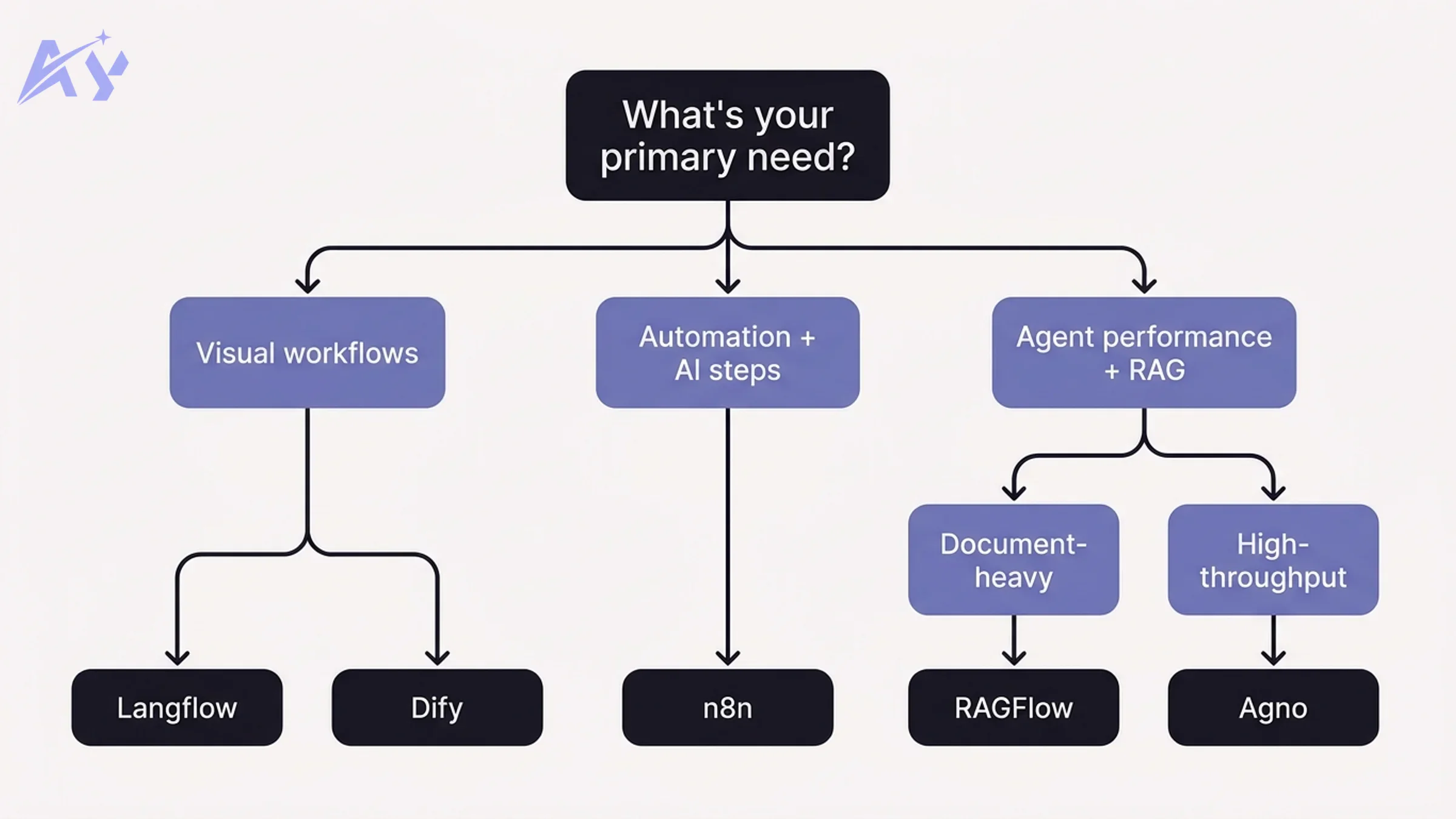
Choose by your primary use case first, then by your team's skills, then by the scale and licensing you need.
Start with your use case.
If you want to build and test LLM apps visually, start with Langflow or Sim. If you are automating business processes that include AI, n8n fits better. If retrieval accuracy over documents is the top priority, RAGFlow is the purpose-built choice. If you want a private assistant that lives in Slack or WhatsApp, look at OpenClaw. If you are shipping production agents in Python, evaluate Agno.
Match your team's skills.
Mixed or non-technical teams that need a visual interface will prefer Langflow, Sim, n8n, or Dify itself. Teams with strong Python skills who want code control will prefer Agno. Ops teams used to Zapier-style tools adapt quickly to n8n.
Check licensing and scale.
If you plan to resell a hosted product, read the licenses closely: Dify restricts multi-tenant use without a commercial license, and n8n's Sustainable Use License restricts offering n8n as a service. Langflow (MIT), Sim, RAGFlow, and Agno (Apache 2.0) are more permissive. For internal tools and low volume, the simplest option usually wins. For production traffic, plan for monitoring, upgrades, and data storage whichever tool you pick.
Do not over-engineer early. Most teams building their first LLM app should start with the simplest thing that works and revisit the platform once real bottlenecks show up.
If none of these fit cleanly, or you need a custom build on top of one of them, AY Automate helps teams choose the stack and implement it, from n8n workflows to RAG pipelines and production agents. Book a consultation to talk through your use case.
FAQ
Is Dify free?
Yes, Dify has a free self-hosted Community Edition and a free Sandbox cloud plan. The Community Edition uses a modified Apache 2.0 license that bans running a multi-tenant service or removing the Dify logo without permission. Sandbox includes 200 message credits, 5 apps, and 1 member, and paid cloud plans start with Professional at $590 per workspace per year (dify.ai/pricing, October 2026).
What is the best open-source alternative to Dify?
Langflow is the closest open-source alternative for visual LLM app building, and it uses the permissive MIT license. For document-heavy retrieval, RAGFlow (Apache 2.0) goes deeper. For code-first production agents, Agno (Apache 2.0) is the strongest pick. n8n is self-hostable but fair-code rather than OSI open source.
Is Flowise still a good Dify alternative?
No, Flowise is no longer a good choice for new projects because it reached end of life on August 31, 2026. The team stopped feature development on July 29, 2026 and scheduled the GitHub repository for archive in August 2026. The Apache 2.0 code remains available to fork, but Sim or Langflow are better maintained options for similar visual workflows.
Can I self-host all of these platforms?
Yes, all six alternatives can be self-hosted. n8n, Langflow, and RAGFlow run with Docker or a local install, OpenClaw installs on your own machine or server, Sim ships a Docker-based self-hosted setup, and Agno runs as a Python app on any container platform. Check each license before you host it for paying customers.
Is n8n a good replacement for Dify?
n8n is a good replacement when your main goal is automating business processes with AI steps, and a weaker one when you are building a standalone LLM app or chatbot. Dify is an LLM application platform; n8n is a workflow automation platform with AI agent nodes. Our n8n vs Dify breakdown covers the trade-offs in detail.
Which Dify alternative has the largest community?
OpenClaw has the largest GitHub following on this list, with about 392,000 stars as of October 21, 2026, followed by n8n at about 208,000 and Langflow at about 155,000. RAGFlow has about 92,000, Agno about 42,000, and Sim about 29,000. Dify itself sits at about 159,000.
Continue Reading
AI QA Testing Agents: What to Automate, Where QA Judgment Leads (2026)
What an AI QA testing agent does well (test generation, regression testing, cross-browser checks), where QA judgment still leads, and how this differs from agent evals.
7 Real n8n Workflow Examples You Can Actually Build (2026)
Most n8n tutorials show you buttons. This one shows you the actual node sequence behind 7 workflows teams run every day, lead capture, invoice reminders, RSS-to-social, database sync, order alerts, reporting, and error monitoring, so you can rebuild any of them in an afternoon.
Vector Databases for AI Agents: When You Actually Need One (2026)
What a vector database does differently from a traditional database, when an AI agent genuinely needs one, and what to consider when choosing between options.
Book a Free Strategy Call
Building this in production?
Walid runs a 30-min call to map your AI engineering team. Free, no slides.
Free weekly brief
Steal our production automations
The exact n8n flows, Claude Code setups, and prompts we ship for clients, broken down step by step. No spam, unsubscribe anytime.

Ex-IBM AI engineer and enterprise architect. Adel owns the technical architecture behind every automation and AI agent system AY Automate ships.