Loading service...





AI Customer Support Agent Development
AI Customer Support Agents That Resolve Tickets, Not Just Chat
AY Automate builds AI customer support agents grounded in your knowledge base, wired into your helpdesk. The agent answers from your verified docs, takes real actions like order lookups and refunds, and hands off to a human with full context when it should not decide alone.
Free · You keep the scoped plan either way
Operational focus
RAG-grounded answers, cited from your knowledge base
Order lookups, refunds, and ticket actions, not just replies
Built for Zendesk, Intercom, HubSpot, Salesforce, and your stack
AI agent delivery for support and ops teams at





What we build support agents with
Grounded knowledge, real tool calls, clean escalation.
Claude Code is the brain behind retrieval and reasoning. n8n wires the agent into your helpdesk, order system, and billing. Nothing ships that you cannot maintain after we leave.
- 01Claude Codethe brain · subagents · MCP

- 02Anthropicmanaged agents · runtime

- 03CursorIDE pair-programming

- 04n8ncron · webhooks · glue

- 05E2Bsandboxed compute

Three Layers of an Agent That Actually Resolves
A co-pilot that only answers questions will not move your deflection rate. What moves it is a system that takes the action itself, and knows when not to.
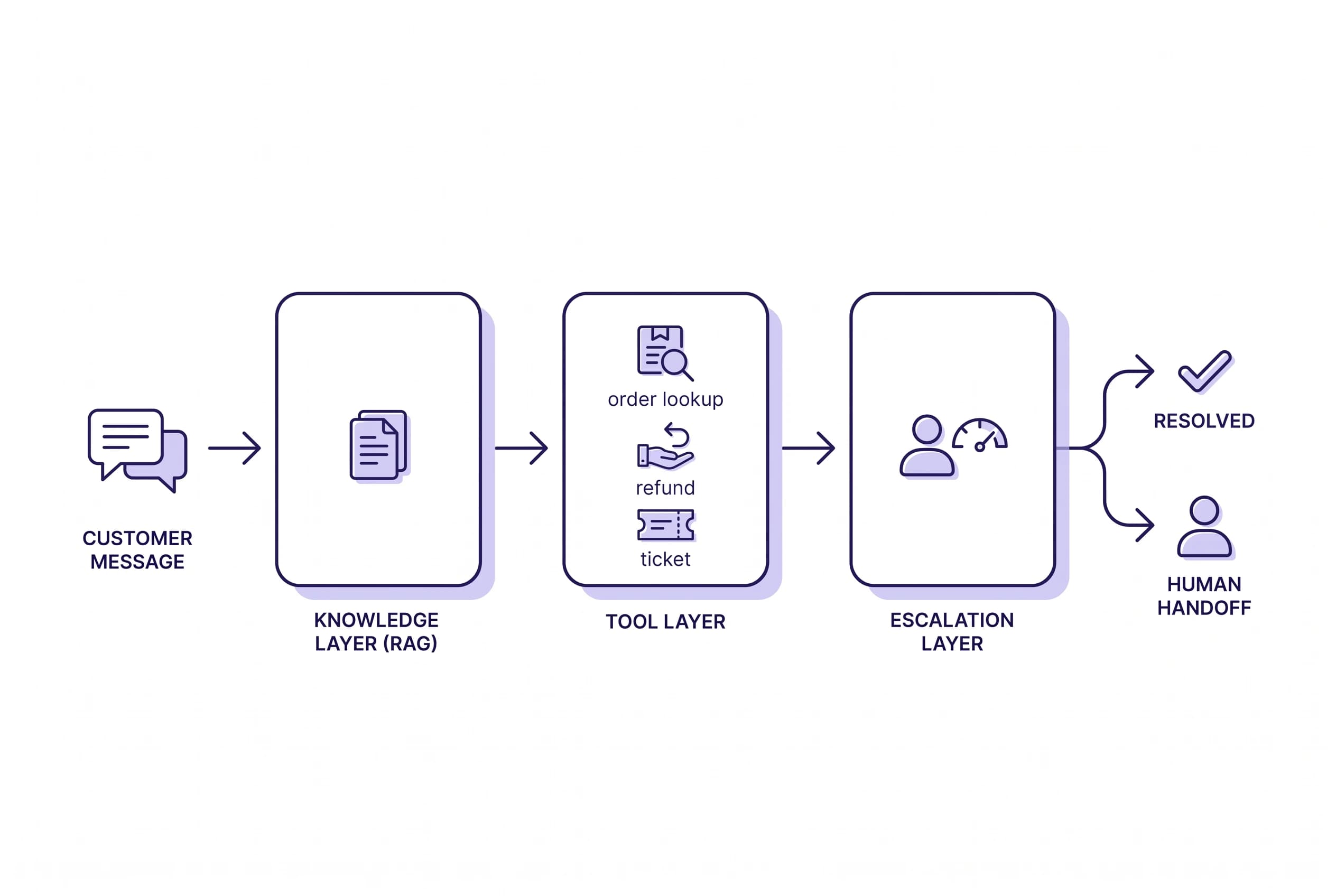
Knowledge layer (RAG)
The agent retrieves passages from your help center, policy docs, and past tickets at the moment of the question, then answers using only that retrieved context. This is the single most effective defense against made-up answers.
Tool layer
Order lookups, refunds, and ticket handoffs are functions the agent can call, not scripted replies. It decides which tool fits, fills in the parameters, and uses the result to compose its answer.
Escalation layer
Every response runs a confidence check. Below the threshold, or on an unclear rule, the agent hands off to a human with full context attached, instead of guessing.
Full architecture write-up, including the RAG and guardrail detail, lives on our guide to how AI customer support agent development works.
What a Working Support Agent Needs
A working agent is a system, not a single model. Only one of the six things below is about the model, the rest is data hygiene, integration, and operational design.
Clean knowledge base
Dirty data is the root cause of hallucinations. We deduplicate docs, remove outdated policy, and assign an owner so content stays current.
RAG retrieval
Every answer is grounded in your verified sources and cited back to the source passage, not the model's memory.
Confidence thresholds
The agent escalates any response it is not confident in, instead of guessing and hoping.
Tool integrations
Order status, refunds, and account actions wired in, so the agent resolves instead of just replying.
Human handoff
Full conversation context passed to a human on escalation. No repeating yourself to a person after the bot gives up.
Multichannel context
One conversation thread across chat, email, and voice, so the customer is not tracked across three separate histories.
Scope, Build, Deploy, Maintain
We do not quote a fixed support-agent package before we know your ticket mix. Every engagement starts with a scoping call.
Scope
DaysWe map your ticket volume, intent mix, and which systems the agent needs to read from and act on: helpdesk, order system, billing. Output: a scoped plan, not a sales pitch.
Build
Scoped in auditWe build the RAG retrieval layer, the tool calls (order lookup, refunds, ticket actions), and the escalation logic, then test against a real eval set on your actual ticket history.
Deploy
Scoped in auditWe ship into your helpdesk (Zendesk, Intercom, HubSpot, or your stack), connected to the systems it needs to resolve real requests, not just answer FAQs.
Maintain
OngoingKnowledge drifts, policies change, and ticket mix shifts. We keep tuning retrieval and thresholds after launch instead of handing over an agent that degrades.
Client Reviews
Real Results from 30+ Companies

Elie Salame
COO · Adstronaut.io






Elie Salame
COO · Adstronaut.io
Platform (Fin, Zendesk AI) vs. a Custom Support Agent
Platforms give you speed and a proven baseline. Custom builds give you depth, ownership, and better economics at volume. The right call depends on your ticket volume, your stack, and how unique your support logic is.
| Buy a Platform | Custom AY Automate Build | |
|---|---|---|
| Time to launch | Days to weeks | Weeks to months, most of it knowledge-base cleanup and integration, not the model |
| Pricing model | Per resolution or per seat, e.g. Fin runs about $0.99 per resolved conversation | Hosting plus maintenance, no per-outcome fee |
| Custom logic | Limited to what the platform supports | Unlimited, built around your actual policies and systems |
| Integration depth | Standard connectors to major helpdesks | Anything with an API, including internal billing or order systems a platform cannot reach |
| Data control | Vendor-managed | Yours, deployed inside your own environment |
| Best for | Standard support patterns, fast start | Unusual business logic, high volume, or deep internal integration |
Most teams start on a platform to prove the value, then move high-volume or specialized flows to a custom build once the per-resolution economics are clear. At 100,000 monthly resolutions, a small per-resolution price gap runs into hundreds of thousands of dollars a year, the point where a custom build often pays for itself.
How We Measure If It's Working
Track outcomes, not activity. We set up these four metrics as part of the build, not as an afterthought.
~41%
Deflection rate
2026 enterprise median, top quartile near 59%. Share of conversations resolved without a human.
70%+
Resolution rate
On high-volume, rule-based intents like order status and password resets.
4.1 / 5
CSAT
Pure-AI handling, vs 4.3 for humans. Hybrid flows that escalate well narrow the gap to nearly nothing.
$0.62
Cost per resolution
AI resolutions average, vs $7.40 for a human agent, per McKinsey's 2026 sample.
Watch these together, not in isolation: rising deflection with falling CSAT means escalation logic is too aggressive, not a win. Sources and full methodology on the AI customer support agent development guide.
Teams who scoped a support agent before building it



+45 founders and operators
“The team is super fast - sometimes we had to slow them down. We managed to scale the company without investing into hiring.”

Elie Salame
COO, Adstronaut.io
Support Agent vs. Chatbot Development: Which Do You Need?
These overlap in the underlying tech but answer different questions. Picking the wrong one just means a slower first call, not a wasted engagement, we sort it out on the scoping call either way.
This page: support agent
- You are measured on ticket volume, deflection rate, CSAT, and cost per resolution.
- The agent needs to look up orders, process refunds, or update tickets, not only reply.
- You want it wired into Zendesk, Intercom, HubSpot, or Salesforce specifically.
- You need a chatbot for a different surface: an in-app product assistant, an internal tool, or a website widget not tied to a helpdesk.
- You are earlier in scoping and not sure yet whether the use case is support, sales, or something else.
- You want the underlying LLM chatbot build itself, retrieval, tool calls, escalation, independent of the support-specific metrics above.
Not sure which fits? Book the scoping call below either way, we route to the right build on that call rather than asking you to self-diagnose first.
When a custom support agent fits
- Your ticket volume makes per-resolution platform pricing expensive over a year.
- The agent needs to reach internal systems, billing, a proprietary order database, that a platform's connectors do not cover.
- Your support logic is unusual enough that a template does not fit.
When it does not
- Your ticket volume is low and standard; a platform like Fin or Zendesk AI is genuinely the faster, cheaper start.
- You are not ready to give access to the helpdesk or order systems the agent needs to act on.
- You want a lead-capture chat widget, not a support-resolution system, see chatbot development instead.
Comparing platform vendors before you commit? See our roundup of the best AI agents for customer support for what to check before buying one.
Free Support Agent Scoping Call
Ready for an Agent That Actually Resolves Tickets?
Book a free scoping call. We will map your ticket mix, the systems the agent needs to act on, and a real deflection target, not a template price.
Book a 30min Free Strategy Call
In this call, we'll walk through your project scope, timeline, and goals - so we can both check if we're a fit. No obligation, no slide deck, just a working session.
Don't want a call? Email walid@ayautomate.com
Opportunity Map
Implementation Path
Fast Follow-Up
“The team is super fast - sometimes we had to slow them down. We managed to scale the company without investing into hiring.”
Elie Salame
COO, Adstronaut.io
Video Call
Phone Call
In-Person
We've created products featured in






Walid Boulanouar
View LinkedInSupport Agent Scoping Call
Share your ticket volume and stack, then schedule the call directly on this page.
Free · You keep the scoped plan either way
30min
CalGoogle Meet
Usually responds in 1 hour
No commitment required
Recommended services
AI Chatbot Development Agency
The underlying chatbot build, for any surface, not only support.
AI Agent Development
Custom agents that take actions across your wider stack, beyond support.
RAG Pipeline Architecture
The retrieval pipeline that grounds every agent answer in your data.
Automation Maintenance & Support
The retainer that keeps a shipped agent accurate as your data changes.
FAQ
AI Customer Support Agent Development Questions
What is the difference between an AI chatbot and an AI customer support agent?+
A chatbot follows fixed scripts and decision trees. An AI customer support agent uses a language model grounded in your knowledge base through RAG, calls tools to take real actions like order lookups and refunds, and decides on its own when to escalate to a human. The agent resolves requests end to end; a chatbot mostly routes or answers from a fixed menu.
How much can an AI support agent actually deflect?+
Median enterprise tier-1 deflection is around 41 percent, with the top quartile near 59 percent, per Zendesk and Salesforce benchmarks. High-volume, rule-based intents like order status and password resets deflect at 70 percent or more; nuanced complaints rarely exceed 25 percent. Your blended rate depends on your ticket mix, which is what we scope in the audit.
Will it give customers wrong answers?+
It can, but the risk is controllable, and it is mostly a data problem, not a model problem. We ground every answer in your knowledge base with RAG, force the agent to cite sources, set a confidence threshold that escalates uncertain cases, and keep your documentation clean. Guardrails like these cut hallucination risk substantially compared with an ungrounded model.
Should we buy a platform like Intercom Fin or build a custom agent?+
Buy a platform when your support maps to common patterns and you want a fast start; Fin runs about $0.99 per resolved conversation with no setup fees on an existing helpdesk. Build custom when you need deep integration with internal systems a platform cannot reach, unusual business logic, full data control, or better unit economics at high volume, since a small per-resolution price difference adds up fast past 100,000 monthly resolutions. Many teams start on a platform and move specialized flows to a custom build once the economics are clear.
Does it integrate with Zendesk, Intercom, Salesforce, or HubSpot?+
Yes. We connect through the same helpdesk APIs platform agents use, and can also reach systems a platform cannot: an internal billing service, a proprietary order database, or a custom CRM. Each action becomes a tool the agent can call, scoped to only what you permit.
How is this different from your AI chatbot development agency service?+
AI chatbot development is the underlying build: the conversation flow, retrieval, and tool-calling architecture for any chat surface, a website widget, an in-app assistant, an internal tool. This page is the applied version specifically for customer support: ticket resolution, order/refund actions, and the deflection, CSAT, and cost-per-resolution economics that matter for a support team. If your need is a general-purpose chatbot rather than a support agent measured against ticket volume, start with AI Chatbot Development Agency instead.
What does it cost?+
Platforms charge per resolution or per seat: Fin runs about $0.99 per resolved conversation with a $49.50 monthly minimum; Zendesk adds an AI add-on around $50 per agent per month on top of seat pricing. A custom build carries higher upfront engineering cost but a lower marginal cost per resolution since you pay for hosting and inference, not a per-outcome fee. We scope a real number after the audit, once we know your ticket volume and systems.
How do you measure if it's actually working?+
Deflection rate (share resolved without a human), resolution rate (the stricter version, confirmed fully answered), CSAT, and cost per resolution, tracked together. Rising deflection with falling CSAT is a warning sign that escalation logic is too aggressive, not a win. We set up this tracking as part of the build, not as an afterthought.