
Book a Free Strategy Call
Skip the read: talk to Walid in 30 min.
Free strategy call. We map your AI engineering team, you keep the notes.
AI automation experts help businesses find repetitive work, connect systems, add suitable AI models, and keep the resulting workflows working after launch. The right expert should understand your process before recommending tools. They should also explain how the system handles errors, sensitive data, human review, testing, and maintenance.
An AI automation expert is a practitioner who combines workflow design, software integration, and AI models to automate business tasks. This guide explains who leads the field, what AI automation includes, how consultants price their work, which skills matter, and how to choose between an individual expert and an agency. It is written for B2B, SaaS, and ecommerce teams that need a working production system rather than a demonstration.
Who are the biggest AI leaders?
The biggest AI leaders depend on what you are measuring. Model developers lead foundational AI research and model access. Software platforms lead distribution. AI automation experts and agencies lead the work of turning those models into business systems. For a buyer, relevant delivery experience matters more than public prominence.
A well known AI company is not automatically the right partner for automating your operations. Building models and applying models are different jobs. Your project may need someone who can map an order process, connect an application programming interface, define approval rules, and monitor failures rather than someone who trains a new model.
It helps to separate the market into clear groups:
- Model providers create or provide access to general AI models.
- Software platforms provide tools for building workflows, applications, or agents.
- Independent experts design and build focused systems for clients.
- Automation agencies provide discovery, engineering, testing, and ongoing support.
- Internal teams own automation inside one company and work closely with its operations.
The right group depends on what you already have. A team with capable engineers may only need specialist advice. A business without integration skills may need an agency that can own discovery, implementation, and maintenance.
What should "leader" mean for your project?
Define leadership in terms of your intended outcome. A useful expert should be able to understand the workflow, identify where AI is appropriate, and explain where fixed rules are safer. They should be able to connect the systems involved and show how they will test normal cases, missing data, duplicate events, and model errors.
Public reach is a weak substitute for delivery evidence. Ask for examples that resemble your workflow without requesting confidential client information. Look for the decisions the expert made, how the system was tested, what remained manual, and what happened after release.
Use criteria that relate directly to production work:
- Does the expert begin with the business process or with a preferred tool?
- Can they explain the difference between a fixed workflow and an AI decision?
- Can they work with the tools your team already uses?
- Do they define ownership when an integration or model fails?
- Will they document access, rules, dependencies, and human review?
- Do they offer maintenance, or will your team own it after handover?
Searches for the best AI automation experts often produce mixed lists of consultants, educators, agencies, and tool vendors. Those categories should not be treated as interchangeable. A person who teaches workflow building may be useful for training, while a production agency must also handle integration design, testing, access control, release work, and support.
AY Automate is an AI automation agency and is therefore commercially related to this topic. We should be assessed by the same delivery criteria as any other provider. Our stated work includes workflow audits, n8n and Claude Code builds, connections to a client's existing stack, testing on real data, and maintenance after launch (AY Automate AI automation agency).
If you want named provider comparisons, use a list with an explicit method rather than a popularity claim. Our guides to the best AI automation agencies and the best AI automation agencies that ship to production cover that narrower decision.
What is exactly AI automation?
AI automation combines a repeatable workflow with an AI model so a system can classify, extract, draft, route, or decide within defined limits. The automation controls when work happens and where data moves. The AI handles inputs that fixed rules cannot interpret reliably enough on their own.
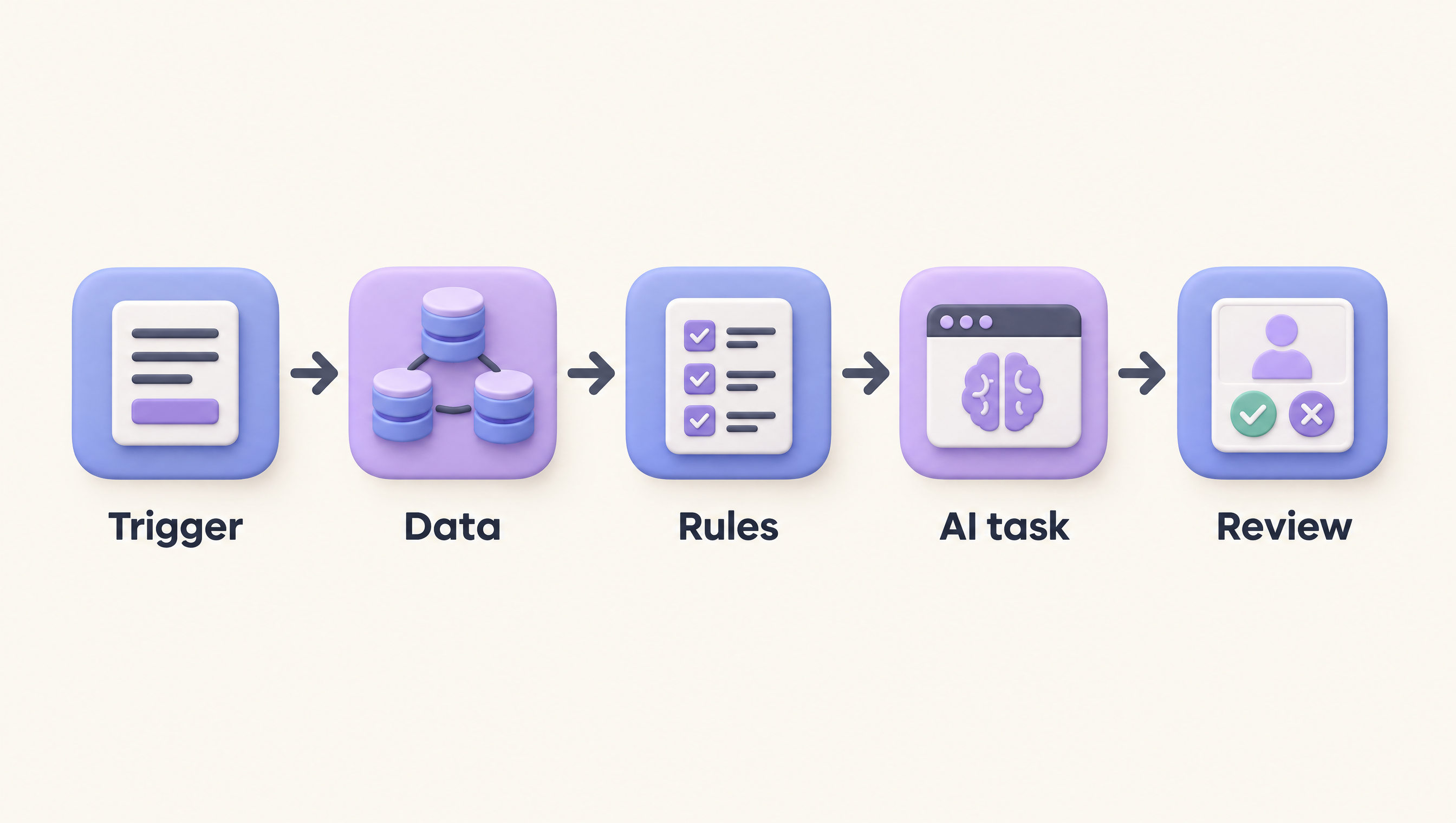
Traditional automation works best when the input and rule are predictable. For example, a system can move a record when a field changes or send a notification when a status reaches a set value. AI becomes relevant when the input includes natural language, documents, images, or requests that vary in form.
A practical AI automation usually contains several parts:
- A trigger starts the workflow, such as a form submission or changed record.
- An integration collects the required data from connected systems.
- Rules check whether the data is complete and whether the workflow may continue.
- An AI model performs a narrow task such as classification or drafting.
- A system records the result, sends it for review, or takes an allowed action.
- Monitoring records errors and gives an owner enough information to respond.
The AI model is only one part. Most production work concerns data access, system connections, permissions, business rules, exceptions, and support. A strong expert spends time on these parts because a convincing model response does not prove that the surrounding workflow is safe or dependable.
What can teams automate?
B2B teams can examine work that moves information between customer relationship management, support, sales, finance, and internal knowledge systems. SaaS teams can examine account operations, support intake, internal reporting, and product feedback routing. Ecommerce teams can examine catalogue operations, order exceptions, support triage, and internal coordination.
These are starting points, not promises that every process should be automated. The expert still needs to inspect the systems, data quality, permissions, exception rate, and cost of mistakes.
A useful discovery process asks:
- What event starts the work?
- Which systems hold the required information?
- What decisions are based on fixed policy?
- Which decisions need interpretation?
- When must a person approve the result?
- What evidence should the workflow retain?
- Who owns failures after release?
Good candidates are repeated often enough to justify engineering effort and have an identifiable owner. The input and expected output should be clear. There should also be a safe route for uncertain or unusual cases.
Poor candidates include undefined processes and work where no one agrees on the correct outcome. Automation will reproduce that uncertainty at a larger scale. Fixing the process first is usually the more sensible choice.
What is the difference between workflows, agents, and retrieval systems?
A workflow follows a designed path. It may include AI steps, but its sequence and allowed actions remain controlled. An agent receives a goal and can choose among permitted tools or steps, which gives it more freedom and also creates more testing and oversight work.
A retrieval augmented generation system, often called a RAG system, finds relevant material from an approved information source and provides that material to an AI model when it creates an answer. Retrieval can make answers more connected to company information, but it does not make every answer correct. Access rules, document quality, retrieval settings, citations, and human review still matter.
AY Automate states that it develops custom agents and internal knowledge bases for multi-step work. It also builds private retrieval pipelines intended to ground AI answers in client information (AI agent and RAG services).
The least flexible design that can solve the problem is often the easiest to test and maintain. If a fixed workflow is enough, an open ended agent may add unnecessary uncertainty. If the task genuinely requires selecting tools or adapting the next step, a constrained agent may fit.
For teams comparing the software layer, our guide to AI workflow automation platforms explains the platform choice in more detail.
How much do AI consultants cost?
AI consultant cost depends on the scope, existing systems, data access, integration difficulty, testing needs, and support model. A useful proposal should separate discovery, implementation, deployment, documentation, and maintenance. Without that scope, a low or high quote tells you little about the work included.
No single rate can represent strategy advice, a small workflow repair, a custom integration, and a maintained AI system. Consultants may charge for time, a defined project, a discovery phase, ongoing support, or a mixture of these. Compare the responsibility and deliverables behind the price rather than comparing headline amounts alone.
Ask every provider to describe the commercial model in plain terms:
- What is included before building begins?
- Which systems and integrations are included?
- Who pays software, model, hosting, and usage costs?
- How many review and revision stages are included?
- What testing will occur before release?
- What documentation and training will be delivered?
- What happens when an external system changes?
- Is support included, optional, or unavailable?
An estimate should name assumptions. If the expert assumes an application programming interface is available, the data is clean, or your team will provide technical access quickly, that assumption affects the delivery plan. Ask what changes if the assumption proves false.
What makes a quote useful?
A useful quote links cost to a defined workflow and acceptance conditions. It explains what the system will do, what it will not do, and which cases need human review. It should also identify dependencies that neither side controls, such as access to an external service.
Discovery can be valuable when the process is unclear. It gives the provider time to map the current work, inspect systems, identify risks, and create a realistic implementation scope. It can also reveal that the proposed automation is not worth building.
Be cautious when a proposal includes only tool names and a promised outcome. Tool choice matters, but it is not a substitute for process design. The proposal should cover error handling, access, testing, logs, ownership, and maintenance.
Also ask how future work will be priced. An automation may need changes when your process, permissions, model, or connected software changes. A project quote that excludes all post-launch work may suit a technical team that can take ownership, but it may not suit a team that expects the provider to remain responsible.
AY Automate's stated model includes workflow audits, builds in a client's existing stack, real-data testing, and maintenance after launch. We also provide embedded engineering, where an engineer works inside the client's team to learn workflows and build systems (AY Automate services). Pricing is not published in the material cited on this page, so you should request a scope based on your workflow.
If your use case is mainly campaign operations, lead movement, or marketing system connections, a specialist marketing automation agency may be a closer fit than a general AI consultant.
Free weekly brief
Steal our production automations
The exact n8n flows, Claude Code setups, and prompts we ship for clients, broken down step by step. No spam, unsubscribe anytime.
Which AI job is highly paid?
Highly paid AI work tends to combine scarce technical skill with responsibility for systems that affect business operations. Job titles alone are unreliable because companies define them differently. When assessing a career path, compare the actual work, required experience, location, employment type, and ownership rather than relying on the title.
What I'd Learn Instead of Automation in 2026Watch "What I'd Learn Instead of Automation in 2026" on YouTube
Relevant roles can include machine learning engineering, AI engineering, data engineering, software engineering for AI products, AI architecture, applied research, automation engineering, and technical consulting. Some roles focus on creating models. Others focus on integrating models into software and business processes.
This page does not publish a salary ranking because no verified salary dataset is cited here. Pay also changes by market and role definition. A useful job comparison should use current salary data for your location and distinguish base pay, variable pay, equity, contract income, and business revenue.
What creates value in an AI automation role?
The strongest practitioners can cross the boundary between business operations and engineering. They can turn an informal process into explicit inputs, decisions, actions, and exceptions. They can also build the integrations, assess model output, and explain operational risks to nontechnical owners.
Useful skill areas include:
- Process mapping and requirements work
- Application programming interfaces and authentication
- Data modelling and data quality
- Workflow tools and software development
- AI model selection and evaluation
- Security, privacy, and access design
- Testing, monitoring, and incident response
- Documentation and stakeholder communication
A narrow tool skill can help you begin, but it may lose value when tools change. The underlying skills last longer: understanding systems, designing interfaces, handling failure, measuring output quality, and working with business owners.
The video below shows Nick Saraev's view on what to learn instead of focusing only on automation. The video, titled "What I'd Learn Instead of Automation in 2026," was published on November 13, 2025 (watch on YouTube).
The career choice also affects how you build experience. An internal role gives you repeated exposure to one company's systems and consequences. Consulting exposes you to varied processes but requires sales, scoping, and client communication. Agency work may provide a team and delivery method, while independent work gives you more control and more direct responsibility.
How do I become an AI expert?
Become an AI automation expert by learning process analysis, integrations, software basics, AI model behaviour, testing, and production support. Build small systems around real workflows, document their limits, and maintain them after release. Tool tutorials help you start, but production experience is what exposes missing data, access problems, and exceptions.
Start with a workflow that has a clear trigger, a limited data set, and a reversible action. Avoid beginning with an agent that can take broad actions across important systems. A controlled project makes it easier to see why each component exists and how failures should be handled.
A practical learning path is:
- Map the process. Write down the trigger, inputs, rules, outputs, owner, and exceptions.
- Build a fixed workflow. Connect simple systems and move structured data without adding AI.
- Add one AI task. Use a model for a narrow classification, extraction, or drafting step.
- Add review. Route uncertain or sensitive cases to a person.
- Test failures. Try missing fields, duplicated events, invalid responses, and unavailable services.
- Document ownership. Record credentials, dependencies, support steps, and change history.
Do not judge a project only by whether it works during a demonstration. Run it with realistic inputs and inspect the cases that do not follow the happy path. Record why the workflow failed and whether the system stopped safely.
What should go in an AI automation portfolio?
A useful portfolio explains the problem and decisions rather than showing only a visual workflow. Describe the original manual process, why automation was suitable, where AI was used, and where fixed rules remained. Explain how you tested the system and what you chose not to automate.
Remove private credentials and confidential business data. If you use sample data, label it honestly. Do not imply that a demonstration has operated in production when it has not.
For each project, cover:
- The workflow and its owner
- The connected systems
- The model's narrow responsibility
- The approval and escalation rules
- The test cases
- The known limits
- The maintenance plan
Learn to explain trade-offs. A buyer may value a smaller controlled workflow more than an ambitious agent with unclear permissions. Good experts can say when ordinary software, a manual check, or a process change is the better answer.
You can also study how specialist implementers work. Our guide to the best n8n agencies focuses on providers working with n8n. A platform skill is useful, but you should pair it with integration, testing, and operations knowledge.
If you need help assessing a workflow, speak with AY Automate about the process, systems, risks, and ownership before deciding what to build. We will still need access to the relevant people and systems, and some work may be better left manual.
How should you compare AI automation experts?
Compare AI automation experts by the work they own, their production method, and the support your team needs. Use the same questions for every candidate. Do not rank a consultant, agency, platform, and educator as if they provide the same service, because each solves a different part of the problem.
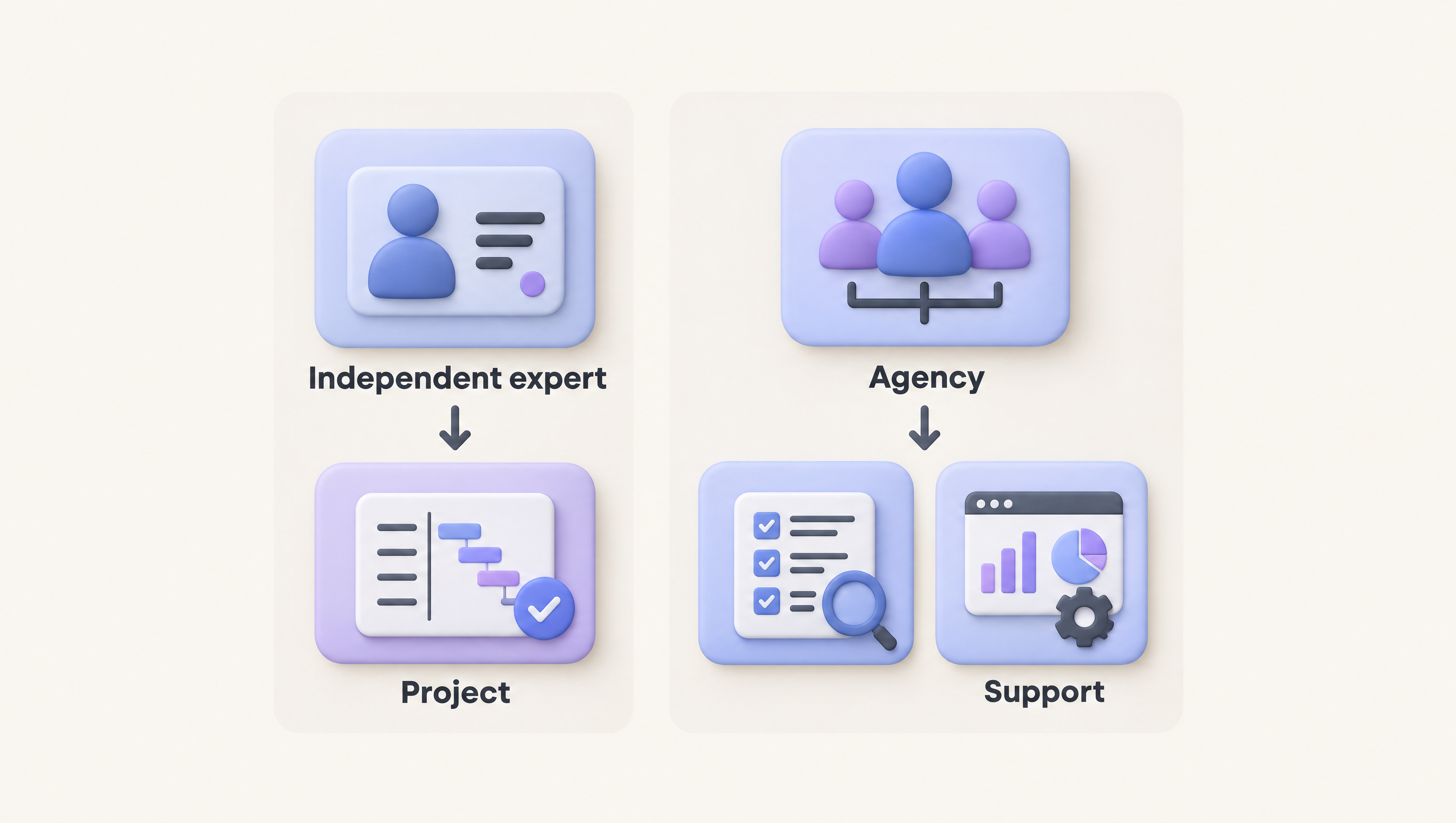
| Provider type | Best fit | What to verify | Main trade-off |
|---|---|---|---|
| Independent expert | A defined project that needs direct specialist input | Availability, integration skills, documentation, and support cover | One person may hold much of the project knowledge |
| AI automation agency | Discovery, engineering, testing, and ongoing maintenance | Named responsibilities, delivery method, testing, and post-launch ownership | More delivery structure may come with more scope and coordination |
| Software platform | A technical team that wants to build internally | Connectors, permissions, deployment options, logs, and usage costs | The platform does not define your process or own the result |
| Internal hire | Repeated automation work tied closely to company operations | Breadth of skills, management support, and access to process owners | Hiring does not remove the need for tools, governance, or specialist input |
| Trainer or educator | Skills development for a team | Curriculum depth, exercises, and relevance to your systems | Training alone does not deliver or maintain a production workflow |
Create a short scorecard before meeting providers. Weight it according to your risk and internal capability. A technical SaaS team may care most about architecture and handover, while an operations team may need the provider to own support and monitoring.
Ask candidates to walk through one representative workflow. Listen for questions about data, exceptions, permissions, and process ownership. If the discussion stays at the level of model names and impressive outputs, the provider may be overlooking the work required around the model.
A sensible selection process includes a defined problem, access to the people who perform the work, and an agreed way to judge the result. Start small enough that you can inspect the output. Expand only after the workflow behaves acceptably with real operating conditions.
What AI automation experts cannot do
AI automation experts cannot repair an undefined process by adding a model, guarantee accurate output, or remove your need to own policy and risk. They also cannot maintain access to systems they do not control. Your team must provide process knowledge, permissions, decisions, and an owner for the resulting system.
Automation does not fit every task. Work may be a poor candidate when it happens rarely, changes constantly, depends on unrecorded judgement, or carries consequences that require direct human authority. A manual process may also be cheaper and easier to change.
An expert cannot make poor source data reliable through prompting alone. Missing records, conflicting fields, old documents, and unclear ownership remain operational problems. Retrieval can give a model approved context, but the quality and access rules of that context still need management.
No provider can promise that an external model, application programming interface, or software connector will never change. Maintenance plans should account for dependencies. Your team should know what stops, who is notified, and how manual work continues when a dependency is unavailable.
AI automation also does not remove accountability. A person or business still owns customer communication, financial decisions, employee decisions, legal duties, and access to sensitive information. The level of human review should reflect the consequence of an incorrect action.
Do not choose AI automation when:
- The process has no agreed owner.
- The expected output cannot be described.
- There is no safe response to uncertainty.
- The required data cannot be accessed appropriately.
- The cost of a wrong action is unacceptable without human approval.
- The process is about to be replaced or redesigned.
- Your team cannot support the workflow and the provider offers no maintenance.
AY Automate can build and maintain automations, workflows, agents, integrations, and private retrieval pipelines, but we cannot define your policies for you or guarantee that model output will always be correct. If you have a specific process in mind, contact AY Automate with the current steps, systems, owner, and main failure risks so we can assess whether automation fits.
FAQ
Who are the biggest AI leaders?
The biggest AI leaders depend on whether you mean model developers, software platforms, researchers, or implementation experts. For an automation project, assess relevant production work, integration ability, testing, and support rather than using public prominence as the main criterion.
What is exactly AI automation?
AI automation is a workflow that uses an AI model for a defined task such as classifying, extracting, drafting, routing, or selecting an allowed action. The surrounding automation manages triggers, data movement, rules, review, records, and errors.
How much do AI consultants cost?
AI consultant cost depends on scope, integrations, data, testing, deployment, and support. Ask for a proposal that separates discovery, implementation, software costs, documentation, and maintenance instead of comparing an isolated rate.
What is the salary of an AI expert?
The salary of an AI expert varies by role, location, experience, employer, and compensation structure. Use a current salary source for your market and compare base pay, variable pay, equity, or contract income separately.
How do I become an AI expert?
You become an AI automation expert by learning workflow design, integrations, data, AI model behaviour, testing, and support. Build narrow projects with realistic inputs, document their limits, and learn to handle failures after release.
AI automation agencies in USA
AI automation agencies serving the USA should be compared by scope, production experience, system integration, testing, security responsibilities, and maintenance. AY Automate states that it serves the USA as well as clients worldwide (AY Automate).
AI automation agency for small businesses
A small business should choose an AI automation agency only when the saved work or reduced operational friction can justify the build and support burden. Start with one repeated process, keep human approval for consequential actions, and confirm who will maintain the system.
Sources
AY Automate AI automation agency service
"What I'd Learn Instead of Automation in 2026" by Nick Saraev
Last checked: November 13, 2026
Book a Free Strategy Call
Building this in production?
Walid runs a 30-min call to map your AI engineering team. Free, no slides.
Free 30-minute call
Want us to look at your setup?
Leave your name and email. You get the calendar right after.

Taha builds and ships custom AI agents and workflow automations for AY Automate clients across SaaS, finance, and professional services.