Book a Free Strategy Call
Skip the read: talk to Walid in 30 min.
Free strategy call. We map your AI engineering team, you keep the notes.
Choosing an AI automation platform gets difficult when every option appears to connect apps, run workflows and add AI. You need to know whether a packaged tool can handle your process, or whether the real requirement is engineering, testing and ongoing maintenance. The practical answer is to choose by workflow complexity, data control, internal skills and ownership after launch.
An AI automation platform is software or an engineered system that connects tools, applies rules or AI models, and moves work between steps. This guide compares types of options rather than ranking named products because the available evidence does not support a fair product shortlist. For many B2B, SaaS and ecommerce teams, the first choice is between a configurable workflow builder and a custom automation service.
Why people look for alternatives
Teams look for alternatives when their current automation cannot represent the full process, needs too much manual repair, or leaves unclear responsibility after launch. The issue is often broader than the platform itself. Data quality, unusual business rules, access limits and missing operational ownership can stop a promising workflow from becoming dependable work.
You may be trying to leave:
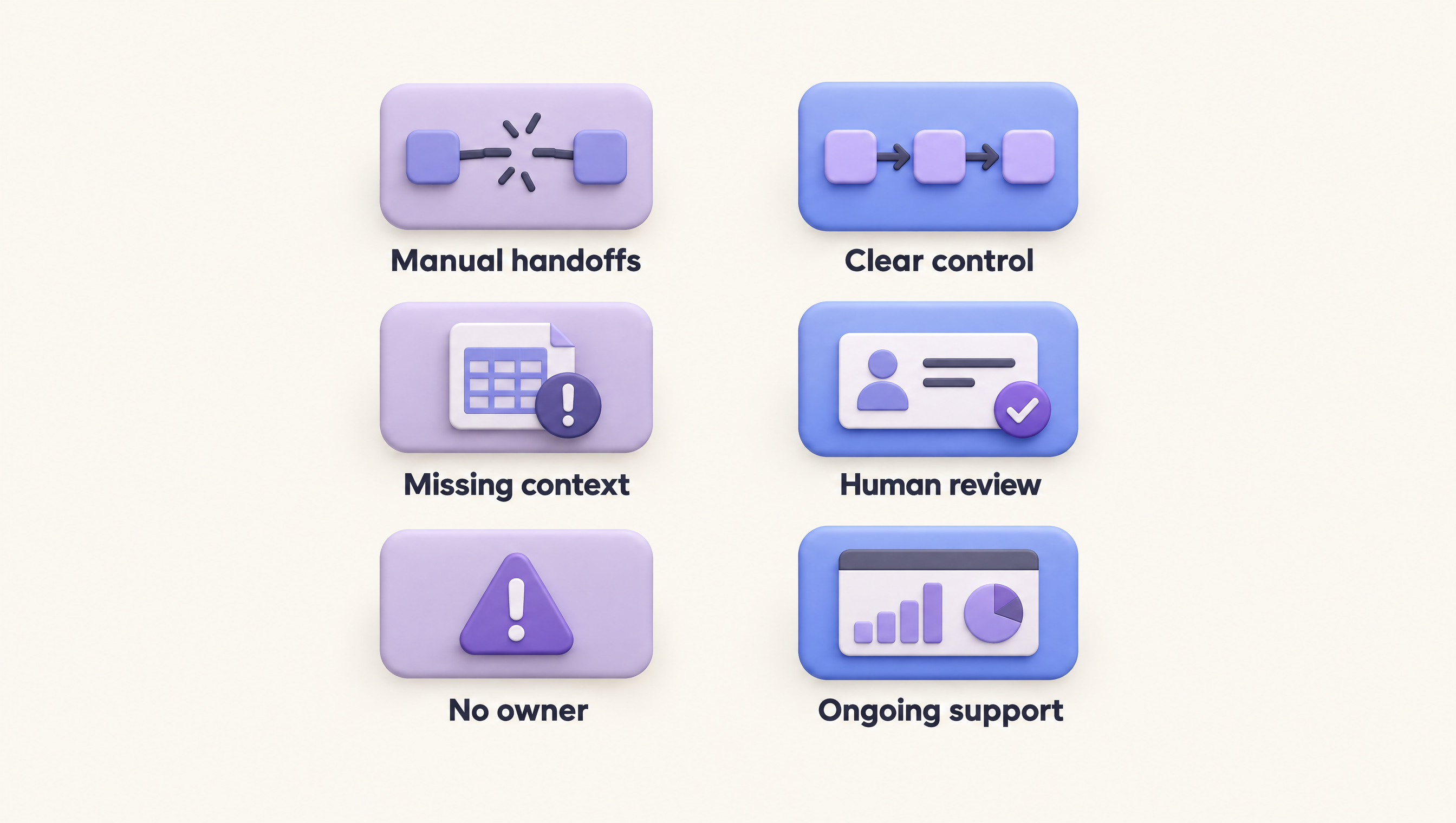
- A workflow that handles the easy path but fails on exceptions
- Manual transfers between a customer relationship management system, support tool, spreadsheet or internal database
- AI output that cannot use your approved business information
- Automations that nobody monitors after the original builder moves on
- A platform that requires more technical work than your team can support
- A fixed interface that cannot represent your approval rules
You are probably looking for:
- Clear control over triggers, actions and approvals
- Connections to the tools your team already uses
- Testing with realistic business data before launch
- A named owner for errors, access changes and updates
- Human review where an AI decision carries risk
- A cost model that matches how often the workflow runs
The platform may still fit if your process is predictable, its integrations cover the systems involved, and someone on your team can own it. Switching tools will not fix an unclear process. Map the inputs, decisions, exceptions and desired result before you replace anything.
| Type of option | What it does | Best for | Pricing basis to check | How it differs from a packaged AI automation platform |
|---|---|---|---|---|
| Configurable workflow builder | Connects triggers and actions through a visual or node based workflow | Repeatable work with known steps | Subscription, execution volume, users and AI use | You configure the workflow within the product's available actions and limits |
| Custom workflow engineering | Connects systems through APIs and purpose built workflow logic | Processes with unusual rules, handoffs or internal systems | Project scope, maintenance and infrastructure | Engineers build around the process instead of fitting it into a fixed product interface |
| AI agent system | Gives an AI model tools and instructions for multi step work | Work that needs interpretation before choosing an action | Model use, workflow runs, infrastructure and support | The path can vary by task, so evaluation and guardrails matter more |
| Private retrieval system | Finds approved internal information and provides it to an AI model | Answers or decisions that must use company information | Storage, model use, data preparation and maintenance | It adds a controlled knowledge layer rather than automating every process by itself |
| Embedded automation engineering | Places engineering work inside the operating team | Teams that need discovery, delivery and continued ownership | Engagement scope and duration | The service includes implementation and maintenance rather than software access alone |
This is not a ranked list. AY Automate provides custom workflow engineering, AI agent development, private retrieval pipelines and embedded automation engineering, so we have a commercial relationship with those categories.
Which criteria should you compare first?
Compare the process before comparing interfaces. Start with the work that enters the system, the decisions it makes, the systems it changes and the people responsible for exceptions. Then check integration depth, data control, testing, maintenance and total operating effort. A polished builder is useful only when it can run your real process.
Can the option represent the entire workflow?
Write the workflow as a sequence from input to completed result. Include approval points, missing data, duplicate records, failed requests and cases that need a person. A basic demonstration often covers only the successful path, while the exceptions create most of the operating work.
Ask a vendor or implementation partner to show how the system handles:
- A required field that is empty
- A duplicate customer or order
- An expired login or revoked permission
- An AI response that does not meet the acceptance rule
- A connected service that is temporarily unavailable
- A request that needs human approval
If these cases cannot be represented clearly, the workflow may need custom logic or a smaller automation boundary. It can be safer to automate one stable part and leave the judgment step with a person.
Does it connect to your real systems?
An integration name on a product page does not tell you whether every required action is available. List the exact records the workflow must read, create and update. Check authentication, field access, file handling and whether the integration supports the event that should start the workflow.
When a standard connector does not expose the required action, an API integration may fill the gap. AY Automate's custom workflow automation work focuses on API integration and workflow engineering for manual handoffs between systems. That is relevant when the limitation is integration depth rather than a missing AI feature.
How will you test AI decisions?
AI steps need an acceptance rule. Decide what a correct result looks like, which failures require human review and what information the model is allowed to use. Test routine cases alongside incomplete, conflicting and unusual inputs.
The test should evaluate the business result, not only whether the workflow completed. For example, a support classification can run without an error while still sending the case to the wrong queue. Keep evidence of inputs, outputs and approvals so the team can investigate failures.
Who owns the automation after launch?
Ownership includes monitoring failed runs, updating access, changing rules and checking whether AI output has drifted from the intended use. Assign these jobs before launch. If no internal person can take them, compare managed services with software subscriptions rather than treating them as equivalent purchases.
AY Automate says its AI automation agency audits workflows, builds with n8n, Claude Code and the client's existing stack, tests on real data, and maintains systems after launch. That service model can fit teams that need delivery and continued technical ownership. It is not a self service software license.
What will the full operating effort be?
Price is only one input. Compare implementation work, model use, workflow executions, infrastructure, monitoring and staff time. A lower software fee can still require substantial internal engineering, while a managed option can cost more but move ownership outside your team.
Request a pricing explanation based on your expected process. The useful unit might be users, runs, tasks, model input, infrastructure or engineering time. Do not compare monthly subscription prices without checking what each option excludes.
Which main kind of option fits your workflow?
The main options are configurable workflow builders, custom workflow engineering, AI agents, private retrieval systems and embedded engineering. Each solves a different constraint. Choose a builder for defined steps, engineering for unusual logic, an agent for variable paths, retrieval for controlled knowledge, or embedded help when ownership is the main gap.
AI Automation Platform (NodeMaven Review 2026)Watch "AI Automation Platform (NodeMaven Review 2026)" on YouTube
Configurable workflow builders
A configurable builder fits work with a known trigger, a limited set of decisions and supported application connections. It can let an operations team change steps without waiting for a full software release. It is usually the first category to evaluate for routine notifications, record updates and scheduled transfers.
Its limit is the boundary of its connectors, controls and execution model. Complex exception handling can turn a simple visual workflow into a difficult system to inspect. Your team must also decide who will diagnose failures and update the workflow when an application changes.
Stay with your current platform if it already covers the required actions and your team can maintain it. A migration adds work and can recreate the same process problems in a different interface. For named product comparisons, see our guide to the best AI workflow automation platforms.
The video below shows a separate 2026 review of an AI automation platform and can help you see the type of product demonstration you should question against your own workflow.
Custom workflow engineering
Custom workflow engineering fits processes that cross internal systems, use unusual business rules or require API actions that a standard connector does not expose. The implementation can preserve the tools your team already uses while replacing manual transfers between them. It also gives you more control over validation and exception handling.
The limit is that custom work needs technical ownership. Requirements can expand, APIs can change and production issues still need attention. You should define the maintenance arrangement, access controls and change process as part of the implementation rather than treating launch as the final step.
AY Automate builds n8n workflows and agents connected to existing business tools, according to its service page. Our role is the implementation partner, not a neutral platform vendor. Teams that only need a standard connector and a few actions may be better served by configuring a packaged tool themselves.
AI agent systems
An AI agent system fits work where the next action depends on interpreting a request, choosing a tool or gathering information across several steps. This can support processes that cannot be represented as one fixed sequence. The agent still needs permissions, constraints and a clear finish condition.
Its limit is predictability. A flexible path creates more cases to evaluate than a fixed rule does. Keep high impact changes behind approval, restrict available tools and record what the agent attempted so a person can review the result.
AY Automate develops custom agents and internal knowledge bases for multi step work, according to its embedded engineering and agency descriptions. This approach is unnecessary when ordinary rules can make the decision. Use fixed logic where the answer is known, and reserve an AI model for interpretation that rules cannot handle well.
Private retrieval systems
A private retrieval system fits workflows that need answers grounded in company documents or approved records. It retrieves relevant material and passes that context to an AI model. This can be one part of a workflow, such as preparing an answer for review, rather than the system that controls every action.
Its limit is the information available to retrieve. Old, conflicting or poorly structured material can produce weak context. The system also needs access controls and a process for updating or removing information.
AY Automate builds private retrieval pipelines intended to ground AI answers in a client's own information, according to its agency page. This category does not replace workflow orchestration on its own. You may still need triggers, integrations, approval steps and monitoring around it.
Embedded automation engineering
Embedded engineering fits teams that know where operational friction exists but do not have spare engineering capacity to map, build and maintain the solution. An engineer works with the team, learns the workflow and implements systems in the existing environment. This can combine discovery and delivery under one owner.
Its limit is that it is a service relationship, not immediate access to a ready made application. Scope, decision rights and documentation need to be clear. A team with strong internal automation skills may prefer direct software access and retain ownership itself.
AY Automate describes its model as placing an engineer inside a client's team to learn workflows and build AI systems. We also state that we test production systems on real data and maintain them after launch. This is a fit question, not proof that the model is right for every workflow.
Free weekly brief
Steal our production automations
The exact n8n flows, Claude Code setups, and prompts we ship for clients, broken down step by step. No spam, unsubscribe anytime.
How to choose
Choose by answering four decisions in order: whether the process is fixed, whether standard integrations cover it, whether AI needs private knowledge, and who will own production. These questions narrow the category before you compare product interfaces. They also expose when the right next step is process design rather than new software.
- Is the process fixed and repeatable? Start with a configurable workflow builder. If the path changes often or depends on interpretation, evaluate an agent system with human approval.
- Do standard connectors expose every required action? Stay with a packaged tool when they do. Consider custom API and workflow engineering when they do not.
- Must the AI use approved internal information? Add a private retrieval layer when company knowledge is required. Do not assume a general AI model already has the right material.
- Can your team own monitoring and changes? Buy software directly if the answer is yes. Compare managed or embedded engineering if the answer is no.
Before selecting an option, document one workflow in detail. Define its trigger, inputs, decisions, outputs, exceptions, approval points and owner. Then ask each provider to explain how that exact process would run and what your team would still need to manage.
If you want to compare the wider software category first, review our guide to workflow automation platforms. If the process itself is unclear, start with what workflow automation is before requesting demonstrations.
Need an implementation partner? We can audit the workflow, identify where fixed rules or AI fit, and build around your existing tools. Speak with AY Automate about an AI automation project when you need engineering and maintenance rather than another software subscription.
FAQ
Which AI is best for workflow automation?
The best choice is the one that can run your exact workflow with acceptable control, integration coverage and maintenance effort. Use a configurable builder for predictable steps, custom engineering for unusual rules, and an agent system when the work requires interpretation. Test one real process and its exceptions before committing.
What are artificial intelligence platforms?
Artificial intelligence platforms are software or engineered systems used to build, run or manage applications that apply AI models. In automation, they may interpret information, choose an action, create content or support a decision inside a wider workflow. They still need data, permissions, rules and operational ownership.
What is AI-powered automation?
AI-powered automation is a workflow that uses an AI model for a task that fixed rules do not handle well, such as classifying text or extracting meaning from an unstructured request. The rest of the workflow can still use ordinary triggers, rules, integrations and approvals. AI does not need to control every step.
What are some effective task automation tools?
Effective task automation options include configurable workflow builders, custom API workflows, AI agent systems and private retrieval systems. The right type depends on whether the work follows fixed steps, needs interpretation, uses internal knowledge or crosses systems without suitable connectors. Start with the task rather than a product list.
Which automation tool is in demand now?
Demand does not show whether a tool fits your systems or operating model. Compare integration depth, exception handling, data controls, AI evaluation and maintenance ownership instead. A widely discussed platform can still be a poor choice when it cannot perform a required action in your business software.
Is there a free AI automation tool?
Some providers may offer free access, but current plan details must be checked directly with each provider. Also account for model use, workflow volume, hosting, setup and maintenance. A free entry plan is most useful for testing a small workflow, not as proof that production operation will have no cost.
When should I choose custom automation instead of a platform?
Choose custom automation when a packaged platform cannot expose required system actions, represent your business rules or handle exceptions safely. Custom work also makes sense when you need one owner for integration, testing and maintenance. Stay with a platform when standard connectors and internal skills already cover the process.
Can AY Automate replace an AI automation platform?
AY Automate can build and maintain workflows, agents, API integrations and private retrieval pipelines around a client's existing tools. It is an engineering service rather than a direct substitute for every packaged platform. Your implementation may still use an automation platform as part of the technical stack.
If your process crosses several systems or lacks a clear technical owner, discuss it with AY Automate before buying another platform. We can help separate work that needs fixed rules, AI judgment, private knowledge or human approval.
Sources
- AY Automate homepage
- AY Automate AI automation agency
- AI Automation Platform (NodeMaven Review 2026), TOP Digital Products
Last checked: 2026-11-09
Book a Free Strategy Call
Building this in production?
Walid runs a 30-min call to map your AI engineering team. Free, no slides.
Free 30-minute call
Want us to look at your setup?
Leave your name and email. You get the calendar right after.

Robel engineers production-grade automation pipelines at AY Automate, focused on integrations, reliability, and the systems that keep client workflows running.