If you are comparing n8n vs Gumloop for AI workflow automation, pick n8n when you want a platform that your technical team or implementation partner can build around and maintain as part of your existing stack. Pick Gumloop when its current product demonstration proves that your operators can build, inspect and support the required workflow with less technical help. The deciding difference is not a feature count. It is whether your team can own the automation after launch.
AI workflow automation is the use of software, connected systems and AI models to complete a repeatable business process with defined inputs, decisions and outputs. This guide does not assume that either platform fits every company. It gives B2B, SaaS and ecommerce teams a practical way to compare them without relying on an unsourced feature list.
How do n8n and Gumloop compare?
The useful comparison starts with operating requirements, not a long catalog of possible integrations. AY Automate uses n8n in client automation work, so we have a commercial relationship with that ecosystem. We do not place n8n first by default. Each option should pass the same workflow, ownership and production tests before you commit.
| Criterion | n8n | Gumloop |
|---|---|---|
| Use in AY Automate client work | AY Automate builds automations using n8n and a client's existing stack. Source | Not published |
| Connection to existing business tools | AY Automate builds n8n workflows connected to tools a business already uses. Source | Not published |
| Testing approach available through AY Automate | Workflows are tested on real client data before launch. Source | Not published |
| Maintenance available through AY Automate | AY Automate maintains implemented automations after launch. Source | Not published |
| Custom API integration through AY Automate | AY Automate provides API integration and workflow engineering. Source | Not published |
| Published pricing in the material cited here | Not published | Not published |
| Published deployment terms in the material cited here | Not published | Not published |
| Published limits for runs, steps or AI usage in the material cited here | Not published | Not published |
The table is intentionally narrow. Pricing, deployment terms and usage limits can change, so confirm them directly with each vendor during procurement. Record the date, plan, included capacity, overage rules and support terms instead of relying on a comparison article after you buy.
Related Reads
Which option gives you clearer ownership?
n8n has the clearer ownership path when your plan includes a technical team or implementation partner responsible for the workflow. Gumloop may fit operator ownership, but you should verify that claim by asking an intended user to build, diagnose and change the same workflow before purchase.
Ownership means more than permission to edit a canvas. Someone must understand the trigger, credentials, data mapping, AI instructions, branching rules, failure handling and destination systems. That person also needs enough access to diagnose a failed run without rebuilding the process from memory.
Start by naming an owner for each of these responsibilities:
- Business rule approval
- Workflow configuration
- System credentials
- AI prompt and model changes
- Failure investigation
- Data quality checks
- Release approval
- Ongoing maintenance
A single person can cover several responsibilities, but none should be left unnamed. If your team expects a nontechnical operator to own the automation, include that operator in the trial. A polished demonstration run by a specialist does not show whether your employee can handle a malformed record, expired credential or changed business rule.
For n8n, AY Automate documents a delivery model that combines workflow audits, n8n implementation, the client's existing stack, real-data testing and maintenance after launch. That gives companies a defined external ownership option when they do not want to staff every engineering task internally. It does not mean that every n8n workflow is automatically maintainable or ready for production.
Gumloop needs the same ownership test. Ask who can change connections, inspect prior executions, move work between environments and restore service after a failure. If the answers depend on one enthusiastic builder, your ownership model is fragile regardless of the platform.
Ownership test: Give the proposed owner a failed sample run and a changed business rule. Ask them to find the cause, update the workflow and explain how they would release the change safely.
Which is easier for your team to build with?
Neither option wins ease of use without a test by the people who will build and maintain the workflow. Choose the platform on which your intended owner can complete a representative process, explain every step and correct a planted error with acceptable help.
Stop Learning n8n in 2026...Learn THIS InsteadWatch "Stop Learning n8n in 2026...Learn THIS Instead" on YouTube
Ease of use is specific to the user and the process. A sales operations specialist, software engineer and ecommerce manager may reach different conclusions after completing the same exercise. Their conclusions matter more than the number of templates shown during a sales call.
Use one representative workflow for the trial. It should include a real trigger, at least one business decision, an AI step where AI is actually needed, and an update to a destination system. Use masked or approved data if the workflow includes sensitive information.
Score the build on observable tasks:
- Connect the source and destination systems.
- Map an input into the required format.
- Add a branch for a common exception.
- Inspect the data entering and leaving each important step.
- Correct a failed run.
- Change one business rule without breaking another path.
- Explain how another owner would take over.
Do not score only the time needed to produce one successful result. A fast first build can hide weak error handling or unclear dependencies. Record where the builder needed documentation, outside help or custom work, because those needs will continue after launch.
The video below shows a broader argument for focusing on automation skills and system design rather than learning one tool in isolation. It is "Stop Learning n8n in 2026...Learn THIS Instead" by Nate Herk | AI Automation.
If both platforms pass the build, choose based on the harder production criteria that follow. If only one passes, you have a useful answer even if the other platform has a longer advertised feature list.
Which handles your business logic better?
n8n is the safer candidate when you plan to commission custom workflow engineering around complex business logic, because AY Automate specifically offers n8n workflows and API integration for that work. Gumloop should still be considered if your team can reproduce the same rules and exceptions during a controlled trial.
Business logic is the set of rules that decides what happens to each case. A workflow may need to route leads by territory, reject incomplete orders, request approval above a threshold or avoid contacting an account under review. The platform must make those rules visible enough to inspect and change.
Write the logic before you compare tools. A useful specification lists inputs, decisions, outputs and exceptions in plain language. It should also say which system is authoritative when two records disagree.
For each option, ask the builder to demonstrate:
- A normal case from start to finish
- Missing or malformed input
- A duplicate event
- An unavailable destination
- An AI output that fails validation
- A rule change after the workflow is live
AY Automate states that its custom workflow automation work provides API integration and workflow engineering to replace manual handoffs between systems. Its custom automation service also covers n8n workflows and autonomous agents connected to tools a business already uses. These services can help when the logic exceeds what an internal operator wants to build alone.
That support is also a limit to consider. If your n8n design requires custom engineering for every change, it may be too expensive or dependent on specialists for a small operations team. Gumloop may be the better practical choice if the actual owner can express and maintain the same logic there. Verify that with the process itself, not a simplified example.
Which is better for AI steps and agents?
The better option is the one that lets you constrain, inspect and test the AI step inside the full business process. Do not choose n8n or Gumloop merely because it can call an AI model. Require controls for inputs, expected output, validation, human review and failure handling in your trial.
An AI step introduces uncertainty that a normal field mapping does not. The model may return an answer in the wrong format, omit required information or make a decision that should have gone to a person. The surrounding workflow must detect these conditions and choose a safe next action.
Define the AI step as a small contract:
| Part | What to document |
|---|---|
| Purpose | The decision or transformation the model performs |
| Input | The exact data the step may receive |
| Output | The required structure and allowed values |
| Validation | The checks applied before the output is used |
| Escalation | The conditions that send work to a person |
| Record | The information retained for investigation |
Run the same approved test cases through both options. Include ordinary cases and difficult inputs from the real process. The goal is not to make the model appear impressive. It is to learn whether the workflow can reject a bad output, preserve context for review and avoid an unsafe downstream action.
AY Automate develops custom agents and internal knowledge bases for multi-step work. It also builds private retrieval pipelines intended to ground AI answers in a client's own information. Those are implementation services rather than automatic n8n capabilities, so do not treat them as proof that a basic n8n setup includes an agent or retrieval architecture.
Gumloop should face the same distinction. A product demonstration may show an AI action, while your process may require permissions, retrieval, validation and review across several systems. Ask the vendor or builder to demonstrate the complete path with your acceptance criteria.
Which is easier to connect to your existing stack?
n8n has a documented implementation path through AY Automate for workflows connected to a company's existing tools and for custom API integration. Gumloop can win only after it demonstrates the specific connections, permissions and operations your workflow requires.
An integration name on a page does not prove that it supports the action you need. One connector may read records but not update them. Another may support ordinary objects but omit the custom object or event that carries your process.
Build an integration inventory before the trial. For every system, list the required trigger, read operation, write operation, authentication method and owner. Mark any system with a private API, unusual permissions or strict rate controls for deeper review.
Your inventory can use this format:
- Source: What event starts the workflow?
- Read: Which records and fields must be available?
- Write: What must the workflow create or update?
- Identity: Which account or service identity performs the action?
- Failure: What happens when the system is unavailable?
- Owner: Who approves access and investigates problems?
Test the exact operations rather than accepting a connector logo as the answer. If the workflow needs a custom API call, ask who will write, secure and maintain it. AY Automate's documented service includes API integration and workflow engineering, which gives n8n buyers one route for custom work.
This is also where broader shortlists can help. Our guides to the best AI workflow automation platforms and best workflow automation platforms can help you consider other categories if neither n8n nor Gumloop supports the required systems cleanly. A platform outside this comparison may be a better fit than forcing a weak connection.
Which is safer to test before production?
Neither platform is production ready merely because a workflow succeeds once. Choose the option that lets your team test realistic data, expected failures, permissions and releases without exposing live operations to an unapproved change.
Testing should answer whether the workflow behaves correctly across the cases your business actually sees. Start with a written acceptance list. Include what should happen, what must never happen and who can approve release.
A practical test set covers:
- Valid input and expected output
- Missing required fields
- Duplicate events
- Delayed or unavailable systems
- Invalid AI output
- Records that require human approval
- Revoked credentials
- A changed field or business rule
AY Automate states that it tests automations on real data as part of its agency service. Real-data testing needs appropriate access and handling rules. Use approved records, limit permissions and avoid copying sensitive information into an unmanaged test process.
Ask both platform teams to show how they separate building from release. You need to know how a change is reviewed, how credentials are controlled and how the prior working version can be restored. If a platform cannot meet your release process, the convenient builder is not enough.
A failed test is useful. It exposes assumptions while the cost of correction is lower. A trial that contains only clean sample data is a demonstration, not a production assessment.
Which is easier to monitor and maintain?
n8n has a documented maintenance route through AY Automate, which offers post-launch maintenance for the automations it builds. Gumloop may require less specialist help for your workflow, but you should confirm who receives alerts, investigates failures and updates the process after connected systems change.
Maintenance starts when the workflow launches. Credentials expire, fields change, APIs respond differently and business owners revise rules. AI models and instructions may also need review when output quality changes.
For each platform, request a live demonstration of the maintenance path. Do not stop at the visual builder. Ask the presenter to open a failed execution, identify the affected record, find the failed step and show how the team would retry or safely repair the case.
Define the operating record before launch:
- Workflow owner and backup owner
- Connected systems and credential owners
- Alert destination
- Failure severity rules
- Retry and manual recovery process
- Change approval process
- Review schedule
- Retirement criteria
Then estimate the human work, not just the subscription. A lower software price can be a poor trade if every exception requires a specialist. A higher implementation cost can also be hard to justify when an operations owner could maintain a simpler flow.
If you want an external team to audit, build, test and maintain the workflow, review AY Automate's AI automation agency service. We use n8n in that work, so treat our platform experience as relevant but not neutral.
Which is cheaper to run?
There is no supported price winner in this comparison because current plan prices, included usage and overage terms are not listed here. Compare the full operating cost using written quotes from the same date and a workload model based on your real process.
Subscription price is one part of cost. Your model should include implementation, internal build time, testing, custom integration work, monitoring, incident response and later changes. AI model charges and charges from connected systems may also sit outside the automation platform quote.
Create three workload cases instead of one optimistic estimate:
- Normal monthly volume
- A busy period
- A failure period with retries or reprocessing
For each case, ask both vendors to calculate the bill and identify assumptions. Record how usage is counted, which actions consume capacity and what happens when you exceed the included amount. Confirm whether test runs, retries and failed runs affect the bill.
Also price the ownership model. If n8n requires outside engineering for your workflow, include that support. If Gumloop shifts more maintenance to business operators, include their time and the escalation route for problems they cannot solve.
Do not compare a self-managed configuration for one option against a managed service for the other without separating the cost components. The lower total should still pass your security, reliability and ownership tests. Price cannot repair a workflow that your team cannot operate.
Which one fits you?
Pick n8n when your priority is custom workflow engineering around your existing stack and you have a technical owner or implementation partner. Pick Gumloop when your intended operators can prove that they can build and maintain the real process with less specialist support. Skip both if neither passes your integration, testing or ownership requirements.
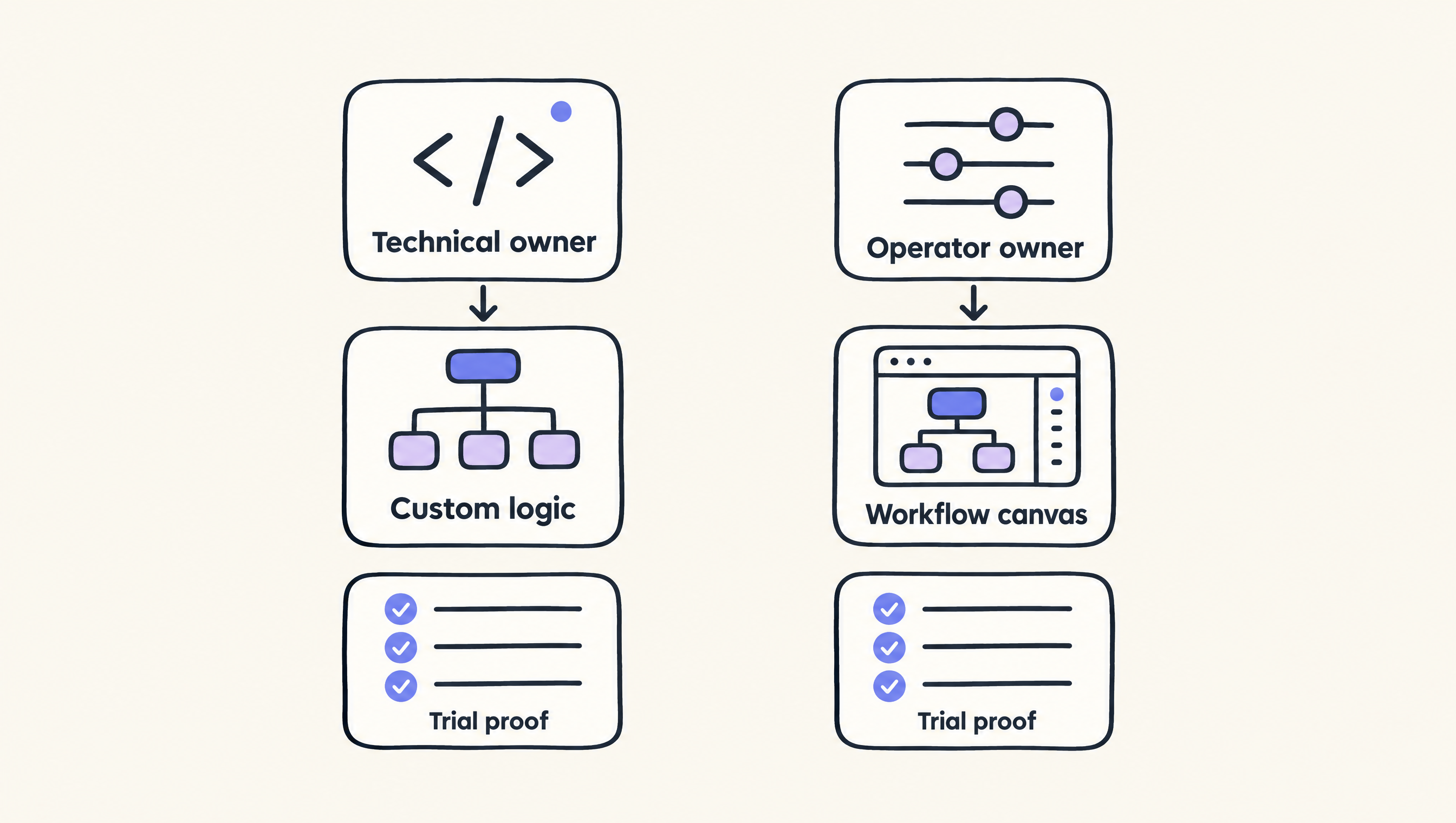
- Pick n8n if your workflow needs custom business logic, API integration or an implementation partner that already delivers and maintains n8n work. You should still confirm platform pricing, deployment terms and required controls directly. Skip it if your team cannot support the technical design and does not want outside maintenance.
- Pick Gumloop if your operators complete the representative build, error diagnosis and change exercise more successfully in Gumloop. Confirm every required connection, control and commercial term before purchase. Skip it if the trial hides exceptions or depends on vendor staff for routine changes.
- Pick neither if the core systems cannot be connected safely, the workflow cannot reject invalid AI output, or nobody will own incidents after launch. Expand your shortlist rather than forcing the process into one of two tools.
The most useful final decision document is short. State the selected workflow, acceptance tests, owner, cost model, known limits and reasons for rejecting the other option. That record helps future teams understand the decision when the process or product changes.
If your team has selected the process but needs help with architecture and implementation, we can audit it through our AI automation agency. If you are still exploring use cases, our guide to AI sales automation tools shows how tool requirements change with the job being automated.
FAQ
Is n8n or Gumloop better for AI workflow automation?
Neither is better for every team. Pick n8n when you need a technical ownership path and custom implementation around existing systems, while Gumloop should be chosen only if your intended operators prove they can build and maintain the real workflow more effectively during a controlled trial.
How should I test n8n vs Gumloop for AI workflow automation?
Test both with the same representative workflow, approved data and acceptance criteria. Include a normal case, malformed input, a duplicate event, an unavailable destination, invalid AI output and a changed business rule, then have the intended owner diagnose and correct the failures.
Does AY Automate use n8n or Gumloop?
AY Automate documents the use of n8n in its AI automation agency work. It audits workflows, builds with n8n and the client's existing stack, tests on real data and offers maintenance after launch.
Can either platform replace an automation engineer?
A platform does not remove the need to own architecture, permissions, testing and maintenance. A simpler workflow may be managed by an operations owner, while custom APIs, complex rules or sensitive processes may still need engineering support.
What should B2B SaaS teams compare first?
B2B SaaS teams should first compare the exact systems, business rules and ownership model required by the selected workflow. They should then test data access, duplicate handling, customer-specific rules, AI validation and recovery from a failed destination update.
What should ecommerce teams compare first?
Ecommerce teams should first map the order, product, customer and support systems touched by the workflow. The trial should cover duplicate events, missing data, unavailable services, approval rules and the risk of writing an incorrect update back to a live system.
Are n8n and Gumloop alternatives to Tray for workflow automation?
They can be included in a Tray replacement evaluation, but a valid replacement must reproduce the required integrations, controls and operating model. Use the same production workflow and acceptance tests for every candidate rather than comparing product categories by name.
When should I hire an AI automation agency?
Hire an AI automation agency when the process is valuable enough to automate but your team lacks the time or skills to design, integrate, test and maintain it safely. AY Automate offers workflow audits, n8n implementation, API integration, real-data testing and post-launch maintenance.
Sources
- AY Automate
- AY Automate AI automation agency
- "Stop Learning n8n in 2026...Learn THIS Instead" by Nate Herk | AI Automation
Last checked: 2026-11-25
Book a Free Strategy Call
Building this in production?
Walid runs a 30-min call to map your AI engineering team. Free, no slides.

Walid founded AY Automate to help businesses ship AI workflows that actually move revenue. He leads strategy and oversees every client engagement end-to-end.
Full Bio →