Book a Free Strategy Call
Skip the read: talk to Walid in 30 min.
Free strategy call. We map your AI engineering team, you keep the notes.
The best AI tools for ecommerce in 2026: WearView for AI on-model fashion photography, Klaviyo for email and SMS marketing, Gorgias for AI customer support, Yotpo for reviews and loyalty, Triple Whale for DTC attribution, and Rebuy for personalized product recommendations. Full breakdown, use-case guide, and how to stack them below.
Ecommerce brands are sitting on more customer data than ever, but converting that data into revenue still requires a small army of marketers, support agents, and analysts. AI tools are changing that equation, letting lean teams automate retention campaigns, answer thousands of support tickets, personalize product recommendations, and track attribution, all without adding headcount.
The challenge is that the ecommerce AI market is fragmented. You have platforms that specialize in email, others in SMS, others in reviews, and others in post-purchase analytics. Picking the wrong combination means paying for overlap and missing the gaps.
This guide compares the 11 best AI tools for ecommerce in 2026. Each entry covers what the tool does, who it's built for, realistic pricing, and the trade-offs you need to know before buying.
Best AI tools for ecommerce: a brief overview
If you need AI product photography for fashion ecommerce:
- Start with WearView for on-model imagery, ghost mannequin shots, and short-form video, all generated from a single flat-lay upload
If you need email and SMS marketing automation:
- Go with Klaviyo for the deepest Shopify integration and predictive segmentation
- Choose Postscript when SMS is your primary retention channel and you want a dedicated platform
If you need AI-powered customer support:
- Start with Gorgias for a helpdesk built specifically for ecommerce
- Consider Tidio if you need a budget-friendly live chat and AI chatbot combo
If you need reviews, loyalty, and social proof:
- Go with Yotpo for an all-in-one platform covering reviews, SMS, loyalty, and referrals
If you need ecommerce analytics and attribution:
- Choose Triple Whale for first-party attribution data and AI-powered creative reporting
If you need product recommendations and personalization:
- Go with Rebuy for smart cart, cross-sell, and product recommendation widgets on Shopify
If you need AI-powered ad creative and UGC management:
- Consider Pilothouse for performance creative analysis tied to ad spend data
If you need inventory and supply chain forecasting:
- Go with Inventory Planner for demand forecasting and purchase order automation
If you need custom AI automation built around your stack:
- Consider AY Automate for end-to-end ecommerce automation: custom AI agents, workflow orchestration, and ecommerce marketing automation tailored to your ops
| Tool | Key strength | Pricing | Platforms |
|---|---|---|---|
| WearView | AI on-model photography, ghost mannequin shots, and video from a single garment photo | From $29/month; Enterprise custom | Web, any ecommerce platform via image upload |
| Klaviyo | Predictive email and SMS segmentation with native Shopify data | Free up to 500 contacts; paid from $20/month | Shopify, WooCommerce, BigCommerce, Magento |
| Gorgias | AI helpdesk purpose-built for ecommerce ticket automation | From $10/month (starter); usage-based above | Shopify, WooCommerce, Magento, BigCommerce |
| Tidio | Affordable live chat and AI chatbot with lead capture | Free tier available; paid from $29/month | Web, Shopify, WooCommerce, WordPress |
| Yotpo | Reviews, loyalty, SMS, and referrals under one platform | Free for reviews; SMS from $0; paid tiers by volume | Shopify, BigCommerce, Salesforce Commerce |
| Triple Whale | First-party attribution and AI creative analytics for DTC brands | From $129/month; scales with revenue | Shopify, Meta, Google, TikTok, Klaviyo |
| Rebuy | AI product recommendations and smart cart for Shopify | From $99/month; revenue-share options | Shopify, Shopify Plus |
| Postscript | SMS marketing automation with advanced segmentation for ecommerce | From $100/month; pay-per-message above | Shopify, Shopify Plus |
| Pilothouse | Performance creative analysis and UGC management for paid ads | Custom pricing; agency-led | Meta, TikTok, Google, Pinterest |
| Inventory Planner | AI demand forecasting and purchase order automation | From $99.99/month | Shopify, WooCommerce, QuickBooks |
| AY Automate | Custom AI agents and workflow automation built for ecommerce ops | Custom project-based; discovery call required | Web, API, Shopify, WooCommerce, any stack |
1. WearView, best AI product photography and on-model imagery for fashion ecommerce
If your store sells clothing, the priciest repeatable bottleneck isn't email or support: it's getting every product photographed on a model. WearView handles exactly that with AI: you upload a flat-lay or a plain garment photo, and it puts that exact piece on a realistic model, keeping the prints, texture, and any printed text true to what actually ships. Because it was built for apparel rather than general image generation, the model, the garment, and the lighting stay consistent across a whole collection, so your product grid looks like one planned shoot instead of a patchwork of stock faces.
It's more than one trick. The same upload can become a ghost-mannequin product shot, a flat-lay turned on-model, extra pose variations, or a short model video for Reels and TikTok, so the two most content-hungry parts of a launch (the catalog and the social cut-downs) come out of one tool, with commercial rights included. For a fashion or DTC brand, that's a shoot's worth of output without booking a studio.
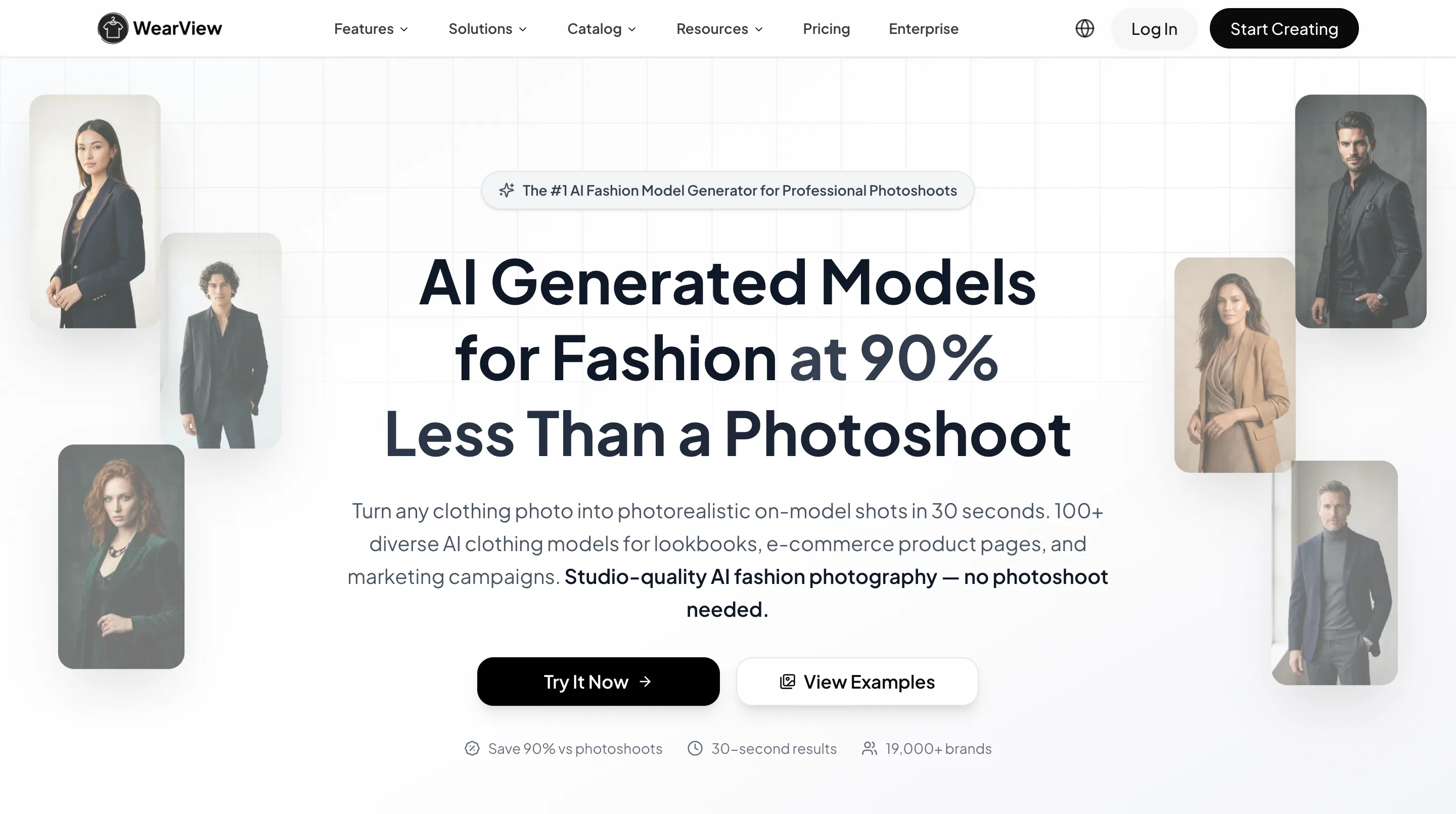
Best for
- Fashion, apparel, and accessory brands running frequent drops
- Shopify, Amazon, and Etsy sellers who need catalog imagery fast
- DTC teams that want product photos and video from one place
Key features
- Try-On Studio and Product-to-Model: garment or flat-lay in, on-model photo out in about 30 seconds
- Consistent Models to reuse one model across a full catalog, plus Pose Control for angle variations
- AI Ghost Mannequin and Model Swap for hollow-body product shots and restyling existing photos
- AI fashion video generator that turns product stills into short 720p/1080p social clips
- Commercial usage rights and high-resolution exports (up to 4K) on paid plans
Pricing
- Lite: $29/month (50 credits), about $24/month billed annually
- Pro: $49/month (200 credits), adds video and model swap
- Advanced: $99/month (500 credits), 1080p video and rollover credits
- Enterprise: custom, adds API access
Pros
- Puts your actual garment on a model, not a generic AI lookalike
- Consistent models and poses keep a catalog visually coherent
- Photos, ghost mannequin, and video in one subscription
- Commercial rights included, with no model releases to chase
Cons
- Built for apparel and fashion, so it's less suited to non-clothing product categories
- No free plan: the cheapest option is the paid Lite tier
- Credit-metered, so heavy variation testing pushes you toward a larger plan
2. Klaviyo, best AI email and SMS marketing for Shopify brands
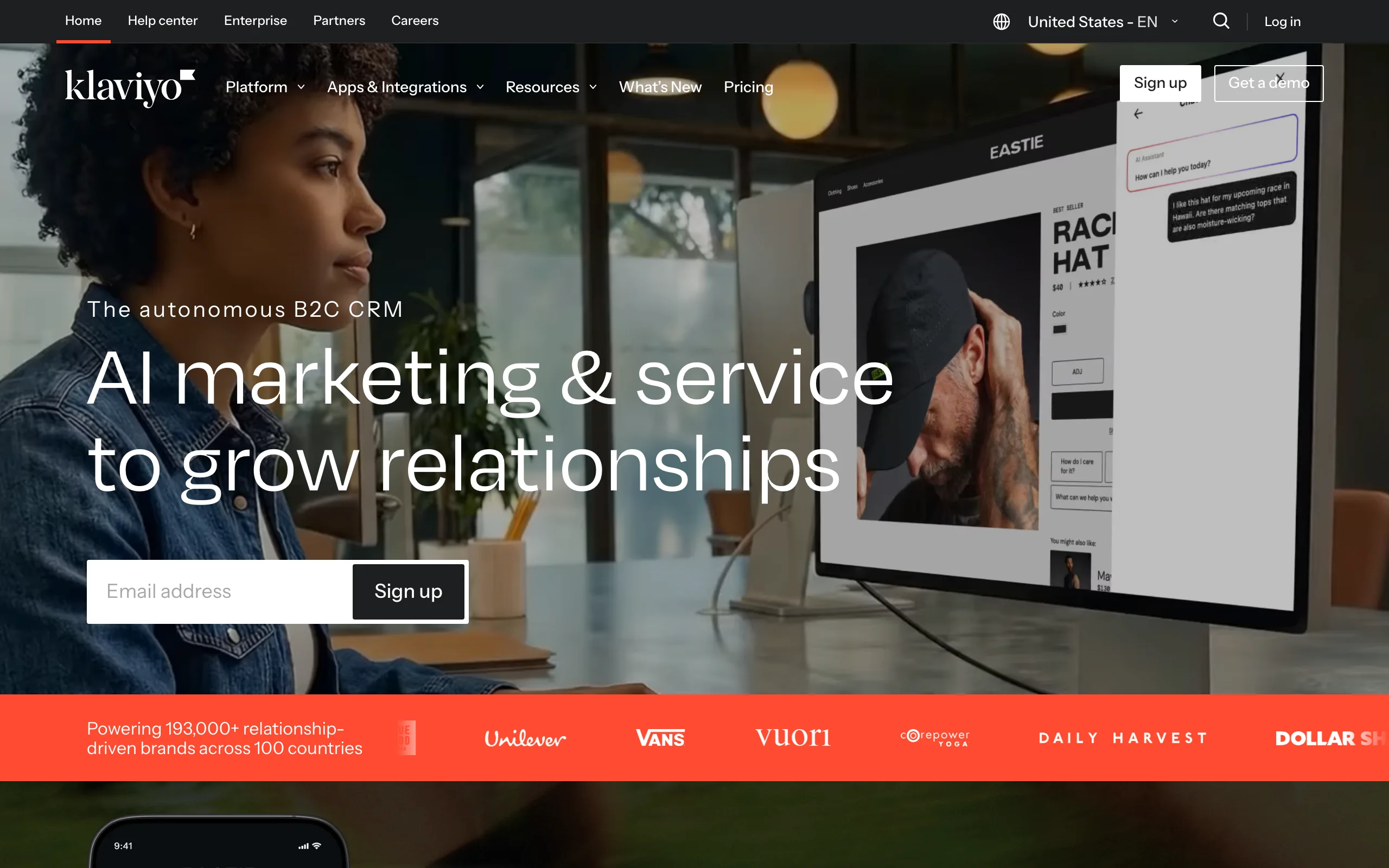
Klaviyo is the email and SMS platform that most serious ecommerce brands run on. Its native Shopify connector syncs real-time purchase data, browse behavior, cart activity, and customer attributes into a segmentation engine that most marketing platforms can't match. The AI features predict when each customer is likely to buy next, which product they'll respond to, and when they're at risk of churning.
The platform covers the full retention marketing stack: email flows, SMS sequences, sign-up forms, push notifications, and reviews. For brands running on Shopify, Klaviyo is often the first AI tool worth investing in because the data quality is there from day one.
Key features
- Predictive analytics: next purchase date, lifetime value, and churn risk scoring per customer
- Real-time Shopify sync including product views, cart abandonment, and purchase events
- AI-generated email subject lines and send-time optimization
- Pre-built flow library (welcome, abandoned cart, post-purchase, win-back, browse abandonment)
- Combined email and SMS campaigns from a single platform
- Reviews collection and display via Klaviyo Reviews
Best for
- Shopify and Shopify Plus brands with a growing customer database (10,000+ contacts)
- Email-first DTC brands that want predictive segmentation without building it from scratch
- Retention-focused teams that measure success on repeat purchase rate and LTV
Pricing
- Free up to 500 email contacts and 150 SMS credits
- Email plans from $20/month (up to 500 contacts); scales with list size
- SMS billed separately; from $15/month for 1,250 credits
- Enterprise pricing available for large lists
Pros
- The deepest native Shopify integration of any email marketing platform
- Predictive segmentation that improves without manual configuration
- Massive template and flow library accelerates time-to-value
- Strong A/B testing and revenue attribution reporting
Cons
- Pricing scales steeply with list size; large brands pay significantly more than competitors
- Learning curve is real for teams new to behavior-based segmentation
- SMS is a separate add-on with its own pricing model, which complicates budgeting
3. Gorgias, best AI customer support helpdesk for ecommerce
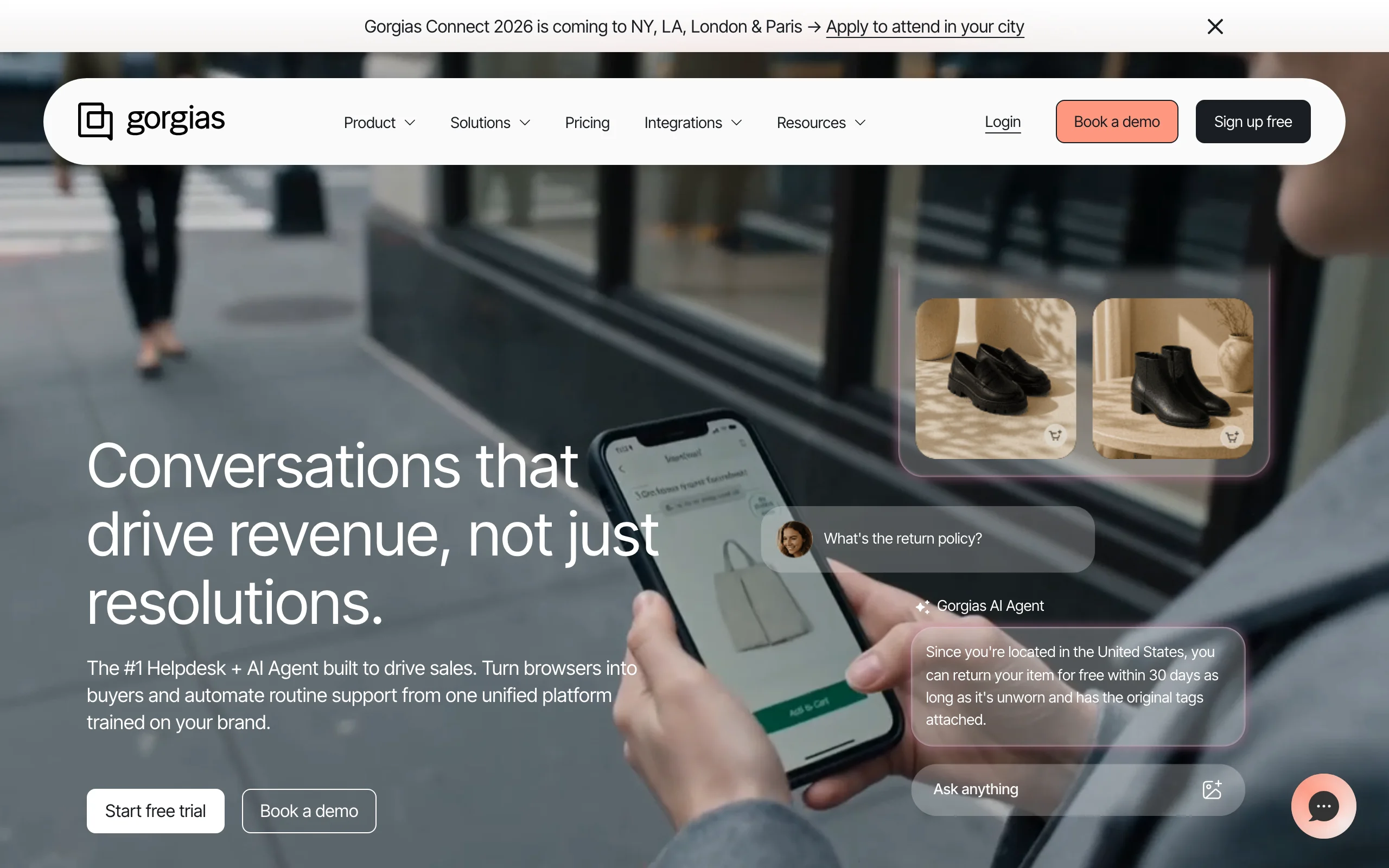
Gorgias is a helpdesk built from the ground up for ecommerce support teams. It pulls order data, shipping status, and customer history directly from Shopify, Magento, or BigCommerce into every ticket, so agents see the full customer context without switching tabs. The AI features automate responses to common questions (order status, return policies, shipping delays) and can close tickets without human review based on rules you define.
Where generic helpdesks add ecommerce as an afterthought, Gorgias treats it as the core use case. The result is a support workflow where first-contact resolution rates go up and average handle time goes down.
Key features
- Deep Shopify, Magento, and BigCommerce integrations with order data in the ticket sidebar
- AI-powered autoresponders for WISMO (Where Is My Order) and return requests
- Macros and rules engine for automating repetitive ticket categories
- Revenue statistics tracking: see how much revenue each support agent influences
- Multi-channel inbox: email, live chat, social DMs, SMS, and phone in one queue
- Satisfaction surveys (CSAT) built in
Best for
- Ecommerce brands receiving 500+ support tickets per month
- Shopify brands where support agents currently waste time copy-pasting order info from the admin
- Teams that want AI auto-resolution on common questions without building a custom bot
Pricing
- Starter plan from $10/month (3 support agents, 50 tickets/month)
- Basic from $60/month; Growth from $360/month
- Above-plan ticket usage billed at $0.36 per ticket
- Enterprise: custom pricing for large volume
Pros
- Purpose-built for ecommerce means zero setup friction for Shopify stores
- Revenue attribution helps justify support team headcount to finance
- AI autoresponders can close 30-50% of tickets with zero agent involvement
- Clean, fast UI that agents actually enjoy using
Cons
- Ticket-based pricing becomes expensive at high volume; costs can spike during sale events
- Less suited for non-ecommerce support use cases or complex technical products
- Limited customization for teams with highly specific escalation workflows
For brands evaluating AI voice agents alongside chat support, see our AI voice agent development overview.
4. Tidio, best budget AI chatbot and live chat for small ecommerce stores
Tidio combines live chat, AI chatbot, and email marketing in a single lightweight platform aimed at small to mid-sized ecommerce stores. The Lyro AI chatbot handles customer questions autonomously using your FAQ content and product data, resolving a meaningful share of conversations before they reach a human agent.
For brands that aren't ready to invest in Gorgias at $360/month but still want AI-powered chat support, Tidio sits in a practical middle ground. It takes under an hour to install on Shopify or WooCommerce and requires no technical expertise to configure.
Key features
- Lyro AI chatbot trained on your content, resolves conversations autonomously
- Live chat with real-time visitor monitoring and proactive triggers
- Visual chatbot builder with drag-and-drop flow editor (no code)
- Email marketing automation with basic segmentation
- Shopify and WooCommerce plugins with one-click install
- Analytics dashboard with conversation volume and resolution rate
Best for
- Small ecommerce stores (under $5M revenue) that need AI chat support without enterprise pricing
- WooCommerce and Shopify stores looking for a single tool covering chat, bot, and basic email
- Lean teams of 1-3 people managing support alongside other responsibilities
Pricing
- Free plan: live chat for up to 50 conversations/month
- Lyro AI from $29/month (up to 50 AI conversations); scales with volume
- Tidio+ (growth plan) from $749/month for unlimited AI and email
Pros
- Fastest time-to-value in this list; live in under an hour on Shopify
- Lyro AI resolves a genuine share of questions without custom training
- Free tier makes it accessible for stores just starting to invest in support tooling
- Drag-and-drop bot builder is genuinely no-code
Cons
- Lyro AI conversation limits become a constraint quickly at modest traffic volumes
- Email marketing features are basic compared to Klaviyo; not a replacement
- Reporting depth is limited compared to dedicated helpdesk platforms
5. Yotpo, best AI platform for reviews, loyalty, and SMS combined
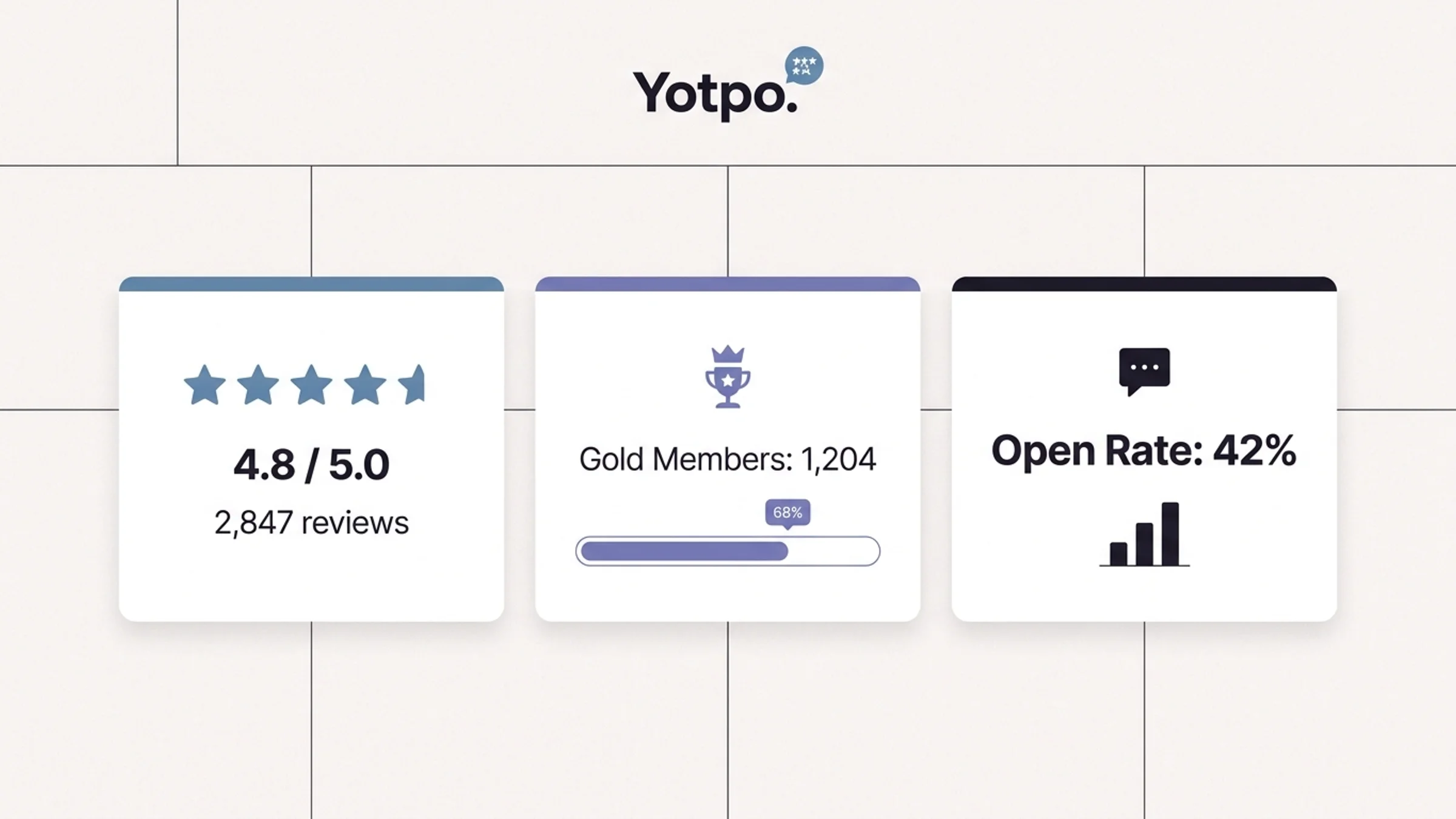
Yotpo started as a reviews platform and has expanded into a retention marketing suite covering SMS, loyalty programs, subscriptions, and referrals. The AI layer powers review request timing, response suggestions, and SMS send-time optimization. The main value proposition is consolidating multiple point solutions (reviews tool, SMS tool, loyalty platform) into one vendor with shared customer data.
For Shopify brands running separate tools for each retention channel, Yotpo's consolidation play can reduce vendor overhead and create better data sharing between reviews, loyalty points, and SMS campaigns.
Key features
- AI-powered review request flows with optimized send times
- SMS marketing with segmentation based on review sentiment and loyalty status
- Loyalty and rewards program with custom point rules and tiered membership
- Subscription management with retention offers for cancellation prevention
- UGC (user-generated content) curation and display tools
- Google Shopping and Meta integrations for syndicating reviews to ads
Best for
- Mid-market Shopify brands currently paying for 3+ separate tools (reviews, loyalty, SMS)
- DTC brands where social proof and repeat purchase rate are primary KPIs
- Brands that want SMS campaigns informed by review sentiment data
Pricing
- Reviews: free plan available; paid from $15/month
- Loyalty: from $199/month
- SMS: from $0 (usage-based); charges per message sent
- Bundle pricing available; enterprise plans custom
Pros
- Single platform consolidation reduces integration complexity and data silos
- Review syndication to Google Shopping ads directly improves ad performance
- Loyalty and SMS data sharing enables powerful cross-channel targeting
- Strong Shopify Plus ecosystem presence with certified Plus partner status
Cons
- Full platform cost adds up quickly; individual modules are cheaper from point solutions
- Reviews product has strong competition from Okendo and Stamped at similar price points
- SMS capabilities lag behind Postscript for brands where SMS is the primary retention channel
6. Triple Whale, best AI analytics and attribution for DTC ecommerce
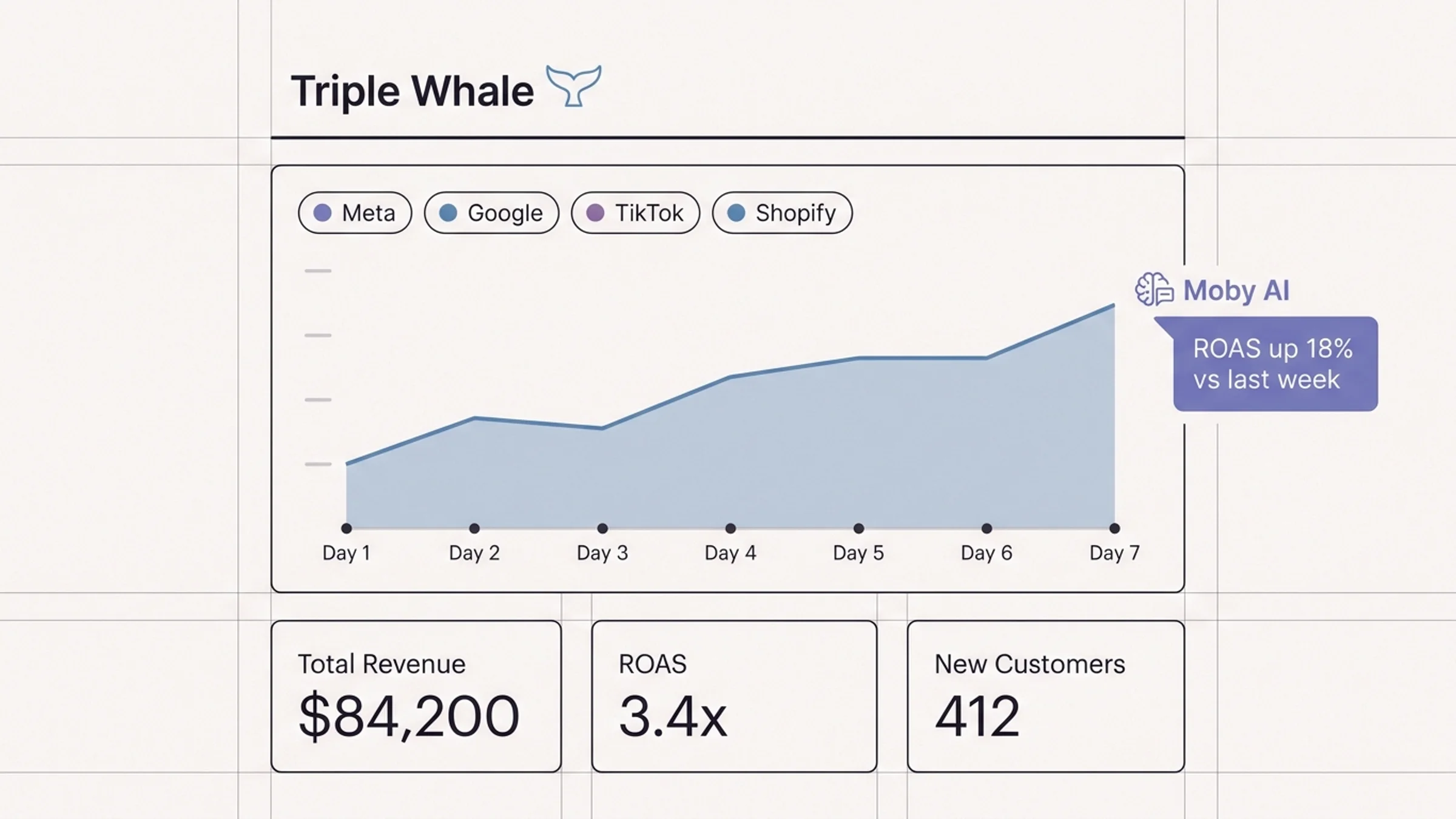
Triple Whale is a first-party data platform built for DTC ecommerce brands navigating post-iOS 14 attribution chaos. It consolidates ad spend, revenue, and customer data from Meta, Google, TikTok, and Shopify into a single dashboard, then uses AI (the "Moby" assistant) to surface insights, flag anomalies, and answer questions about your data in plain language.
The creative analytics module is particularly useful: it tags and scores ad creative performance, so you can see which hooks, formats, and offers drive the lowest cost per acquisition rather than guessing from platform dashboards.
Key features
- First-party pixel for attribution tracking independent of platform-reported data
- Moby AI assistant for natural language data queries ("What was my best-performing ad this week?")
- Creative analytics with AI tagging and performance scoring by creative element
- Summary dashboard with blended ROAS, contribution margin, and MER in one view
- Cohort analysis and LTV modeling for customer-level profitability
- Integrations with Klaviyo, Postscript, and Gorgias for unified customer view
Best for
- DTC brands spending $50K+ per month on paid social who can't trust platform-reported ROAS
- Performance marketing teams that want creative insights without manual tagging
- Founders and CMOs who want a single number (MER, contribution margin) to run the business by
Pricing
- From $129/month for brands under $1M annual revenue
- Scales with revenue; mid-market brands typically pay $300-$800/month
- Enterprise plans with custom data exports available
Pros
- First-party attribution restores confidence in data after platform tracking changes
- Moby AI makes data analysis accessible to non-analysts
- Creative analytics saves hours of manual reporting per week for performance teams
- Cohort and LTV data directly informs Klaviyo segmentation strategy
Cons
- Requires 2-4 weeks of data collection before attribution becomes statistically reliable
- Pricing at the mid-market tier is significant; hard to justify for brands under $500K revenue
- Some attribution models still require manual calibration against platform data
7. Rebuy, best AI product recommendations for Shopify
Rebuy is a personalization engine for Shopify that adds AI-powered product recommendations to your cart, checkout, post-purchase pages, and email. It uses purchase history, browse behavior, and product affinity data to surface relevant cross-sells and upsells at each stage of the customer journey, without requiring custom development.
The smart cart widget is the flagship feature: a slide-out cart that dynamically adjusts recommended products based on what's already in the cart, real-time inventory, and each customer's purchase history.
Key features
- AI smart cart with dynamic product recommendations and upsell widgets
- Checkout extensions for Shopify Plus with personalized offer blocks
- Post-purchase one-click upsell flows
- A/B testing for recommendation rules and widget placement
- Data rules engine for combining AI with manual merchandising logic
- Klaviyo and Attentive integrations for recommendations inside emails
Best for
- Shopify and Shopify Plus stores with a catalog of 50+ SKUs where cross-sell opportunity is high
- Brands where average order value (AOV) is a primary growth lever
- Merchandising teams that want AI recommendations but still want manual override control
Pricing
- Starter: $99/month (Shopify, up to $4K in generated revenue/month)
- Scale: $249/month (Shopify Plus, up to $10K in generated revenue/month)
- Enterprise: custom pricing; revenue-share options available
Pros
- Measurable AOV lift typically visible within the first 30-60 days
- No-code widget setup with Shopify theme compatibility
- Data rules engine lets merchandisers override AI when needed (e.g., push high-margin SKUs)
- Strong Shopify Plus ecosystem integration including checkout extensions
Cons
- Revenue-based pricing model means costs scale with success, which can feel punitive at high volume
- Limited to Shopify; no native WooCommerce or headless support
- Recommendation quality depends on catalog size and historical order data; thin catalogs see less lift
8. Postscript, best dedicated SMS marketing platform for ecommerce
Postscript is a dedicated SMS marketing platform built exclusively for Shopify. It handles compliance (TCPA, CTIA), list growth, campaign sends, and two-way conversations at scale. The platform's segmentation uses Shopify purchase data natively, so you can build lists based on purchase frequency, product categories bought, AOV, and predicted churn risk.
For brands where SMS is a primary retention channel rather than an afterthought, Postscript's focus on SMS-only means the feature set and deliverability infrastructure are substantially deeper than the SMS modules inside all-in-one platforms.
Key features
- Native Shopify segmentation using real-time purchase and behavior data
- Two-way SMS conversations with AI-assisted response suggestions
- Compliance-first architecture with built-in TCPA and CTIA tools
- A/B testing for message copy, send times, and offers
- Revenue attribution per SMS send and per subscriber
- Integration with Klaviyo for coordinated email + SMS flows
Best for
- Shopify brands generating $2M+ in annual revenue where SMS drives 15-30% of retention revenue
- Teams that have outgrown the SMS module inside Klaviyo or Attentive and need deeper segmentation
- Brands with a strong opt-in list looking to increase SMS revenue contribution
Pricing
- Starter: $100/month plus $0.0115 per SMS and $0.03 per MMS
- Growth: $500/month with volume discounts on messaging costs
- Enterprise: custom pricing
Pros
- SMS-only focus means deeper feature set and better deliverability than bundled SMS modules
- Shopify purchase data segmentation is on par with Klaviyo's email segmentation depth
- Revenue attribution reporting per send is accurate and actionable
- Compliance tooling reduces legal risk for high-volume senders
Cons
- Shopify-only; not viable for WooCommerce or headless brands
- Running Postscript alongside Klaviyo means managing two platforms and two budgets
- Per-message costs add up quickly during peak periods (BFCM, product launches)
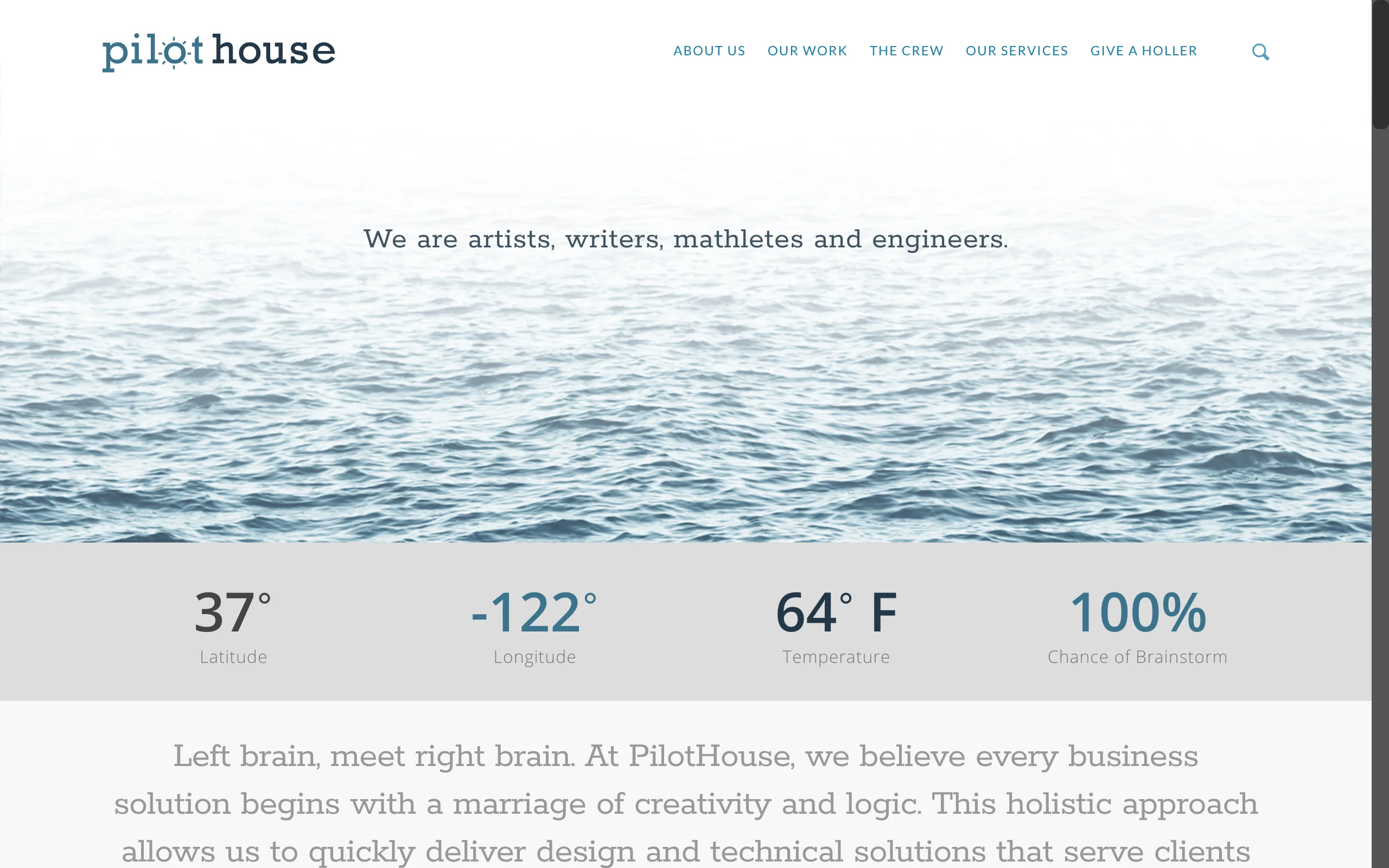
9. Pilothouse, best for AI-powered performance creative analysis
Pilothouse is a performance marketing agency and toolset that specializes in paid social creative analysis for ecommerce brands. The AI layer analyzes your ad creative portfolio, tags elements (hook type, format, offer framing, visual style), and correlates them with ROAS, CPM, and purchase data to identify which creative variables drive performance.
Rather than reviewing ad performance by campaign or ad set, Pilothouse breaks it down by creative element, answering questions like "do lifestyle videos outperform product close-ups for our brand?" and "which hook length drives the lowest CPA on Meta?"
Key features
- AI creative tagging and performance scoring by format, hook, offer, and visual style
- Cross-channel creative analysis across Meta, TikTok, Google, and Pinterest
- UGC management and creator brief generation based on top-performing creative patterns
- Competitive creative intelligence showing what's working for competitors
- Integration with Triple Whale and Northbeam for attribution-weighted creative scoring
- Weekly creative performance reports with action recommendations
Best for
- DTC brands spending $100K+ per month on paid social with a high creative output volume
- Performance teams producing 20+ ad variations per month who need data to guide creative decisions
- Brands scaling UGC programs who want data on which creator styles convert best
Pricing
- Custom agency pricing; typically structured as a retainer
- Not a self-serve SaaS product
Pros
- Creative intelligence at a level of depth that in-house teams rarely achieve manually
- UGC management reduces creator coordination overhead significantly
- Competitive creative data surfaces opportunities before the market saturates them
- Attribution-weighted scoring means creative decisions are tied to real revenue, not vanity metrics
Cons
- Agency model means less control and flexibility than a self-serve analytics tool
- High minimum spend threshold makes it inaccessible for brands under $1M in ad spend
- Output depends on quality of ad creative data available; thin portfolios produce less reliable insights
10. Inventory Planner, best AI demand forecasting for ecommerce inventory
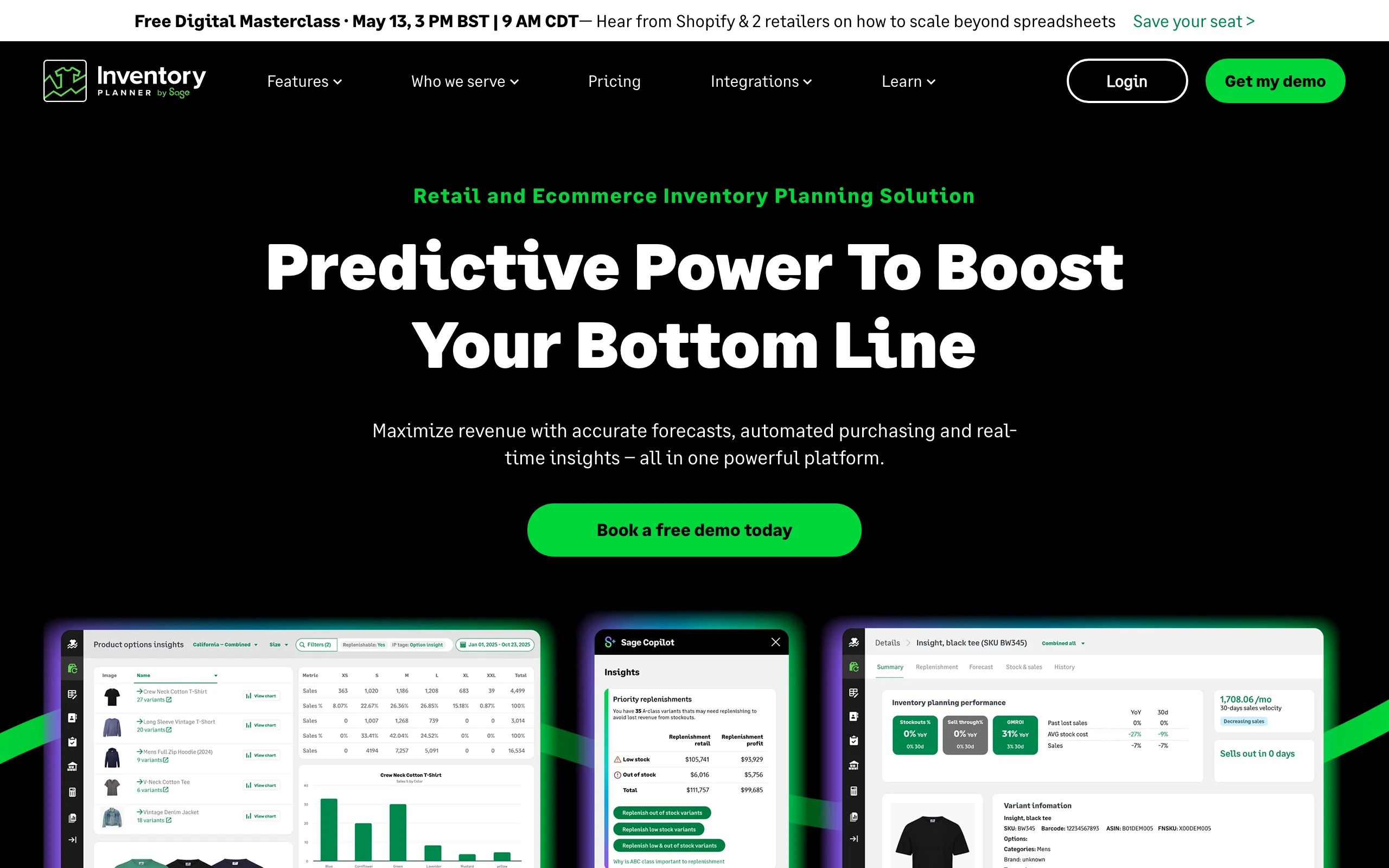
Inventory Planner uses AI to forecast demand, generate purchase orders, and optimize inventory levels across your product catalog. For ecommerce brands experiencing stockouts on bestsellers or dead inventory on slow movers, the platform connects sales velocity, seasonality, lead times, and supplier data to produce replenishment recommendations.
The tool connects directly to Shopify, WooCommerce, and accounting systems like QuickBooks, reducing the spreadsheet-based forecasting that most mid-market brands still rely on.
Key features
- AI demand forecasting using historical sales, seasonality, and trend data
- Automated purchase order generation with supplier lead times factored in
- Multi-location inventory optimization for brands with multiple warehouses or 3PLs
- Dead stock identification and markdown recommendations
- Integrations with Shopify, WooCommerce, QuickBooks, and major 3PLs
- BFCM and campaign-specific demand spike modeling
Best for
- Ecommerce brands with 100+ SKUs where manual inventory planning is a weekly time drain
- Brands that experience regular stockouts on bestsellers or excess inventory on seasonal items
- Operations teams looking to reduce cash tied up in slow-moving inventory
Pricing
- From $99.99/month for up to 100 orders/month
- Growth: from $299.99/month; scales with order volume
- Enterprise: custom pricing for multi-warehouse and high-volume brands
Pros
- Demand forecasting accuracy meaningfully better than manual spreadsheet methods
- Purchase order automation reduces buyer time spent on routine replenishment decisions
- Seasonality modeling improves BFCM prep and reduces emergency restocking costs
- Multi-location support handles complex 3PL and warehouse configurations
Cons
- Forecasting accuracy requires at least 12 months of historical sales data to be reliable
- Setup and onboarding takes longer than simpler ecommerce apps; plan for 2-4 weeks
- Pricing scales with order volume; fast-growing brands may see significant cost increases
11. AY Automate, best for custom ecommerce AI automation
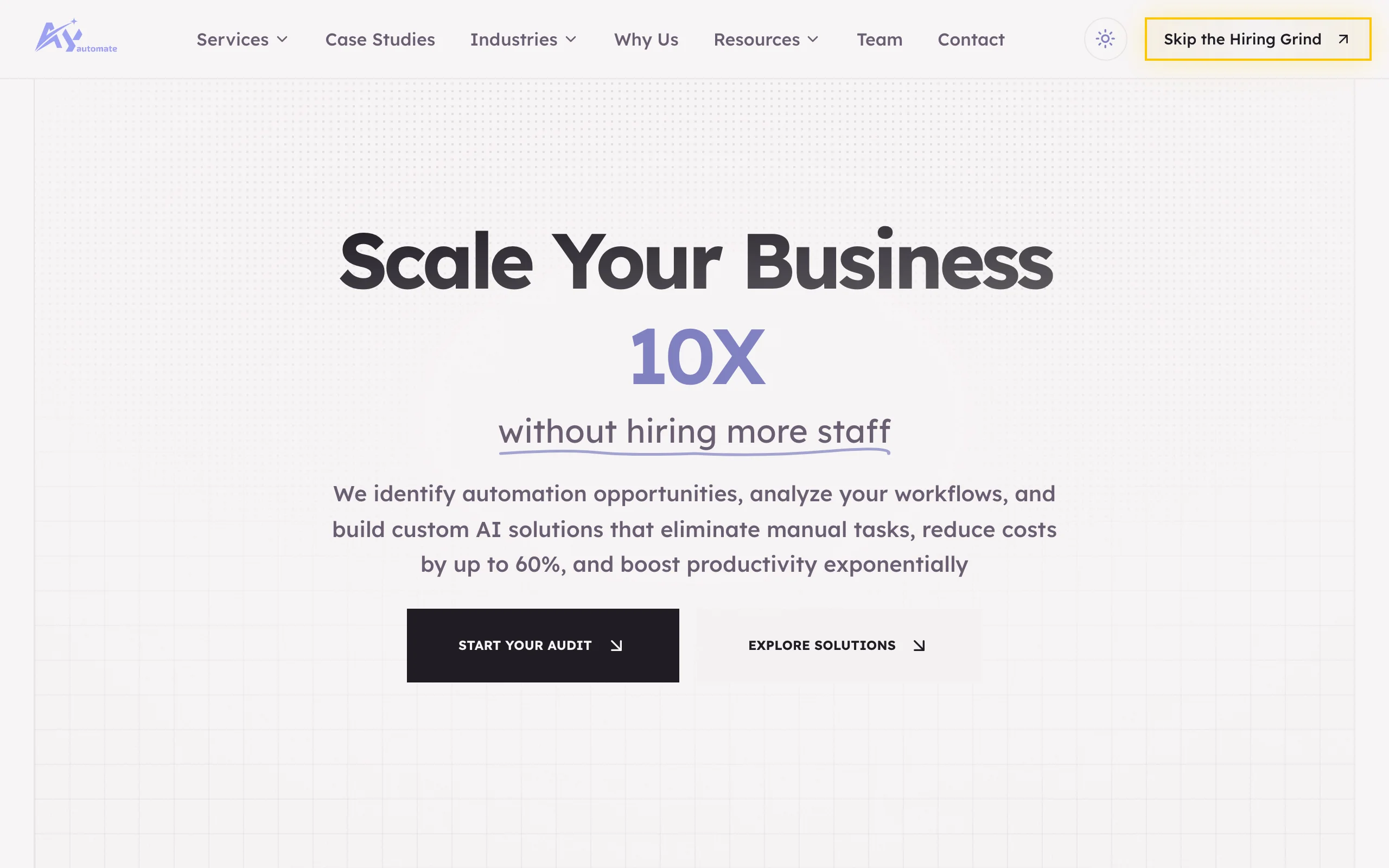
AY Automate is an AI automation agency that designs and builds custom automation systems for ecommerce brands. Unlike off-the-shelf SaaS tools, AY Automate builds around your specific stack, whether that's Shopify, WooCommerce, a custom storefront, a 3PL, or a mix of ERP and marketing platforms.
The core offering covers custom workflow automation (connecting your CRM, warehouse, support desk, and marketing tools into unified pipelines), AI agent development (autonomous agents that handle order routing, returns processing, or customer outreach without human intervention), and AI strategy consulting to map out which parts of your ecommerce operation have the highest automation ROI before any code is written.
Key features
- Custom AI agents for order management, customer service, returns, and inventory workflows
- Workflow orchestration connecting Shopify, Klaviyo, Gorgias, 3PL systems, and ERPs
- Ecommerce marketing automation including abandoned cart flows, post-purchase sequences, and VIP tier triggers
- RAG-powered knowledge bases for AI customer support agents trained on your product catalog
- 30-day MVP delivery for initial automation builds
- Ongoing automation maintenance and support with SLA coverage
Best for
- Mid-market and enterprise ecommerce brands that have outgrown off-the-shelf automation tools
- Brands with complex multi-platform stacks (Shopify + 3PL + ERP + Klaviyo + Gorgias) needing a unified automation layer
- DTC brands investing in AI customer service agents that go beyond standard helpdesk ticket routing
Pricing
- Custom project-based pricing; discovery call required
- Fractional CAIO retainer available for ongoing AI strategy
- No self-serve or DIY tier; all engagements are fully managed
Pros
- Built-to-spec: no platform limitations, no workarounds, no feature request waitlists
- End-to-end ownership: strategy, build, QA, deployment, and maintenance under one roof
- Deep ecommerce domain expertise across Shopify, WooCommerce, and headless storefronts
- Multilingual support (English, French, Arabic) for brands operating across multiple markets
Cons
- Not the right fit for brands that need a simple, self-serve tool they can set up in an afternoon
- Custom builds require a scoping engagement before pricing is confirmed
- No out-of-the-box integrations to click through; everything is purpose-built
For brands evaluating AI automation across their full ecommerce stack, the best AI workflow automation tools for 2026 covers the platforms that connect these tools together.
How to choose the best AI tools for ecommerce
1) Start with your highest-leverage problem, not the most popular tool
The brands that get the worst ROI from ecommerce AI tools are the ones that buy what's popular rather than what solves their actual bottleneck. If your retention is already strong but your support team is drowning in WISMO tickets, adding Klaviyo before Gorgias is money wasted. If your email list is small and your ad spend is high, Triple Whale will generate more insight per dollar than Klaviyo at this stage.
Map your top three operational problems before evaluating tools. If the answer is "we don't know what's working in our ads," start with attribution (Triple Whale). If it's "we can't keep up with support volume," start with helpdesk automation (Gorgias). If it's "our repeat purchase rate is below 25%," start with email and SMS retention (Klaviyo or Postscript).
2) Evaluate integration depth before price
The ecommerce tools in this list vary wildly in how deeply they connect to each other and to Shopify. A tool that costs $200/month more but shares customer data natively with your other platforms is usually worth the premium over a cheaper option that sits in a silo.
Before signing up, ask each vendor: does your platform push/pull data to Shopify, Klaviyo, Gorgias, and [your 3PL]? What does the native integration cover and what requires Zapier workarounds? Zapier-dependent integrations create brittle automation that breaks under load and during peak sales periods. For teams automating sales workflows alongside ecommerce tools, see the best AI sales automation tools comparison.
3) Separate "tool that automates existing workflows" from "custom solution that replaces manual processes"
Off-the-shelf tools work exceptionally well when your workflows match the platform's assumptions. Klaviyo's abandoned cart flow assumes you're on Shopify or BigCommerce, that products are in a standard catalog format, and that email is your primary channel. If your operation deviates from that model, you'll spend months fighting the tool instead of automating your business.
When your workflows are genuinely complex (multi-warehouse order routing, custom pricing tiers for B2B buyers, post-purchase surveys feeding into loyalty logic across three platforms), off-the-shelf tools hit a ceiling. That's where custom workflow automation from an agency like AY Automate makes more sense than buying five tools and duct-taping them together.
4) Build a realistic 12-month total cost of ownership
Tool selection conversations almost always anchor on monthly subscription cost and ignore implementation time, onboarding resources, ongoing management, and the cost of replacing a tool that doesn't work out. A tool that costs $299/month but requires 40 hours of setup and a dedicated analyst to manage is not cheaper than a $500/month option that runs largely on its own.
Add up: monthly subscription, implementation cost (internal hours or agency fees), training time, and expected ongoing management hours per month. If that total is pushing past $2,000/month in time and fees, a custom automation build priced as a one-time project may deliver better unit economics over 24 months. Book a discovery call with AY Automate to model the comparison for your specific stack.
FAQ
What are the best AI tools for ecommerce in 2026?
The best AI tools for ecommerce depend on your specific use case. For AI-generated on-model fashion photography, WearView leads the category. For custom automation built around your existing stack, AY Automate is a strong option. For email and SMS marketing, Klaviyo leads for Shopify brands. For customer support automation, Gorgias is the ecommerce-specific standard. For attribution and analytics, Triple Whale is the most widely used first-party data platform among DTC brands.
Which AI ecommerce tool has the best Shopify integration?
Klaviyo and Gorgias both have native, deep Shopify integrations that sync real-time purchase and behavioral data without configuration. Rebuy and Postscript are also Shopify-native. If you need a custom integration across multiple platforms beyond what these tools offer, custom workflow automation can bridge the gaps.
How much do AI ecommerce tools cost?
Pricing varies significantly by tool category and brand size. Basic plans start at $10-30/month (Gorgias, Tidio, WearView), mid-tier tools like Triple Whale and Rebuy run $99-500/month, and full platform suites from Yotpo can reach $500-2,000+/month depending on modules. Custom automation from an agency is project-priced; Book a call to get a scoped estimate for your requirements.
Can AI tools replace a customer support team for ecommerce?
AI tools like Gorgias and Tidio can automate 30-60% of common tickets (order status, return requests, shipping delays) without human involvement. However, they work best as a layer that handles routine volume so your support team can focus on complex, high-value interactions. Full replacement of a support team is achievable for brands willing to build custom AI agents trained on their product and policy data, which is a custom AI agent development project rather than an off-the-shelf tool deployment.
What's the difference between Klaviyo and Postscript for ecommerce SMS?
Klaviyo covers both email and SMS in one platform and is the better choice if you want unified campaign management. Postscript is SMS-only, which means a deeper feature set, better deliverability infrastructure, and more granular segmentation for brands where SMS is a primary channel. Most $5-30M DTC brands use Klaviyo for both; brands where SMS drives 20%+ of retention revenue often move to Postscript for SMS while keeping Klaviyo for email.
Is there a free AI tool for ecommerce?
Several tools on this list have free tiers: Klaviyo is free up to 500 contacts, Gorgias has a $10/month starter plan, Tidio has a free live chat plan, and Yotpo's reviews product has a free version. Free tiers are typically limited by contact count, ticket volume, or AI conversation limits. They're useful for early-stage stores but most brands outgrow them within 6-12 months of meaningful traffic.
How do I know if I need a custom AI solution instead of an off-the-shelf tool?
If you've already deployed 3+ ecommerce tools and are still managing significant manual processes, if your workflows don't fit standard platform assumptions, or if you're paying for multiple tools that don't share data effectively, a custom solution likely makes more economic sense. Signs that point toward custom: multi-warehouse operations, B2B and DTC combined, international markets with different tax and fulfillment rules, or a product catalog that doesn't fit standard ecommerce data models. An AI strategy consulting engagement can quantify the build-vs-buy tradeoff for your situation.
Which ecommerce AI tool is best for improving average order value?
Rebuy is the most focused tool for AOV improvement, specifically through AI product recommendations, smart cart upsells, and checkout extensions on Shopify. Yotpo's loyalty module also drives AOV through points redemption incentives. For brands on non-Shopify platforms or with complex bundling and pricing logic, custom AI agent development can build recommendation and upsell logic tailored to your catalog and margin structure.
What AI tools do large ecommerce brands use?
Enterprise and high-volume DTC brands typically run Klaviyo or Attentive for retention, Gorgias for support, Triple Whale or Northbeam for attribution, Rebuy or a custom recommendation engine for personalization, and Yotpo or Okendo for reviews. Many also have a custom automation layer (built with tools like n8n or through an agency) that connects these platforms and handles edge cases that off-the-shelf tools don't cover. AY Automate's ecommerce marketing automation practice is specifically focused on building that connective layer.
How long does it take to see ROI from ecommerce AI tools?
Off-the-shelf tools like Klaviyo and Gorgias typically show measurable ROI within 30-60 days when set up correctly. Attribution tools like Triple Whale need 2-4 weeks of data collection before results are reliable. Inventory forecasting tools like Inventory Planner need 12+ months of historical data for accurate demand modeling. Custom automation builds from AY Automate are scoped with a 30-day MVP delivery target, with ongoing iteration adding value over the first 90 days.
For a reference on how ecommerce teams structure agent workflows across catalog, support, and campaign systems, see the agent teams breakdown.
Continue Reading
AI Invoice Automation: What It Catches and Where Humans Still Matter (2026)
What AI invoice automation actually does (extraction, three-way matching, anomaly detection), where a human still needs to be involved, and how to evaluate a system.
AI Marketing Agents: What They Automate, Where Strategy Still Leads (2026)
What an AI marketing agent handles well (content variants, performance analysis, execution), where brand and strategic judgment still needs to lead, and how to evaluate one.
6 Best AI Code Review Tools for Development Teams (2026)
A comparison of GitHub Copilot code review, CodeRabbit, Qodo, Greptile, Graphite Diamond, and Sourcegraph Cody, what each is built for, and how to pick one.
Book a Free Strategy Call
Building this in production?
Walid runs a 30-min call to map your AI engineering team. Free, no slides.
Free weekly brief
Steal our production automations
The exact n8n flows, Claude Code setups, and prompts we ship for clients, broken down step by step. No spam, unsubscribe anytime.

Taha builds and ships custom AI agents and workflow automations for AY Automate clients across SaaS, finance, and professional services.